
News Break
Beat the Collectors and Win Your Debt Lawsuit
July 20, 2026
Blog / News Break
Master debt recovery through the courts with proven legal strategies, deadlines, and defenses to protect your finances and avoid costly judgments.

Debt recovery through the courts is the legal process where a creditor or debt collector files a lawsuit to force you to pay a debt — and if you don't respond in time, they can automatically win.
Here's a quick breakdown of how it works:
Getting that first piece of legal mail — a summons, a court notice, a demand letter — can feel like the floor dropping out from under you. You don't know what it means. You don't know what to do next. And every day you wait, your options get narrower.
The good news? Responding is the single most powerful thing you can do. Most people don't. In fact, research suggests that around 95% of people sued by debt collectors never file an answer — and they lose automatically as a result.
You don't have to be one of them.
I'm Brian Parker, and I've spent over 30 years in courtrooms fighting creditors, debt buyers, and collection law firms — and I built KillDebt specifically to give everyday people the tools and knowledge to fight back in debt recovery through the courts without needing to spend thousands on an attorney. Let's walk through exactly what you need to know.
As we move through May 2026, the landscape of consumer debt lawsuits reveals that cases are surging. In Florida and Michigan, court dockets are overflowing with collection cases. A significant report on Michigan courts (opens in a new tab) highlights how these lawsuits disproportionately impact low-income residents, often resulting in "silent" losses because defendants don't show up.
When you ignore a lawsuit, the court grants a default judgment. This is essentially a "win by forfeit" for the creditor. Once they have this judgment, the Fair Debt Collection Practices Act (FDCPA) protections—which usually limit how collectors can talk to you—don't stop the court from enforcing the debt through aggressive means.

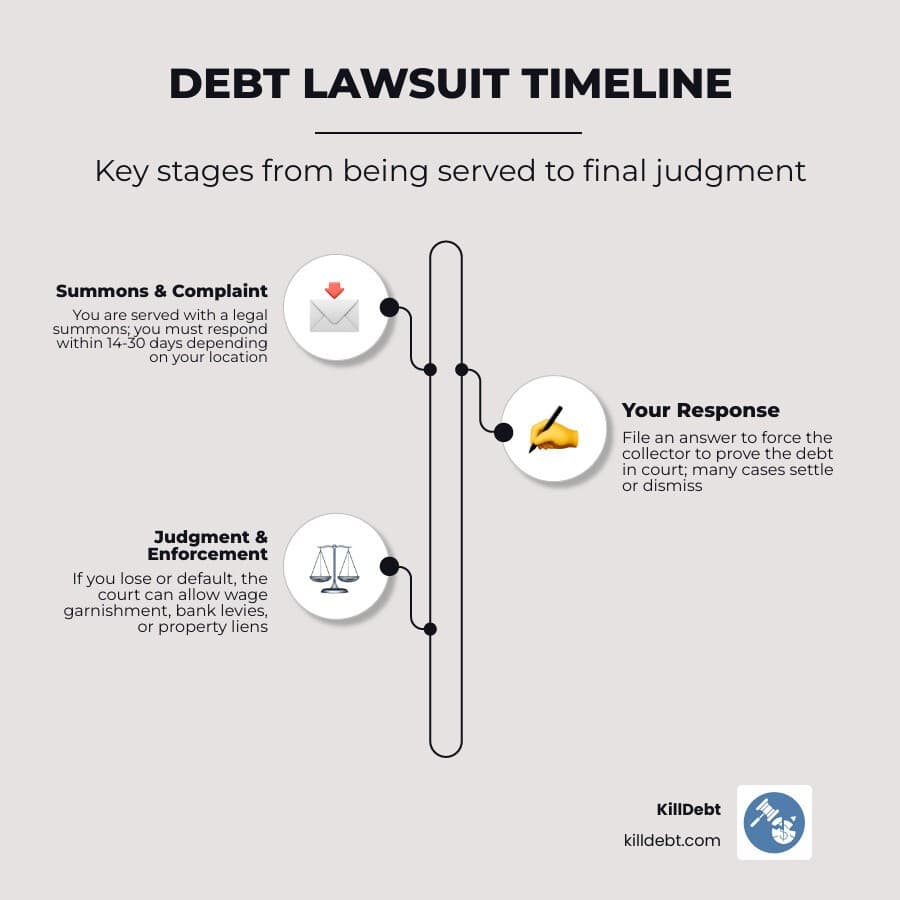
The process officially begins with two documents: the Summons and the Complaint.
It is vital to understand who is suing you: the original creditor or a debt buyer. Original creditors (like the bank that issued your credit card) have their own records. Debt buyers, however, purchase "charged-off" debt for pennies on the dollar. Knowing the difference between a summons and a complaint is your first step in mounting a defense. If the plaintiff is a debt buyer, they often lack the proper paperwork to prove they actually own your specific account.
You have more power than you think. Under the FDCPA, you have the right to demand a debt validation notice. This forces the collector to provide proof of the debt within five days of their first contact.
If a collector violates your rights—such as calling you before 8 a.m. or after 9 p.m., or threatening you with jail (which is illegal for consumer debt)—you may be entitled to statutory damages. In fact, the FDCPA explained shows that you can sue a collector for up to $1,000 in additional damages plus attorney's fees if they break the law.
The clock starts ticking the moment those papers touch your hand. In most jurisdictions, you have a narrow window to act.

Knowing exactly what to do in the first 7 days can save your bank account. Your complete first steps guide should include:
Filing an "Answer" is how you tell the court you are fighting back. Don't just say "I can't pay." That’s an admission that you owe the money. Instead, use affirmative defenses. These are legal reasons why the plaintiff shouldn't win even if the facts in the complaint are true.
Common defenses include:
We recommend using a solid counter-affidavit to challenge the collector's evidence. You can find a sample answer to a debt collection lawsuit to see how these are structured, or follow our guide on how to answer a debt summons to ensure you don't miss any technical requirements.
Sometimes, the best defense is a good settlement. Debt collectors often buy debt for as little as 4% of the face value. This gives them huge room to negotiate. You might be able to negotiate lower payments or a lump-sum settlement for 40% to 60% of the total balance.
Debt settlement can work for you by ending the lawsuit before it ever reaches a judge. Just remember: get everything in writing before you send a single penny.
The rules for debt recovery through the courts change significantly depending on where you live. If you miss the deadline by even one day, you risk a default judgment.
| Jurisdiction | Response Deadline | Court Type |
|---|---|---|
| Florida | 20 Days | Small Claims / County Court |
| Michigan | 21-28 Days | District Court |
| UK | 14 Days | County Court |
| Ireland | 8-28 Days | District / High Court |
In California, the process for answering a debt lawsuit is highly formalized, while Michigan court debt cases often involve a mandatory pre-trial hearing. In Ireland, court procedures for recovering debts (opens in a new tab) are dictated by the amount: debts under €15,000 go to the District Court, while those over €75,000 must go to the High Court.
In Florida, small claims collection lawsuits (opens in a new tab) are limited to $8,000 (as of recent updates). These courts are designed to be more "user-friendly," but don't let that fool you—the collectors will still bring experienced attorneys. In Michigan, most cases land in District Court, where you have 21 days to respond if served in person.
To win, a debt collector must prove the chain of assignment. This is the paper trail showing the debt moved from the original creditor to the current plaintiff. If there is a gap in that chain of assignment, they lose. This is a cornerstone of our debt lawsuit defense guide.
A "zombie debt" is an old debt that has risen from the grave. Every state has a statute of limitations—a time limit after which a creditor cannot legally sue you. In Florida and Michigan, this is typically 5 and 6 years respectively, though it varies by contract type.
Be careful: making a small payment or even acknowledging the debt in writing can sometimes "reset" the clock. Learning how to win a zombie lawsuit usually involves proving the date of the last payment to show the court the time has expired. This even applies to zombie mortgage debt from years-old foreclosures.
Even if you lose the case, the law protects certain types of income from being seized. Debt collectors generally cannot take your wages or bank account if the funds come from:
In Florida, legal remedies for creditors (opens in a new tab) are strictly limited by "head of household" exemptions, which can protect 100% of your wages if you provide more than half the support for a dependent.
If a judgment is entered, the collector moves from "asking" to "taking." You need to know what happens after a summons results in a loss. The creditor can apply for a writ of garnishment, which orders your employer to send up to 25% of your take-home pay directly to the creditor.
They can also place a lien on your home, meaning you can't sell or refinance it without paying the debt. However, there are ways to remove default judgment debt if you can prove you were never properly served or if there was a clerical error.
If you are on the other side—the one trying to get paid—the UK's GOV.UK guide (opens in a new tab) suggests using a "warrant of control" to send bailiffs to seize goods. In Ireland, enforcement of debt judgments (opens in a new tab) might involve an "Instalment Order" or even a "Judgment Mortgage" against the debtor's property. If the debtor still refuses to pay, EX321 guidance (opens in a new tab) details how to apply for a third-party debt order to freeze their bank accounts.
If you woke up one morning to find your bank account frozen because of a civil judgment collection agency you never knew about, you can file a "Motion to Vacate." This asks the judge to cancel the judgment. You'll need to predict the debt lawsuit outcome based on your ability to show a "meritorious defense" and a "reasonable excuse" for missing the court date.
Mastering debt recovery through the courts doesn't require a law degree, but it does require action. The system is designed to reward those who show up and penalize those who stay silent.
At KillDebt, we’ve taken over 30 years of legal expertise from attorney Brian Parker and built it into ParkerGPT, an AI that analyzes your specific court documents and helps you draft professional, court-ready responses.
Want to see how you'll do before you step into the courtroom? Our brand-new Court Tester allows you to simulate your hearing. You can argue your motion in front of an AI judge and face off against AI opposing counsel while your private AI co-counsel whispers the winning strategy in your ear.
Don't let a debt collector take your hard-earned wages because of a paperwork error. Master your defense with KillDebt and take control of your financial future today.
Get started with KillDebt pricing
Important Legal Disclaimer
This educational content is based on general legal principles and my experience in debt collection defense. It is provided for informational purposes only and does not constitute legal advice. Laws vary by state and by local court. For specific legal advice, consult a qualified attorney licensed in your jurisdiction. No attorney-client relationship is created by reading this guide.
Critical Multi-State Variations: FDCPA applies uniformly at the federal level, but state consumer protection laws may provide additional rights and remedies. Statute of limitations periods vary significantly by state and debt type. What constitutes sufficient debt validation varies in practice across jurisdictions. State-specific rules on call frequency, written notice requirements, and permissible collector conduct may differ from federal minimums.

About the author
Brian Parker
I have over 30 years of experience defending consumers against debt collection lawsuits and have seen every tactic, threat, and pressure play that collectors use. Through KillDebt and ParkerGPT, I have systematized the proven defense strategies that actually work - so consumers can respond from a position of knowledge, not fear. My approach focuses on aggressive legal defense based on documented case success rather than false hope that leads to default judgments.