
News Break
Don't Let Them Bully You: How to Report Illegal Debt Practices
May 8, 2026
Blog / News Break
Learn how remove default judgment debt: step-by-step vacate guide, grounds, deadlines by state, and avoid garnishment.

If you're trying to figure out how remove default judgment debt from your record, here's the short answer:
Act fast. Deadlines range from 14 days to 1 year depending on your state.
A default judgment is what happens when a creditor sues you — and you don't respond. The court doesn't hear your side. The plaintiff wins automatically.
That's it. No trial. No defense. Just a ruling against you.
And it hits hard. With a default judgment in place, creditors can garnish your wages, freeze your bank account, and place liens on your property. Over 70% of debt collection lawsuits end this way — often because people didn't know they were even being sued.
This happens more than you'd think. Process servers sometimes deliver papers to the wrong address, leave them with a child, or — in some cases — don't deliver them at all. You find out about the judgment when money disappears from your paycheck or your bank account gets locked.
The good news: a default judgment is not always the end of the road.
Courts can — and regularly do — remove default judgments when defendants act quickly and show good reason. This guide walks you through exactly how to do that, step by step.
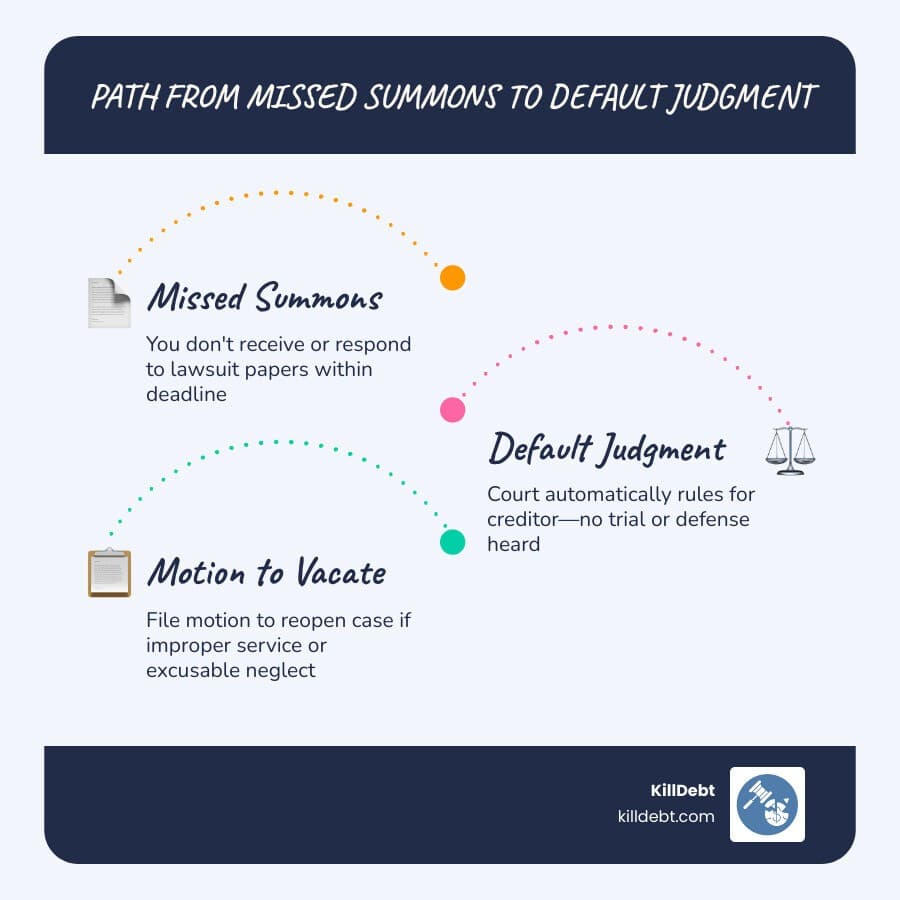

When you discover a judgment against you, the first thing we need to do is stay calm. A judgment is a court order, but it isn't etched in stone. To "remove" it, we use a legal process called "vacating" or "setting aside" the judgment.
Think of it as a "Ctrl+Z" for a court case. When a judge grants a Motion to Vacate, the judgment is cancelled. It’s as if the "automatic win" for the creditor never happened. However, it’s important to understand that this doesn’t usually make the debt vanish instantly—it simply puts the lawsuit back at the beginning, giving you the chance to fight the claim on its merits.
To succeed, you generally have to prove two things to the court:
Understanding the debt collection lawsuit timeline is crucial because the law favors "finality." This means the longer you wait after finding out about a judgment, the harder it becomes to convince a judge to reopen the case.
Judges don't set aside judgments just because you're a nice person or because the debt is a burden. You need specific legal "grounds." Here are the most common reasons we see:
Knowing what to do when sued by a debt collector starts with identifying which of these categories fits your situation.
In the legal world, "Personal Jurisdiction" is a fancy way of saying the court has the power to make a decision about you. For a court to have this power, you must be properly notified of the lawsuit through a Summons and Complaint.
If the creditor failed to serve you according to the strict rules of your state (Florida or Michigan, for example), the court lacks jurisdiction. A judgment entered without jurisdiction is "void." We often find that debt buyers are sloppy with service, which is your best opening to how remove default judgment debt.
If you've discovered a judgment on your credit report or via a garnishment notice, follow these steps immediately.
1. Locate the Court and Case Number You can find this on your credit report, the garnishment paperwork, or by calling your local courthouse. You need the "Index Number" or "Case Number."
2. Get the Court File Go to the courthouse where the judgment was entered. Ask the clerk for the complete file. Specifically, look for the Affidavit of Service. This is the document where the process server swore under oath that they delivered the papers to you. If the description of the person served doesn't match you, or the address is a place you haven't lived in five years, you have your evidence.
3. Determine Your Deadline Every state has a time to respond and specific windows for vacating. In Michigan, for instance, you typically have only 21 days from the entry of a default judgment to ask to set it aside. In other areas, you might have up to a year for "excusable neglect," but "lack of service" often has no expiration date.
This is the "meat" of your request. You cannot just write a letter to the judge. You must file a formal Motion to Set Aside Default Judgment.
Along with the motion, you must include an Affidavit of Meritorious Defense. This is a sworn statement, signed in front of a notary, where you explain your side. You need to be specific. Don't just say "I don't owe this." Say, "I do not owe this debt because the statute of limitations expired in 2021," or "I never had an account with this original creditor."
Using a solid counter-affidavit is the key to showing the judge that reopening the case isn't a waste of the court's time.
Once your papers are drafted:
Because we focus on Florida and Michigan, it is vital to know that the rules change the moment you cross state lines.
| State | Deadline to File Motion | Common Requirement |
|---|---|---|
| Michigan | 21 Days from Entry | Must show "Good Cause" and "Meritorious Defense" |
| Florida | "Reasonable Time" (usually 1 year) | Must show "Excusable Neglect," "Due Diligence," and "Meritorious Defense" |
| Texas | 30 Days (14 in Justice Court) | Must show the failure to answer was an accident or mistake |
| New York | 1 Year (Excusable Default) | No limit for lack of personal jurisdiction |
In Michigan, if you miss that 21-day window, you have to file a "Motion for Relief from Judgment," which has a much higher bar for success. In Florida, the "Three-Prong Test" is famous: you must prove you had a good reason for missing the deadline, you acted quickly once you found out, and you have a real defense to the debt.
When the day of your hearing arrives, show up early. Dress like you’re going to a job interview—professionalism goes a long way with judges.
When your case is called, you will speak first. Briefly explain to the judge:
The creditor’s attorney will likely be there (or on the phone) to argue against you. Stay calm. Don't interrupt. The judge may ask if you need a lawyer, and while you can do this yourself, being prepared with the right facts is what wins the day.
There are generally three ways this goes:
Don't fall for lawsuit myths—simply showing up doesn't guarantee a win. You must have your paperwork in order.
Ignoring a judgment is like ignoring a fire in your kitchen—it only gets bigger. In Michigan and Florida, a judgment isn't just a piece of paper; it’s a weapon for the creditor.
We've detailed exactly how debt collectors take wages and bank accounts in our companion guides, and the reality is that a judgment gives them the keys to your financial life.
Removing a default judgment is one of the most empowering things you can do for your financial health. It stops the garnishments, clears your record, and gives you a second chance to stand up for your rights.
At KillDebt, we know that the legal system can feel like it's designed to make you lose. That's why we created a DIY legal defense system powered by ParkerGPT. This AI is trained on consumer debt law and real-world court strategies developed over 30 years by attorney Brian Parker.
Unlike generic templates, our system analyzes your actual lawsuit documents and generates court-ready responses tailored to your specific case. We also recently introduced the Court Tester, an AI courtroom simulation. You can upload your filings and practice arguing your motion in front of an AI judge, with a private AI co-counsel whispering strategy to you.
Don't let a procedural mistake ruin your finances. Whether you're in Michigan, Florida, or beyond, you have the right to be heard. Take control of your case with KillDebt today.

About the author
Brian Parker
I have over 30 years of experience defending consumers against debt collection lawsuits and have seen every tactic, threat, and pressure play that collectors use. Through KillDebt and ParkerGPT, I have systematized the proven defense strategies that actually work - so consumers can respond from a position of knowledge, not fear. My approach focuses on aggressive legal defense based on documented case success rather than false hope that leads to default judgments.