
News Break
Sued by a Debt Collector? Do These 7 Things First
December 4, 2025
Blog / News Break
Just got served? There are two documents in that envelope and they mean very different things. Attorney Brian Parker explains what each one requires you to do.
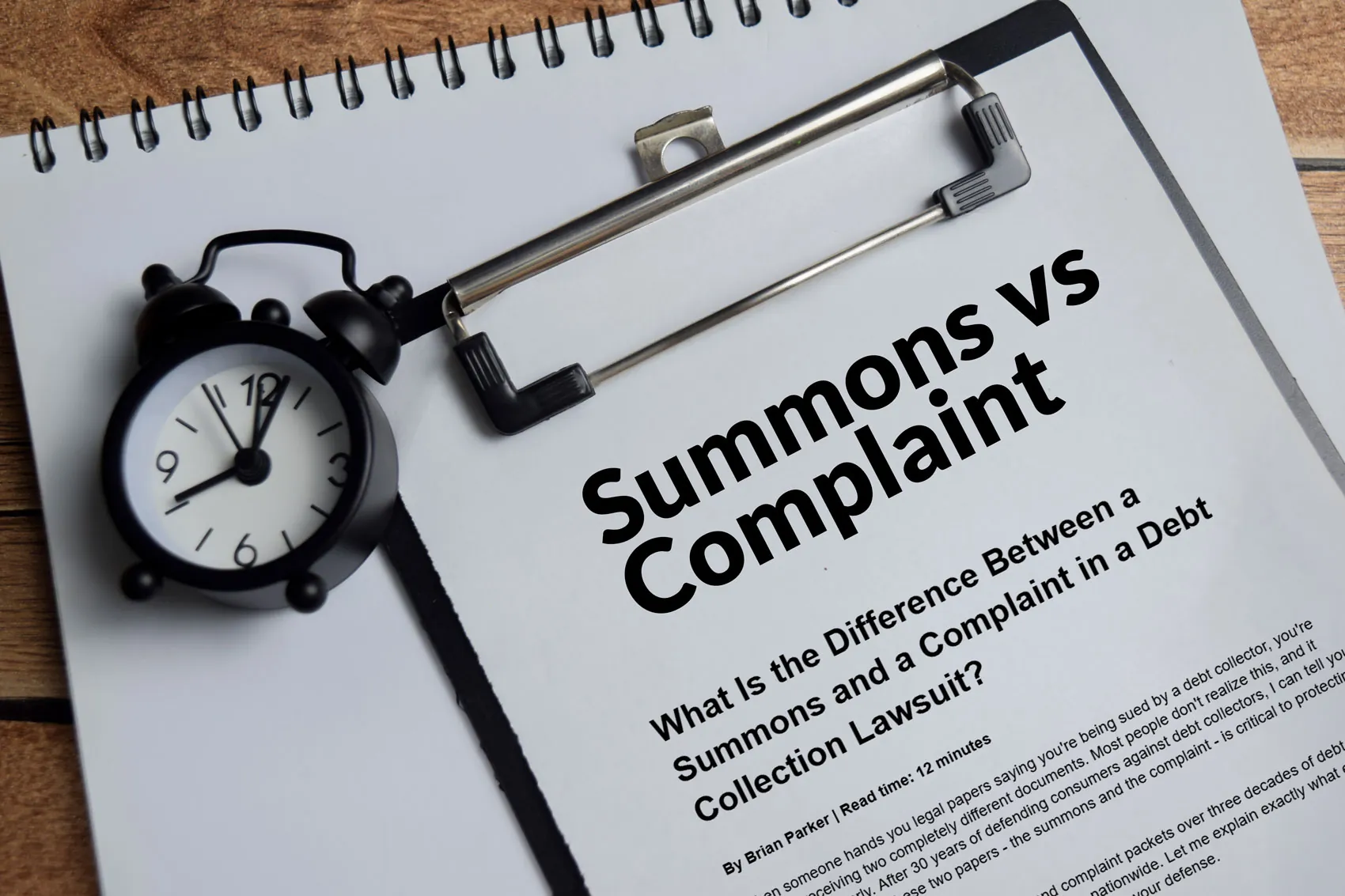
By Brian Parker | Read time: 12 minutes
When someone hands you legal papers saying you're being sued by a debt collector, you're actually receiving two completely different documents. Most people don't realize this, and it costs them dearly. After 30 years of defending consumers against debt collectors, I can tell you that understanding these two papers - the summons and the complaint - is critical to protecting yourself.
I’ve reviewed thousands of summons and complaint packets over three decades of debt defense work, and the patterns are the same nationwide. Let me explain exactly what each document does and why the difference matters for your defense.
Here's why you get both papers: Debt collectors can't just file one paper and sue you. Court rules require them to serve you with two separate documents that work together to create a valid lawsuit.
Document #1: The Summons - This is the court's official notification that you're being sued
Document #2: The Complaint - This contains the debt collector's pleadings or accusations against you
Why this matters: Each document triggers different legal rights, defenses, and deadlines. If either document is wrong, the entire lawsuit can collapse.
If you need the full step-by-step defense plan for responding to a lawsuit, see my Complete First Steps Guide for What to Do When Sued by a Debt Collector?
The summons is like an official invitation to court that you legally cannot ignore. It establishes the court's power over you and starts the countdown clock on your response time.
The summons tells you:
Your Response Deadline:
Look for language like "YOU HAVE 21 DAYS AFTER SERVICE TO FILE A RESPONSE" or similar wording. This deadline is absolute - even one day late typically means you lose automatically.
Deadline calculations vary by state. Some states exclude weekends and holidays, others don't. Some provide additional time for mail service. Always verify the specific rules in your jurisdiction or consult local legal counsel."
Important: Response deadlines vary significantly by jurisdiction, typically ranging from 10-45 days depending on your state, court type, and service method. Some states exclude weekends and holidays from deadline calculations, while others don't. Federal courts typically allow 21 days, but state courts range from 10 days (some small claims courts) to 30+ days. Always verify the specific deadline calculation rules in your jurisdiction.
Service Information:
The summons should show when and how you were served. This matters because improper service can invalidate the entire lawsuit. Valid service typically requires:
Important: Service of process requirements differ dramatically between states. While some jurisdictions require personal service by authorized process servers, others allow certified mail, publication service, or alternative methods. What constitutes valid service in one state may be completely invalid in another. Research your specific state's service requirements or consult with a local attorney.
Court Jurisdiction:
The summons establishes which court has authority over your case. Check if:
Important: Court jurisdiction and venue rules are highly state-specific. Some states allow debt collectors to sue anywhere within the state, while others require filing in the county where you live or where the debt was incurred. Federal diversity jurisdiction has different venue requirements than state courts. These rules can significantly impact your defense strategy.
Improper Service Problems:
Jurisdiction Issues:
Service requirements vary significantly by state. What constitutes proper service in one jurisdiction may be invalid in another. Research your specific state's service requirements or consult with a local attorney familiar with your jurisdiction's rules.
A complaint must prove four things to win against you:
If any of these fail, the lawsuit can be defeated.
Important: The exact proof requirements differ by state. Some jurisdictions require strict documentation from debt buyers, while others allow more flexibility in what collectors can submit. Always check your state’s evidence rules and procedures.
The complaint is where the debt collector presents their case against you. It's organized in numbered paragraphs that tell their version of why you owe money.
Typical complaint structure:
Every allegation in the complaint must be proven in court. Debt collectors often make claims they cannot actually prove with real evidence.
Common Allegations the Collector Makes (and Why They Often Fail):
Breach of Contract:
They claim you signed an agreement and broke it by not paying. Problem: Most debt buyers don't have your actual signed contract.
Account Stated:
They claim you received monthly statements and didn't dispute them. Problem: They often can't produce the actual statements they reference.
Unjust Enrichment:
They claim you received benefits (credit) and it's unfair not to pay. Problem: This theory often fails when proper contracts exist.
Important: The legal requirements for proving ownership of debt and the right to sue differ significantly between states. Some jurisdictions have strict documentation requirements for debt buyers, requiring a complete chain of title and assignment documentation. Others are more permissive. Additionally, some states have specific counter-affidavit procedures (like Michigan under MCL 600.2145) that can defeat certain types of claims, while other states don't recognize these procedures at all.
Summons Requirements:
Complaint Requirements:
Summons-Based Defenses:
Complaint-Based Defenses:
The critical point: Most debt buyers struggle with complaint requirements because they purchase debts without complete documentation.
Now that you understand what each document means, here’s how to review your papers step by step.
The summons tells you WHEN to respond.
The complaint tells you WHAT to respond to.
If either document has errors - wrong jurisdiction, improper service, false allegations -
you have grounds to challenge the entire lawsuit.
Most debt collectors make mistakes because they file cases in high volume using AI systems
that generate complaints from templates. Finding errors is common - you just need to know
what to look for.
When you receive lawsuit papers, the first task is to separate the summons from the complaint and review each one for different types of information. The summons tells you what the court requires from you and when you must act. The complaint tells you what the collector is accusing you of and what they must prove to win.
A proper review means checking four things:
If you can confirm these items, you know exactly where the collector’s weaknesses might be. The next section walks you through these steps in detail.
Check the summons for:
Analyze the complaint for:
Compare their claims to what you know:
Common red flags:
Debt collectors now file lawsuits in high volume using automated systems**,** which means errors and weak documentation are more common than people realize. They count on people not understanding these documents or the legal requirements behind them.
When you understand what the summons and complaint must accomplish legally, you can:
Remember: Getting these papers is not an automatic loss. It's an opportunity to examine their case under legal standards they must meet to win.
Interpreting lawsuit papers is where most people make mistakes. The summons sets your deadline, but the complaint contains the allegations the collector must prove. Knowing how to read both correctly is the difference between a strong defense and a default judgment.
KillDebt’s ParkerGPT system can analyze your summons and complaint the same way I do in my legal practice. You can upload your papers and get an immediate breakdown of deadlines, jurisdiction issues, ownership claims, chain of title problems, and the defenses that apply in your state. It is the fastest way to understand what the collector must prove and where their case is weak.
If you want support while reviewing your documents, you can explore ParkerGPT inside KillDebt. This gives you expert-level analysis for a fraction of the cost of hiring a lawyer, without compromising on accuracy or strategy.
Understanding your lawsuit papers is just the foundation. Your immediate priorities should be:
Most importantly: Don't let fear or confusion paralyze you into inaction. These documents give you the roadmap to their case - use it to plan your defense.
What to Do When Sued by a Debt Collector: Complete First Steps Guide - Get the detailed action plan with templates and deadlines
How Much Time Do I Have to Respond to a Debt Collection Lawsuit? - State-specific deadline calculator and rules
Who Is Suing Me? Original Creditor vs. Debt Buyer Explained - Critical differences that affect your entire strategy (Coming Soon)

About the author
Brian Parker
I have over 30 years of experience defending consumers against debt collection lawsuits. Throughout my career, I've analyzed thousands of summons and complaint documents, identifying the patterns of weakness that debt collectors rely on. My approach focuses on aggressive legal defense that challenges every element debt collectors must prove to win their cases.