News Break
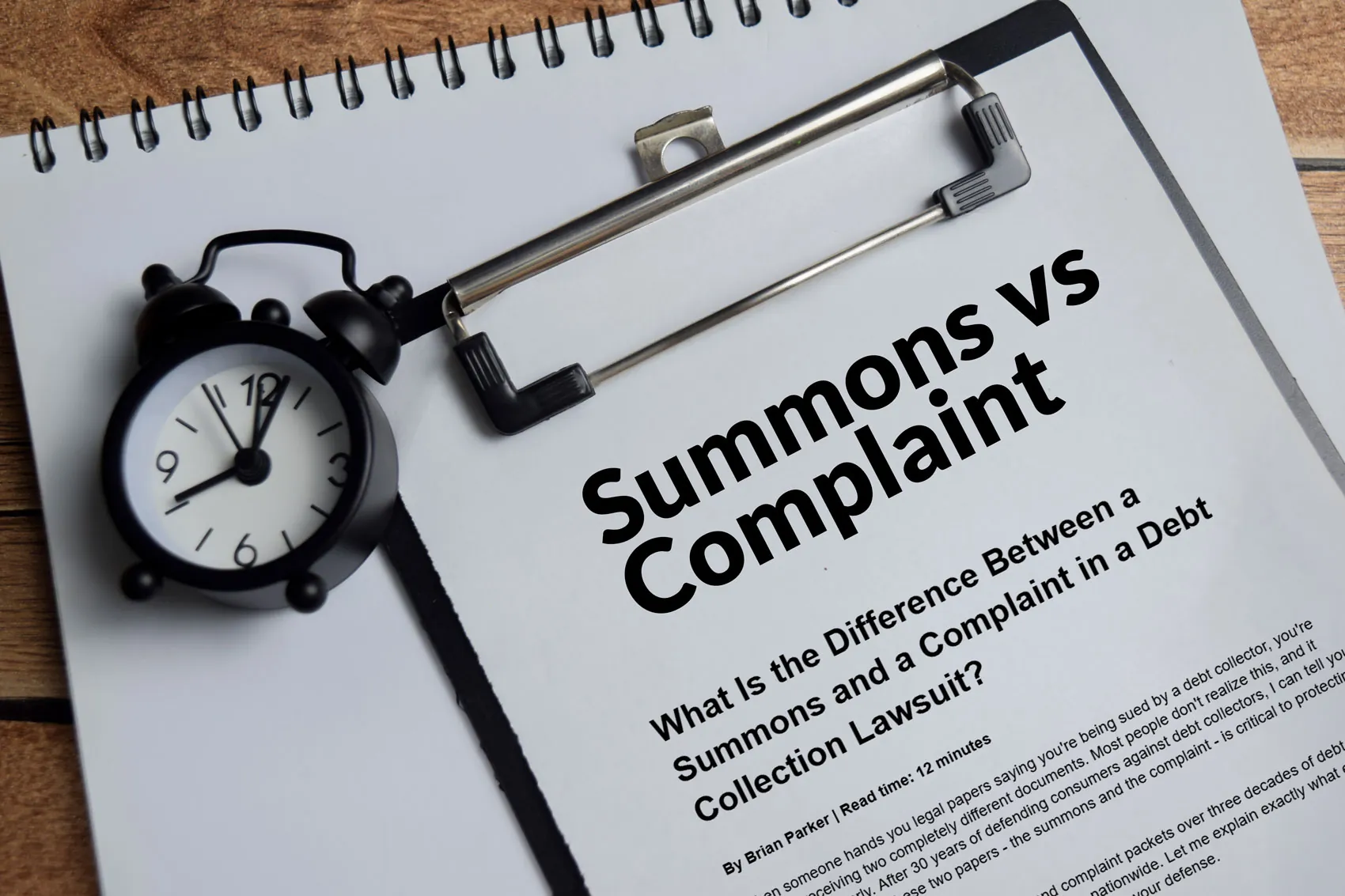
Summons vs Complaint: What Each Paper Actually Means
December 11, 2025
Blog / News Break
You do not always need a lawyer for a debt collection lawsuit. Learn when defending yourself works, when to hire an attorney, and what defense costs either way.

By Brian Parker | December 2025 | Read time: 14 minutes
You do not always need a lawyer to defend yourself in a debt collection lawsuit. In many cases, especially debt buyer lawsuits under ten thousand dollars, people successfully defend themselves without an attorney when they understand the rules, deadlines, and documentation weaknesses debt collectors rely on.
However, there are situations where hiring a lawyer is critical. Secured debts, large balances, complex federal cases, or asset protection issues often require professional representation.
The real question is not “Do I need a lawyer?” and when does self-representation give you leverage and when does it expose you to unnecessary risk.
This guide explains how to make that decision correctly.
When a lawsuit arrives, panic is normal. Debt collectors depend on that reaction.
Here is the uncomfortable truth most people never hear. Most debt collection lawsuits are not built to be proven. They are built to be ignored.
Roughly 70% of people sued never respond at all. That silence produces automatic default judgments. When someone answers the lawsuit, even without an attorney, the outcome changes dramatically.
Not because courts are lenient. But because debt collectors must prove things they often cannot.
You are often a strong candidate for self-representation when all of the following apply
Debt buyers purchase portfolios, not full case files. That gap is where defenses live.
If you can read documents carefully and follow instructions, self-representation is not reckless. In many cases, it is strategic.
There are situations where self-representation is the wrong move. You should strongly consider hiring an attorney when:
Courts and procedures vary widely by state and by judge. Some situations demand professional advocacy to avoid irreversible damage.
Debt defense attorneys commonly charge:
Spending five thousand dollars to defend a three-thousand-dollar claim is rarely rational.
This economic pressure is why many people default. Not because they are wrong. But because the system prices them out of defense.
Why Self-Representation Often Works Against Debt Buyers

Debt buyers rely on assumptions. They assume you will not answer. They assume you will not read exhibits. They assume you will not challenge ownership. Those assumptions are usually correct.
When they are wrong, cases collapse. Common weaknesses include:
Standing is not just an option for Creditors or Debt Collectors. Ownership must be proven. Data is not evidence by itself.
I've seen this pattern over and over. Debt buyers like Velocity sue claiming they own loans through missing or improper assignments. When the defendant demands to see the actual chain of title, Velocity produces a bill of sale that references a 'master purchase agreement' but doesn't actually attach it. No specific account numbers. No dates that make sense. That's when you realize they don't actually own what they're claiming to own. The case gets dismissed because standing requires proof, and they don't have it.
No. Federal consumer protection laws apply whether you are represented or not. That includes the Fair Debt Collection Practices Act. Examples of issues that arise frequently:
Some of these violations create leverage. Others create counterclaims. State rules vary significantly. Always check your local court rules before asserting defenses.
I've handled cases where the bank's own documents proved the debt was securitized years before. Once that debt goes into a trust pool, it's no longer owned by the original creditor. The bank tried to sue anyway, but they couldn't legally claim ownership of something they sold to investors. Look at the language in their complaint: do they say "debt" or "account"? That tells you whether it's securitized.
The most dangerous choice is silence.
Default judgments can lead to
None of that happens because the collector proved their case. It happens because no one challenged it.
Self-representation does not mean zero help. Just research all of your options.
Many attorneys offer limited scope services such as:
This approach can provide expert oversight without full representation costs.
It is often the most efficient path.
After decades defending consumers, I built KillDebt to solve a specific problem. Most people cannot afford full legal representation. But they also should not face debt collectors blindly.
ParkerGPT is not a lawyer. It does not replace attorneys. It does not give legal advice.
What it does is give you the same structural advantages I use in litigation without the $5,000 retainer.
When you upload a debt collection complaint or bill of sale to ParkerGPT, it does not treat your case like a generic question. It analyzes it the way a litigation attorney would:
This is fundamentally different from asking ChatGPT, "how do I respond to a debt lawsuit?" General AI tools lack litigation context. They don't know that a Bill of Sale is not an Assignment. They don't know that three assignments on the same day is physically impossible. They don't know that generic pool debt transfers without specific account numbers fail under Michigan, Ohio, Virginia, and most other state laws.
ParkerGPT does it all in debt defense and is not a general information source like a ChatGPT. ParkerGPT is devoted only to the debt defense lane as it's built on thirty years of my actual cases, actual defenses, and actual outcomes.
There are situations where technology alone is insufficient. You still need an attorney when
KillDebt is designed to be honest about those boundaries. We tell you when you need a lawyer, not to sell you something, but because your situation demands it.
Ask yourself:
If the answers favor clarity and control, self-representation may be appropriate. If the answers point to complexity and risk, hire counsel.
This is not about bravery. It is about leverage.

About the author
Brian Parker
I have over 30 years of experience defending consumers against debt collection lawsuits. Throughout my career, I've analyzed thousands of summons and complaint documents, identifying the patterns of weakness that debt collectors rely on. My approach focuses on aggressive legal defense that challenges every element debt collectors must prove to win their cases.