News Break
Capital One Says the Discover Merger Proves Ownership. Brian Deposed Their Witness
September 25, 2026
Who is suing you · Capital One
Capital One sues on two kinds of account. On its own cards it sues as the original creditor. It usually holds your agreement and your statements, and an employee who can explain the records. It still has to prove the balance and the terms that applied to you. Since the May 2025 merger it also sues on Discover accounts. Brian treats those like debt buyer cases.
Sources: notes on the deposition of Capital One’s corporate representative (September 2026) · Paquin v. Capital One Financial Corp. (M.D. Fla. 2026) · Updated October 2026
First, which card
A Capital One card
This is an original creditor case. Capital One made the loan, so there is little chain of title to attack. The questions move to the balance, the agreement that applied to you, and the statute of limitations. You can also ask whether Capital One moved the account into a trust.
A Discover card
Brian has seen many of these since the merger. He treats them like debt buyer cases. A merger moves a bank’s assets by law. Brian’s point is that Capital One still has to show your account was one of them.
The chain on a Discover account · as Capital One’s witness described it
Brian’s line from the deposition is that self-executing is not self-proving. The merger statute moves Discover Bank’s assets without paperwork. Capital One still needs paperwork to show your account sat at Discover Bank on the day the merger took effect.
Discover Financial Services
The company on your contract. Capital One’s witness said this company stopped existing at the merger.
Transfer: No document produced at the deposition
Discover Bank
Funded the account. In that case, the complaint called it a Discover Bank debt.
Transfer: Merger, May 2025, by law
Capital One
The plaintiff.
Discover Products Inc.
Serviced the account.
A trust
Holds the receivables. The witness could not say what it held before.
When the bank calls
The FDCPA, the federal debt collection law, covers debt collectors. A bank that collects its own debt is generally outside it. Two narrow exceptions exist: the bank collects under another name, or it got the debt after it was already in default.
Some state laws cover any person who collects a debt. A bank counts as a person under those laws. Florida’s law bars calls between 9 p.m. and 8 a.m. in your time zone without your consent. California, Texas, West Virginia, North Carolina, Maryland, Pennsylvania and Massachusetts also have laws that reach a creditor. What each one covers depends on your state.
The federal TCPA is a separate law. It covers autodialed calls to cell phones and calls that use a recorded or artificial voice. It covers any caller, a bank included. It sets $500 for each call that breaks it, and up to $1,500 if the caller acted willfully or knowingly. A late call from a live person is not a TCPA violation on its own.
One case
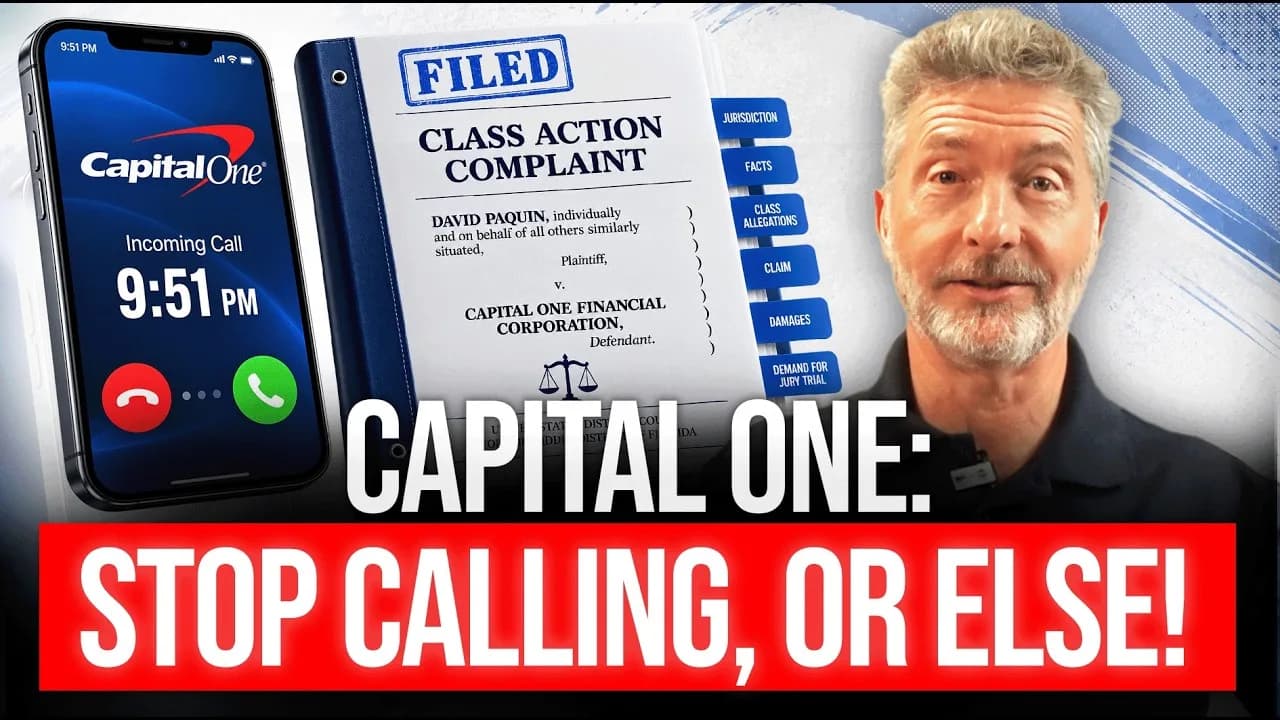
The plaintiff filed it in July 2026 in federal court in Florida. The complaint says Capital One called at 9:51 p.m. on April 20 and at 9:08 p.m. on April 24, 2026. The plaintiff seeks class action status and claims more than $5 million. These are allegations in a complaint.
Paquin v. Capital One Financial Corp. (M.D. Fla. 2026) · Fla. Stat. 559.72(17) (opens in a new tab)
Brian Parker · 30+ years defending these cases
“Original creditor cases are not unwinnable, but they require precision, not blanket denial.”
Brian Parker · Who is suing you: original creditor or debt buyer · February 2026
“Original creditors collecting their own debts are generally exempt from the FDCPA. That exemption ends the moment a bank sells an account.”
Brian Parker · How banks sell your account · March 2026
Inside the platform
Watch · September 2026
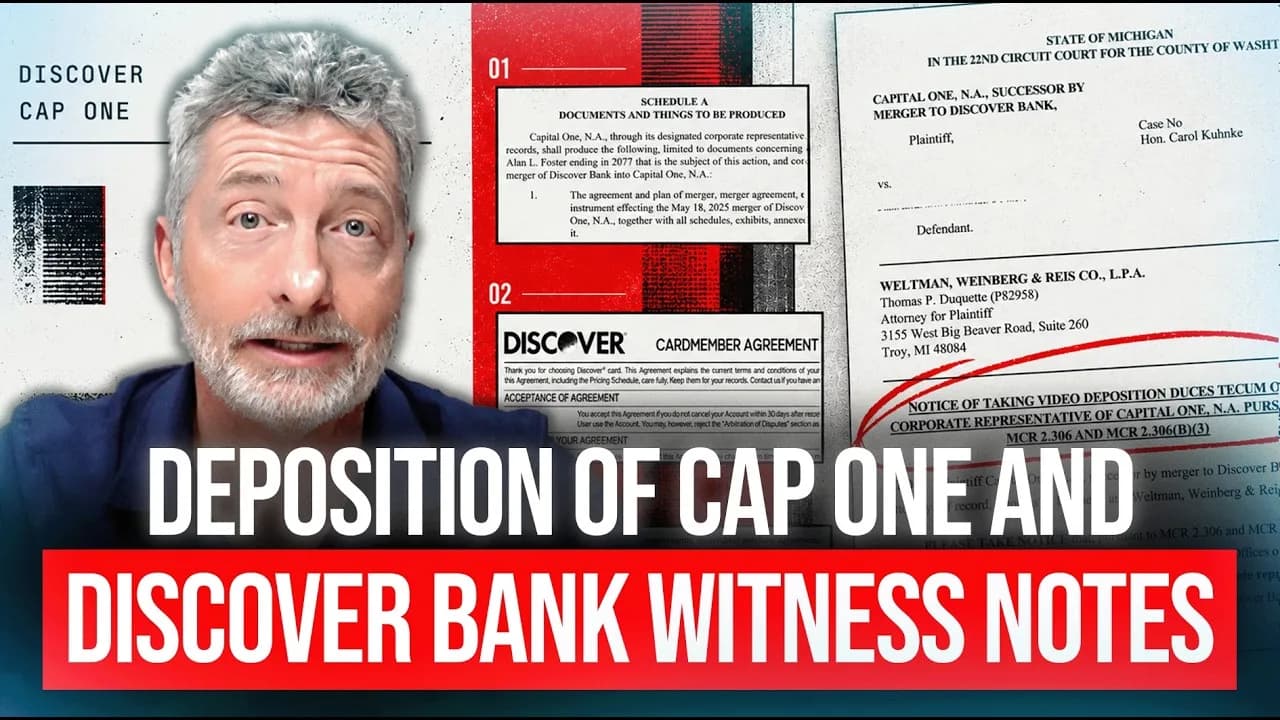
Deposition of Cap One and Discover Bank Witness Notes
Capital One Calls Lead to Class Action
August 2026
Brian Parker Answers Your Debt Defense Questions
August 2026
From the open forum
These are members’ own threads about their cases. We make no claim about how any of them came out.
From the blog
September 25, 2026
August 17, 2026
August 28, 2026
What people ask
If the account is years old, the timing questions are on the old debt page. If you have already been served, start here instead.
Brian’s answer is yes, if you challenge it. The merger moved Discover Bank’s assets to Capital One by law in May 2025. His point is that the statute carries only what Discover Bank owned. So Capital One still has to show your account was one of them on that date. The deposition article covers what he asked and what nobody could produce.
Usually not. The FDCPA covers debt collectors, and a bank that collects its own debt is generally outside it. Two narrow exceptions exist: the bank collects under another name, or it got the debt after it was already in default. Some state laws reach a bank anyway, depending on your state.
In Florida, no. Florida’s law bars any person collecting a consumer debt from calling between 9 p.m. and 8 a.m. in your time zone without your consent, and that covers a bank. The FDCPA sets the same hours, but only for third-party collectors. Other states differ. Your time zone controls, not the caller’s.
Ask for the version that applied to you. A bank’s lawyers often attach a generic agreement written years after the account opened. In the deposition case, the Discover contract carried Discover Bank’s terms with a 2025 note that it is now a Capital One contract.
Before you file anything
Check first whether your agreement has an arbitration clause at all. If it has one, the card issuer chose arbitration when it wrote the agreement. On a Discover account, that issuer was Discover. Brian gives the same advice for a bank as for a debt buyer: “Arbitration is not your first move. Arbitration is your last resort.”
Brian Parker · arbitration guide · Ask Brian mailbag (August 2026)
Start with what to do after being served. Then let ParkerGPT read what Capital One filed against you. Both plans include every tool on this site except Court Tester, which is Pro only.
Just served? Read the summons guide first.
A defense attorney starts with a retainer in the four figures. KillDebt Basic is $175 a month, cancel any time.