
News Break
HOA Convenience Fees: The Two-Door Check That Works in All 50 States
August 26, 2026
Blog / News Break
Nine reader questions from the comments and the community forum: silence after discovery, arbitration, protected income, merger debts, and garbage time.

About once a month, Brian Parker sits down with questions from the YouTube comments and the community forum and answers them in a batch. This is the August round, and it is a good one: nine situations, most of them live cases, none of them hypothetical. A note that Brian makes on camera and this article keeps: the people asking are not his clients, and answers to a comment are education about a kind of situation, never instructions for a specific case.
One of the nine matters more than the rest. Brian had planned a standalone video on garbage time, his name for the window before a lawsuit can hurt you. He decided this is that video, so this is that article, and it closes the set.
Key Takeaways
- When a collector goes silent after your discovery responses, silence is good news. Document it.
- Brian avoids arbitration on principle: court gives you rules of evidence and a neutral judge; arbitration gives you the card company's chosen forum.
- A judgment is an annuity. Answer every lawsuit, even broke, because ten renewable years is a long time to be wrong.
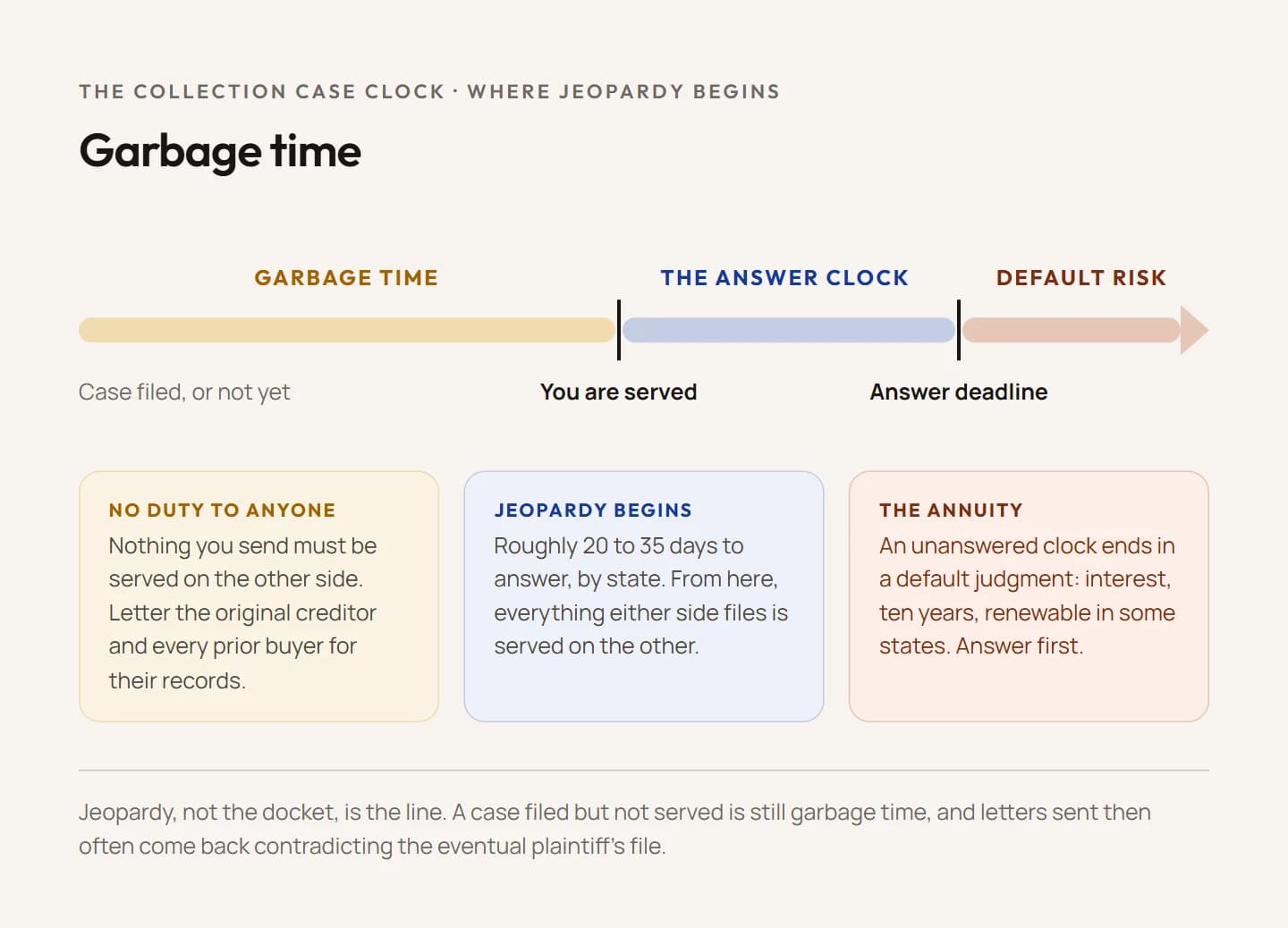
- Garbage time is the window before you are in jeopardy, and it is for sending letters no one can make you disclose.
A member answered a summons with a counter affidavit, responded to every discovery request on deadline, and then heard nothing for over a month. Sit still, or push for dismissal?
ParkerGPT's read, which the member posted in the forum: the silence is exactly what you want. No motions means the case is not moving against you. A collector that has gone quiet after meeting a hard defense is deciding whether you are worth the trouble. So document the silence, because a record of a plaintiff not prosecuting its own case helps later, and let the next move be theirs. If a summary judgment motion comes, oppose it. If they call to settle, listen.
Brian agrees with all of that, then adds the part only a litigator would: he does not let the other side dictate the pace of his case. He might send something that makes them uncomfortable anyway, like a deposition notice for their records custodian. It pokes the bear, and that is the point. A debt buyer does not want its witness deposed, and it definitely does not want questions about documents it does not have. Both moves are defensible; the difference is temperament, and knowing that both exist is the education.
Two readers asked versions of this, one holding a 60-day deadline to elect arbitration or return to court. There is a strain of internet advice that says elect arbitration, because the collector will not pay the fees and will fold.
Brian is on record against it, and his reasoning is worth having in full. In court you hold the rules of evidence, the rules of procedure, real discovery, and a judge who is at least structurally neutral, in a forum your tax dollars run. In arbitration you hold whatever the arbitrator thinks you should have, in a forum the card company chose when it wrote the agreement. The arbitrator may not be an attorney; raise a chain of title argument and you may get a blank look. And the billion-dollar company on the other side can absorb arbitration costs for the long-run benefit of beating you. Take the Constitution over the clause.
Often, practically, yes. Federal benefits like Social Security and veterans disability are generally protected from garnishment for consumer debts. If protected benefits are your whole income, get the determination letter that says so and show it to the other side. Brian has run this play: collectors cannot get blood from a stone, and faced with documentation that there is nothing collectable, they usually dismiss without prejudice and go away, keeping the theoretical right to return if you win the lottery. It feels wrong to lead with your disability, but it is a chip, and it wins quietly. Pair it with the exemption rules for garnishment in your state.
Brian is seeing these constantly since the merger, and his approach is simple: treat a merger debt like a debt buyer case, because that is what it is. An account that started at Discover and is now sued on by Capital One traveled, and the plaintiff has to prove the journey: that your specific account was part of what moved, and that the right to sue moved with it. That is the same proof fight this blog has covered against debt buyers, and the same place their paperwork fails.
A member in South Carolina asked how to answer a suit from a collector they had never heard of. Beyond the usual answer and counter affidavit, Brian pointed at a doctrine that state is strong on: the right to cure. Some states require a creditor to send a notice giving you the chance to catch up before it may sue on a consumer debt, and courts have held that a debt buyer standing in the original creditor's shoes inherits that obligation. No compliant notice, no lawsuit. South Carolina has the doctrine; Wisconsin's Consumer Act carries its own version. If you are in a right-to-cure state, that box gets checked before anything else.
A reader was served over a $15,000 online loan from a bank in a state they have no connection to. Brian's playbook for identity theft cases, in order:
Brian's answer is the tough-love centerpiece of the video. A collector with an unanswered lawsuit does not shrug and leave; it takes a default judgment, and a judgment is an annuity. It accrues interest at statutory rates, it follows you, and in Michigan it lasts ten years and renews for ten more. The day you go back to work, the judgment that could never have been proven against a filed answer is waiting for your paycheck, grown. Broke is a reason to answer, not a reason to skip it. And if the collector has FDCPA or credit reporting violations of its own, those are chips: brought up in good faith, they settle cases whole, sometimes as a mutual walkaway where both sides drop everything and go home.
A New Jersey member asked whether to file the state's certification flavor of the document now or hold it for discovery. Brian's answer cut past the labels to the anatomy. Whatever your state calls it, a counter affidavit is made of three things: their bad pleadings, their documents used against them, and the truth. Not a flat admit-deny-deny. Open with a preliminary statement that tells an overloaded court in two sentences what is wrong with their case, then cut and paste their own mistakes into it. Brian once had a plaintiff whose paperwork claimed it purchased the debt from itself, and that paragraph appeared, quoted, in every document he filed afterward. Use their documents against them; do not depend on documents that only say bad things about you.
A member expected to be served before the case was even filed, a quirk a few states allow, and worried it destroyed the strategy Brian calls garbage time. It does not, because garbage time was never about the docket. It is about jeopardy.
You are in jeopardy when you have been served or have appeared: an answer clock is running and everything you file must be served on the other side, just as everything they do must now be served on you. Before that, whether the case is filed or not, you owe nobody notice of anything. That window is garbage time, and the move is to turn it into gold: send validation and documentation letters to the original creditor and every earlier debt buyer in the chain, the predecessors in interest. They are not parties to any lawsuit, so about half the time they simply answer, and what they send often contradicts the file of whoever eventually sues you. You are not hiding anything; you simply have no duty to report letters you were always allowed to write.
The letters live in the member library, and this batch of questions came with a happy footnote: the member who beat LVNV Funding twice on appeal showed up in the comments answering questions about how he did it. His whole story is here.
Want your question in the next round? Leave it in the comments on the video or post it in the community forum; Brian films Sunday and pulls from both.

About the author
Brian Parker
I have over 30 years of experience defending consumers against debt collection lawsuits and have seen every tactic, threat, and pressure play that collectors use. Through KillDebt and ParkerGPT, I have systematized the proven defense strategies that actually work - so consumers can respond from a position of knowledge, not fear. My approach focuses on aggressive legal defense based on documented case success rather than false hope that leads to default judgments.