News Break
Navigating the Maze of Superior Court Debt Motions
July 24, 2026
Blog / News Break
Learn how to exploit debt buyer lawsuit weaknesses to beat collection lawsuits, avoid default judgments, and fight back in court.
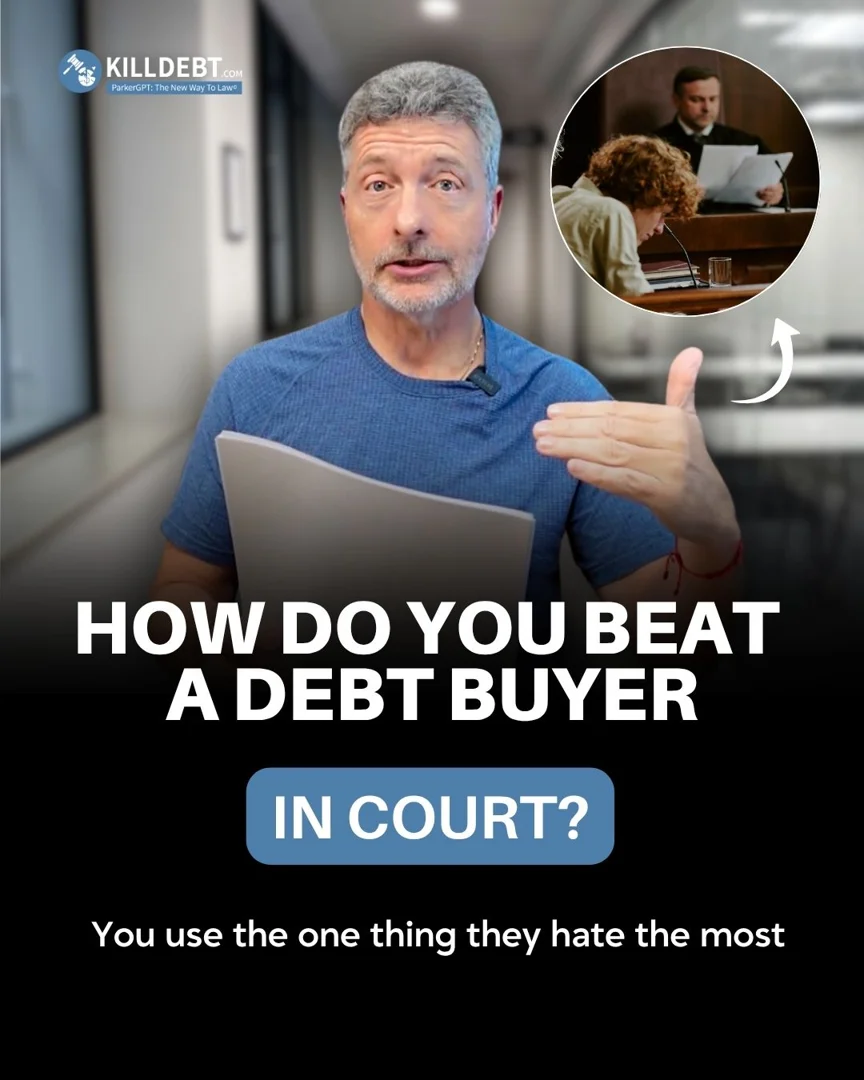
Understanding debt buyer lawsuit weaknesses could be the difference between a default judgment draining your wages and walking away with your case dismissed — or settled for a fraction of what they're claiming.
Here are the most common weaknesses in debt buyer lawsuits:
If a company you've never heard of just sued you, here's what you need to know right away: debt buyers are not the same as original creditors. They bought your account — often for as little as 2 to 5 cents on the dollar — from a pile of thousands of accounts on a spreadsheet. They almost certainly don't have your original signed contract. They may not even have complete records of how your balance was calculated.
And they're counting on one thing: that you won't show up.
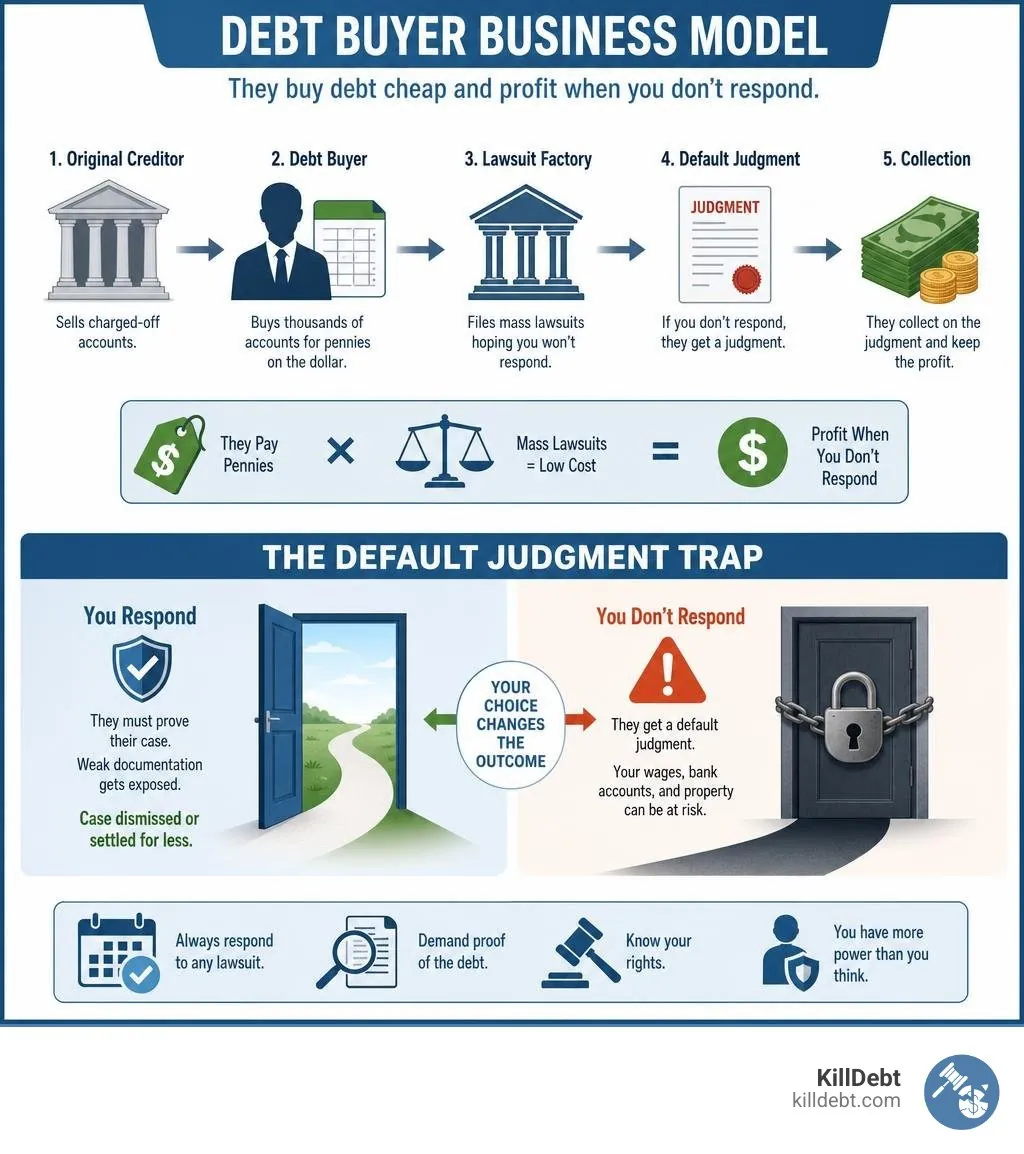
Roughly 90% of debt collection lawsuits end in default judgment because consumers don't respond. That's the entire business model. A debt buyer might pay $30,000 for a portfolio of accounts with a face value of $1 million. They don't need to win every case — they just need you to do nothing.
But if you do respond? Their case often falls apart quickly.
I'm Brian Parker, and I've spent over 30 years in courtrooms fighting debt buyers and collection law firms — I've seen every documentation gap, every robo-signed affidavit, and every bluff that makes up the typical debt buyer lawsuit weaknesses playbook. Everything in this guide comes from that real-world experience, distilled into the clearest possible steps so you can defend yourself with confidence.
When you open a credit card or take out a loan, you deal directly with the original creditor (such as Citibank, Chase, or a local credit union). If you fall behind on payments, the original creditor may eventually "charge off" the account and sell it to a third-party debt buyer (such as Midland Credit Management, Portfolio Recovery Associates, or LVNV Funding).
Who is suing you changes your entire defense strategy.
An original creditor has direct access to your application, signed contracts, complete billing statements, and payment history. They can easily authenticate these documents under the "business records exception" to the hearsay rule because their own employees created them.
A debt buyer has none of these structural advantages. They did not create the records, they did not manage your payments, and they did not speak to you when you opened the account. To win, they must legally prove their standing to sue—meaning they have to show a flawless legal transfer of your specific account from the original creditor down to them.
Our debt lawsuit defense guide details how to identify who is suing you and how to tailor your defense to their specific structural limits.
| Feature | Original Creditor | Debt Buyer |
|---|---|---|
| Who They Are | The bank or lender that originally extended you credit. | A third-party company that bought your debt for pennies on the dollar. |
| Documentation Quality | High. They have original contracts, complete statements, and payment histories. | Low. They usually only have a generic bill of sale and an electronic spreadsheet row. |
| Hearsay Vulnerability | Low. Their employees can easily authenticate their own business records. | High. They cannot easily authenticate records created by another company. |
| FDCPA Applicability | Generally exempt when collecting their own debts. | Strictly covered as a "debt collector" under federal law. |
Because debt buyers purchase accounts in bulk, they rarely receive the actual physical documents associated with your account. They buy digital data. This creates a massive evidentiary hurdle for them in court.
Under the rules of evidence in both Florida and Michigan, a document is considered inadmissible hearsay unless a qualified witness can authenticate it. A debt buyer's employee cannot simply stand up in court and swear that Citibank's records are accurate. They do not work for Citibank, they do not know how Citibank's computer systems work, and they have no personal knowledge of how your original balance was calculated.
By raising timely hearsay objections, you can often prevent the debt buyer from introducing the very records they need to prove you owe the money. Additionally, under the Fair Debt Collection Practices Act (FDCPA), debt buyers are legally classified as debt collectors, meaning you have powerful consumer protections that do not apply when dealing with original creditors. You can learn more about these rights in our guide on what is a debt collector under the fdcpa your rights explained.
When you are served with a summons and complaint, the court places the burden of proof entirely on the plaintiff (the debt buyer). You do not have to prove that you do not owe the money; they must prove by a preponderance of the evidence that they own your specific debt, that the amount is accurate, and that they have the legal right to sue you.
To exploit debt buyer lawsuit weaknesses, your first and most critical move is filing a formal, written Answer to the summons. If you want to beat them, you must follow a structured fight debt collection lawsuit complete guide to avoid making fatal procedural mistakes.
The debt buying industry relies on high-volume transactions. Major corporations like Encore Capital Group (the parent company of Midland Credit Management) claim that one in every five US consumers either owes them money or has owed them money in the past. To manage this volume, they buy portfolios of thousands of accounts "as-is" with explicit disclaimers from the original creditors stating that the information provided may be incomplete, inaccurate, or entirely unverified.
When they file a lawsuit, they typically attach:
They almost never attach the actual "Account Schedule" or "Exhibit A" referenced in the Bill of Sale because doing so would expose the private information of thousands of other consumers. This is a massive legal gap. If they cannot produce the specific, unredacted schedule showing your account was part of that exact sale, they cannot prove they own your debt. You can read our detailed breakdown on how argue lack evidence lawsuit to see how to point out these exact gaps to a judge.
The entire business model of junk debt buyers is built on the default judgment trap. They rely on the fact that 90% of consumers will ignore the lawsuit out of fear or confusion. When a consumer fails to file an Answer within the court's strict deadline (usually 20 to 30 days depending on whether you are in Michigan or Florida), the court automatically enters a default judgment against them.
With a default judgment, the debt buyer can:
By simply filing a timely, written Answer that denies their ownership allegations, you completely disrupt their business model. Suddenly, they have to assign an attorney to review your file, produce actual evidence, and prepare for hearings. Because they paid pennies on the dollar for your debt, the cost of paying an attorney to fight a contested case often exceeds the value of the debt itself, forcing them to dismiss the case or settle for a tiny fraction of the balance. Do not fall for the common traps; read our analysis of debt collection lawsuit myths 7 things that wont save you before drafting your response.
The single most effective defense in a debt buyer lawsuit is challenging the chain of title. Chain of title refers to the continuous, unbroken sequence of transfer documents proving ownership of the debt from the original creditor down to the specific debt buyer suing you.
Think of it like buying a house: you wouldn't buy a home from someone who couldn't prove they bought it from the previous owner, who bought it from the owner before them. The same rule applies to consumer debt.
To establish standing, the debt buyer must show a complete chain of assignments. If the debt went from Citibank to Debt Buyer A to Debt Buyer B to Plaintiff, the plaintiff must produce a valid, signed Bill of Sale for every single one of those transfers. If even one link is missing, the chain is broken, and the lawsuit must be dismissed.
For a deeper dive into this defense, review our guides on the chain of assignment debt collector and the chain custody debt documents.
Most debt buyers try to bypass their standing requirements by filing a single, generic Bill of Sale that contains zero details about your specific account.
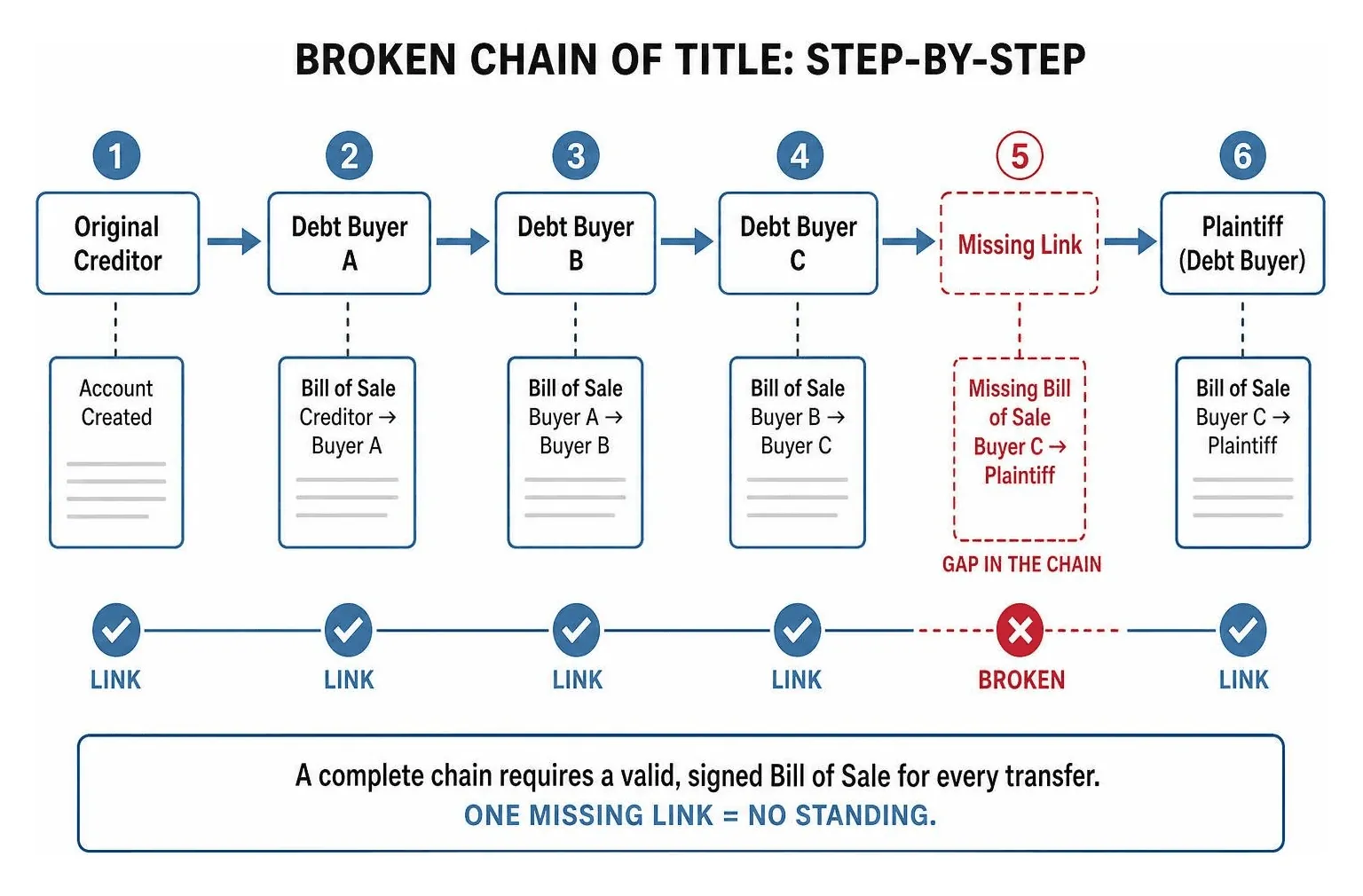
When you point out that the generic Bill of Sale does not explicitly identify your account number, your name, or the exact balance, you expose a major ownership gap. If they cannot produce the underlying account schedules linking you to that bulk purchase, they have a lack standing debt suit and no legal right to collect a single dollar from you.
The ownership trail is often further complicated by securitization. Just like mortgages, credit card debts are frequently bundled together and sold into complex financial trusts.
When a debt is securitized, the original creditor transfers ownership to a depositor, who transfers it to a securitization trust. If the debt buyer later purchases this account, they must trace the ownership back through these complex trusts. Many times, the paperwork documenting these internal transfers was never executed correctly, creating additional ownership defects that can be exploited during discovery to defeat the lawsuit.

To make up for their lack of actual documentation, debt buyers routinely rely on robo-signed affidavits. These are written statements signed by debt buyer employees who claim to have personally reviewed the records and can verify that you owe the debt.
In reality, these "affiants" sign hundreds of these documents a day, spending only seconds on each file. They have never actually reviewed your original contract, they have no personal knowledge of how your account was serviced, and they are simply looking at a computer screen showing data purchased in a bulk spreadsheet.
Under the rules of evidence, these affidavits are inadmissible hearsay. You can learn how to counter this tactic in our guide on the key to strong answer in a collection lawsuit solid counter affidavit.
To defeat a robo-signed affidavit, you must object to its admissibility. A valid affidavit must be based on the personal knowledge of the person signing it.
During discovery, you can challenge the affiant's credibility by demanding to know:
In Michigan, state law (MCL 600.2145) provides specific rules regarding affidavits of account stated, which require a consumer to file a timely counter-affidavit to prevent the collector's affidavit from being treated as prima facie evidence. In Florida, strict rules governing the business records exception require the plaintiff to show that the witness is thoroughly familiar with the record-keeping systems used to generate the documents. Filing a solid response is critical; read our step-by-step instructions on filing a counter affidavit when answering a debt collection lawsuit.
When a debt buyer sues you, you do not just have to play defense. You can often go on the offensive by filing counterclaims under the Fair Debt Collection Practices Act (FDCPA). If a debt buyer violates the FDCPA, they can be held liable for statutory damages of up to $1,000, plus your actual damages and your attorney's fees.
One of the most common FDCPA violations is attempting to collect on time-barred debt—also known as "zombie debt."
Every state has a strict statute of limitations that limits how long a creditor has to file a lawsuit to collect a debt.
Once this time limit expires, the debt is legally unenforceable. While a collector may still be allowed to ask you to pay in some jurisdictions, filing a lawsuit on a time-barred debt is a direct violation of federal law. Understand your state's limits by checking our expired debt statute defense guide, along with our localized resources: the statute of limitations florida guide 2026 and the statute of limitations michigan.
The "zombie debt trap" occurs when a debt buyer purchases ancient, expired accounts for less than a penny on the dollar and tries to trick you into reviving them. In many states, making even a tiny partial payment or signing a written promise to pay will restart the statute of limitations clock, giving the debt buyer the legal right to sue you all over again.
In the landmark case PIERRE v. MIDLAND CREDIT MANAGEMENT INC (2022) | FindLaw (opens in a new tab), federal courts analyzed the deceptive nature of collection letters targeting out-of-statute debts. Additionally, the U.S. Supreme Court's ruling in Henson v. Santander Consumer USA Inc. | 582 U.S. ___ (2017) | Justia U.S. Supreme Court Center (opens in a new tab) clarified who qualifies as a "debt collector" under the FDCPA, leaving open the "principal purpose" definition which still allows consumers to sue debt buyers whose primary business is collecting defaulted debts.
Many debt buyers don't collect debts themselves. Instead, they use complex networks of "master servicers" and downstream collection agencies. These downstream agencies often use aggressive, illegal tactics—such as threatening immediate lawsuits or credit destruction when they have no legal authority to do so.
Under federal precedents like Consumer Fin. Prot. Bureau v. Manseth (Consumer Fin. Prot. Bureau v. Manseth, 22-CV-29-LJV (W.D. N.Y. Aug 22, 2023)) - vLex United States (opens in a new tab), debt buyers can be held vicariously liable for the illegal actions of the third-party collectors they hire if they retain control over the accounts, ignore compliance warnings, or fail to monitor their collection partners.
Getting sued by a debt buyer is stressful, but it is also a massive opportunity. Because they rely entirely on default judgments and have systemic documentation gaps, simply standing up and fighting back places you in the top 10% of defendants.
At KillDebt, we believe you shouldn't have to spend thousands of dollars on an attorney to exploit these obvious debt buyer lawsuit weaknesses. Our DIY legal defense system is powered by ParkerGPT, an AI trained specifically on consumer debt law and real-world court strategies developed over 30+ years by defense attorney Brian Parker.
We analyze your actual lawsuit documents, identify their specific evidentiary gaps, and generate court-ready responses tailored to your jurisdiction in Florida or Michigan.
And if you want to test your defense before you ever step foot in front of a judge, our brand-new Court Tester provides an AI-powered courtroom simulation based on your actual case. You can upload your real filings and practice arguing your motion in front of an AI judge, against AI opposing counsel, while a private AI co-counsel whispers real-time strategy directly to you.
Do not let junk debt buyers bully you into a default judgment. Explore our affordable pricing plans and take control of your financial future today.
IMPORTANT LEGAL DISCLAIMER
This educational content is based on general legal principles and my experience in debt collection defense. It is provided for informational purposes only and does not constitute legal advice. Laws vary by state and by local court. For specific legal advice, consult a qualified attorney licensed in your jurisdiction. No attorney-client relationship is created by reading this guide.
Critical Multi-State Variations: FDCPA applies uniformly at the federal level, but state consumer protection laws may provide additional rights and remedies. Statute of limitations periods vary significantly by state and debt type. What constitutes sufficient debt validation varies in practice across jurisdictions. State-specific rules on call frequency, written notice requirements, and permissible collector conduct may differ from federal minimums.

About the author
Brian Parker
I have over 30 years of experience defending consumers against debt collection lawsuits and have seen every tactic, threat, and pressure play that collectors use. Through KillDebt and ParkerGPT, I have systematized the proven defense strategies that actually work - so consumers can respond from a position of knowledge, not fear. My approach focuses on aggressive legal defense based on documented case success rather than false hope that leads to default judgments.