
News Break
How to Respond to a Debt Collection Lawsuit Properly
July 23, 2026
Blog / News Break
File a superior court debt motion to vacate default judgment. Learn steps, deadlines, exemptions & defenses to fight debt collectors now.
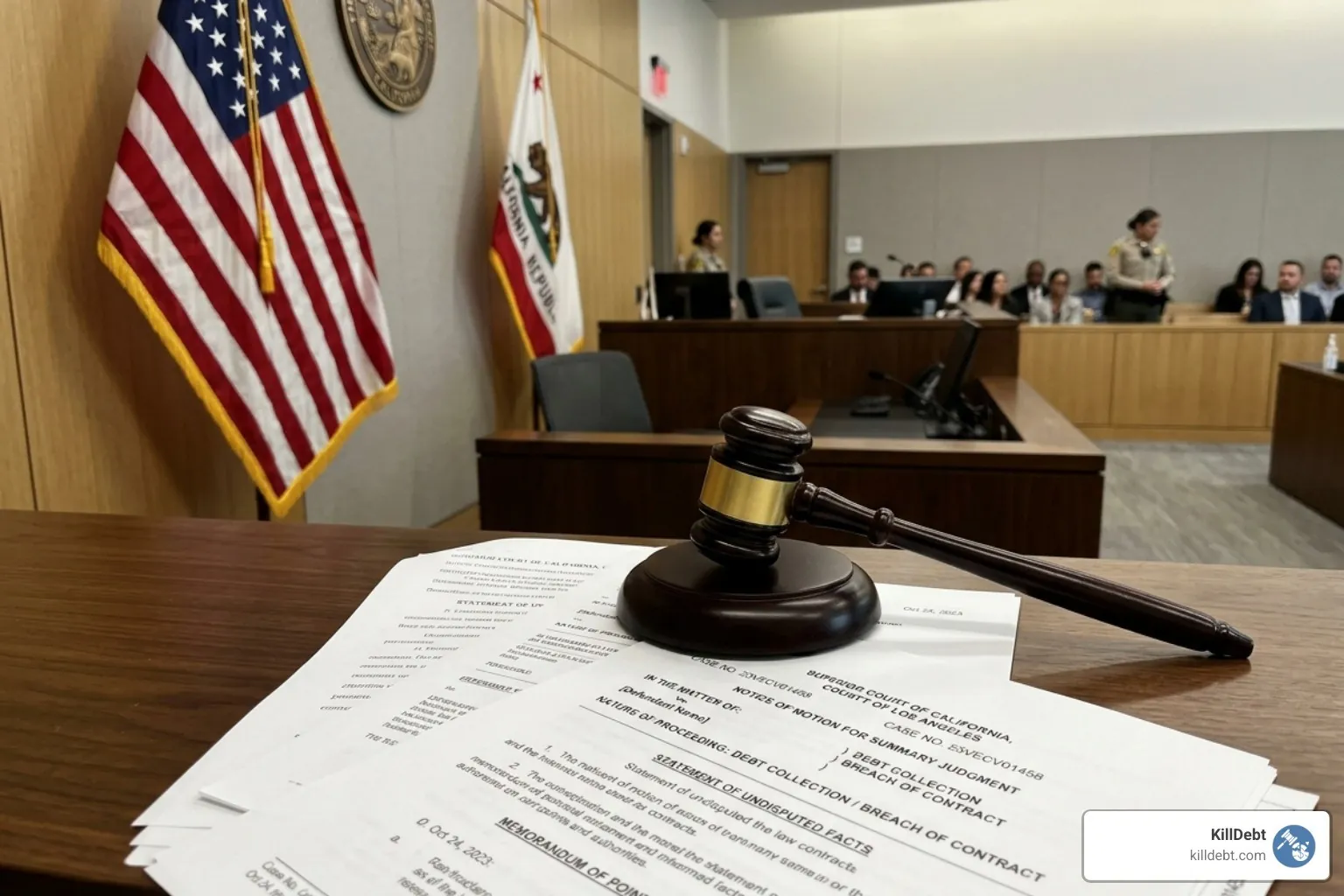
A superior court debt motion is a formal legal request filed in superior court to challenge, modify, or respond to a debt-related judgment or court order — and knowing how to use one could be the difference between losing your paycheck and keeping it.
Here's a quick look at the most common superior court debt motions and when to use them:
| Motion Type | When to Use It | Key Deadline |
|---|---|---|
| Motion to Vacate Default Judgment | You missed a court date or were never properly served | Varies by state (30 days in MD; no time limit in CA for void judgments) |
| Motion to Dismiss | The debt is past the statute of limitations or complaint is defective | Within the answer period |
| Motion to Set Aside | Judgment was entered due to improper service or fraud | State-specific |
| Motion for Payment Plan | You owe the debt but can't pay in full | After judgment is entered |
| Claim of Exemption | Creditor is garnishing protected income (e.g., Social Security) | As soon as garnishment begins |
Getting sued for a debt is stressful. Most people never see it coming — or worse, they never even receive the court papers. Then one day, their bank account is frozen or their paycheck is short by 25%.
This happens more than you might think. The vast majority of debt collection lawsuits end in default judgments — often because defendants didn't respond in time, or because they were never properly served in the first place. High rates of default are partly tied to inadequate and even fraudulent service practices, a problem that disproportionately affects communities of color.
The system can feel designed to make you give up. But it isn't hopeless.
Whether you just received a summons, discovered an old judgment against you, or are already facing wage garnishment, there are legal tools available to fight back — without necessarily hiring an expensive attorney.
This guide walks you through everything: what these motions are, how to file them, what deadlines apply in your state, and how to protect your income and assets along the way.
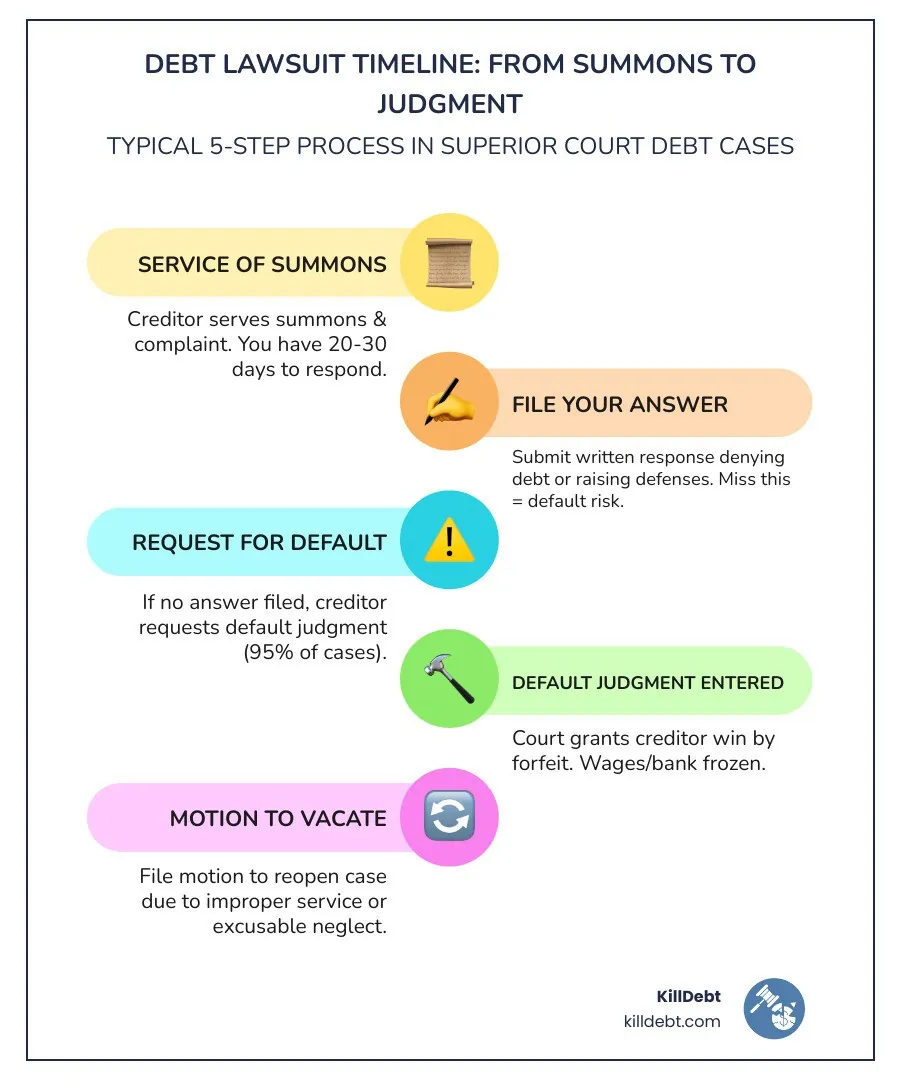

A default judgment is essentially a "win by forfeit" for the debt collector. It occurs when a creditor files a lawsuit and the defendant fails to respond within the legally mandated timeframe. In debt collection, this is the industry standard. Statistically, about 95% of people sued by debt collectors do not file an Answer. Because no defense is mounted, the court simply grants the creditor everything they asked for.
This high rate of default isn't always because the debtor is "guilty" or ignoring the problem. Often, it's due to Difference Between Summons & Complaint in Debt Collection Lawsuit confusion or, more nefariously, "sewer service." This is a practice where a process server claims to have delivered the court papers but actually throws them in the trash (the "sewer"). Without notice of the suit, the consumer has no chance to defend themselves until their wages are already being garnished.
The process usually follows a specific sequence. First, you are served with a Summons and Complaint. You typically have a 20-to-30-day window (depending on your state and court level) to file a written Answer. If that window closes without a response, the plaintiff (the creditor) will file a request for a "clerk's entry of default."
This is a formal note in the court record that you haven't shown up. Following this, the creditor moves for a "default judgment," which is a court order signed by a judge. Once that order is signed, it is legally enforceable, meaning the creditor can start taking your money.
Improper service is more than just a technicality; it is a violation of your Constitutional right to due process. If you were never served, the court never actually gained "personal jurisdiction" over you. This makes the resulting judgment "void."
In many jurisdictions, a void judgment is a legal nullity—it’s as if it never happened. However, you still have to file a superior court debt motion to tell the judge that the service was fraudulent or inadequate. If you find yourself in this position, follow a What to Do When Sued by a Debt Collector: Complete First Steps Guide to ensure you don't miss the window to reclaim your rights.
If a judgment has already been entered against you, your primary tool for fighting back is a Motion to Vacate (sometimes called a Motion to Set Aside). This motion asks the judge to "undo" the judgment and let the case proceed to a fair trial.
To succeed, you generally need to prove two things:
Knowing the Time to Respond: Debt Collection Lawsuit limits is critical here, as waiting too long can sometimes bar you from relief.
Filing a motion in Superior Court is more formal than Small Claims. You will generally need:
For those in Michigan, you can find specific guidance on How to File a Motion and Affidavit to Set Aside a Default or Default (opens in a new tab) to ensure your paperwork meets local standards.
A major development in consumer law occurred with cases like California Capital Insurance Company v. Hoehn. This ruling emphasized that if a judgment is "void" on its face—meaning there was a fundamental legal error like lack of service—the usual time limits for vacating a judgment might not apply.
Under statutes like California's CCP § 473(d), a court can set aside a void judgment at any time. This is a massive win for consumers who discover "zombie" judgments from ten years ago that they never knew existed. It removes the judicially created hurdles that previously forced people into expensive, independent lawsuits just to clear a fraudulent record.
Deadlines are the "landmines" of the legal world. If you step on one, your case is likely over. Here is how the landscape looks in our primary service areas:
| State | Deadline to File Motion to Vacate | Common Defense |
|---|---|---|
| Michigan | Generally 21 days after default, but longer for improper service | Improper service or "good cause" |
| Florida | Usually 1 year for "excusable neglect," but "void" judgments (no service) can be challenged later | Statute of limitations or lack of standing |
In Michigan, for example, if you want to set aside a default, you must show "good cause" and file an affidavit of facts showing a meritorious defense. In Florida, the rules are strict regarding the one-year window for most mistakes, but they remain flexible if you can prove you were never served at all.
If a superior court debt motion is not filed or is denied, the creditor moves into the "enforcement" phase. This is where the "legal" debt becomes "real-world" pain. In states like California, unpaid judgments gather interest at a staggering 10% per year. A $10,000 debt can nearly double in a decade just from interest alone.
Creditors have a toolbox full of ways to get paid:
To understand how creditors find your money, you can look into Identifying the Judgment Debtor's Property (Supplemental Proceedings) (opens in a new tab), which details the invasive questions they are allowed to ask.
Even if you have a judgment against you, you have rights. Not all money is "collectible."
If a creditor freezes an account containing exempt funds, you must file a "Claim of Exemption" immediately. The court will then hold a hearing to decide if the money should be returned to you.
Just because there is a judgment doesn't mean you can't negotiate. In fact, many creditors are more willing to settle once they realize that garnishing you will take 20 years.
You can file a motion for an "installment payment plan." If granted, the court orders you to pay a specific amount monthly (e.g., $50), and as long as you pay, the creditor is usually barred from garnishing your wages. This provides predictability and protects your primary income. Following the Debt Collection Lawsuit Timeline: What Happens Next After You're Served can help you identify the best moments to pivot toward settlement.
Navigating a superior court debt motion can feel like trying to solve a Rubik's Cube in the dark. The rules are dense, the deadlines are unforgiving, and the stakes involve your financial livelihood. But you don't have to do it alone.
At KillDebt, we provide a DIY legal defense system powered by ParkerGPT. This isn't just a chatbot; it’s an AI trained on over 30 years of real-world court strategies developed by attorney Brian Parker. We help you analyze lawsuit documents, identify the collector's weaknesses, and generate court-ready motions at a fraction of what an attorney would charge.
We’ve even introduced the Court Tester—an AI courtroom simulation. You can upload your actual filings and "practice" arguing your motion in front of an AI judge. You’ll face AI opposing counsel and have a private AI co-counsel whispering strategy tips that only you can see. It’s the ultimate way to build confidence before you ever step foot in a real Superior Court.
Don't let a default judgment define your financial future. Whether you're in Florida or Michigan, the tools to fight back are at your fingertips.

About the author
Brian Parker
I have over 30 years of experience defending consumers against debt collection lawsuits and have seen every tactic, threat, and pressure play that collectors use. Through KillDebt and ParkerGPT, I have systematized the proven defense strategies that actually work - so consumers can respond from a position of knowledge, not fear. My approach focuses on aggressive legal defense based on documented case success rather than false hope that leads to default judgments.