
News Break
No Lawyer? No Problem: Top Resources for Self-Represented Litigants
June 25, 2026
Blog / News Break
Learn how to beat a lack standing debt suit by challenging debt buyer proof and winning dismissal in court.
If you've been handed a summons in a lack standing debt suit, the most important thing to know right now is this: the company suing you may not legally have the right to collect that debt at all.
Here's a quick answer if you're in a hurry:
Warning: If you ignore the lawsuit entirely, the court will likely enter a default judgment against you — allowing wage garnishment, bank account freezes, and asset seizure. Respond on time, no matter what.
Debt collection lawsuits are now routine. Millions of Americans are sued every year, often by companies they've never heard of — debt buyers who purchased old accounts in bulk for pennies on the dollar. These buyers frequently lack the documentation needed to prove they actually own your specific debt. That documentation gap is called a lack of standing, and it can be your most powerful defense in court.
Standing has nothing to do with whether you owe the money. It's about whether this particular plaintiff has the legal right to sue you for it. That's a very different question — and one that trips up debt buyers constantly.
I'm Brian Parker, founder of KillDebt, and over the past 30+ years fighting debt buyers and collection law firms in courtrooms across the country, I've used the lack standing debt suit defense to stop collectors in their tracks more times than I can count. In this guide, I'll walk you through exactly how it works and how you can use it too.
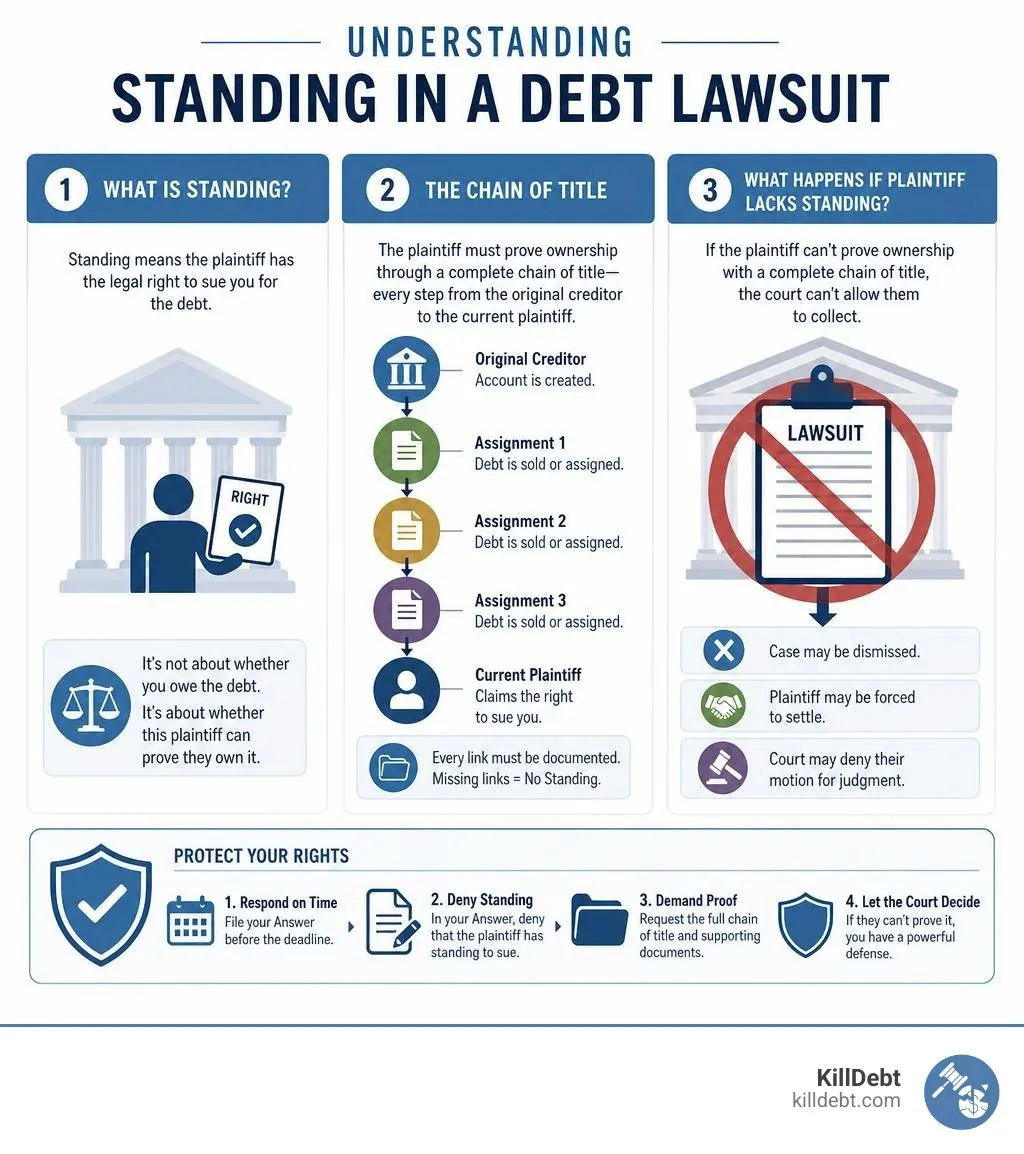

When you are sued, the court doesn’t just assume the person or company suing you has the right to do so. In the legal world, a plaintiff must have what is called "standing" to bring a lawsuit. If they do not, the court lacks jurisdiction to hear the case, and the lawsuit must be dismissed.
In a debt collection lawsuit, establishing standing requires the plaintiff to prove they are the "real party in interest." This means they must prove they own the debt and have a legal right to collect it from you. When you are sued by the original creditor (like Chase, Citibank, or Capital One), standing is rarely an issue because they are the party that directly lent you the money.
However, when a third-party debt buyer sues you, the dynamic changes completely. To understand the massive difference between these two types of plaintiffs, take a look at our guide on Who is Suing Me: Original Creditor vs. Debt Buyer Explained.
At its core, standing is a constitutional requirement. Under Article III of the U.S. Constitution, federal courts can only hear actual "cases" or "controversies." To satisfy constitutional standing, a plaintiff must show they suffered an "injury-in-fact" that is concrete, particularized, and traceable to the defendant's actions.
This strict constitutional requirement was highlighted in the June 2026 decision in Eleventh Circuit Dismisses FDCPA Suit by Consumer Attorney Over Lack of Article III Standing, which reinforced that technical or derivative injuries are not enough to establish standing in federal court.
While state courts have their own procedural rules, the fundamental concept remains the same: a plaintiff cannot sue you for money unless they can prove they are the ones who were personally harmed by your non-payment. If a debt buyer cannot prove they legally acquired your specific debt, they have suffered no legal injury, and they have no standing.
One of the biggest hurdles consumers face is a psychological one. They think, "Well, I did have a credit card with that bank, and I didn't pay it, so I must lose this lawsuit."
This is one of the most common Debt Collection Lawsuit Myths: 7 Things That Won't Save You.
Standing is a procedural defense, not a substantive one. It does not look at whether you owe money to someone; it looks strictly at whether the plaintiff has the legal right to collect it. If a random person on the street sued you for your mortgage, the court would throw the case out because that person has no standing. The same rule applies to junk debt buyers. If they cannot prove they own the contract, they cannot collect a dime from you.

Debt buyers like Midland Funding, Portfolio Recovery Associates, LVNV Funding, and Cavalry SPV do not lend money. Instead, they buy charged-off debts in bulk. They might pay as little as 4 cents on the dollar for a portfolio containing thousands of old accounts.
Because these accounts are bought in bulk, the transactions are incredibly messy. The debt buyer receives a massive spreadsheet with basic consumer data, but they rarely receive the actual contracts, statements, or complete paper trails for individual accounts. To see how these collectors operate, read our detailed breakdown of the Chain of Assignment: Debt Collector.
To establish standing, a debt buyer must prove a seamless "chain of title" from the original creditor down to themselves. If the debt was sold from Bank A to Debt Buyer B, and then to Debt Buyer C, the plaintiff (Debt Buyer C) must produce authenticated bills of sale and assignment agreements for every single transfer.
These transfers are governed by "forward flow agreements" and bulk bills of sale. However, these documents are almost always generic. They will say something like, "Bank A hereby sells the accounts listed in Exhibit A to Debt Buyer B."
But guess what? They almost never attach "Exhibit A" to the lawsuit because it contains the private information of thousands of other consumers. Without that specific list proving your account was included in the sale, they cannot prove ownership. This is a classic evidentiary gap. To learn how to leverage these missing documents, read our guide on How to Argue Lack of Evidence in a Lawsuit.
When you receive a summons and complaint, look closely at the attachments. A plaintiff who lacks standing will usually betray themselves through the following red flags:
If you spot these issues, you should immediately send a dispute. You can use our Debt Validation Letters: Your First Line of Defense Against Collectors or download a ready-to-use Debt Validation Letter Template to demand proof before the case goes any further.
If the debt collector has already filed a lawsuit, you cannot rely on a simple letter. You must actively defend yourself in court. Here is the step-by-step process to challenge their standing, which we cover in-depth in our Debt Lawsuit Defense Guide.
Your first opportunity to challenge standing is in your written Answer to the summons. You must file this within your state's deadline. If you do not raise the defense of standing in your Answer or a pre-answer motion to dismiss, you may waive it entirely.
This waiver rule is a critical legal standard. For example, in the landmark case US Bank N.A. v Nelson (2019 NY Slip Op 00494) , the court affirmed that standing is an affirmative defense that is waived if not explicitly raised in the defendant's answer or a timely motion to dismiss. Do not rely on a general denial; write out "Lack of Standing" as a specific affirmative defense.
Once you have filed your Answer and prevented a default judgment, the case enters the "discovery" phase. This is where you can force the plaintiff to show their cards. You should issue formal discovery requests, including:
For a complete walkthrough on managing this phase, check out our Fight Debt Collection Lawsuit: Complete Guide.
To bypass their lack of physical documentation, debt buyers often submit "affidavits of debt" signed by their own employees. They try to introduce these under the "business records exception" to the hearsay rule.
You must object to these affidavits. An employee of a debt buyer cannot legally testify about how Bank A kept its records, how Bank A calculated interest, or whether Bank A properly mailed statements. They have no personal knowledge of Bank A's business practices.
This evidentiary boundary was emphasized in Kraus v Credit Control Servs., Inc. , where the court scrutinized the admissibility of debt collection records and standing. If the affidavit is excluded as hearsay, the plaintiff will have no admissible evidence to prove they own the debt.
Because KillDebt operates in Florida and Michigan, we focus our legal strategies strictly on the procedural rules of these two states. Both states have unique rules regarding standing, documentation, and debt collector licensing.
| State | Answer Deadline | Licensing Required for Debt Buyers? | Key Defense Focus |
|---|---|---|---|
| Florida | 20 Calendar Days | Yes (Must be registered as a Consumer Collection Agency) | Chain of title under the FCCPA; strict proof of assignment |
| Michigan | 21 Days (in person/mail) / 28 Days (electronic) | Yes (Must be licensed as a Collection Agency) | Verification of account history; compliance with MCR 2.113(C) |
In Florida, the procedural clock ticks fast. Once served, you have exactly 20 calendar days to file your written Answer. If you miss this, the collector can file for a default. Florida courts are particularly strict about documentation. Under Florida law, if a plaintiff sues on a written instrument, they must attach the contract or the assignment to the complaint.
Furthermore, under the Florida Consumer Collection Practices Act (FCCPA), third-party debt buyers must be registered. You can read more about navigating these local rules in Debt Collection Lawsuits: How to Fight Back and Win in Florida and Debt Defense – Florida Procedure - Consumer Attorneys .
Additionally, Florida courts have been active in dismissing claims where plaintiffs cannot show a direct, concrete injury, as seen in Florida State Court Dismisses Letter Vendor Claim for Lack of ... .
In Michigan, you have 21 days to respond if you were served personally, or 28 days if you were served by mail or electronically. Michigan Court Rule (MCR) 2.113(C) requires that if a claim is based on a written instrument, a copy must be attached to the pleading.
Michigan courts have increasingly focused on improving access to justice and ensuring debt buyers actually prove their cases rather than relying on rubber-stamped default judgments. You can review the state's efforts in the official report [PDF] Advancing Justice for All in Debt Collection Lawsuits \| Michigan Courts .
For step-by-step DIY defense steps in Michigan, consult Going to Court to Defend a Debt Collection Case \| Michigan Legal ... and How To Defend and Dismissed Debt Collectors Lawsuit in Michigan? .
If you successfully demonstrate that the plaintiff lacks standing, the court has a few ways to resolve the case:
Challenging a debt collector on standing is one of the most effective ways to beat a lawsuit. But going up against collection attorneys can feel intimidating, especially when you are trying to draft formal answers, discovery requests, and motions on your own.
That is why we built KillDebt.
Our AI-powered platform features ParkerGPT, an AI engine trained specifically on consumer debt law and real-world defense strategies developed over 30+ years by myself, attorney Brian Parker. Unlike generic AI chatbots, ParkerGPT analyzes your actual lawsuit papers, spots the exact paperwork gaps in the collector's chain of title, and generates court-ready Answer templates and discovery requests customized for your state's rules.
Even better, we just rolled out our brand-new tool: Court Tester.
Court Tester is an advanced AI courtroom simulation built directly on the facts of your actual case. You simply upload your lawsuit filings, and within minutes, you can practice arguing your lack of standing motion in front of an AI judge, facing off against an AI opposing counsel, while a private AI co-counsel whispers real-time legal strategies that only you can see. It is the ultimate way to build confidence and prepare for your day in court.
You don't have to hire an expensive attorney to defend your rights. To see our affordable subscription options and start fighting back today, visit our KillDebt Pricing page.
IMPORTANT LEGAL DISCLAIMER
This educational content is based on general legal principles and my experience in debt collection defense. It is provided for informational purposes only and does not constitute legal advice. Laws vary by state and by local court. For specific legal advice, consult a qualified attorney licensed in your jurisdiction. No attorney-client relationship is created by reading this guide.
Critical Multi-State Variations: FDCPA applies uniformly at the federal level, but state consumer protection laws may provide additional rights and remedies. Statute of limitations periods vary significantly by state and debt type. What constitutes sufficient debt validation varies in practice across jurisdictions. State-specific rules on call frequency, written notice requirements, and permissible collector conduct may differ from federal minimums.

About the author
Brian Parker
I have over 30 years of experience defending consumers against debt collection lawsuits and have seen every tactic, threat, and pressure play that collectors use. Through KillDebt and ParkerGPT, I have systematized the proven defense strategies that actually work - so consumers can respond from a position of knowledge, not fear. My approach focuses on aggressive legal defense based on documented case success rather than false hope that leads to default judgments.