News Break
How to Fight Debt Collectors Without Losing Your Mind
August 3, 2026
Blog / News Break
Learn where court file answer to a debt summons: deadlines, courthouses, e-filing, fees & state rules to avoid default judgment.
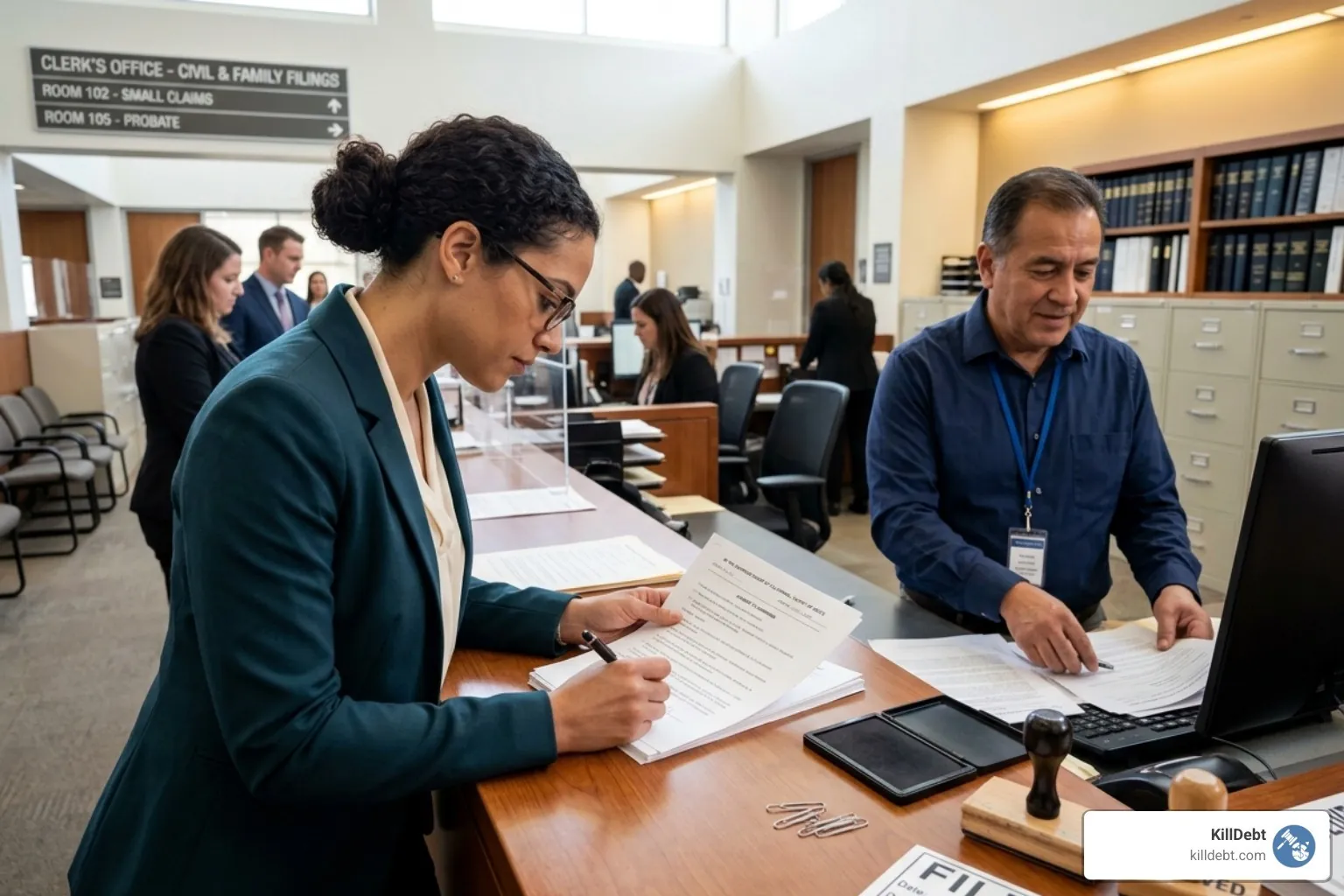
If you've just received a summons and are frantically searching for where to court file your answer, here's the short version:
Quick Answer: Where to File Your Court Answer
| Situation | Where to File |
|---|---|
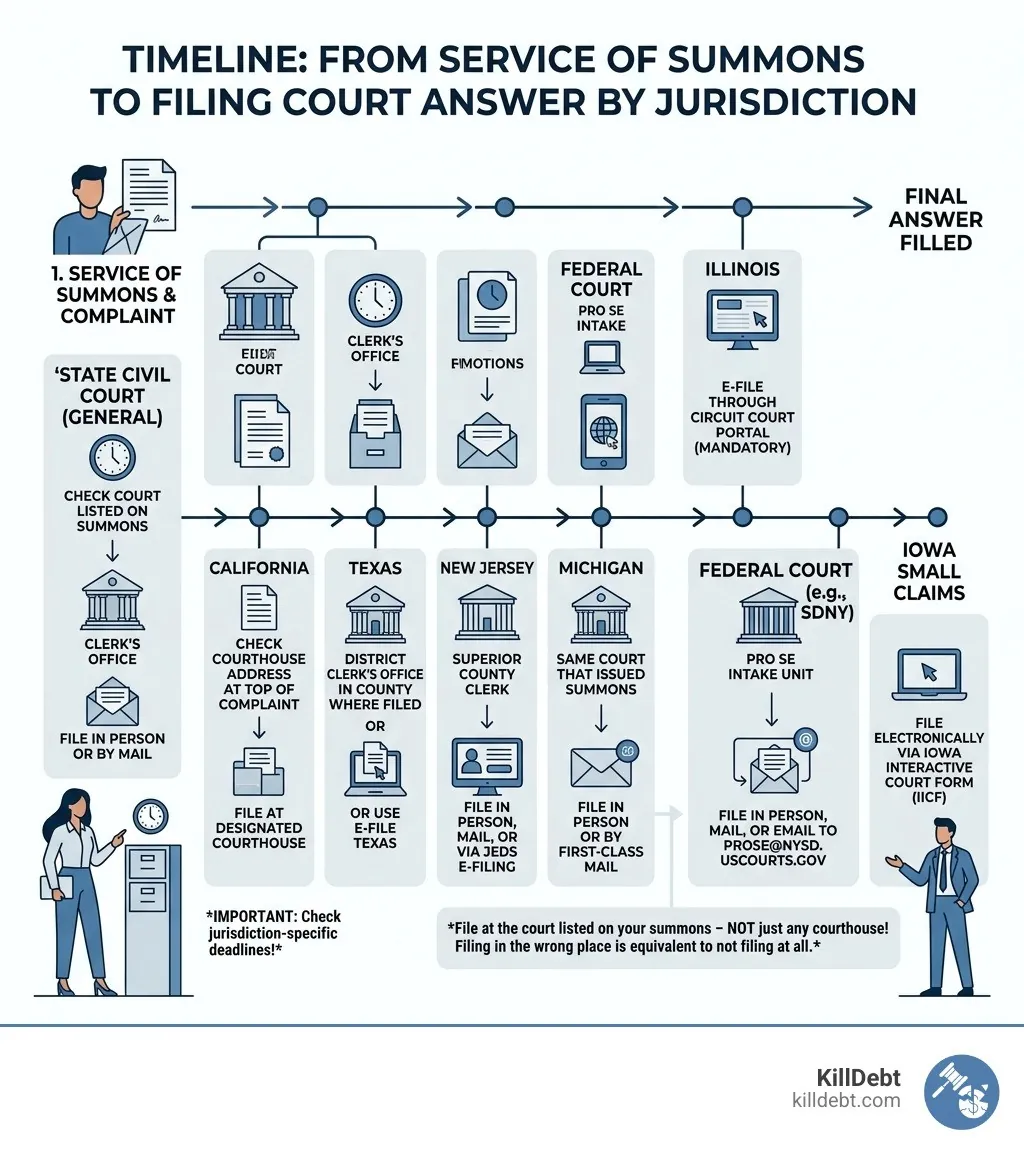
| State civil court (most cases) | Clerk's office of the court listed on your summons |
| California | Courthouse address printed at the top of the Complaint |
| Texas | District clerk's office in the county where the case was filed, or via E-File Texas |
| New Jersey | Superior Court county clerk — in person, by mail, or via JEDS e-filing |
| Michigan | Same court that issued the summons — in person or by first-class mail |
| Illinois | E-file through the circuit court's portal (mandatory since 2018) |
| Federal court (e.g. SDNY) | Pro Se Intake Unit — in person, mail, or email to ProSe@nysd.uscourts.gov |
| Iowa small claims | Electronically via the Iowa Interactive Court Form (IICF) |
The single most important rule: File at the court listed on your summons — not just any courthouse. Filing in the wrong place is the same as not filing at all.
Getting a debt lawsuit dropped on your doorstep is stressful. The clock starts ticking the moment you're served, and missing the deadline — even by one day — can mean a default judgment against you. That judgment can give a debt collector the power to garnish your bank account, put a lien on your property, or freeze your wages. The good news? Filing an Answer is one of the most powerful moves you can make. It forces the plaintiff to actually prove their case in court instead of winning automatically.
I'm Brian Parker, and for over 30 years I've fought debt collectors and collection law firms in courtrooms across the country — I know exactly where to court file an answer and how to do it right. In this guide, I'll walk you through the exact filing locations, deadlines, and logistics you need — state by state — so you can defend yourself with confidence.

An "Answer" is your formal written response to the allegations made in a lawsuit. When a debt collector sues you, they file a "Complaint" or "Petition" full of numbered paragraphs. Your job is to go through those paragraphs and respond to each one. This isn't just a letter to the judge; it is a legal document that sets the stage for your entire defense.
Filing an Answer is critical because it prevents a "default judgment." If you don't respond, the court assumes everything the debt collector says is true. By filing, you're essentially saying, "Not so fast. Prove it." This is also your one and only chance to raise affirmative defenses, such as the statute of limitations or that you never actually owed the debt. If you don't include these in your Answer, you might waive your right to use them later. For a deeper dive into the mechanics of the document itself, check out our debt lawsuit defense guide and learn how to answer a debt summons effectively.
The most common question we hear is, "When is this due?" The answer depends entirely on your jurisdiction and how you were served.
In Michigan, if you were served in person, you generally have 21 days to file. If you were served by mail or live out of state, that window extends to 28 days. In Florida, the clock is even tighter; you typically have only 20 calendar days from the date of service to file your response.
When calculating, remember the "Day 0" rule: do not count the day you were served. Start counting on the following day. If your deadline falls on a Saturday, Sunday, or legal holiday, it usually extends to the next business day. Because missing this window is so dangerous, we’ve put together a specific guide on the time to respond debt collection lawsuit to help you get the math right.
If you miss the deadline, the plaintiff will file for a default judgment. Once a judge signs that order, the debt collector can move into the collection phase, which includes:
If you’ve already missed the deadline, you may need to file a "Motion to Vacate" or "Motion to Set Aside Default," but this is a much harder uphill battle than filing an Answer on time. To avoid this nightmare, read our fight debt collection lawsuit complete guide.
Knowing where court file answer starts with a close look at the paperwork you received. The "Venue" is the specific geographic location where the case is being heard. Usually, this is the county where you live or where the debt was allegedly incurred.
Look at the very top of your Summons and Complaint. You will see a header (the "caption") that lists the State, the County, and the specific Court (e.g., "6th Circuit Court" or "17th District Court").
In Florida, you will likely be filing with the Clerk of the Circuit Court in your specific county. You can find a directory of these locations on the official Florida Courts website. In Michigan, you'll head to the district or circuit court clerk's office listed on the summons.
If you are dealing with a smaller debt, you might be in a "Justice Court" or "Small Claims" division. These often have simplified rules, but the filing location remains the same: the clerk's office at the address provided on your paperwork. For more on these specific courts, see our guide on justice court debt answer.
While most consumer debt cases happen in state court, some end up in Federal Court. If your case is in the Southern District of New York (SDNY), for example, you don't go to the local county building. You must file with the Pro Se Intake Unit.
Federal rules are strict. If you are representing yourself (pro se), you must follow specific How to file an Answer and Notice of Pro Se Appearance procedures. Failure to file in the correct federal building can result in an immediate default.
Before you worry about the "where," you need to ensure the "what" is correct. In Michigan, many defendants use Form MC 03, the standard Civil Answer form.
When filling out your Answer, you have three main options for each allegation:
Don't forget your defenses! If the debt is past the statute of limitations, you must say so now. You may also want to consider filing a counter-affidavit when answering a debt collection lawsuit to challenge the evidence provided by the debt buyer. For inspiration, we have a sample answer to debt collection lawsuit available for review.
In May 2026, e-filing is more common than ever.
E-filing is often the safest bet because you get an immediate electronic receipt proving you met the deadline.
If you aren't e-filing, you have two choices: go to the courthouse or use the mail.
| Method | Pros | Cons |
|---|---|---|
| In-Person | Immediate confirmation; Clerk can check for basic errors. | Requires travel; Court hours are limited (usually 8:30 AM - 4:30 PM). |
| Convenient; No need to leave home. | Risk of delay/loss; Requires "Certified Mail, Return Receipt Requested." |
If you file by mail, never just drop it in a standard blue mailbox. Use USPS Certified Mail with a Return Receipt. This provides you with a "green card" signature that proves the court received your Answer. Many jurisdictions, including Michigan, provide specific Instructions for Answer (Civil) - Michigan Courts that emphasize the number of copies you need (usually the original plus 2 or 3 copies).
One of the biggest surprises for defendants is the cost. In many states, you have to pay a fee just to defend yourself.
Filing with the court is only half the battle. You must also "serve" the plaintiff. In a debt lawsuit, this usually means mailing a copy of your Answer to the law firm representing the debt collector.
You must include a Certificate of Service (or Proof of Service) with the copy you file with the court. This is a signed statement telling the judge, "I swear I sent a copy to the other side." If you need a template for the cover letter, see our debt summons response letter sample.
Fees can vary wildly:
If you cannot afford the fee, ask the clerk for a "Fee Waiver" or "In Forma Pauperis" application. Do not let a filing fee stop you from defending your rights.
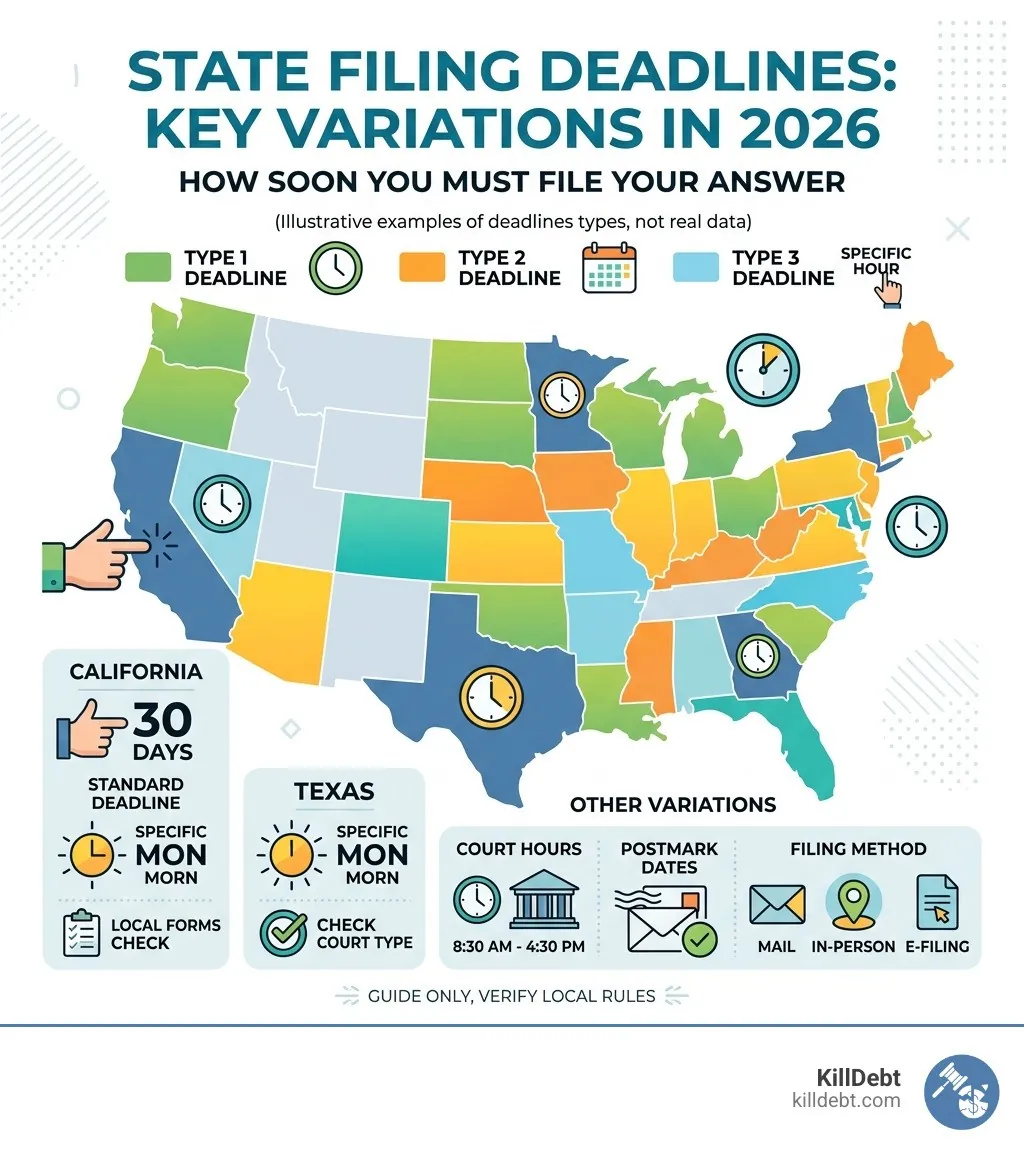
Every state has its own quirks. In Texas, for example, the deadline in District Court is 10:00 AM on the Monday following the expiration of 20 days from the date of service. If you miss that Monday morning window, you are in the "danger zone" for a default.
In California, the 30-day window is strict. You must also check for "Local Forms." Some counties require specific cover sheets that aren't used anywhere else in the state. Always check the court's website or ask the clerk if there are "local rules" you need to follow. Helpful resources like Completing an Answer to a Petition/Complaint can provide additional clarity on these state-level forms.
Small claims cases (often for debts under $5,000 or $10,000 depending on the state) are designed to be simpler. In Iowa, for example, small claims are for $6,500 or less. In these courts, you might not even need a formal Answer document; sometimes, a simple "Appearance" form is enough. However, the requirement to file where court file answer remains the same—it must go to the clerk's office of the court listed on your summons.
Filing an Answer is the single most important step in stopping a debt collector in their tracks. It moves the case from an "automatic win" for the collector to a "legal battle" where you have a fighting chance.
At KillDebt, we believe you shouldn't have to spend thousands on an attorney just to have your day in court. Our DIY legal defense system is powered by ParkerGPT, an AI trained on the real-world strategies I've used over my 30-year career.
We don't just give you a template; we analyze your specific lawsuit documents to find the weaknesses the debt collectors are hiding. And with our brand new Court Tester, you can practice your defense in an AI courtroom simulation before you ever step foot in front of a judge. You'll argue your motion against an AI opposing counsel while a private AI co-counsel whispers strategy only you can see.
Don't let a debt collector win by default. Use our fight debt collection lawsuit complete guide and let ParkerGPT help you file a professional, court-ready Answer today.
Get started with KillDebt pricing
Important Legal Disclaimer
This educational content is based on general legal principles and my experience in debt collection defense. It is provided for informational purposes only and does not constitute legal advice. Laws vary by state and by local court. For specific legal advice, consult a qualified attorney licensed in your jurisdiction. No attorney-client relationship is created by reading this guide.
Critical Multi-State Variations: FDCPA applies uniformly at the federal level, but state consumer protection laws may provide additional rights and remedies. Statute of limitations periods vary significantly by state and debt type. What constitutes sufficient debt validation varies in practice across jurisdictions. State-specific rules on call frequency, written notice requirements, and permissible collector conduct may differ from federal minimums.

About the author
Brian Parker
I have over 30 years of experience defending consumers against debt collection lawsuits and have seen every tactic, threat, and pressure play that collectors use. Through KillDebt and ParkerGPT, I have systematized the proven defense strategies that actually work - so consumers can respond from a position of knowledge, not fear. My approach focuses on aggressive legal defense based on documented case success rather than false hope that leads to default judgments.