
News Break
How to Fight Debt Collection Lawsuit and Keep Your Cash
April 17, 2026
Blog / News Break
Download your free sample answer to debt collection lawsuit. Learn to respond, file defenses & avoid default judgment in 20-30 days.

A sample answer to debt collection lawsuit is a legal document template you file with the court to formally respond to a debt collector's claims against you — and it may be the single most important thing you can do to protect your finances.
Here's what a basic Answer document contains:
Key deadlines by state:
| State | Days to Respond |
|---|---|
| Florida | 20 calendar days |
| Ohio | 28 days |
| California | 30 days |
| Texas | 14 days (Justice Court) |
| Most other states | 20-30 days |
That thick envelope sitting on your table right now? It feels like the end of the road. It isn't.
But here's the hard truth: debt collectors win 70-95% of lawsuits simply because people don't respond. Not because the debt is valid. Not because the collector has a strong case. Just because the defendant went silent.
When you don't file an Answer, the court can issue a default judgment against you automatically. That means wage garnishment of up to 25% of your earnings, frozen bank accounts, and lasting credit damage — even if the debt isn't really yours, the amount is wrong, or the collector doesn't have the right paperwork.
The good news? Filing a response doesn't require a law degree. It requires a clear template, a deadline, and the courage to take one step forward.
This guide walks you through exactly what to write, how to file it, and which defenses could get your case dismissed entirely.
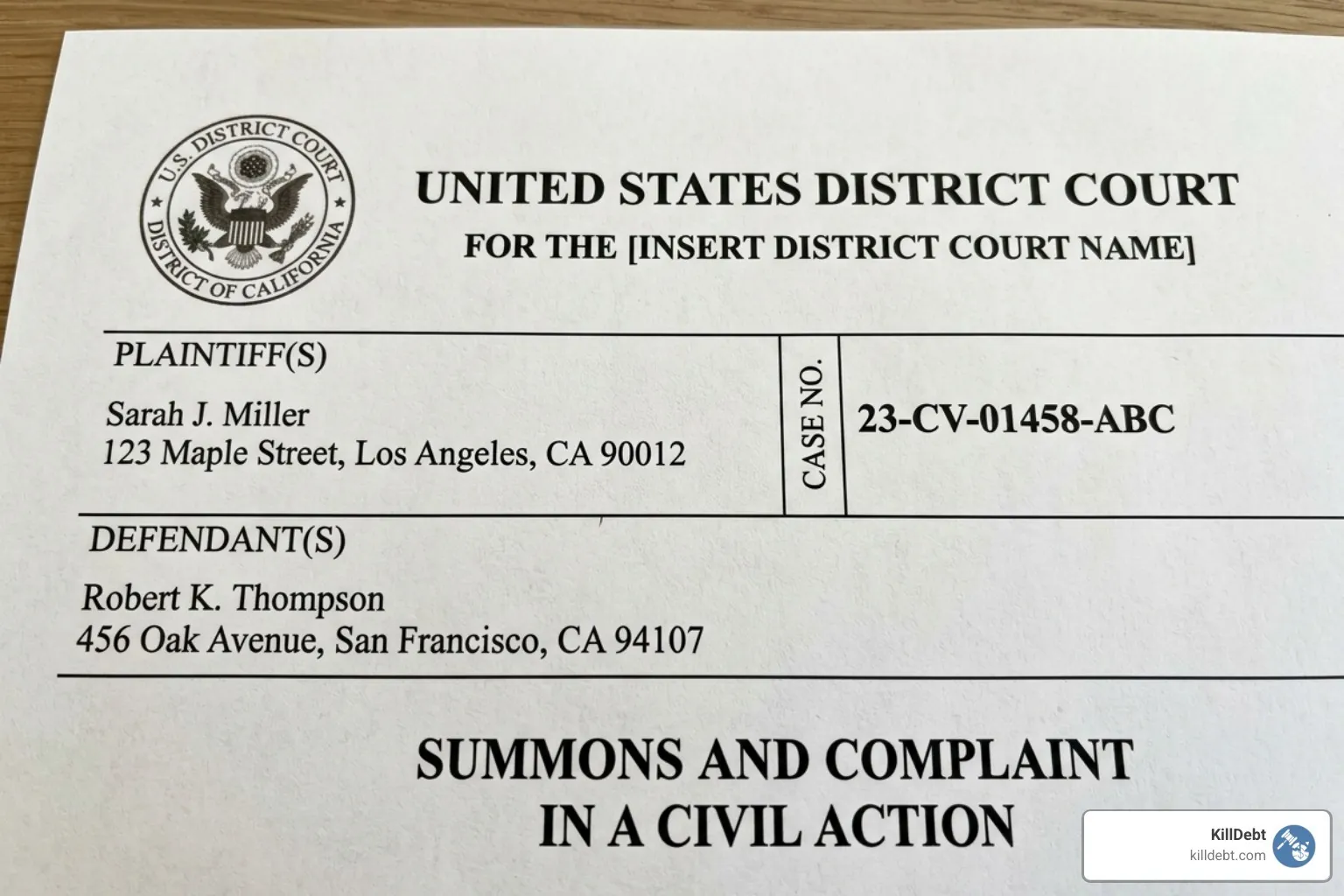
When a debt collector decides to take you to court, they don't just send a polite invitation. They initiate a formal legal action by filing two specific documents: the Summons and the Complaint. It is vital to understand the Difference Between Summons & Complaint in Debt Collection Lawsuit before you attempt to draft your response.
The Summons is the court's official notice to you. It tells you that you are being sued, which court is handling the case, and—most importantly—how many days you have to respond. The Complaint is the list of allegations. It’s where the collector (the Plaintiff) explains why they think you (the Defendant) owe them money.
On these documents, you’ll see a Case Number. This is like the social security number for your lawsuit; you must include it on every document you file. You also need to identify Who Is Suing Me: Original Creditor vs. Debt Buyer Explained. Often, the company suing you isn't the one you originally borrowed money from. They are "debt buyers" who bought your account for pennies on the dollar and may not even have the original contract.
Finally, pay attention to the Service of Process. This is the formal delivery of the lawsuit to you. In Florida, for example, this usually requires personal delivery by a sheriff or a certified process server. If they just dropped it on your porch or mailed it via regular mail, you might have a defense based on "improper service."
If you’ve been asking yourself, "Have You Been Sued by a Debt Collector?" and the answer is yes, you cannot afford to wait. Ignoring the lawsuit is the single biggest mistake you can make.
As mentioned earlier, debt collectors rely on the fact that most people are too intimidated to fight back. When you don't file an Answer, the Plaintiff wins by default. This leads to:
By using a sample answer to debt collection lawsuit, you stop the "automatic win" for the collector. You force them to actually prove their case, which—believe it or not—many debt buyers cannot do.
Drafting your Answer doesn't mean writing a long, emotional story about why you couldn't pay. In fact, the court doesn't want to hear your life story in the Answer; they want to see your legal response to their specific claims.
Your document should follow a standard format. Start with the Caption, which mirrors the header on the Complaint you received. Then, you will address each Numbered Paragraph in the Complaint. For example, if paragraph 1 of the Complaint says you live in Orange County, Florida, your Answer should have a corresponding paragraph 1.
You can find official templates like the [PDF] DEFENDANT'S ANSWER - DEBT CLAIM CASE - El Paso County (opens in a new tab)to see the structure, but remember to adapt it to your specific court's rules in Florida or Michigan.
This is the "meat" of your response. For every numbered allegation in the Complaint, you must choose one of three responses. This is the Key to Strong Answer in a Collection Lawsuit: Solid Counter-Affidavit and a well-structured Answer.
| Response | When to Use It | Legal Effect |
|---|---|---|
| Admit | When the statement is 100% true (e.g., your name or address). | You agree this is a fact; the Plaintiff doesn't have to prove it. |
| Deny | When any part of the statement is incorrect or you disagree with the debt amount. | The Plaintiff is forced to provide evidence to prove this claim. |
| Lack Knowledge | When you don't have enough info to know if it's true (e.g., the chain of debt ownership). | This acts as a denial and forces the Plaintiff to prove the claim. |
Pro Tip: Many legal experts suggest denying as much as possible (within the bounds of truth). If you aren't sure if the interest calculation is correct, don't admit it! Force the collector to show their math.
After you respond to the specific paragraphs, you get to list your "Affirmative Defenses." These are legal reasons why the collector shouldn't win, even if everything else they say is true. Don't fall for Debt Collection Lawsuit Myths: 7 Things That Won't Save You—stick to real legal defenses.
Common defenses include:
Once your Answer is written and signed, you have to get it to the right people. You cannot just mail it to the collector and call it a day. You have to follow the rules for Time to Respond: Debt Collection Lawsuit.
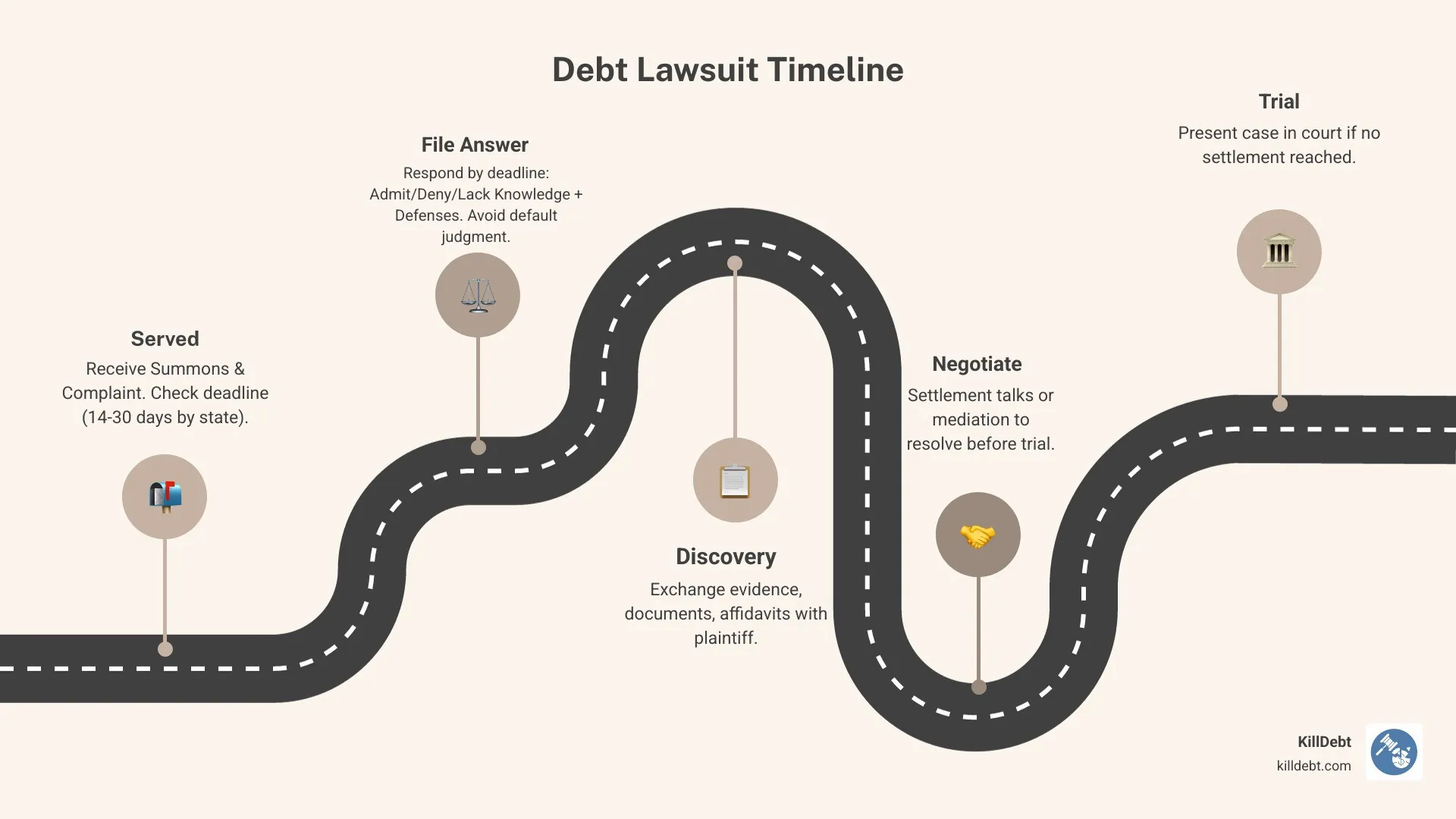
Filing your Answer is a huge victory—it stops the clock on a default judgment. But it's just the beginning of the Debt Collection Lawsuit Timeline: What Happens Next After You're Served.
Here is what generally comes next:
For more details on the immediate aftermath, check out our What to Do When Sued by a Debt Collector: Complete First Steps Guide.
Receiving a lawsuit is stressful, but you don't have to face it alone or unprepared. By using a sample answer to debt collection lawsuit, you are taking the first step toward financial freedom.
At KillDebt, we’ve revolutionized how consumers fight back. Our DIY legal defense system is powered by ParkerGPT, an AI trained specifically on consumer debt law by attorney Brian Parker, who has over 30 years of experience. We don't just give you a generic template; we analyze your actual lawsuit documents to find the specific weaknesses in the collector's case.
Ready to take it a step further? Our Court Tester AI allows you to simulate your hearing before you ever step foot in a courtroom. You can argue your motion against an AI opposing counsel while a private AI co-counsel whispers winning strategies in your ear. Combined with our Case Searcher tool, we provide the ultimate arsenal for your defense.
Don't let a debt collector take your hard-earned wages by default. Protect your rights with KillDebt and start your AI-powered defense today.

About the author
Brian Parker
I have over 30 years of experience defending consumers against debt collection lawsuits and have seen every tactic, threat, and pressure play that collectors use. Through KillDebt and ParkerGPT, I have systematized the proven defense strategies that actually work - so consumers can respond from a position of knowledge, not fear. My approach focuses on aggressive legal defense based on documented case success rather than false hope that leads to default judgments.