
News Break
How to Vacate a Default Judgment in Florida
June 1, 2026
Blog / News Break
Learn how to vacate judgment: step-by-step guide, legal grounds, deadlines & tips to remove default judgments fast.

Knowing how to vacate a judgment could be the most important legal move you make this year — especially if a debt collector just froze your bank account or you found out a court ruled against you without you ever knowing about the lawsuit.
Here's the short answer on how to vacate a judgment:
The key point: Vacating a judgment does not mean the lawsuit goes away. It means the court cancels the default ruling and gives you a chance to actually defend yourself.
A default judgment happens fast — and often without you even knowing a lawsuit was filed. One day you're going about your life. The next, your paycheck is being garnished or your bank account is frozen. That's the real-world impact of a judgment entered while you were absent from the process, whether you were never properly served or simply missed a critical deadline.
The good news? Courts can cancel these judgments. The process is called vacating, and it exists precisely because the legal system recognizes that people sometimes don't get a fair shot the first time.
I'm Brian Parker, founder of KillDebt — and after 30 years in the courtroom fighting creditors, debt buyers, and collection law firms, I've helped thousands of consumers understand exactly how to vacate a judgment and take back control of their financial lives. In this guide, I'll walk you through every step.
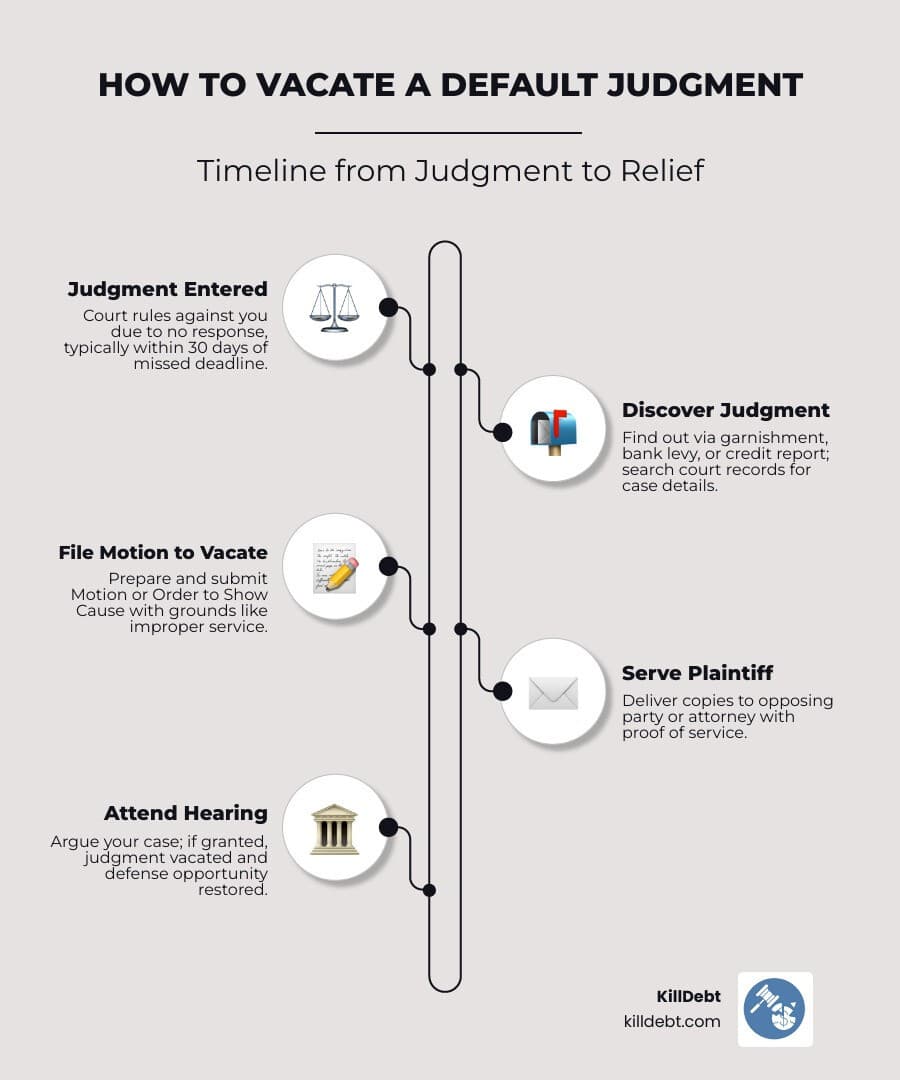

In debt collection, a default judgment is essentially an "automatic win" for the person suing you (the plaintiff). It happens when you, the defendant, fail to respond to a summons and complaint or miss a mandatory court date.
When you don't show up, the judge assumes you have no defense and grants the plaintiff everything they asked for. This isn't just a piece of paper; it gives the creditor powerful legal tools to take your money. They can initiate a wage garnishment, where up to 25% of your take-home pay is diverted to them, or a bank levy, where your accounts are frozen and drained. They can even place a property lien on your home, making it impossible to sell or refinance without paying them first.
According to How to Get a Default Removed: Vacating a Judgment - LegalClarity (opens in a new tab), a default judgment is often the result of a breakdown in communication or a procedural error. Maybe you moved and the papers went to an old house, or maybe you were so overwhelmed by debt that you ignored the envelope. Whatever the reason, the law provides a mechanism to "set aside" or vacate this order if you can show you deserve a second chance.
You can't just ask a judge to vacate a judgment because you don't like the outcome. You need specific legal reasons, known as "grounds." In our experience at KillDebt, the most successful motions focus on technical errors or legitimate life emergencies.
Common grounds include:
As noted in the Criteria for a Motion to Vacate Default and/or Set Aside Default ... (opens in a new tab), courts generally prefer to decide cases on their merits rather than on technicalities, but the burden of proof is on you to show why the "default" should be undone.

This is often the strongest argument for how to vacate a judgment. "Service of process" is the legal requirement that you be handed the lawsuit papers. If you weren't served, the court has no power over you.
We often see "sewer service," where a process server claims they delivered the papers but actually threw them in the trash. To fight this, you must look at the Affidavit of Service in the court file. Does it describe someone who doesn't look like you? Does it claim service at an address where you didn't live in May 2026? If you can prove you weren't there—using travel records, work logs, or a lease agreement—the judgment is considered "void" and must be vacated.
If you were served but still missed the date, you must prove "excusable neglect." This means you made an honest mistake that any reasonable person might make. A medical emergency, a death in the family, or being misled by the plaintiff's attorney (who might have told you "don't worry about court while we negotiate") are common examples.
However, a good excuse isn't enough. You also need a meritorious defense. This is a legal reason why you might win the case if it were reopened. Examples include:
For more on how these defenses work, check out our guide on how remove default judgment debt.
Ready to take action? Here is the workflow we recommend for our users in Florida and Michigan.
Your motion packet should typically include:
You can find templates for these in the Microsoft Word - HOW TO VACATE A DEFAULT JUDGMENT.doc resources, though we recommend using ParkerGPT to customize these documents to your specific Michigan or Florida court rules.
Once your papers are ready, head to the court clerk. After they stamp your documents, you must "serve" the opposing counsel. This usually means sending a copy via certified mail.
In Florida, for instance, you might use the Motion to Set Aside Default or Default Judgment - Florida Courts (opens in a new tab) forms. Once filed, the clerk will either give you a hearing date or tell you how to schedule one.
Timing is everything. If you wait too long, a judge might decide you "slept on your rights."
| State | General Deadline | Exception for Improper Service |
|---|---|---|
| Florida | Usually 1 year for excusable neglect | No time limit if judgment is void |
| Michigan | Usually 21 days after notice of default | Up to 1 year for specific reasons |
| General Rule | 30 days is the "Gold Standard" | Varies by jurisdiction |
In Florida, the How to Set Aside a Florida Judgment | Vacating Judgments (opens in a new tab) rules emphasize that while you have one year for "mistake or inadvertence," you should act immediately upon discovering the judgment. If you wait six months after finding out about a garnishment to file your motion, the judge may deny it simply because of the delay.
The hearing is your moment to shine. The judge will listen to your oral argument and review your evidence. Be prepared to show your "proof"—whether that’s a doctor’s note, a lease showing you lived elsewhere, or receipts showing the debt was paid.
The plaintiff's attorney will likely be there, arguing that you are just trying to delay the inevitable. This is where our Court Tester AI becomes your secret weapon. You can simulate this exact argument before you ever step foot in the courthouse, so you know exactly what to say when the "AI opposing counsel" tries to trip you up.
If the judge signs your order, congratulations! The judgment is canceled. This means:
If the judge says no, don't panic. You have options:
At KillDebt, we believe that the legal system shouldn't be a trap for the uninformed. A default judgment is a setback, but it doesn't have to be a permanent financial scar. By learning how to vacate a judgment, you are exercising your right to be heard.
Our DIY legal defense system, powered by ParkerGPT, was built for this exact moment. Trained by attorney Brian Parker with over 30 years of real-world experience, our AI analyzes your lawsuit documents and generates the specific motions you need to fight back. And with our new Court Tester, you can practice your hearing in a safe, AI-driven simulation until you're ready to win.
Don't let a "default" define your future. Everyone deserves a do-over. Start your defense today at https://killdebt.com/.

About the author
Brian Parker
I have over 30 years of experience defending consumers against debt collection lawsuits and have seen every tactic, threat, and pressure play that collectors use. Through KillDebt and ParkerGPT, I have systematized the proven defense strategies that actually work - so consumers can respond from a position of knowledge, not fear. My approach focuses on aggressive legal defense based on documented case success rather than false hope that leads to default judgments.