
News Break
Florida Debt Deadlines: A Guide to the Statute of Limitations Florida
July 16, 2026
Blog / News Break
Fight LVNV Funding Michigan in court with proven defenses, timelines, and strategies to avoid default judgment and wage garnishment.
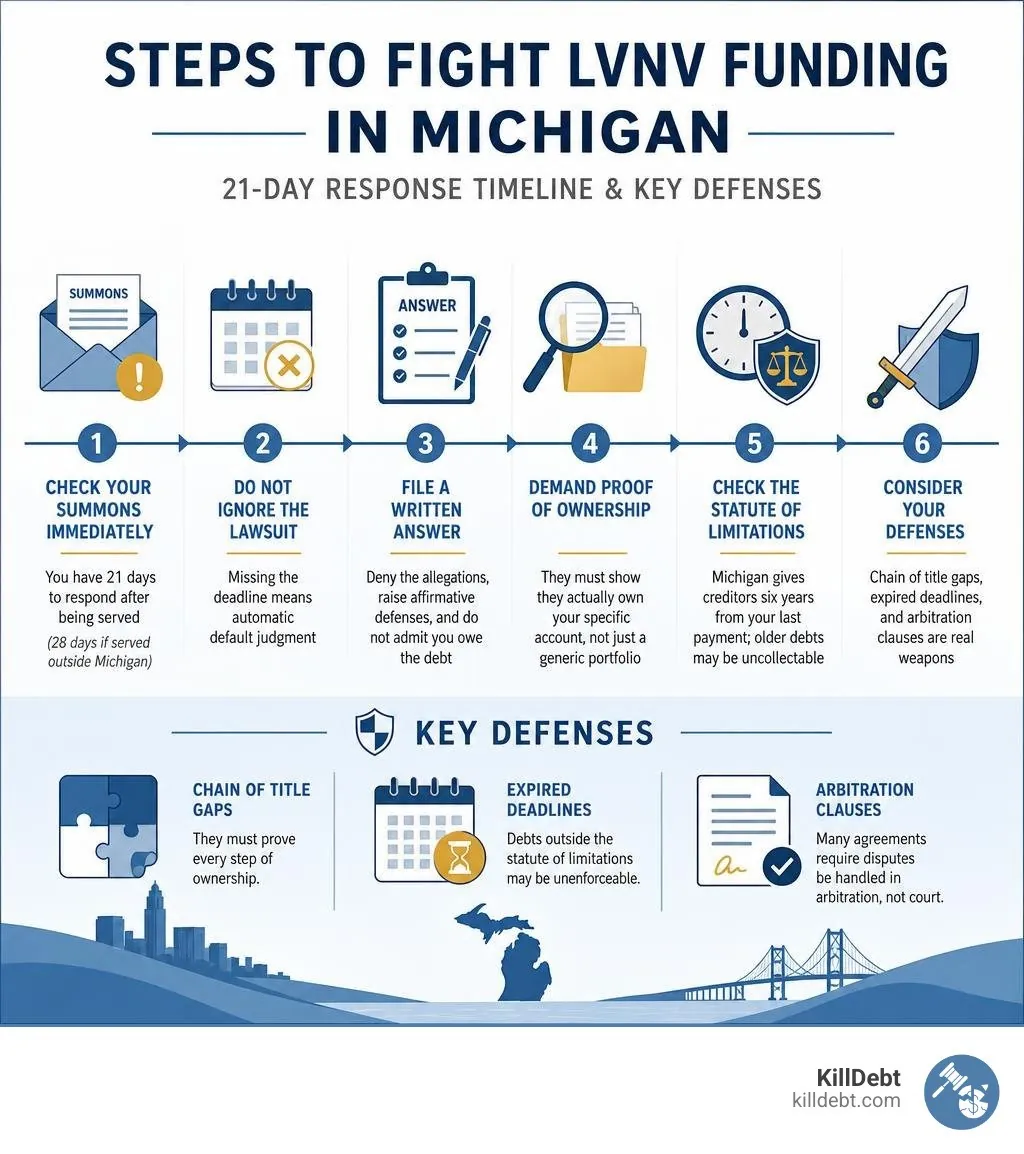
If you need to fight LVNV Funding in Michigan, here is what to do right now:
Getting a lawsuit from a debt collector you've never heard of is terrifying. You don't recognize the name. You don't know what you owe. And suddenly you have a court deadline staring you down.
LVNV Funding, LLC is one of the largest debt buyers in the country. They purchase old, charged-off debts — often for just pennies on the dollar — and then sue consumers to collect the full balance. Most people who get served don't respond in time. That's exactly what LVNV counts on.
But here's the thing: filing a real Answer completely changes the dynamic. It forces LVNV to actually prove their case — ownership, amount, timing, and their legal right to sue you. Many cases settle for far less, or get dropped entirely, once a defendant shows up and fights back.
I'm Brian Parker, and for over 30 years I've fought debt buyers and collection law firms in courtrooms across the country — including cases just like yours involving fighting LVNV Funding in Michigan. I built KillDebt to put those same tools and strategies directly in your hands, fast and affordably.
If you have received a collection letter or a court summons, you might be asking: Who on earth is LVNV Funding, LLC, and why do they think I owe them money?
LVNV Funding is a classic "junk debt buyer." They do not issue credit cards, provide personal loans, or sell retail goods. Instead, they purchase massive portfolios of delinquent or charged-off consumer accounts from original creditors (like Citibank, Capital One, or Synchrony Bank) for pennies on the dollar—typically between two and eight cents per dollar of debt.
LVNV Funding is a passive debt buyer, meaning they do not directly call you or lick envelopes themselves. They are a subsidiary of Sherman Financial Group, and they outsource the actual account management and collection operations to their affiliate, Resurgent Capital Services. If Resurgent's phone calls and letters do not get you to pay, they package the account up and send it to local collection law firms in Michigan to file a lawsuit.
To understand how this chain of custody operates and why it is the weakest link in their legal armor, you can read our guide on Who Is Suing Me Original Creditor vs. Debt Buyer Explained.
Because LVNV Funding is a passive entity, they must hire licensed Michigan law firms to haul you into court. If you are facing a lawsuit in Michigan, the plaintiff listed will be "LVNV Funding, LLC," but the attorneys signing the paperwork will likely belong to one of these well-known collection firms:
These firms operate like high-volume legal factories. They file thousands of lawsuits across Michigan district courts every single month, relying heavily on the expectation that 90% of consumers will simply ignore the summons. When you ignore them, they win an easy default judgment. To learn more about how these firms operate and how to disrupt their factory line, check out our guide on Debt Collector Lawsuits Michigan.
The moment you are served with a summons and complaint, a countdown timer starts. In Michigan, the deadline to file a written Answer is strictly enforced under Michigan Court Rule (MCR) 2.108(A)(1):
If you miss this window, the law firm representing LVNV will immediately file for a default. Once a default judgment is entered against you, they gain the power to freeze your bank accounts, garnish up to 25% of your disposable paycheck, and place liens on your property.
To prevent this, you must file a formal, written Answer with the court and serve a copy on LVNV's attorneys. For a complete tactical overview of this process, read our Michigan Court Defense Guide.
Answering a lawsuit is not about telling your side of the story or explaining why you fell behind on your payments. The court is a arena of evidence, and your Answer is your opportunity to hold LVNV to their strict burden of proof.
When drafting your Answer:
To ensure you do not accidentally waive your rights or fall into common procedural traps, review our comprehensive Debt Lawsuit Defense Guide.
One of the most dangerous procedural traps in Michigan debt collection law is MCL 600.2145 (the open account affidavit rule).
If the law firm representing LVNV Funding attaches a sworn affidavit of amount due to their complaint, that affidavit automatically becomes prima facie (sufficient on its face) evidence of the debt. If you file a standard Answer without addressing this, the judge can grant summary judgment to LVNV based solely on that piece of paper.
To break this trap, you must file a sworn counter-affidavit along with your written Answer. This counter-affidavit must:
By filing this counter-affidavit, you strip LVNV of their easy shortcut. They can no longer rely on their self-serving affidavit and are forced to produce actual, admissible evidence of the debt and its ownership at trial. For more on navigating these specific court rules, read our deep dive on Michigan Court Debt Cases.
To win a lawsuit against a debt buyer, you must understand what they are legally required to prove. Because LVNV is not the original creditor, they must establish standing—meaning they have the legal right to sue you on this specific contract.
To establish standing, LVNV must prove a complete, unbroken "chain of title" from the original creditor down to them. They cannot simply show up with a generic bill of sale that says they bought "a portfolio of accounts." Under Michigan case law, specifically Brownbark II LP v. Bay Area Floorcovering, a debt buyer must provide account-level identification showing that your specific account was part of that specific transaction.
If you are facing a lawsuit from a debt buyer, you can learn how to attack their standing in Lack of Standing Debt Suit and discover how to point out their missing evidence in How To Argue Lack of Evidence Lawsuit.
| Original Creditor Proof | Debt Buyer (LVNV) Proof |
|---|---|
| Direct contract signed by consumer | Generic Bill of Sale with no account numbers |
| Complete, unbroken monthly statements | Incomplete electronic records or "printouts" |
| Direct witness with personal knowledge of the account | Robo-signed affidavit from a third-party servicer |
| Clear, direct standing to sue | Gaps in the chain of title (missing assignments) |
In addition to challenging their paperwork, you have powerful statutory shields under Michigan law:
Another highly effective strategy is the Arbitration Strategy. Most original credit card agreements (especially those from Chase, Citibank, and Synchrony) contain a mandatory arbitration clause. This clause allows either party to elect to resolve disputes through private arbitration organizations like the American Arbitration Association (AAA) or JAMS instead of the court system.
Under the Michigan Uniform Arbitration Act, if you raise this defense and file a motion to compel arbitration, the court must stay (pause) the lawsuit. Because filing and administrative fees in private arbitration are heavily weighted against the business claimant (often costing LVNV $1,500 to $5,000 just to initiate), they will frequently dismiss the case rather than pay more to arbitrate than the debt is actually worth.
Additionally, under MCL 600.8407(1), debt buyers are strictly barred from using Michigan's Small Claims Division. This means they are forced to sue you in District Court General Civil, where you have full discovery rights to demand their internal files, assignment agreements, and purchase contracts. To dispel other common misconceptions about debt lawsuits, see Debt Collection Lawsuit Myths 7 Things That Wont Save You.
While state laws protect you in Michigan courts, the federal Fair Debt Collection Practices Act (FDCPA) protects you nationwide.
Under the FDCPA, specifically 15 U.S.C. § 1692e(8), if a consumer disputes a debt, the debt collector is legally prohibited from reporting that debt to credit bureaus without also reporting that it is disputed. If LVNV or Resurgent fails to apply the "XB" dispute code to your credit file after receiving your written dispute, they have committed a federal violation, which may entitle you to statutory damages of up to $1,000 plus attorney's fees.
If you decide that settling the debt is your preferred path, filing a timely Answer is still your best move. Debt buyers are far more willing to negotiate realistic settlements when they realize you are prepared to fight. While they initially demand 100% of the balance, typical settlements with LVNV range between 10% and 35% of the claimed balance if you negotiate from a position of strength, and 40% to 60% is common for standard lump-sum agreements. You can also negotiate a "pay-for-delete" agreement where they agree to completely remove the collection tradeline from your credit report upon payment.
For a step-by-step roadmap on balancing defense with negotiation, read our Fight Debt Collection Lawsuit Complete Guide.
Michigan federal courts have shaped how consumer protection laws are applied to debt buyers. Understanding these rulings can help you avoid costly mistakes:
Fighting a massive debt buyer like LVNV Funding can feel like a David versus Goliath battle. But remember: they are running a numbers game. They rely on fear, confusion, and default judgments to turn a profit. The moment you stand up, file a proper Answer, and demand real proof, you disrupt their entire business model.
At KillDebt, we designed our DIY legal defense system to level the playing field. Powered by ParkerGPT—an AI trained specifically on consumer debt law and real-world court strategies developed over 30 years—our platform analyzes your lawsuit documents, spots key weaknesses in the plaintiff's chain of title, and generates court-ready answers and affidavits.
We have also rolled out our brand-new Court Tester courtroom simulation. This tool allows you to upload your actual case filings and, within minutes, argue your motions in front of an AI judge against an AI opposing counsel, while an AI co-counsel whispers real-time strategies only you can see.
You do not have to let debt buyers bully you. Take control of your case today by visiting KillDebt Pricing and discover how simple, affordable, and powerful DIY debt defense can be.
IMPORTANT LEGAL DISCLAIMER
This educational content is based on general legal principles and my experience in debt collection defense. It is provided for informational purposes only and does not constitute legal advice. Laws vary by state and by local court. For specific legal advice, consult a qualified attorney licensed in your jurisdiction. No attorney-client relationship is created by reading this guide.
Critical Multi-State Variations: FDCPA applies uniformly at the federal level, but state consumer protection laws may provide additional rights and remedies. Statute of limitations periods vary significantly by state and debt type. What constitutes sufficient debt validation varies in practice across jurisdictions. State-specific rules on call frequency, written notice requirements, and permissible collector conduct may differ from federal minimums.

About the author
Brian Parker
I have over 30 years of experience defending consumers against debt collection lawsuits and have seen every tactic, threat, and pressure play that collectors use. Through KillDebt and ParkerGPT, I have systematized the proven defense strategies that actually work - so consumers can respond from a position of knowledge, not fear. My approach focuses on aggressive legal defense based on documented case success rather than false hope that leads to default judgments.