
News Break
Won a Judgment? How to Collect What You Are Owed
June 26, 2026
Blog / News Break
Learn how the statute of limitations Michigan works for civil claims, criminal cases, debt, and personal injury—know your deadlines before time runs out.
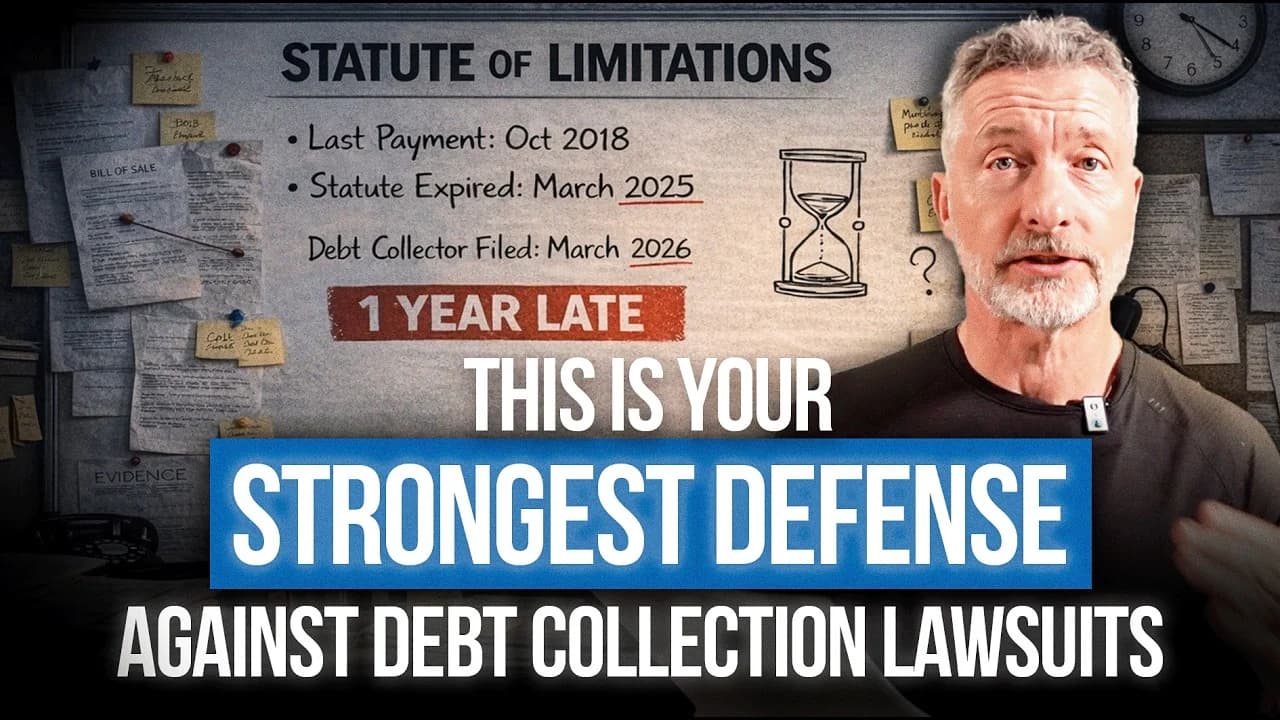
The statute of limitations in Michigan sets a hard deadline on how long someone has to sue you — or charge you with a crime. Miss it, and the case is dead.
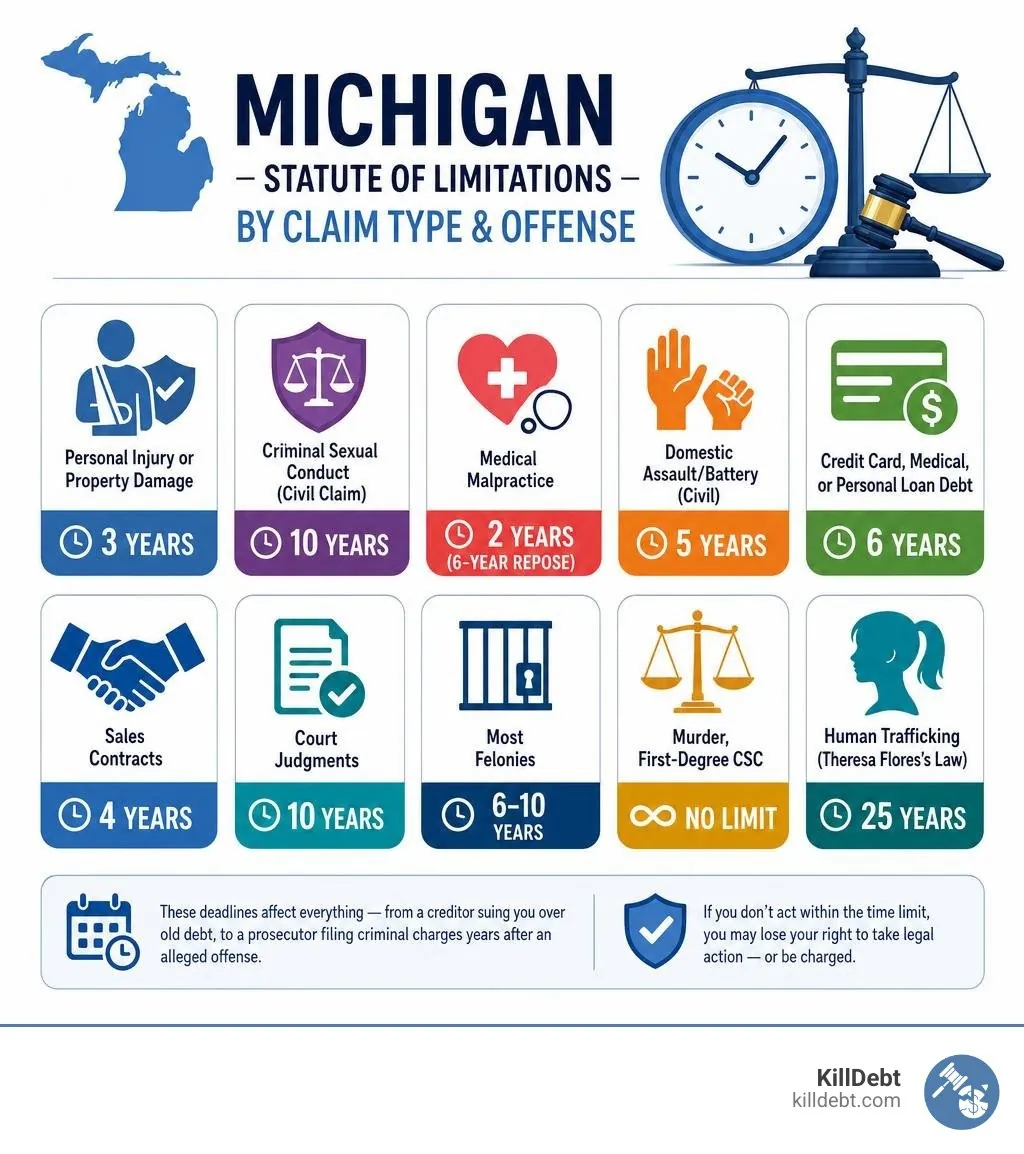
Here are the most common Michigan limits at a glance:
| Claim or Offense | Time Limit |
|---|---|
| Personal injury or property damage | 3 years |
| Criminal sexual conduct (civil claim) | 10 years |
| Medical malpractice | 2 years (6-year repose) |
| Domestic assault/battery (civil) | 5 years |
| Credit card, medical, or personal loan debt | 6 years |
| Sales contracts | 4 years |
| Court judgments | 10 years |
| Most felonies | 6–10 years |
| Murder, first-degree CSC | No limit |
| Human trafficking (Theresa Flores's Law) | 25 years |
These deadlines affect everything — from a creditor suing you over old debt, to a prosecutor filing criminal charges years after an alleged offense.
If you've received a summons or collection letter, the statute of limitations could be your most powerful defense. But you have to raise it — courts won't do it for you.
I'm Brian Parker, founder of KillDebt, and I've spent over 30 years in courtrooms defending consumers against creditors, debt buyers, and collection law firms — including countless cases where the statute of limitations in Michigan was the deciding factor. In this guide, I'll break down exactly how these deadlines work, when they can be paused or reset, and how to use them to protect yourself.
IMPORTANT LEGAL DISCLAIMER
This educational content is based on general legal principles and my experience in debt collection defense. It is provided for informational purposes only and does not constitute legal advice. Laws vary by state and by local court. For specific legal advice, consult a qualified attorney licensed in your jurisdiction. No attorney-client relationship is created by reading this guide.
Critical Multi-State Variations: FDCPA applies uniformly at the federal level, but state consumer protection laws may provide additional rights and remedies. Statute of limitations periods vary significantly by state and debt type. What constitutes sufficient debt validation varies in practice across jurisdictions. State-specific rules on call frequency, written notice requirements, and permissible collector conduct may differ from federal minimums.
When we talk about the statute of limitations Michigan enforces, we have to split the legal world into two distinct halves: civil claims and criminal prosecutions. Both have clocks ticking away, but they serve completely different masters and follow entirely different rules.
In a civil case, the clock exists to protect citizens from being sued over ancient, dusty disputes where evidence has vanished and memories have faded. It is a matter of fairness between private parties. In criminal cases, the statute of limitations exists as a matter of public policy. It ensures the state prosecutes crimes swiftly, preventing the government from holding the threat of charges over someone's head indefinitely, except for the most egregious offenses.
To help you visualize how these two worlds differ, we have broken down the primary distinctions below:
| Feature | Civil Claims | Criminal Prosecution |
|---|---|---|
| Who brings the action? | Private individuals, businesses, or debt buyers | The state government (prosecutors) |
| Primary Goal | Financial compensation or property recovery | Punishment, rehabilitation, or public safety |
| Standard of Proof | Preponderance of the evidence ("more likely than not") | Beyond a reasonable doubt |
| General Timeframes | 1 to 10 years depending on the claim | 6 years (misdemeanors) to unlimited (serious felonies) |
| How to Raise It | Must be raised as an affirmative defense by the defendant | Raised by the defense; factual disputes go to a jury |
To explore the detailed breakdown of civil deadlines across different case types, you can consult the Michigan Statute of Limitations: Deadlines by Case Type | Michigan Legal Services Authority .
In Michigan's criminal justice system, the nature of the crime determines how much time prosecutors have to file charges. If they miss the window, they lose the right to prosecute entirely.
If there is a factual dispute about whether a criminal charge was filed on time, Michigan courts treat this as a question of fact for a jury to decide. You can read more about how these defenses are handled in the courtroom in the official StatutesofLimitations guide.
If you are injured in an accident or someone damages your property, you do not have forever to seek justice. Under the REVISED JUDICATURE ACT OF 1961 (EXCERPT) , the standard limitation period for personal injury and property damage claims is 3 years from the date of the injury or death.
This three-year window applies to:
If you attempt to file a lawsuit even one day after that three-year window closes, the opposing party will move to dismiss your case, and the judge will almost certainly grant their request—no matter how severe your injuries were.

Michigan law recognizes that certain civil harms are incredibly complex, traumatic, or difficult to detect immediately. Because of this, the state has carved out highly specific rules, exceptions, and extension windows for sensitive cases.
The rules are even more protective when the victim of sexual assault was a minor at the time of the abuse. Under Senate Bill 872 (MCL 600.5851b), a person who was a minor when they suffered criminal sexual conduct can file a civil lawsuit up until they reach age 28, or 3 years after they discover (or reasonably should have discovered) both the injury and its causal relationship to the abuse—whichever is later.
However, it is important to note that these extended discovery rules do not apply retroactively to resurrect claims that had already expired before the law was enacted in 2018.

Now, let us talk about where the statute of limitations Michigan enforces hits closest to home for most of us: consumer debt.
When you fall behind on payments, creditors and aggressive debt buyers will threaten lawsuits. But they are racing against a clock. In Michigan, the statute of limitations on most consumer debts—including credit cards, medical bills, auto loans, personal loans, and mortgages—is 6 years.
If you want to understand how these cases play out in local courts, read our guide on Michigan Court Debt Cases. If you are already facing a collector, you will also want to check out our breakdown of Debt Collector Lawsuits Michigan.
There is one major exception to the six-year rule: sales contracts. Under Michigan's Uniform Commercial Code (UCC), if the debt arises from a contract for the sale of goods (such as purchasing a vehicle where the vehicle itself serves as collateral), the statute of limitations is only 4 years.
To understand how the 6-year limit works, we have to look at when the clock actually starts ticking. The legal term for this is "accrual."
The clock does not start when you first opened the credit card account. It starts when you breached the contract—usually 30 days after your last payment, when you missed a scheduled payment and failed to cure the default.
Whether the contract was written or oral, the 6-year limit applies. Once those six years have passed without a payment or written acknowledgment of the debt, the creditor or debt buyer loses the legal right to sue you to collect. If you have been served with papers, understanding where you stand on the timeline is vital. We map this out step-by-step in our guide on the Debt Collection Lawsuit Timeline: What Happens Next After You're Served.
Here is the most critical lesson in this entire guide: The statute of limitations is an affirmative defense.
What does that mean? It means the court will not look at a lawsuit, realize the debt is 10 years old, and throw it out for you. If a debt buyer sues you on a time-barred debt (often called "zombie debt") and you do not respond, they will win a default judgment against you anyway. Once they have a default judgment, they can garnish your wages and freeze your bank accounts, completely bypassing the expired statute of limitations.
To win, you must file a formal Answer to the lawsuit and explicitly state that the debt is barred by the statute of limitations. For a deep dive on how to execute this defense, see our article on the Expired Debt Statute Defense. And to avoid making costly mistakes, be sure to read Debt Collection Lawsuit Myths: 7 Things That Won't Save You.
Sometimes, the statute of limitations clock stops ticking. In legal terms, this is called tolling. When a statute is tolled, the clock is paused and will only resume when the tolling event ends.
Under the 2024 Michigan Compiled Laws Chapter 600 - Revised Judicature Act of 1961 Act 236 of 1961 - Revised Judicature Act of 1961 (600.101 - 600.9948) 236-1961-58 - Chapter 58 Limitation of Actions (600.5801...600.5869) , several scenarios can pause the clock:
While tolling pauses the clock, certain actions can completely reset it back to zero. In debt collection, this is a dangerous trap for consumers.
The 6-year debt clock can be completely restarted if you:
Navigating the statute of limitations in Michigan can feel like trying to defuse a bomb with a manual written in ancient Latin. But whether you are dealing with a personal injury claim, trying to understand a criminal timeline, or fighting off aggressive debt buyers, knowing the rules is your ultimate shield.
If you are currently facing a debt collection lawsuit, you do not have to pay thousands of dollars to an attorney to protect your rights. At KillDebt, we provide a DIY legal defense system powered by ParkerGPT—an AI trained specifically on consumer debt law and real-world court strategies developed over 30+ years.
Unlike generic AI tools, ParkerGPT analyzes your actual lawsuit documents, identifies weak points in the collector's case (like an expired statute of limitations), and generates court-ready responses with step-by-step instructions.
And if you want to practice before you step foot in a courtroom, we recently rolled out our brand-new Court Tester. This AI courtroom simulation builds a virtual court based on your actual filings. Within minutes, you can argue your motion in front of an AI judge, face off against AI opposing counsel, and receive strategy whispers from a private AI co-counsel.
Do not let zombie debt collectors bully you into a default judgment. Head over to our KillDebt Pricing Page to find an affordable subscription plan and take control of your financial future today.
IMPORTANT LEGAL DISCLAIMER
This educational content is based on general legal principles and my experience in debt collection defense. It is provided for informational purposes only and does not constitute legal advice. Laws vary by state and by local court. For specific legal advice, consult a qualified attorney licensed in your jurisdiction. No attorney-client relationship is created by reading this guide.
Critical Multi-State Variations: FDCPA applies uniformly at the federal level, but state consumer protection laws may provide additional rights and remedies. Statute of limitations periods vary significantly by state and debt type. What constitutes sufficient debt validation varies in practice across jurisdictions. State-specific rules on call frequency, written notice requirements, and permissible collector conduct may differ from federal minimums.

About the author
Brian Parker
I have over 30 years of experience defending consumers against debt collection lawsuits and have seen every tactic, threat, and pressure play that collectors use. Through KillDebt and ParkerGPT, I have systematized the proven defense strategies that actually work - so consumers can respond from a position of knowledge, not fear. My approach focuses on aggressive legal defense based on documented case success rather than false hope that leads to default judgments.