News Break
Can You Boost Your Credit After a Debt Lawsuit? Yes, and Here's How
July 14, 2026
Blog / News Break
Master local court debt recovery with this step-by-step guide covering filing, defenses, and enforcement options.

Local court debt recovery is the legal process creditors use to sue you for an unpaid debt — and if you've just received a summons, a Statement of Claim, or a collection letter with a court deadline, you're in the right place.
Here's what you need to know fast:
The court process can feel overwhelming — unfamiliar forms, strict deadlines, and legal language designed for lawyers, not regular people. But knowing the rules gives you real power to fight back.
I'm Brian Parker, and for over 30 years I've defended consumers against creditors, debt buyers, and collection law firms in courts across the country — including countless local court debt recovery cases just like yours. At KillDebt, I've turned that experience into tools and guides that put you on equal footing without the high cost of an attorney.
When a creditor or a third-party debt buyer decides to pursue a local court debt recovery lawsuit, the case is channeled into a specific division of the local court system based on the amount of money being claimed. Understanding which division handles your case is critical because the rules of evidence, filing fees, and the overall level of formality vary dramatically.
In jurisdictions like New South Wales (NSW), the Local Court is split into two primary divisions: the Small Claims Division and the General Division.
While these specific thresholds are set in Australia, we see highly comparable structures in the United States, particularly in our primary service areas of Michigan and Florida. For instance, in Michigan, small claims are handled with highly relaxed rules, whereas the District Court handles formal civil cases up to $25,000, and Circuit Courts handle larger claims.
Understanding these thresholds is the first step in building your defense. If a creditor files in the wrong division or attempts to use formal court procedures for a minor claim, you can use that procedural misstep to your advantage.
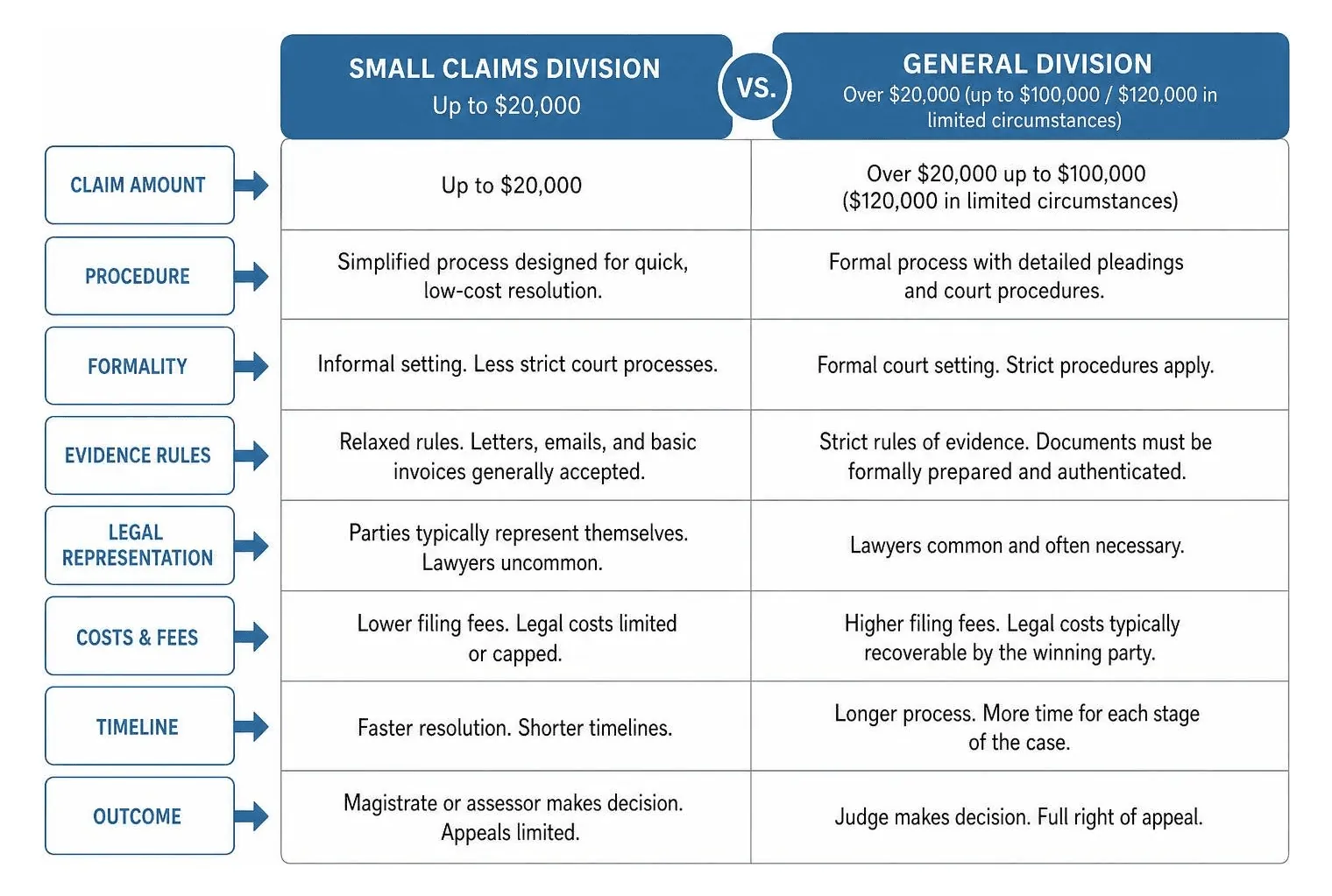
The Small Claims Division is specifically designed to resolve disputes quickly and cheaply. If the debt is under $20,000, the court encourages an informal atmosphere where parties often represent themselves.
In this division, strict rules of evidence do not apply. The magistrate or assessor can review letters, emails, and basic invoices without requiring the formal, complex authentication processes needed in higher courts. Legal costs are heavily restricted or capped, meaning that even if you lose, you are generally not forced to pay thousands of dollars of the creditor's attorney fees.
To see how these minor civil procedures are structured, you can read the guide on How to Recover a Debt (opens in a new tab), which outlines the simplified steps used to resolve smaller claims without the heavy burden of formal trial procedures.
Once a debt claim crosses the $20,000 threshold, the gloves come off. The case enters the General Division of the Local Court, where the environment is highly formal and the stakes are much higher.
In the General Division:
Because of this complexity, representing yourself in the General Division without proper guidance is highly risky. If you are facing a formal lawsuit in Michigan, for example, our detailed breakdown of Michigan Court Debt Cases explains how these district and circuit court dynamics function and what you must do to protect your bank accounts.
While the terminology differs, local court debt recovery processes share striking similarities across the globe. Whether you are dealing with a local court in Sydney or a county court in Florida, the core battle remains the same: the creditor must prove you owe the money, and you must assert your legal rights.
In the United States, different states set their own unique boundaries for small claims and formal civil debt collection:
For a closer look at how these international and state-level jurisdictions manage debt petitions, you can review the official information sheet on DEBT CLAIM CASES (opens in a new tab) to understand how courts require specific documentation before a creditor can secure a judgment.
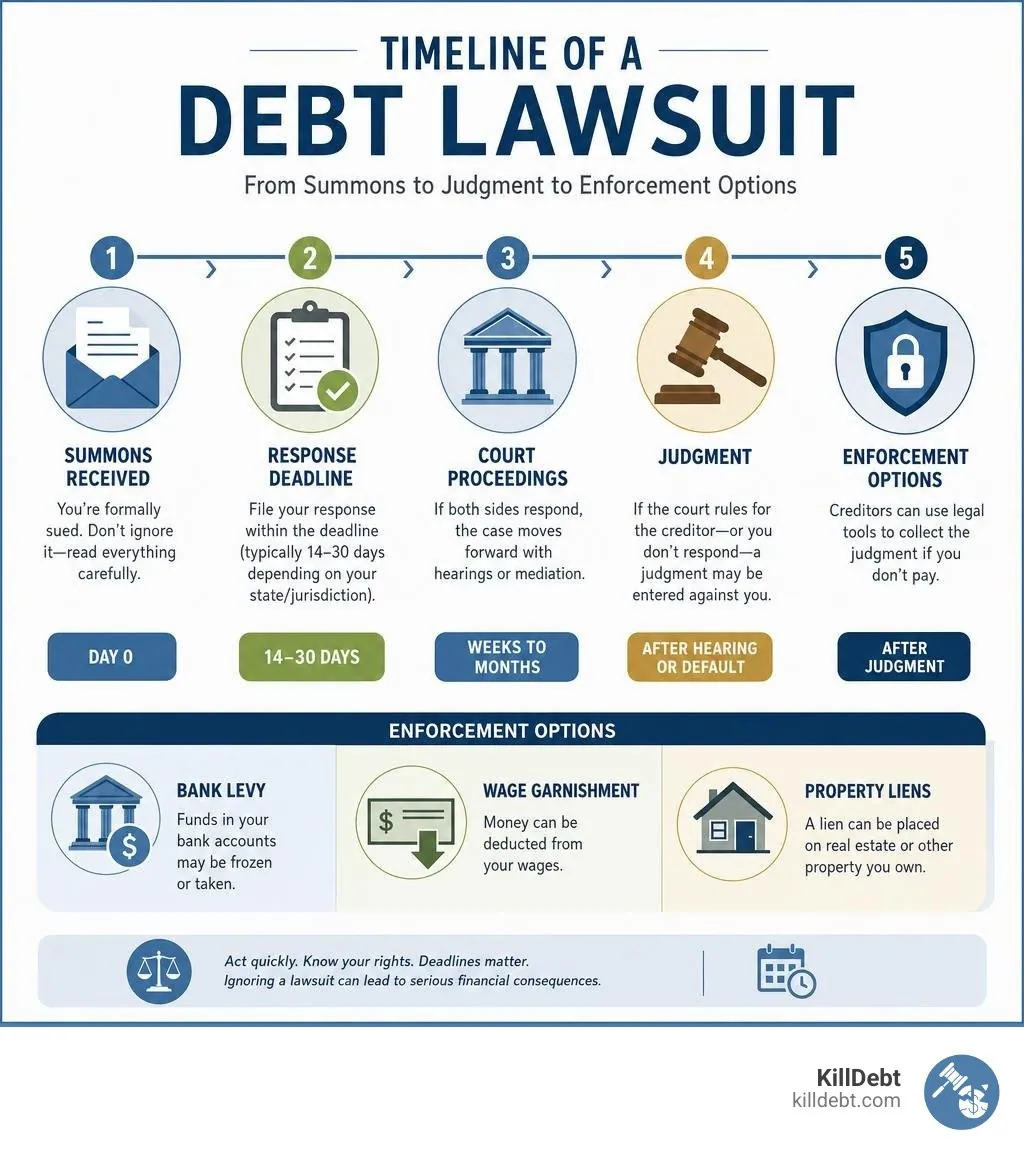
A debt recovery lawsuit does not happen overnight. It follows a structured, step-by-step legal process. If you ignore any of these steps, you hand the debt collector an easy victory. Let's break down exactly how a case moves through the local court system so you know what to expect.
The lawsuit officially begins when the plaintiff (the creditor or debt collector) files a Statement of Claim (or a Complaint in US jurisdictions) with the court and pays the required filing fee.
Once filed, the document must be properly served on you, the defendant. Proper service is not just a courtesy; it is a constitutional and legal requirement. The plaintiff must typically serve you in one of the following ways:
Once you are served, the clock starts ticking. In NSW, you have exactly 28 days to file a response (a Defence). In US jurisdictions like Oregon or Florida, the window is often 20 to 30 days. If you fail to file a written response within this window, the plaintiff can immediately apply for a default judgment.
If you are dealing with a small claims matter in Virginia, you might see a specific document structure. You can learn more about this by reviewing Using This Revisable PDF Form (opens in a new tab), which demonstrates how formal warrants are drafted and served on consumers.
If you file a Defence, the court will schedule a directions call-over (often within six weeks of the Defence being filed). The call-over is a short court appearance where the registrar or magistrate decides how the case will proceed. The court might:
If the matter is not settled, it will be set down for a formal hearing. At least four weeks before the review date, you will be directed to exchange written witness statements or affidavit evidence with the other side.
At the final hearing, both parties present their arguments, question witnesses under oath, and submit physical evidence. The magistrate will then make a final decision and enter a judgment.
If you lose the case, or if a default judgment is entered against you, the creditor gains powerful legal tools to collect the money. However, you still have options.
If the magistrate made a legal error, you can appeal the decision to a higher court (such as the Supreme Court in NSW) within 28 days. If you do not appeal, or if the appeal is unsuccessful, the creditor can enforce the judgment using several methods:
For a detailed look at how these enforcement mechanisms operate internationally, see Courts.ie - Enforcement of debt Judgments (opens in a new tab). If a judgment has already been entered against you and you want to understand the creditor's next steps, read our guide on Won a Judgement How to Collect.
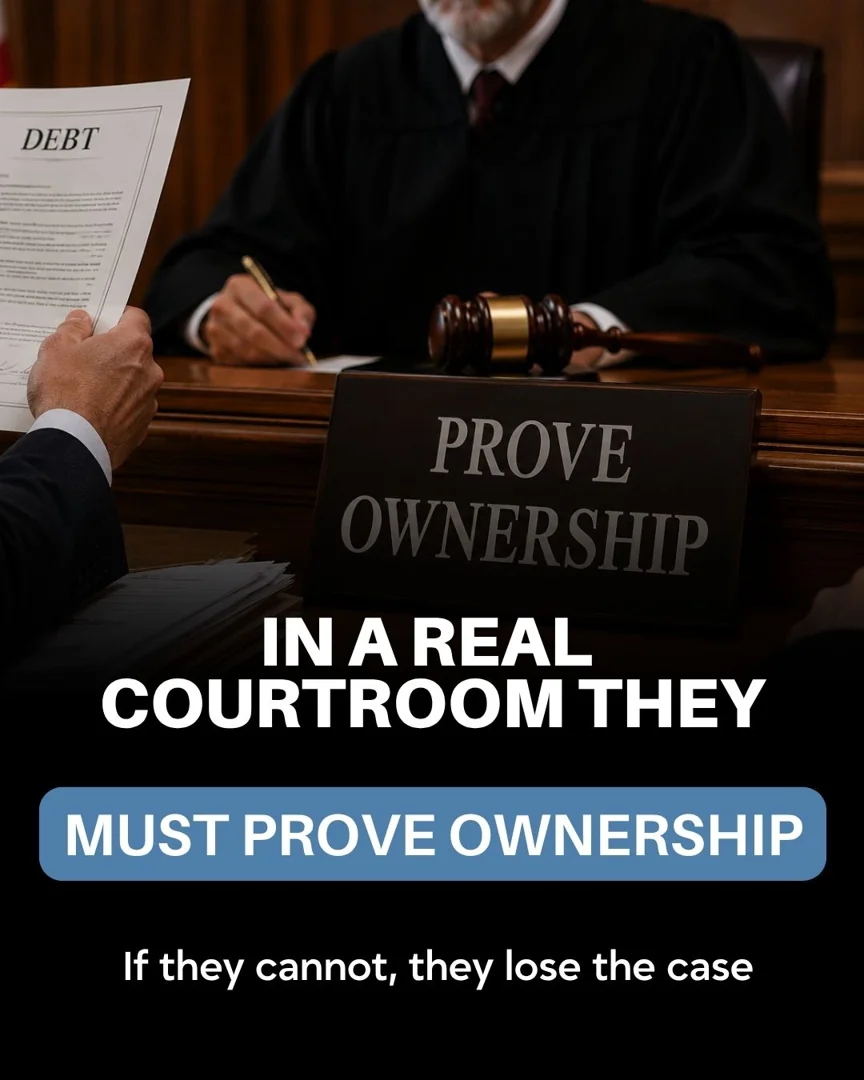
Many consumers assume that if they owe the money, they have no defense. This is a costly mistake. In a local court debt recovery lawsuit, the burden of proof is entirely on the plaintiff. They must prove every element of their case with admissible evidence. If they cannot, the court must dismiss the case.
When defending yourself, you must force the plaintiff to prove their standing to sue and the accuracy of their numbers. For a comprehensive roadmap on how to construct a strong defense in court, read our Michigan Court Defense Guide.
The strategy you use depends heavily on whether you are being sued by the original creditor (like your credit card company) or a third-party debt buyer (a company that bought your old debt for pennies on the dollar).
Debt buyers purchase thousands of old accounts in bulk. During these bulk transactions, critical documentation is often lost or never transferred. To win a lawsuit, a debt buyer must prove:
By demanding that the debt buyer produce the original contract, the complete chain of title, and the itemized billing statements, you expose the weaknesses in their case. Often, they will choose to dismiss the lawsuit rather than spend the time and money trying to locate these documents.
An affirmative defense is a legal reason why the plaintiff cannot win, even if the allegations in their complaint are true.
The most powerful affirmative defense in debt collection is the statute of limitations. In NSW, Michigan, and Florida, the time limit to start a court case to recover a debt is generally six years from when the money became owed, the last repayment was made, or the debt was last acknowledged in writing (whichever came last). If the creditor waits too long to sue, the debt becomes legally unenforceable.
If you lose the lawsuit, you must focus on protecting your exempt assets. Under the law, certain income and property are protected from creditors:
Facing a local court debt recovery lawsuit is stressful, but you do not have to navigate the court system alone. At KillDebt, we believe that every consumer deserves access to a powerful, affordable defense.
That is why we created ParkerGPT, an AI legal defense system trained on real-world court strategies developed over 30+ years by experienced consumer defense attorneys. ParkerGPT analyzes your lawsuit documents, spots critical weaknesses in the collector's evidence, and generates custom, court-ready responses with step-by-step instructions.
To help you feel completely prepared before you step into a courtroom, we recently rolled out our brand-new Court Tester. Court Tester is an advanced AI courtroom simulation built directly on the facts of your actual case. You simply upload your real court filings, and within minutes, you are arguing your motion in front of an AI judge, facing off against an AI opposing counsel, while a private AI co-counsel whispers winning strategies that only you can see.
Don't let debt collectors take your hard-earned money by default. Take control of your case, analyze your documents, and build a winning defense today. Explore our plans and start your defense journey at the KillDebt DIY Legal Defense portal.
Get started with KillDebt pricing
IMPORTANT LEGAL DISCLAIMER
This educational content is based on general legal principles and my experience in debt collection defense. It is provided for informational purposes only and does not constitute legal advice. Laws vary by state and by local court. For specific legal advice, consult a qualified attorney licensed in your jurisdiction. No attorney-client relationship is created by reading this guide.
Critical Multi-State Variations: FDCPA applies uniformly at the federal level, but state consumer protection laws may provide additional rights and remedies. Statute of limitations periods vary significantly by state and debt type. What constitutes sufficient debt validation varies in practice across jurisdictions. State-specific rules on call frequency, written notice requirements, and permissible collector conduct may differ from federal minimums.

About the author
Brian Parker
I have over 30 years of experience defending consumers against debt collection lawsuits and have seen every tactic, threat, and pressure play that collectors use. Through KillDebt and ParkerGPT, I have systematized the proven defense strategies that actually work - so consumers can respond from a position of knowledge, not fear. My approach focuses on aggressive legal defense based on documented case success rather than false hope that leads to default judgments.