
News Break
How to Ask Collectors for Proof: The Ultimate Debt Validation Guide
July 9, 2026
Blog / News Break
Master your Michigan court defense guide from summons to hearing with proven strategies and self-help tools.

If you've just received a summons or collection notice, this Michigan court defense guide gives you a clear path forward — even without a lawyer.
Quick-reference steps if you're being sued in Michigan:
Getting sued for a debt is overwhelming. You're staring at legal paperwork full of jargon, facing a deadline you don't fully understand, and wondering if you can possibly fight back without spending thousands on an attorney.
The answer is yes — you can.
Michigan has a detailed set of court rules, self-help tools, and legal standards designed to make the process navigable. Whether you're in District Court for a claim under $25,000, facing a larger Circuit Court suit, or dealing with a UIA overpayment notice, the rules give you real options to defend yourself — if you know how to use them.
This guide walks you through everything: how Michigan courts are structured, how to respond to a summons, how to use discovery to expose a collector's weak case, and how to access free resources like Michigan Legal Help's growing network of courthouse self-help centers.
I'm Brian Parker, and I've spent over 30 years in courtrooms across the country fighting debt collectors, debt buyers, and collection law firms — the experience behind everything in this Michigan court defense guide. I've seen how collectors rely on consumers not knowing their rights, and I built KillDebt specifically to close that gap.
Before you can build your defense strategy, we need to look at where your case is being heard. In Michigan, the court system is divided into different levels based on the type of case and the amount of money involved.
If you are dealing with Michigan Court Debt Cases, your lawsuit will almost certainly begin in either the District Court or the Circuit Court.
The jurisdictional threshold of $25,000 is a hard line. If a debt collector sues you for $15,000, they must file in the District Court. If they sue you for $30,000, it belongs in the Circuit Court.
But jurisdiction is only half the battle. To successfully sue you, the plaintiff must have standing.
In Debt Collector Lawsuits Michigan, standing is often the collector's weakest point. Many lawsuits are filed by third-party debt buyers (like Midland Funding or Portfolio Recovery Associates) who bought your alleged debt for pennies on the dollar. To have standing to sue you, they must prove they actually own the specific account. This requires a clean "chain of title" showing the assignment of the debt from the original creditor to the current plaintiff. If they cannot produce these documents, they lack standing, and we can ask the court to dismiss the case.
While jurisdiction determines which level of court hears your case, venue determines which physical location is the right one.
Under Michigan court rules, a debt collection lawsuit must generally be filed in the county or district where:
If a debt collector sues you in a county where you do not live and have never lived, they have violated venue rules. Filing in an improper venue is a common tactic used to make it harder for you to appear in court. Challenging improper venue early is a core strategy we cover in our comprehensive Debt Lawsuit Defense Guide.
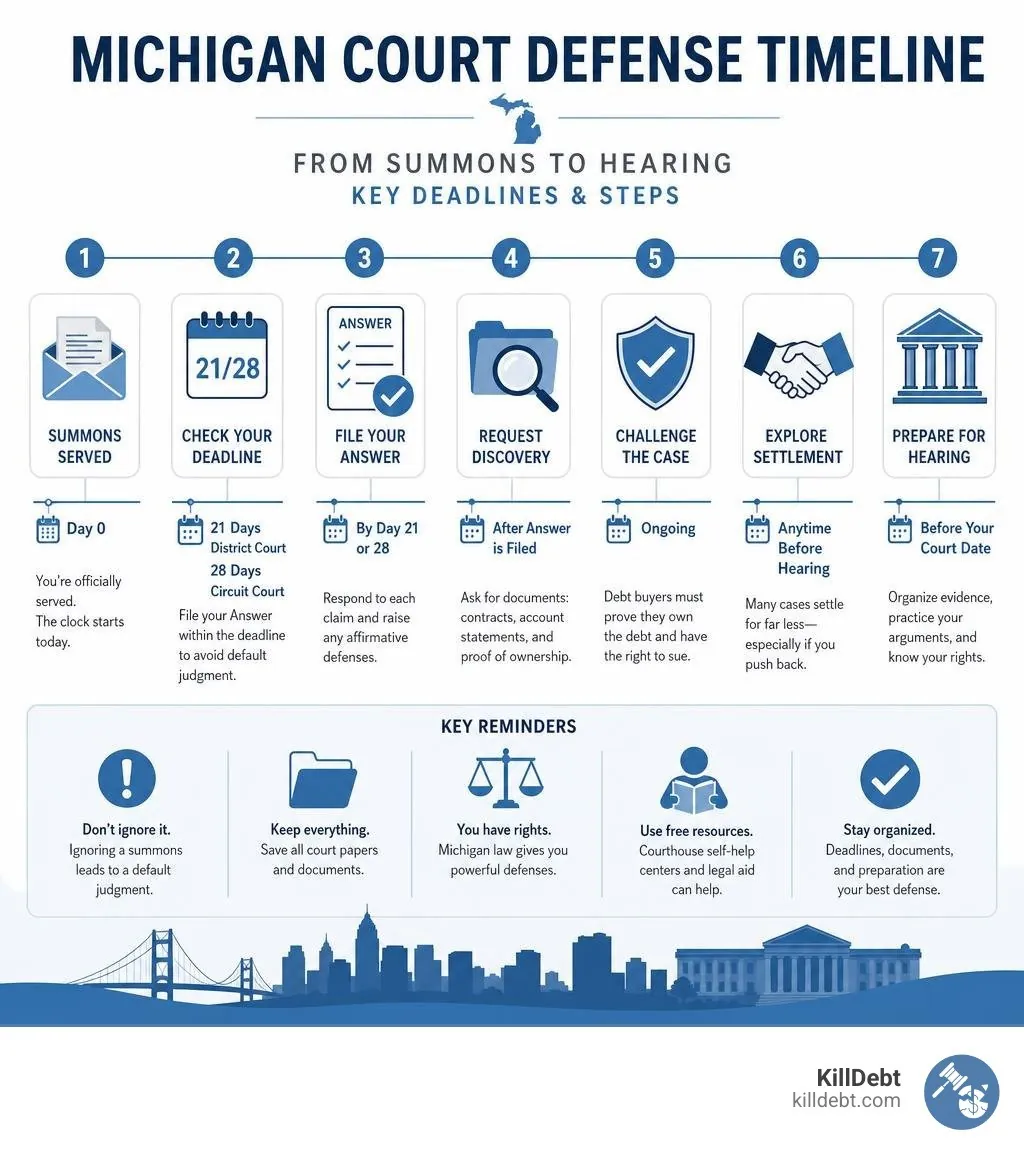
Once you are served with a lawsuit, the clock starts ticking. Knowing what to do in the first few days can mean the difference between winning your case and losing by default.
When you receive a summons and complaint, you must file a written Answer. In Michigan, the deadline is strict:
If you miss this window, the collector will file for a default judgment, allowing them to garnish your wages or freeze your bank accounts. When drafting your Answer, you must respond to every single numbered paragraph in the complaint by admitting, denying, or stating that you lack sufficient information to form a belief.
This is also the moment to raise your affirmative defenses—legal reasons why the plaintiff should not win even if their factual allegations are true (e.g., the statute of limitations has expired, or they lack standing). To understand the immediate actions you need to take, read our guide on What to Do When Sued by a Debt Collector Complete First Steps Guide, and learn How to Answer a Debt Summons step-by-step.
To help you calculate your exact deadline, check out our resource on the Time to Respond Debt Collection Lawsuit, and look at a Sample Answer to Debt Collection Lawsuit to see what a completed form looks like.
Not every case has to end in a dramatic trial. In fact, the vast majority of civil cases in Michigan are resolved through Alternative Dispute Resolution (ADR) or settlement.
If you want to fight back effectively and explore these alternatives safely, check out our Fight Debt Collection Lawsuit Complete Guide.
While our primary focus at KillDebt is civil consumer defense, a complete Michigan court defense guide must touch on how the state handles criminal defense. Michigan’s criminal procedures are highly structured to protect the constitutional rights of the accused.
Michigan Court Rules (MCR) Chapter 6 governs criminal procedure across the state. This chapter outlines everything from the initial arraignment to the final appeal. Key stages include:
For a deeper look at what to expect during a criminal trial, you can explore resources like Criminal Defense Trial and what to expect. FREE Consults. (opens in a new tab)and learn How a Criminal Defense Lawyer Builds a Strong Case in Central ... (opens in a new tab).
If a criminal defendant cannot afford an attorney, the Michigan Indigent Defense Commission (MIDC) ensures they receive effective counsel. Over the years, the Department of Licensing and Regulatory Affairs (LARA) has approved a series of progressive standards to elevate the quality of public defense:
All trial court funding units in Michigan were required to submit compliance plans for these standards by April 22, 2024, ensuring that indigent defense is robustly funded and independent.
If you are representing yourself in a civil case, you are not entirely on your own. Michigan has made massive strides in expanding access to justice for self-represented litigants.
Michigan Legal Help is an incredible online portal offering free legal information, automated forms, and step-by-step guides for civil matters.
To make these resources even more accessible, the state has funded physical courthouse self-help centers:
These centers are highly useful if you are dealing with everyday legal issues, including consumer debt or overpayment notices from the Unemployment Insurance Agency (UIA). If you receive a UIA overpayment notice, Michigan Legal Help provides specific toolkits to help you protest the determination or apply for a waiver. If you need to draft a formal response for a lower court, our resource on the Justice Court Debt Answer can help you format your defense.
No one should be denied access to the legal system because of their financial situation. If you cannot afford court filing fees, you can file an MC 20 (Fee Waiver Request). If the judge approves it, your filing fees are waived.
Michigan courts also guarantee:
If you are preparing to draft your own response to a credit card company, read our guide on How to Write an Answer to a Credit Card Lawsuit to ensure you don't accidentally waive your rights.
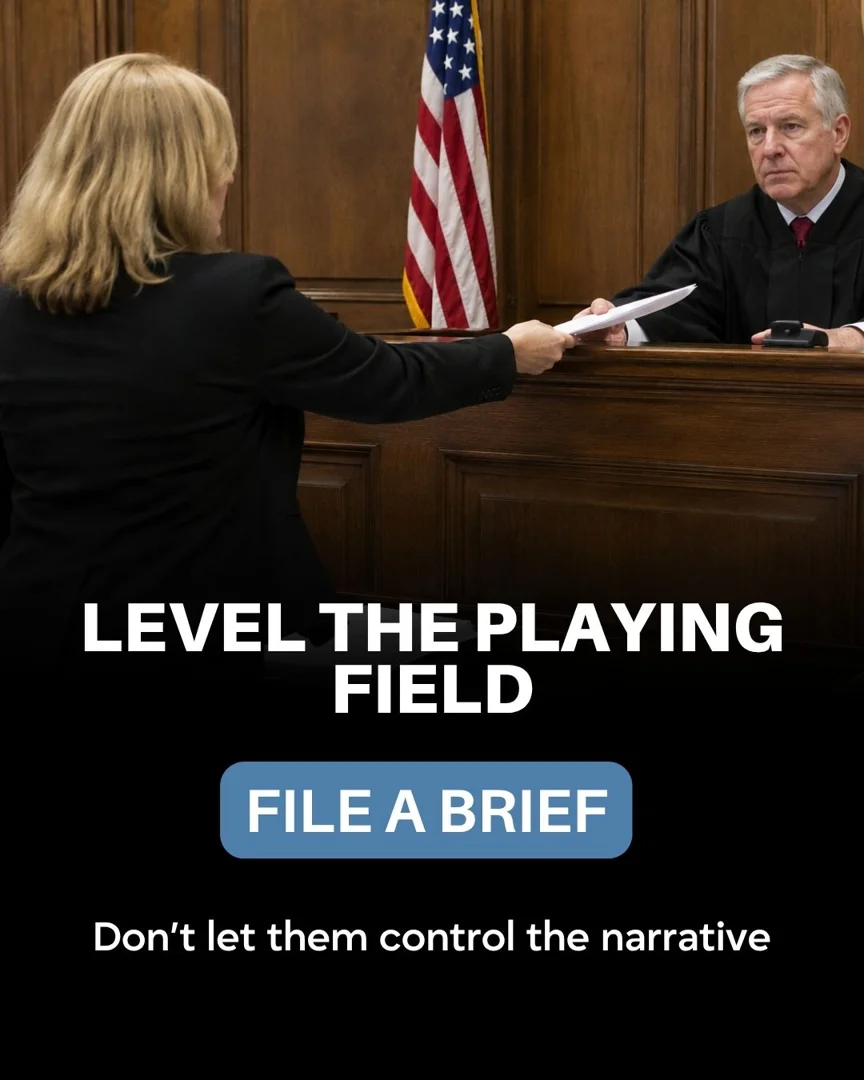
When your hearing date arrives, preparation is everything. Standing in front of a judge can be intimidating, but knowing how to present your evidence and conduct yourself will level the playing field.
| Defense Approach | Pros | Cons | Best Suited For |
|---|---|---|---|
| Traditional Attorney | Professional representation; deep knowledge of local rules. | Extremely expensive; often costs more than the debt itself. | Complex, high-dollar cases ($25,000+). |
| Pure Self-Representation (Pro Se) | Free; complete control over your case. | High risk of procedural mistakes; time-consuming. | Simple, low-dollar disputes or small claims. |
| KillDebt DIY with ParkerGPT | Affordable; built on 30+ years of legal strategy; instant document analysis. | Requires you to print and file the generated documents. | Anyone facing a debt collector who wants professional-grade defense on a budget. |
Taking control of your legal defense in Michigan doesn't require a law degree or thousands of dollars in retainer fees. Armed with this Michigan court defense guide, the right rules, and the state's expanding self-help resources, you have everything you need to stand your ground.
But you don't have to do it alone.
At KillDebt, we've developed a DIY legal defense system powered by ParkerGPT—an AI trained specifically on consumer debt law and real-world courtroom strategies built over my 30+ years as a consumer defense attorney. Unlike generic AI tools, ParkerGPT analyzes your actual lawsuit documents, uncovers critical weaknesses in the collector's case, and generates court-ready answers with clear, step-by-step instructions.
We also just rolled out our brand-new tool: Court Tester.
Court Tester is an advanced AI courtroom simulation built directly around your actual case. You simply upload your real court filings, and within minutes, you can practice arguing your motion in front of an AI judge, face off against an AI opposing counsel, and receive private strategy tips from an AI co-counsel whispered directly to you. It's the ultimate way to build confidence before you ever step foot in a real courtroom.
Ready to fight back? Visit https://killdebt.com/pricing to find the right plan for your defense, and let's put an end to the collector's calls once and for all.
IMPORTANT LEGAL DISCLAIMER
This educational content is based on general legal principles and my experience in debt collection defense. It is provided for informational purposes only and does not constitute legal advice. Laws vary by state and by local court. For specific legal advice, consult a qualified attorney licensed in your jurisdiction. No attorney-client relationship is created by reading this guide.
Critical Multi-State Variations: FDCPA applies uniformly at the federal level, but state consumer protection laws may provide additional rights and remedies. Statute of limitations periods vary significantly by state and debt type. What constitutes sufficient debt validation varies in practice across jurisdictions. State-specific rules on call frequency, written notice requirements, and permissible collector conduct may differ from federal minimums.

About the author
Brian Parker
I have over 30 years of experience defending consumers against debt collection lawsuits and have seen every tactic, threat, and pressure play that collectors use. Through KillDebt and ParkerGPT, I have systematized the proven defense strategies that actually work - so consumers can respond from a position of knowledge, not fear. My approach focuses on aggressive legal defense based on documented case success rather than false hope that leads to default judgments.