
News Break
The Most Effective Solution for Debt Validation Letter
April 15, 2026
Blog / News Break
Master your justice court debt answer: deadlines, defenses, filing steps & asset protection. Beat debt collectors—DIY guide now!

If you've just been served with court papers, a justice court debt answer is the written document you file with the court to respond to a debt lawsuit against you. Here's what you need to know right away:
Quick Answer: How to Respond to a Justice Court Debt Claim
Getting served with a debt lawsuit feels terrifying. One day you're going about your life. The next, you're holding official court papers saying someone is suing you for thousands of dollars.
Here's the thing most people don't know: simply filing a written response — your Answer — is often enough to completely change the outcome of your case.
If you don't file an Answer, the court can enter a default judgment against you automatically. That means the debt collector wins without ever having to prove anything. They can then pursue wage garnishment, bank levies, or property liens.
But if you do file? You force them to prove their case. Many debt buyers — companies that purchase old debts for pennies on the dollar — don't have the paperwork to do that.
This guide walks you through every step, even if you've never set foot in a courtroom.
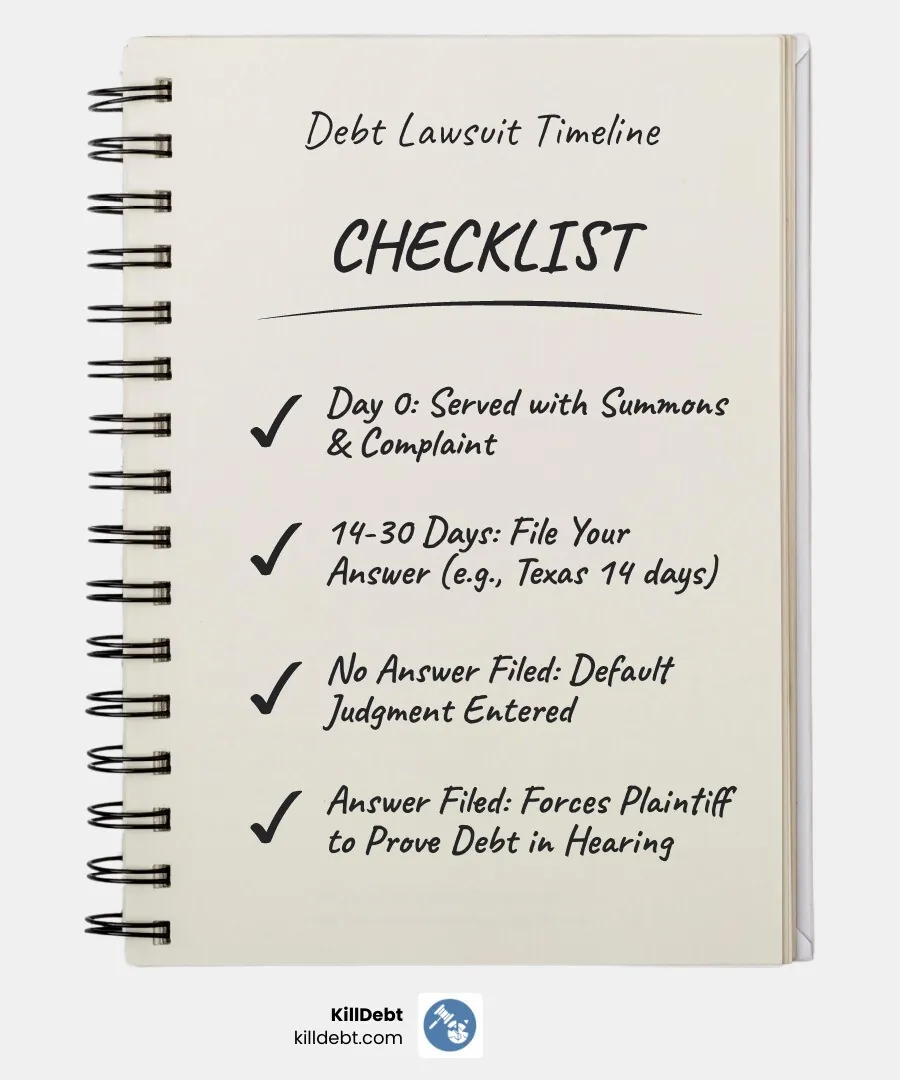
The very first thing we need to do is look at the clock. In law, deadlines are everything. If you miss your window to file a justice court debt answer, the court assumes you agree with everything the debt collector says.
The "clock" starts ticking the moment you are "served." This usually happens when a process server hands you the papers or, in some cases, when they are sent via certified mail. This packet contains two vital documents: the Summons (telling you that you’re being sued and where to go) and the Complaint (listing why they think you owe money). Understanding the difference between summons and complaint in debt collection lawsuit is your first step toward a solid defense.
For our friends in Florida and Michigan, the rules are specific:
If your deadline falls on a weekend or a court holiday, you usually have until the next business day. However, we always recommend aiming to file at least two days early. Life happens—traffic, printer jams, or long lines at the clerk's office shouldn't be the reason you lose a lawsuit. You can find more details on the time to respond to a debt collection lawsuit to ensure you stay on track.
We cannot stress this enough: filing an Answer is your shield. It protects your legal rights and prevents the "automatic loss" known as a default judgment.
When a judge signs a default judgment, the debt collector gets a "golden ticket" to your finances. They can:
By filing your justice court debt answer, you stop this runaway train. You are essentially telling the court, "Wait a minute. I want to see their proof." This forces the plaintiff (the person suing you) to actually provide evidence that the debt is yours, that the amount is correct, and that they have the legal right to collect it.
While the general process is similar, Florida and Michigan have their own flavors of justice court (often called County Court in Florida or District Court in Michigan).
In Florida, many small claims cases (debts under $8,000) involve a "Pre-trial Conference." You might be required to show up in person on a specific date listed on your summons rather than filing a written answer first. However, if the case is in County Court for a larger amount, that 20-day written response rule is king. Check out Facing a Debt Collection Lawsuit in Florida? Here's How to Respond (opens in a new tab) for localized tips.
In Michigan, the courts provide a standardized form called MC 03, Answer (Civil). This form makes it much easier for you to respond without needing a law degree. You can also find a Do-It-Yourself Civil Answer - Michigan Legal Help (opens in a new tab) tool that walks you through the process. Michigan is very strict about the 21-day limit, so don't dawdle!
Now, let's get into the nitty-gritty of the document itself. When you look at the Complaint, you’ll see numbered paragraphs. Your justice court debt answer needs to address these paragraphs one by one.

You have three main ways to respond to each allegation:
In many jurisdictions, you can use a General Denial. This is a short statement where you deny everything in the Complaint at once. This shifts the entire burden of proof onto the creditor. They must now prove every single element of their case to win.
An "Affirmative Defense" is a reason why, even if the facts in the Complaint are true, the plaintiff should still lose. These are the "Yes, but..." arguments of the legal world. You must include these in your initial Answer, or you might lose the right to use them later.
To make your defenses even stronger, consider filing a counter-affidavit when answering a debt collection lawsuit. A key to strong answer in a collection lawsuit is a solid counter-affidavit because it puts your side of the story into a sworn statement that the judge must consider.
Once your justice court debt answer is written and signed, you have to get it to the right people. This is a two-step dance: Filing and Serving.
You must deliver the original copy of your Answer to the Clerk of the Court where the lawsuit was filed.
You are legally required to give the other side a copy of your Answer.
For a more detailed walkthrough, check out our what to do when sued by a debt collector: complete first steps guide.
Sometimes, the court where you were sued isn't the right one.
Filing the Answer is the beginning, not the end. While you wait for your hearing date, you need to know what property is safe from creditors. Even if you lose the case, certain types of income and property are "exempt" under Florida and Michigan law.
| Asset Type | Florida Protections | Michigan Protections |
|---|---|---|
| Social Security | 100% Exempt | 100% Exempt |
| Wages | Head of Family (up to $750/wk) | Partial protection (varies) |
| Homestead | Unlimited value (with limits) | Up to $40,475 (varies by age) |
| Retirement (401k/IRA) | Generally 100% Exempt | Generally 100% Exempt |
| Veterans Benefits | 100% Exempt | 100% Exempt |
Listing these exemptions in your justice court debt answer is a smart move. It tells the creditor right away that even if they win, they might not be able to collect anything from you. This is often called being "judgment proof."
When the hearing date arrives, don't show up empty-handed. Bring:
Don't let debt collection lawsuit myths trip you up—like the idea that the case will just "go away" if you ignore it. Preparation is your best friend.
Filing a justice court debt answer is the single most important step you can take to protect your future. It moves you from a victim of the system to an active participant in your defense.
At KillDebt, we believe that everyone deserves a fair fight. That’s why we built ParkerGPT, our AI legal defense system. It’s trained on the real-world strategies of Brian Parker, an attorney with over 30 years of experience fighting debt collectors in Michigan and Florida.
Instead of staring at a blank page and guessing which boxes to check, you can use our platform to analyze your lawsuit documents and generate a court-ready response. And if you’re feeling nervous about the hearing? Our brand-new Court Tester lets you practice in an AI courtroom simulation. You can argue your motions in front of an AI judge and see how an AI opposing counsel might respond—all while a private AI co-counsel whispers winning strategies in your ear.
Don't let the debt collectors win by default. Take a deep breath, follow the steps in this guide, and remember: you have rights, and we are here to help you use them.
Ready to take the first step? Visit KillDebt today and let's get to work on your defense.

About the author
Brian Parker
I have over 30 years of experience defending consumers against debt collection lawsuits and have seen every tactic, threat, and pressure play that collectors use. Through KillDebt and ParkerGPT, I have systematized the proven defense strategies that actually work - so consumers can respond from a position of knowledge, not fear. My approach focuses on aggressive legal defense based on documented case success rather than false hope that leads to default judgments.