
News Break
One Simple Way to use ParkerGPT on KillDebt
May 15, 2026
Blog / News Break
Master how compel discovery debt case: Challenge collectors, force responses, win with motions, sanctions & timelines!
Knowing how to compel discovery in a debt case could be the single most important move you make after receiving a summons.
Here is the quick answer if you are facing a deadline right now:
How to Compel Discovery in a Debt Case (Quick Steps)
Discovery is how both sides in a lawsuit exchange evidence before the case goes to trial. The whole point is to prevent what lawyers call a "trial by ambush" - where one side blindsides the other with evidence they never saw coming.
In a debt collection lawsuit, discovery is especially powerful for defendants. Why? Because the plaintiff has to prove two things: that you owe the debt, and that the amount is correct. If they cannot produce the original contract, the chain of ownership, or accurate account records - their case falls apart.
The problem is that many debt collectors, especially third-party debt buyers, count on you not asking. They purchase debts in bulk, often with incomplete records, and they hope you will simply pay up or miss your court date.
Discovery flips that dynamic. It puts the burden back on them.
But what happens when the plaintiff ignores your discovery requests entirely - or buries you in vague objections? That is exactly when you need to know how to compel them to respond.
I'm Brian Parker, and for over 30 years I've been in courtrooms across the country forcing debt buyers and collection law firms to produce the evidence they'd rather keep hidden - and I built KillDebt specifically to show you how to compel discovery in a debt case the same way I do it. In this guide, I'll walk you through every step, from sending your first request to filing a motion that gets results.

When you are sued for a debt, the court doesn't just take the collector's word for it. They are required to play by the rules of evidence. Discovery is the formal "investigation" phase of your lawsuit. Think of it as a legal magnifying glass you get to hold over the plaintiff's claims.
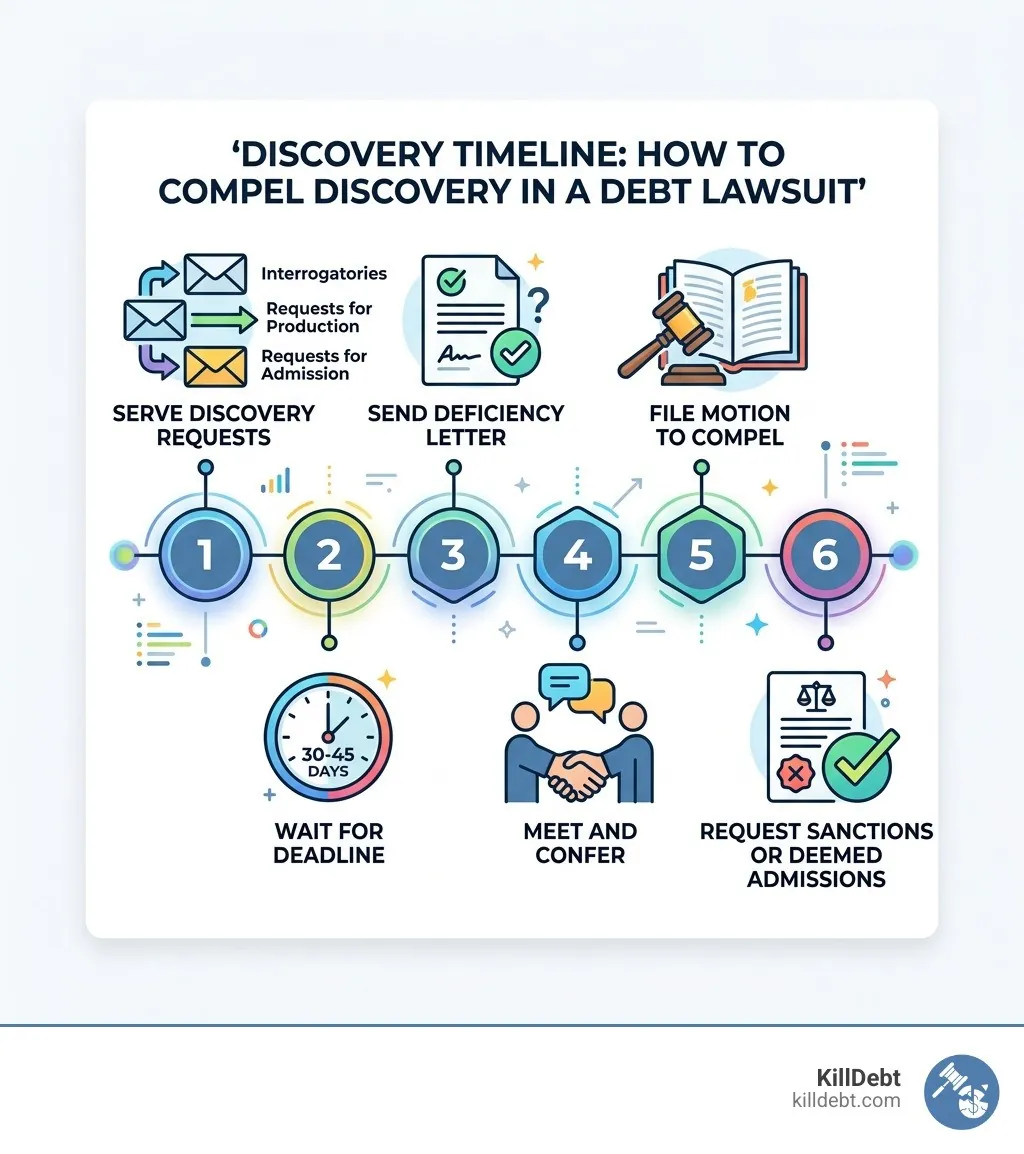
As we discuss in our debt lawsuit defense guide, discovery is not just a procedural hurdle; it is a defining moment where your narrative takes shape. There are three primary tools you will use to smoke out the truth:
Using these tools effectively is the core of Debtor Defense: Using Discovery & Interrogatories to Settle (opens in a new tab). By forcing the creditor to work hard and spend money on legal fees just to answer your questions, you make them much more likely to settle for pennies on the dollar or drop the case entirely.
The "Achilles' heel" for most debt buyers is the chain of assignment debt collector records. When a debt is sold from a bank to a debt buyer, and then perhaps to another debt buyer, there must be a paper trail-a "chain of title"-linking the original creditor to the person suing you.
In your discovery requests, you should specifically demand:
If they can't prove they own the debt, they have no "standing" to sue you. It's like someone trying to evict you from a house they don't own.
Timing is everything. In May 2026, court dockets are as busy as ever, and judges have little patience for those who miss deadlines.
According to How the Discovery Process Works in Florida Civil Lawsuits (opens in a new tab), documenting these dates is crucial because you cannot move to compel until the clock has officially run out.
You've sent your requests. You've waited the 30 or 45 days. And... nothing. Or perhaps you got back a stack of papers where every single answer says, "Plaintiff objects to this request as unduly burdensome."
Now what? You don't just run to the judge immediately. Courts expect you to act like a "reasonable adult in the room" first. This is known as the "Meet and Confer" requirement.
Before you can file a motion, you must make a "good faith effort" to resolve the dispute. This usually involves:
Debt collectors love "boilerplate objections." These are generic, copy-pasted responses that don't actually address your request. Look out for:
If you see these, you are looking at non-compliance. Our fight debt collection lawsuit complete guide emphasizes that pointing out these evasive tactics is how you win over a judge.
This is the "nuclear option" for defendants. Under Rule 36 (in both the Federal and Florida/Michigan rules), if a party fails to respond to a Request for Admission within 30 days, the matter is automatically admitted.
Imagine you sent a request saying: "Admit that the Plaintiff has no evidence that the Defendant signed a contract." If they ignore you for 31 days, the court legally accepts that statement as 100% true.
You can then use these "deemed admissions" to file a motion for summary judgment, essentially asking the judge to end the case in your favor right then and there. This is why a sample answer to debt collection lawsuit should always be followed up with aggressive discovery.
If the "Meet and Confer" fails, it is time to draft your Motion to Compel Discovery. This is a formal request asking the judge to issue an order. If the plaintiff ignores a judge's order, they face serious consequences.
| Tool | What it is | Goal in Motion to Compel |
|---|---|---|
| Interrogatories | Written questions | Force a sworn answer to "Who owns this?" |
| Requests for Production | Document demand | Force them to provide the actual contract/ledger. |
| Requests for Admission | True/False statements | Force them to admit they lack evidence. |
Steps to Drafting:
For those in the Sunshine State, the Motion to Compel Discovery Responses-Bankruptcy and Adversary | U.S. Bankruptcy Court Middle District of Florida (opens in a new tab) provides a great procedural baseline for how these motions should look.
A judge isn't going to take your word for it that the collector is being difficult. You need to provide an Exhibit List. Your motion should include:
Attaching these documents is the key to strong answer in a collection lawsuit solid counter affidavit; it shows the court you are organized and serious.
When you finally get to the hearing for your Motion to Compel, the plaintiff's lawyer will likely show up with excuses. They might claim "Attorney-Client Privilege" or "Trade Secrets" (common when you ask for their internal "manuals" on how they collect debt).
How to defeat these:
In Florida, Rule 1.380 is your best friend. It explicitly covers "Failure to Make Discovery; Sanctions." In Michigan, similar rules allow the court to protect you from "abusive discovery practices."
If the plaintiff is being particularly stubborn, you can ask for Sanctions. Under RULE 1.380. FAILURE TO MAKE DISCOVERY; SANCTIONS (opens in a new tab), the court has the power to:
We often recommend filing a counter affidavit when answering a debt collection lawsuit alongside these motions to further put the plaintiff on the defensive.
Navigating a debt lawsuit can feel like you're playing a game where the other side wrote the rules. But how to compel discovery in a debt case is the rule that levels the playing field. It forces the debt collector to step out of the shadows and prove their claims with actual evidence-something many of them simply cannot do.
At KillDebt, we believe you shouldn't have to be a millionaire to have a world-class defense. Our platform is powered by ParkerGPT, an AI trained on the real-world strategies I've used for over 30 years. It doesn't just give you "templates"; it analyzes your specific court filings to identify weaknesses in the collector's case.
And if you're nervous about heading into court? We just rolled out the Court Tester. It's an AI courtroom simulation where you can upload your motion and practice arguing it in front of an AI judge and opposing counsel. You'll even have a "private AI co-counsel" whispering strategy tips that only you can see.
Don't let a debt collector's silence win them a judgment. Force the answers, demand the proof, and take control of your financial future.
Learn more about how KillDebt can help you compel discovery and win your case here.

About the author
Brian Parker
I have over 30 years of experience defending consumers against debt collection lawsuits and have seen every tactic, threat, and pressure play that collectors use. Through KillDebt and ParkerGPT, I have systematized the proven defense strategies that actually work - so consumers can respond from a position of knowledge, not fear. My approach focuses on aggressive legal defense based on documented case success rather than false hope that leads to default judgments.