
News Break
How to Handle a Default Judgment and Negotiate with Collectors
July 8, 2026
Blog / News Break
Learn how a validation of debt letter stops collectors and forces proof of your debt within 30 days.
A validation of debt letter is the written request you send to a debt collector demanding they prove the debt is real, the amount is accurate, and they have the legal right to collect from you.
Here's what you need to know right now:
"It is often not clear what debt a collector is contacting the consumer about." — National Consumer Law Center
That confusion is by design. Debt collectors — especially third-party buyers who purchased your account for as little as 4 cents on the dollar — often have incomplete records. A properly sent validation letter forces them to prove what they claim, or walk away.
Over 35% of debt collection lawsuits filed by third-party buyers in Georgia bankruptcy courts in 2024 were dismissed because buyers couldn't prove they owned the debt. That's how powerful this one letter can be.
And yet, 70% of consumers who receive collection notices don't realize they must act in writing within that 30-day window to trigger the collector's legal obligation to stop.
I'm Brian Parker, and for over 30 years I've been defending consumers against debt collectors, debt buyers, and collection law firms — and the validation of debt letter is one of the first weapons I reach for. This guide distills everything I've learned about making it work.
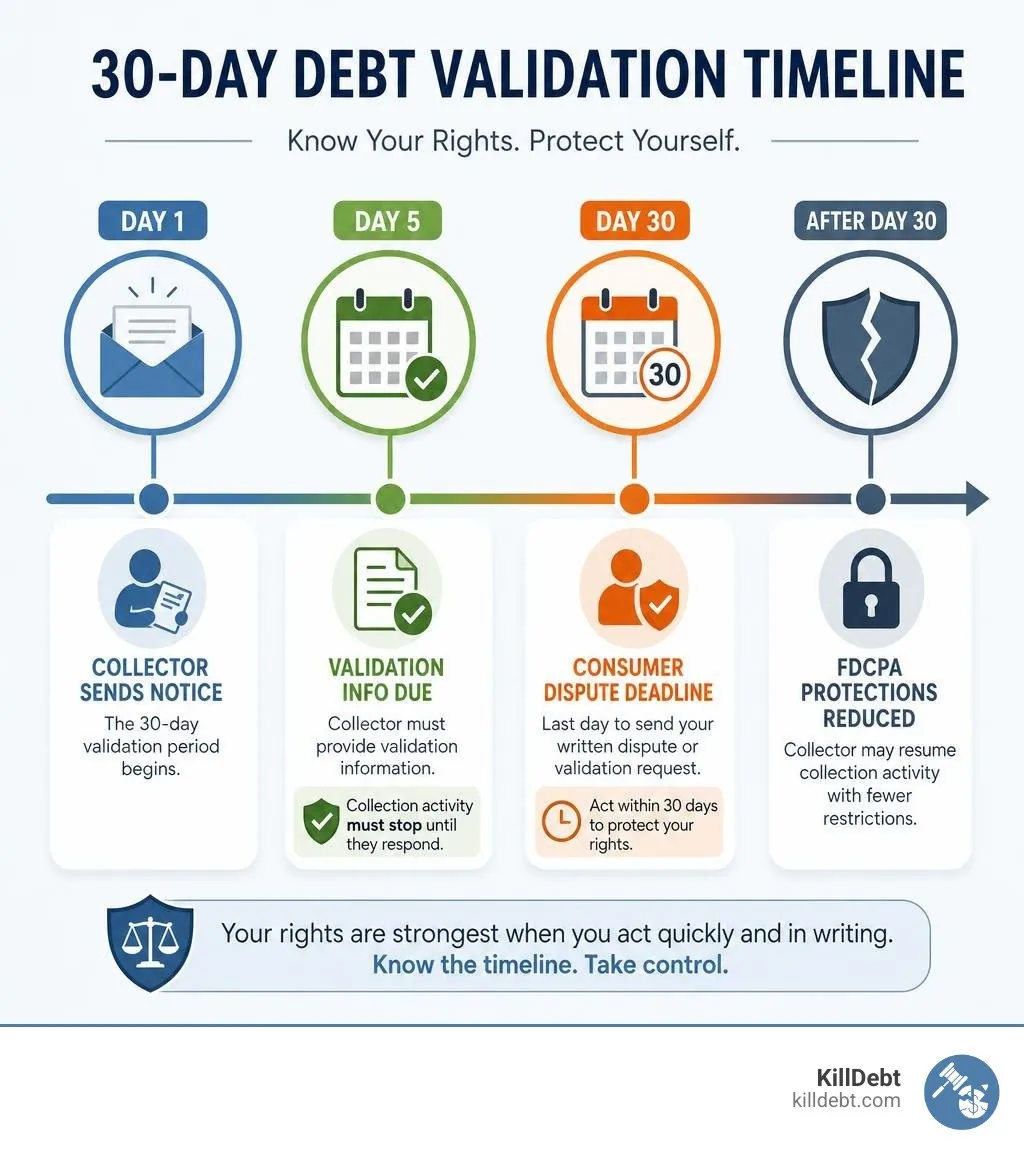
When you receive a collection letter, your natural reaction might be panic, anger, or the urge to ignore it entirely. But the Fair Debt Collection Practices Act (FDCPA) gives you a powerful shield. Under FDCPA Section 809, debt validation is your right to demand that a third-party debt collector prove you actually owe the money before they take another step.
Think of it as a legal pause button. When you send a validation of debt letter within the 30-day window, you shift the burden of proof entirely onto the collector's shoulders. They cannot call you, write to you, or report the debt as undisputed on your credit report until they mail you verification. For many debt buyers, obtaining the actual contract or complete payment history is too expensive or impossible, meaning they will simply close your file and walk away.
Using Debt Validation Letters: Your First Line of Defense Against Collectors ensures you do not inadvertently admit to a debt you do not owe, restart an expired statute of limitations, or make payments to an unauthorized entity.
There is a dangerous point of confusion for many consumers: the difference between the collector’s Validation Notice and your Validation Letter (also called a dispute or verification request). Think of this dynamic like a tennis match.
The Serve (The Collector's Notice): Under federal law and CFPB Regulation F, a debt collector must provide you with specific validation information. This must be sent either in their initial communication or within five days of first contacting you. According to the CFPB's What information does a debt collector have to give me about a debt ... (opens in a new tab), this notice must contain:
The Return (Your Validation Letter): Once you receive their notice, you return the serve by sending your own written dispute. This is where you state that you dispute the debt and demand verification.
State laws add extra layers of protection. For instance, if you live in Michigan, MCL - Section 339.918 - Michigan Legislature (opens in a new tab)sets strict guidelines on what a licensed collection agency must provide to consumers, reinforcing your right to written verification of the debt.
To stop aggressive collection agencies in their tracks, your letter must be precise, professional, and legally grounded. It should not be an emotional plea or an explanation of your financial hardships. In fact, admitting any liability or explaining why you cannot pay can actually hurt your case.
| Component | Collector's Validation Notice | Your Written Dispute & Verification Request |
|---|---|---|
| Who Sends It | The Debt Collector | The Consumer (You) |
| Legal Basis | FDCPA § 809(a) & Regulation F | FDCPA § 809(b) |
| Purpose | Disclose basic details of the alleged debt | Formally dispute the debt and demand documentation |
| Consequence of Failure | Collector faces FDCPA violations and fines | Collector can assume the debt is valid and sue |
Under FDCPA Section 809(b), once a collector receives your timely written dispute, they must immediately cease all collection activities. This halt remains in place until they acquire and mail verification of the debt to you. If they fail to validate but continue calling or writing, they are in direct violation of federal law and can be sued for statutory damages.
Your letter should be a clinical, direct assertion of your rights. To protect yourself, make sure your letter includes:
To get started immediately, you can download a customizable Debt Validation Letter Template. If you reside in Florida or Michigan, utilizing state-specific templates like the Florida Free Debt Validation Letter - BoloForms (opens in a new tab)or the Michigan Free Debt Validation Letter - BoloForms (opens in a new tab)will ensure your letter aligns perfectly with local consumer protection statutes.
For additional inspiration and alternative phrasing, you can also review this [PDF] Sample Debt Validation Letter (opens in a new tab)or explore other Free Debt Validation and Credit Dispute Letters (opens in a new tab).
Third-party debt buyers purchase massive portfolios of old debts for pennies on the dollar. These portfolios are often transferred as simple spreadsheets containing nothing more than a name, phone number, and an alleged balance. They rarely contain the actual paperwork.
When drafting your letter, do not settle for a generic printout of a balance. Demand the following specific items to expose their weak documentation:
You can see how these demands look in a finished draft by reviewing our Example Debt Validation Letter. To understand how to evaluate the collector's response when they try to send you a flimsy, automated one-page printout, consult the Verification Proof of Debt Letter Template & Expert Guide | Salestaxcel (opens in a new tab).
Successfully disputing a debt requires a methodical approach. You must treat this process as if you are building a legal case for court—because if the collector violates your rights, you just might be. Follow the Debt Validation Dispute Process to keep your defense organized.
Keep a dedicated folder containing every piece of mail you receive, the envelopes (which show postmark dates), copies of your letters, and proof of delivery.

How you send your letter is just as important as what is written inside. If a collector claims they never received your dispute, your FDCPA protections are incredibly difficult to enforce in court.
USPS Certified Mail with Return Receipt Requested is the gold standard for consumer protection. While some online guides suggest using standard Priority Mail with tracking, Certified Mail provides a physical "green card" signed by the recipient or a digital signature record. This is undeniable legal proof of delivery that a judge will accept without hesitation.
Yes, it costs roughly $10 to $11, but that receipt is your insurance policy. It proves exactly when the 30-day clock stopped for the collector and when their obligation to halt collection efforts began.
Once the tracking number shows the collector received your validation of debt letter, several critical legal protections are activated:
To understand how this plays out in real-world scenarios, read more about the Letter of Debt Validation and what it means for your long-term financial peace. For a comprehensive legal overview of your rights during this post-mailing phase, check out What Is Debt Validation Letter (Complete Guide For 2026) - Morgan & Morgan (opens in a new tab).

When a debt collector ignores your timely validation letter and continues to collect, they aren't just being annoying—they are breaking federal law.
Under the FDCPA, continuing collection activity without validating a timely disputed debt is a clear statutory violation. If you take them to court, you can recover:
Additionally, you can file a formal complaint with the Consumer Financial Protection Bureau (CFPB) and your state’s Attorney General. The CFPB typically forces a response from the collector within 15 days, often resulting in the collector closing the account permanently to avoid regulatory fines.
When you receive a validation notice, look at it with a critical eye. Many debt collectors send notices riddled with errors because they assume you won't check. Use the insights in How to Write a Debt Validation Letter: What to Include - LegalClarity (opens in a new tab)to spot these common warning signs:
When a debt collector targets you, knowledge is your best defense—but execution is what wins cases. Sending a validation of debt letter is your opening move, but if the collector decides to sue, you need professional-grade tools to fight back in court without spending thousands on a traditional attorney.
At KillDebt, we provide a DIY legal defense system powered by ParkerGPT, an advanced AI trained specifically on consumer debt law and real-world court strategies developed over 30+ years by veteran consumer defense attorney Brian Parker. Unlike generic template builders, ParkerGPT analyzes your actual lawsuit documents, exposes the collector's evidentiary weaknesses, and generates court-ready answers and motions tailored to your specific case.
Ready to take your defense to the courtroom? We recently rolled out the Court Tester—an AI-powered courtroom simulator built on your actual case filings. Upload your documents, and within minutes, you can practice arguing your motions in front of an AI judge, facing AI opposing counsel, while your private AI co-counsel whispers winning strategies only you can see.
Don't let debt collectors bully you into a default judgment. Empower yourself, protect your hard-earned money, and fight back with the ultimate AI-driven legal defense system.
Protect your rights with KillDebt and explore our straightforward, affordable options on our Pricing Page. Learn more about our mission and ParkerGPT on our About Page, and watch real-world defense strategies in action on the KillDebt YouTube Channel.
This educational content is based on general legal principles and my experience in debt collection defense. It is provided for informational purposes only and does not constitute legal advice. Laws vary by state and by local court. For specific legal advice, consult a qualified attorney licensed in your jurisdiction. No attorney-client relationship is created by reading this guide.
Critical Multi-State Variations: FDCPA applies uniformly at the federal level, but state consumer protection laws may provide additional rights and remedies. Statute of limitations periods vary significantly by state and debt type. What constitutes sufficient debt validation varies in practice across jurisdictions. State-specific rules on call frequency, written notice requirements, and permissible collector conduct may differ from federal minimums.

About the author
Brian Parker
I have over 30 years of experience defending consumers against debt collection lawsuits and have seen every tactic, threat, and pressure play that collectors use. Through KillDebt and ParkerGPT, I have systematized the proven defense strategies that actually work - so consumers can respond from a position of knowledge, not fear. My approach focuses on aggressive legal defense based on documented case success rather than false hope that leads to default judgments.