
News Break
How to Use Homestead Exemptions to Stop Wage Garnishment in Its Tracks
June 12, 2026
Blog / News Break
Master the debt validation dispute process with this step-by-step guide to protect your rights and stop collection.
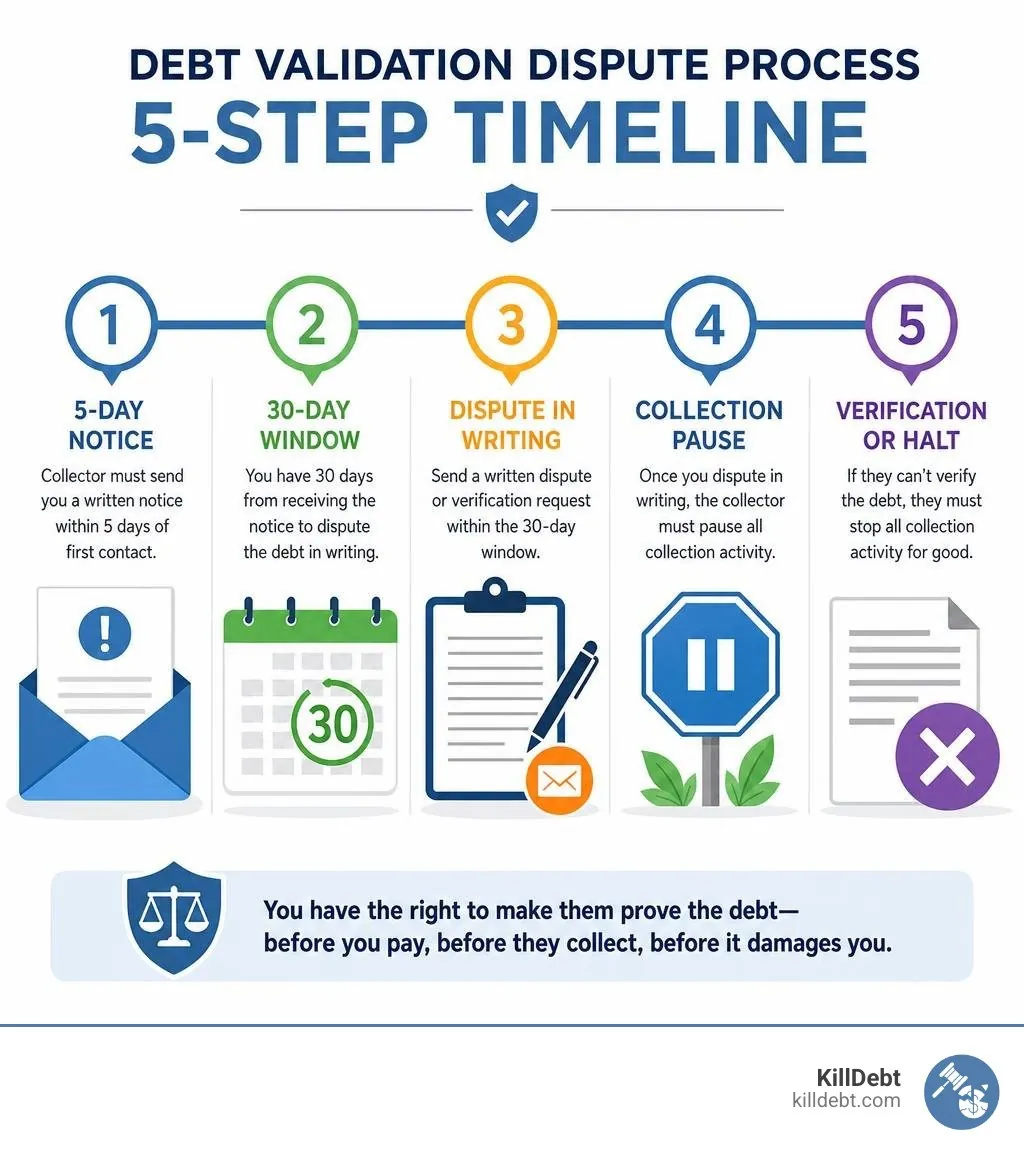
The debt validation dispute process is one of the most powerful — and most overlooked — tools in federal consumer protection law. Here is how it works at a glance:
The debt validation dispute process in 4 steps:
Getting a letter or call from a debt collector is stressful. Most people either panic and pay, or panic and ignore it. Both are mistakes.
Here is the thing: debt collection is a $20 billion industry where debts are bought and sold constantly — often for as little as four cents on the dollar. That means the company contacting you may have never seen your original contract. They may have the wrong amount. The wrong person. A debt you already paid.
You have a federal right to make them prove it before you do anything else.
And if you have already received a summons or a court deadline, that urgency is even greater. Acting fast — and acting correctly — can be the difference between a default judgment and a real defense.
I'm Brian Parker, and for over 30 years I've been in courtrooms fighting debt buyers, collection agencies, and collection law firms — and I've seen the debt validation dispute process used to stop collectors in their tracks, even when the odds looked terrible. I built KillDebt to give you the same tools and strategies I've used to protect thousands of consumers, without the $1,500+ attorney bill.
IMPORTANT LEGAL DISCLAIMER
This educational content is based on general legal principles and my experience in debt collection defense. It is provided for informational purposes only and does not constitute legal advice. Laws vary by state and by local court. For specific legal advice, consult a qualified attorney licensed in your jurisdiction. No attorney-client relationship is created by reading this guide.
Critical Multi-State Variations: FDCPA applies uniformly at the federal level, but state consumer protection laws may provide additional rights and remedies. Statute of limitations periods vary significantly by state and debt type. What constitutes sufficient debt validation varies in practice across jurisdictions. State-specific rules on call frequency, written notice requirements, and permissible collector conduct may differ from federal minimums.
To successfully navigate the debt validation dispute process, you must understand the difference between two critical documents that sound almost identical but serve completely opposite purposes.
Many consumers confuse the "validation notice" with a "verification request." Think of them as two sides of the same legal coin under the Fair Debt Collection Practices Act (FDCPA).
| Feature | Validation Notice | Verification Request (Dispute) |
|---|---|---|
| Who Sends It? | The debt collector sends it to you. | You send it to the debt collector. |
| Why Is It Sent? | Required by federal law to disclose debt details. | To dispute the debt and force the collector to prove it. |
| The Deadline | Within 5 days of their initial communication. | Within 30 days of your receipt of their notice. |
| Legal Basis | FDCPA Section 809(a) (opens in a new tab) | FDCPA Section 809(b) (opens in a new tab) |
| Impact | Triggers your 30-day clock to dispute. | Forces an immediate pause on all collection activity. |
When a third-party debt buyer purchases a portfolio of past-due accounts for pennies on the dollar, they rarely receive the actual signed contracts, comprehensive payment histories, or statements. They usually buy nothing more than a giant electronic spreadsheet filled with basic names, addresses, and dollar figures.
By initiating the dispute process, you are testing whether they actually have the legal right and documentation to collect that money. If you want to dive deeper into why these letters are your best shield, read our detailed guide on Debt Validation Letters: Your First Line of Defense Against Collectors.
Under federal law, a debt collector cannot just call you out of the blue and demand cash without putting the details in writing. Within five days of their first contact with you, they must send you a formal written document known as a Validation Notice.
According to the Consumer Financial Protection Bureau (CFPB), this notice must contain:
If they fail to send this notice within five days of first contact, they are in direct violation of federal law.
The beauty of the debt validation dispute process is that it flips the script. It instantly shifts the burden of proof off your shoulders and places it squarely on the debt collector.
When you send a timely written dispute, the collector is legally required to halt all collection efforts. This means:
For anyone facing urgent threats of wage garnishment or a collection lawsuit, this legal "time-out" is incredibly valuable. It gives you the breathing room needed to assess the situation, gather your records, and build a defense.
Now that you know your rights, let's look at how to execute this process step-by-step. To make this work, you must be precise, keep immaculate records, and use certified mail. If you want a quick, comprehensive master template, you can read our breakdown of the Letter of Debt Validation.
Do not take the collector's word for anything. Treat their validation notice like a rough draft that is full of mistakes. Grab your own financial records and compare them. Look closely for these common errors:
Incorrect Amounts: Are they tacking on illegal interest, mysterious "processing fees," or collection costs that were never authorized in your original contract?
Identity Theft/Wrong Person: Is this debt actually yours, or do you share a similar name with the actual debtor? Debt buyers frequently mix up consumer files.
Debts Already Paid: Did you settle this debt years ago?
Time-Barred Debt (Statute of Limitations): Every state has a legal time limit for how long a creditor can sue you to collect a debt.
Your letter does not need to be a 10-page legal brief. In fact, keeping it simple and direct is highly effective. You do not want to volunteer extra personal or financial information that the collector can later use against you.
Your letter should state that you are exercising your rights under FDCPA Section 809(b) to dispute the debt and request verification. Specifically, ask them to provide:
Avoid writing a long story about why you fell behind on your bills. Simply state: "I am writing to formally dispute the validity of this alleged debt and request verification of the same." To save time, you can download a pre-formatted, legally sound Debt Validation Letter Template.
Once your letter is ready, do not just drop it in a standard mailbox with a regular stamp. If the collector claims they "never received it," your 30-day dispute window will close, and you will lose your strongest legal leverage.

You must send your letter via USPS Certified Mail with Return Receipt Requested (the physical green card or the electronic return receipt).
This gives you:
Keep a physical folder containing a copy of the exact letter you sent, the certified mail receipt, and the signed green card once it arrives back in your mailbox. If you want to see what a completed version looks like, check out this Example Debt Validation Letter.
Once the debt collector receives your certified letter, the ball is in their court. Under federal regulation § 1006.38 Disputes and requests for original-creditor information. | Consumer Financial Protection Bureau (opens in a new tab), they must immediately cease all collection activities.
They cannot call you, they cannot write to you, and they cannot report the debt to credit bureaus. If they have already reported the debt, they must notify the credit reporting agencies that the account is actively disputed. If you suspect they are ignoring your letter, you should send a Dispute Invalid Debt Notice to protect your credit profile.
What if you send multiple letters? Under CFPB rules, if a dispute is "duplicative" (meaning you send the exact same dispute repeatedly without providing any new, material information), the collector can refuse to respond, but they must notify you of their reasoning. Always include new evidence (like a bank statement or a settled receipt) if you are disputing a second time.
Let's look at the two potential paths your dispute will take.
If the collector manages to dig up documentation and sends it to you, do not panic. First, analyze what they sent.
Under current federal court rulings, the legal standard for "verification" is surprisingly low. The collector does not necessarily have to provide a perfectly preserved original contract signed in ink. In many jurisdictions, they only need to provide written confirmation from the original creditor that the amount matches what is in their files.
However, if they do send verification, review it closely:
If the debt is verified and accurate, you have several options: you can negotiate a settlement for a fraction of the total balance, set up a payment plan, or prepare a formal court defense if they decide to file a lawsuit. If you are already facing a court summons, you must file a formal written "Answer" with the court within your state's deadline (usually 20 days in Florida and 21 days in Michigan) to avoid losing by default.
This is where the magic happens. Because debt buyers buy portfolios so cheaply, they often find that retrieving original documents from years ago is simply too expensive or entirely impossible.
If they cannot validate the debt, they have two choices:
If they fail to validate the debt but continue to call you, write to you, or report the unverified debt to credit bureaus, they are violating the FDCPA. Under federal law, you can sue a non-compliant debt collector for up to $1,000 in statutory damages, plus your actual damages and attorney's fees.
Navigating the debt validation dispute process can feel overwhelming, but it is your absolute best tool for leveling the playing field against aggressive collection agencies. Debt collectors are businesses looking for the easiest path to a payday. When you stand up, demand proof, and assert your federal rights, you make collecting from you highly unprofitable.
If you are currently facing a collection letter, a threatening phone call, or a terrifying court summons in Florida or Michigan, you do not have to fight this battle alone — and you do not need to spend thousands of dollars on a defense attorney.
At KillDebt, we provide a DIY legal defense system powered by ParkerGPT — an AI trained specifically on consumer debt law and real courtroom strategies developed over 30+ years by veteran consumer defense attorney Brian Parker.
Unlike generic AI tools, KillDebt analyzes your actual lawsuit filings, identifies the collector's legal weaknesses, and generates court-ready responses with simple, step-by-step instructions.
And if you want to practice your defense before stepping foot in front of a judge, our brand-new Court Tester tool allows you to run a courtroom simulation. You can upload your actual filings and, within minutes, argue your motion in front of an AI judge, face off against AI opposing counsel, and receive real-time, private strategy whispers from an AI co-counsel.
Take control of your financial future today. Use KillDebt to build your defense and stop collectors in their tracks.
IMPORTANT LEGAL DISCLAIMER
This educational content is based on general legal principles and my experience in debt collection defense. It is provided for informational purposes only and does not constitute legal advice. Laws vary by state and by local court. For specific legal advice, consult a qualified attorney licensed in your jurisdiction. No attorney-client relationship is created by reading this guide.
Critical Multi-State Variations: FDCPA applies uniformly at the federal level, but state consumer protection laws may provide additional rights and remedies. Statute of limitations periods vary significantly by state and debt type. What constitutes sufficient debt validation varies in practice across jurisdictions. State-specific rules on call frequency, written notice requirements, and permissible collector conduct may differ from federal minimums.

About the author
Brian Parker
I have over 30 years of experience defending consumers against debt collection lawsuits and have seen every tactic, threat, and pressure play that collectors use. Through KillDebt and ParkerGPT, I have systematized the proven defense strategies that actually work - so consumers can respond from a position of knowledge, not fear. My approach focuses on aggressive legal defense based on documented case success rather than false hope that leads to default judgments.