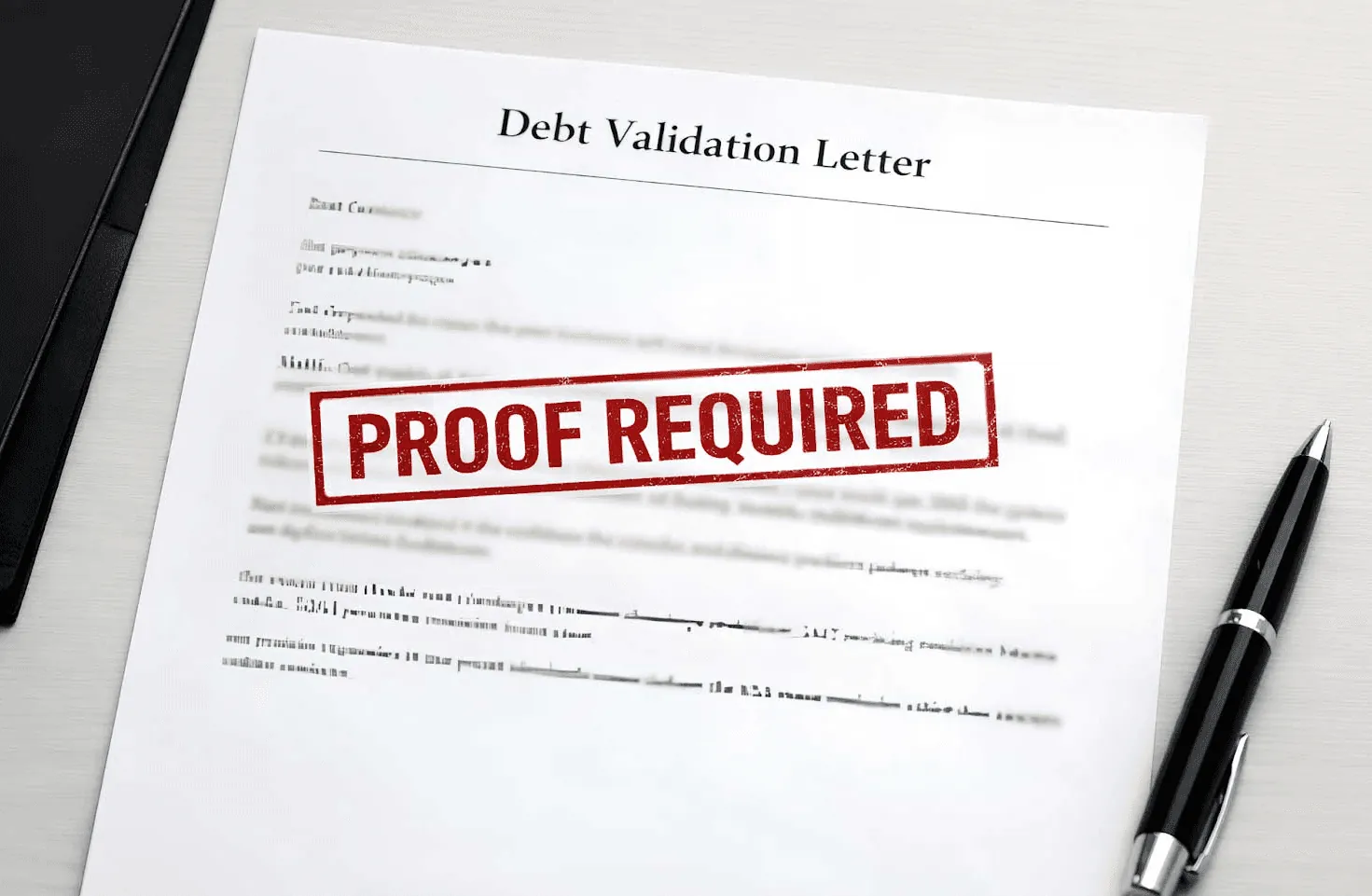
Understanding Your FDCPA Validation Rights
The Federal Legal Foundation
Under 15 U.S.C. § 1692g, a debt collector must send you a written validation notice within five days of its initial communication. This requirement is mandatory. It establishes the procedural framework governing all further collection activity.
That validation notice must disclose:
The amount of the alleged debt
The name of the creditor to whom the debt is currently claimed to be owed
A statement that the debt will be assumed valid unless you dispute it within thirty days
Notice that a written dispute within thirty days requires the collector to obtain verification
A statement that the name of the original creditor will be provided upon written request if different from the current claimant
Your 30 Day Validation Window
You have thirty days from receipt of the validation notice to dispute the debt in writing. This period is not a courtesy. It is a statutory leverage point.
Once a written dispute is sent:
Collection activities must cease if you dispute in writing
They cannot report to credit bureaus until providing adequate validation
Legal action is prohibited until they validate the debt
All collection communications must stop except to provide validation or notify of legal action
This thirty day window is your opportunity to force the collector to prove its case before it is allowed to escalate pressure.
The Validation Requirement
When a debt is disputed in writing, the burden shifts to the collector. Confirmation that an account exists in its system is not enough.
The Debt collector must:
Cease collection activities until validation is provided
Obtain verification of the debt from the creditor
Provide you with validation showing they have the right to collect
Include the original creditor information if different from current claimant
In practice, this is where most debt buyers fail. They purchase accounts with limited data, not litigation ready documentation. Debt validation exposes that gap early, before pressure tactics or lawsuits begin.
The Strategic Power of Validation Letters
Why Validation Letters Work
Debt collectors, especially debt buyers, routinely fail adequate validation because they acquire charged off accounts without litigation ready documentation. What they typically receive are electronic data files, not complete account records. As a result, they often lack:
Original signed agreements between you and the creditor
Complete account statements showing transaction history
Proper assignment documentation establishing ownership of your specific account
Authentication witnesses with personal knowledge of the account
This structural deficiency is not accidental. It is built into the debt buying model.
The Business Model Problem
Debt buyers operate on volume, not proof. Their model assumes that most consumers will not respond to collection attempts, allowing cases to move forward with minimal documentation. When you send a written validation demand, you interrupt that model and force them into evidentiary territory they are not prepared to enter.
This creates immediate strategic advantages:
Collection activity must pause during the validation period
Documentation gaps surface early
Settlement leverage increases when validation cannot be produced
FDCPA violations frequently occur during inadequate or misleading validation attempts
Validation works because it shifts the burden before escalation begins.
The Credit Reporting Leverage
When debt buyers appear on your credit report without providing proper validation notice, additional leverage is created under both federal statutes.
Under FDCPA § 1692e(8), a debt collector may not communicate credit information that is known or should be known to be disputed without disclosing the dispute.
Under the Fair Credit Reporting Act, furnishers must conduct reasonable investigations of disputed information and must delete or correct information that cannot be verified.
Improper validation combined with inaccurate or disputed credit reporting often produces parallel FDCPA and FCRA violations.
Crafting Effective Validation Letters
Essential Elements of Validation Demands
A validation letter should not ask general questions. It should demand specific proof tied to ownership, amount, and legal authority.
1. Ownership Documentation
Complete chain of title from the original creditor to the current collector
Assignment documents identifying your individual account, not generic portfolio sales
Proof of standing to collect this specific debt
2. Account Documentation
Original signed agreement or governing contract
Complete account statements showing all transactions
Documentation of default and charge off
3. Amount Verification
Itemization of principal, interest, fees, and costs
Legal authorization for all claimed amounts
Explanation of how any additional charges were calculated
4. Legal Compliance
Proof of required state licensing, if applicable
Documentation supporting any filed lawsuit or service claims
Evidence of compliance with applicable state and federal collection laws
Strategic Validation Language
Effective validation letters assert legal rights. They do not negotiate, soften demands, or invite discussion. The language you use determines whether a collector takes your dispute seriously or responds with boilerplate. Precision matters because vague requests produce vague responses.
Examples of strong validation language include:
Invoke specific FDCPA rights: "Under 15 U.S.C. § 1692g, I dispute this alleged debt and demand validation..."
Request complete documentation: "Provide complete chain of title documentation showing your ownership of this specific account..."
Challenge standing: "Demonstrate your legal standing to collect this debt through proper assignment documentation..."
Demand account-level proof: "Provide original signed agreements and complete account statements, not computer printouts or summaries..."
The Combined FDCPA and FCRA Strategy
The strongest approach pairs validation demands with credit reporting challenges.
This strategy includes:
An FDCPA validation letter demanding proof of ownership and amount
An FCRA dispute challenging the accuracy and completeness of credit reporting
Impermissible purpose challenges questioning the collector’s access to your credit file
Documentation demands that require proof of every element of the claimed debt
Used together, these statutes force debt collectors into a position where silence, mistakes, or incomplete responses all work in your favor.
What Constitutes Adequate Validation
Inadequate Validation Attempts
From my analysis of thousands of validation responses, debt collectors most often respond with materials that look official but do not satisfy FDCPA requirements.
Typical inadequate validation includes:
Generic affidavits signed by individuals with no personal knowledge of your account
Computer-generated printouts instead of original account statements
Bills of sale that reference bulk portfolios without assigning your specific account
Incomplete chains of title with missing or undocumented ownership transfers
These responses do not establish legal ownership or amount accuracy and do not satisfy the FDCPA’s validation requirement. They create grounds to challenge continued collection activity.
Proper Validation Standards
Adequate validation requires account-level proof, not summaries or assumptions.
Proper validation should include:
Original signed agreements between you and the original creditor
Complete account statements showing all transactions from account opening through charge-off
Specific assignment documents transferring your individual account, not just portfolio sales
Authorized signatures on all assignment and transfer documents
The controlling standard is simple: the collector must prove both that the debt is owed and that it has the legal right to collect it.
Authentication Requirements
Even when documents are produced, they must be admissible and reliable.
Proper authentication requires:
Witnesses with personal knowledge of account creation and maintenance
Valid business record procedures supporting the documents
A clear chain of custody for transferred account records
Proof that individuals signing assignments were authorized to do so
Documents that cannot be authenticated are legally insufficient, even if they appear complete.
Timing and Procedural Requirements
The Critical 30-Day Period
Validation rights under the FDCPA are time sensitive and procedural. The statute creates a defined window during which the collector’s ability to act is restricted unless and until it can substantiate the debt.
During this period:
You have 30 days from receipt of the validation notice to dispute the debt in writing
Verbal disputes do not trigger validation obligations
Collection must cease once a proper written dispute is received
Credit reporting is prohibited until adequate validation is provided
What Happens During the Validation Period
Once a written dispute is sent and validation is pending:
All collection activity must stop except to provide validation
No collection calls or letters are permitted
Credit reporting must pause
Legal action must not proceed until validation is completed
Any deviation creates potential FDCPA violations.
Post-Validation Options
After receiving a validation response, you should evaluate it strategically:
Challenge inadequate validation that fails to meet statutory standards
Identify FDCPA violations within the validation response itself
Use documentation gaps as leverage in settlement discussions
Prepare legal defenses based on ownership and proof failures
If a lawsuit follows inadequate validation, state discovery rules may be used to compel full production and expose evidentiary defects.
State courts have varying discovery rules and timelines for compelling document production and admission requests that can supplement federal validation requirements. Consult with an attorney familiar with your state's discovery procedures for specific enforcement mechanisms.
Common Validation Mistakes by Collectors
FDCPA Violations During Validation
Debt collectors frequently commit violations during the validation process, including:
Continuing collection while validation is pending (§ 1692g)
Providing responses that fail to prove ownership or amount accuracy (§ 1692g)
Making false ownership representations in validation materials (§ 1692e)
Reporting disputed debts without dispute notation (§ 1692e(8))
Including collection language or Mini-Miranda warnings in formal legal responses (§ 1692e(11))
The “Verification” vs. “Validation” Confusion
Collectors often attempt to substitute verification for validation:
Verification: Confirming the account exists in their internal system
Validation: Proving legal ownership and amount accuracy with admissible evidence
FDCPA requires validation, not mere verification of account information in their computer system.
Timing Violations
These timing failures frequently convert weak collection cases into strong FDCPA claims.
Common timing-related violations include:
Continuing collection during the 30-day dispute period
Failing to respond to a written dispute with proper validation
Resuming collection before validation is complete
Reporting to credit bureaus without completing the validation process
Strategic Use of Validation Failures
When a debt collector fails to provide adequate validation after a proper written dispute, the balance of leverage shifts. Validation failures restrict what the collector is legally allowed to do next and open multiple strategic paths for the consumer:
Collection activity must remain suspended until proper validation is provided
Settlement negotiations become consumer favored when proof gaps are exposed
FDCPA counterclaims become available based on validation violations
Case dismissal may be possible if collection or litigation proceeds without validation
Enforcement and Jurisdiction Considerations
FDCPA validation requirements apply uniformly as federal law, but enforcement procedures can differ depending on whether the matter is in state or federal court. When collectors proceed in state court after providing inadequate validation, state civil discovery rules may be required to compel compliant responses, including targeted document requests addressing FDCPA obligations.
FDCPA Counterclaims from Validation Violations
Validation failures can support affirmative FDCPA claims that change the posture of the case:
Statutory damages up to $1,000 per violation
Attorney fees and costs for successful FDCPA claims
Settlement leverage exceeding the alleged debt balance
Shift from defendant to plaintiff in the litigation framework
Building Legal Defenses from Validation Failures
Inadequate validation does more than pause collection. It supports substantive defenses and procedural challenges, including:
Standing challenges where the collector cannot prove a legal right to sue
Authentication defects that undermine document admissibility in court
FDCPA counterclaims based on statutory validation violations
Settlement negotiations from a documented position of strength
Using KillDebt for Debt Validation and Broader Debt Defense
I built KillDebt as a comprehensive consumer debt defense platform based on 30+ years of handling real debt collection cases. It's not limited to one tactic or one type of dispute—it's designed to solve debt collection problems the way they unfold in actual litigation.
At the core of KillDebt is ParkerGPT, the AI analysis system trained on real debt collection cases, court filings, and litigation documents I've developed and used over decades. ParkerGPT doesn't guess or improvise. It analyzes cases by applying proven legal patterns, court-tested documents, and continuously updated procedural rules to the facts in front of it—exactly the way I would if you hired me to defend your case.
In the context of debt validation letters, KillDebt helps by:
Generating precise validation demands using correct FDCPA language
Tailoring documentation requests based on whether the collector is an original creditor or a debt buyer
Identifying standing and chain of title issues that often surface during validation
Integrating validation strategy with credit reporting disputes when applicable
But validation is only one entry point.
KillDebt also provides access to an extensive library of court tested templates, motion strategies, and procedural tools covering lawsuits, discovery, affidavits, settlement leverage, and FDCPA enforcement. Members receive ongoing updates as laws, court rulings, and collection practices evolve, along with discounted consultations and supporting materials tied directly to my educational videos and case analyses.
The goal is to give consumers the same structured advantage that experienced debt defense attorneys use without breaking the bank
State Law Enhancements to Federal Rights
State Consumer Protection Acts
Many states provide additional validation or disclosure requirements beyond federal FDCPA:
California RFDCPA: May require additional disclosures and applies to original creditors as well as debt collectors.
Texas Finance Code: Has specific debt collection licensing and disclosure requirements that supplement FDCPA.
New York: Requires debt collection licensing and may have additional validation procedures.
Michigan RCPA: Mirrors FDCPA but may have different procedural requirements or damage structures.
The examples above are illustrative only and subject to change. Always verify your state's current statutes before relying on specific state requirements
State-Specific Validation Requirements
Some states require collectors to provide:
Licensing information and proof of authorization to collect in the state
Additional debt verification beyond federal FDCPA minimums
Enhanced dispute procedures with longer response times or more detailed documentation requirements
Specific language requirements in validation notices and responses
State debt collection laws vary significantly in validation requirements, licensing obligations, and consumer protections. Research your specific state's debt collection statutes to understand additional validation rights that may apply beyond federal FDCPA requirements.
Your Validation Letter Action Plan
Immediate Response (Upon First Contact)
[ ] Document the validation notice they provided (or failed to provide)
[ ] Calculate your 30-day deadline from receipt of validation notice
[ ] Identify the debt collector type (original creditor, debt buyer, collection agency)
[ ] Research their business model and typical documentation problems
Strategic Letter Preparation
[ ] Draft comprehensive validation demand using proper FDCPA language
[ ] Include specific documentation requests based on collector type
[ ] Add FCRA credit dispute language if debt appears on credit reports
[ ] Send via certified mail with return receipt requested
Response Analysis
[ ] Analyze their validation response for adequacy and FDCPA compliance
[ ] Identify documentation gaps and authentication problems
[ ] Document any FDCPA violations during validation process
[ ] Develop follow-up strategy based on response quality
Strategic Implementation
[ ] Challenge inadequate validation with detailed analysis of deficiencies
[ ] Pursue FDCPA counterclaims for validation violations
[ ] Negotiate settlements using identified weaknesses
[ ] Prepare legal defenses if they proceed without adequate validation
Summary
A Debt Validation Letter is one of the most powerful tools available to consumers under the Fair Debt Collection Practices Act. When used correctly, it can immediately stop collection activity, expose documentation gaps, and create leverage for dismissal or settlement. Federal law requires debt collectors to prove both that a debt is owed and that they have the legal right to collect it. Most debt collectors, particularly debt buyers, cannot meet that burden because they acquire accounts without litigation-ready records.
This guide explains how validation rights work, what constitutes proper validation, and why inadequate responses often violate federal law. It outlines how validation letters disrupt the debt collection business model, how validation failures support FDCPA counterclaims, and how validation can be combined with credit reporting disputes for additional leverage. It also explains timing rules, common collector mistakes, and how state laws may expand consumer protections beyond the federal minimum.
Used strategically, debt validation letters shift the burden back to the collector before pressure escalates and before litigation gains momentum.
Next Steps in Your Debt Defense Journey
Understanding and using validation letters effectively is fundamental to successful debt defense. Your next learning priority should focus on:
What Is a Debt Collector? FDCPA Definition and Your Rights - Understanding who must provide validation and what protections apply
FDCPA Rights: What Debt Collectors Cannot Do to You - Comprehensive analysis of prohibited practices during validation and collection (coming soon)

About Brian Parker
I have over 30 years of experience defending consumers against debt collection lawsuits and have seen every myth, excuse, and misconception that prevents people from taking effective action. Through KillDebt and ParkerGPT, I've systematized the proven defense strategies that actually defeat debt collectors while debunking the dangerous myths that lead to default judgments. My approach focuses on aggressive legal defense based on documented case success rather than false hope that destroys financial futures.
Frequently Asked Questions (FAQ)
What is a debt validation letter?
A debt validation letter is a written dispute sent under 15 U.S.C. § 1692g that requires a debt collector to prove the amount of the debt and its legal authority to collect it before continuing collection activity.
When must a debt collector send a validation notice?
A debt collector must send a written validation notice within five days of its initial communication with you. This is a federal requirement under 15 U.S.C. § 1692g(a).
How long do I have to dispute the debt?
Every state is different, but generaly, you have 30 days from receipt of the validation notice to dispute the debt in writing. Verbal disputes do not trigger validation obligations. This 30-day window is a federal requirement; check your state law to see if additional time is permitted.
What happens after I send a written validation dispute?
Once a proper written dispute is sent, federal law requires that collection activity must stop until adequate validation is provided. ⚠️ Note: State laws may impose additional restrictions or require different procedures. For example, some states have longer validation periods or additional documentation requirements. Consult your state's consumer protection act for enhanced protections.
What counts as adequate validation?
Adequate validation requires account-level proof, including original agreements, complete account statements, and documentation showing a valid chain of ownership. Generic affidavits or computer printouts are usually insufficient. ⚠️ Note: Your state's rules of evidence may impose specific authentication requirements (e.g., who must sign affidavits, what counts as admissible business records). Verify these requirements in your state's evidence rules before challenging inadequate validation.
Is confirming the debt exists the same as validation?
No. Confirmation that an account exists in a collector's system is verification, not validation. The FDCPA requires proof of legal ownership and amount accuracy. This distinction is consistent across all jurisdictions.
No. Collection communications must stop while validation is pending, except to provide validation or formal notice of legal action. This is required under 15 U.S.C. § 1692g(b) and is a federal standard.
No. Credit reporting is prohibited until adequate validation is provided under 15 U.S.C. § 1692g(b). Additionally, the Fair Credit Reporting Act (FCRA) requires that any reporting must disclose that the debt is disputed. ⚠️ Note: Your state may have additional FCRA enforcement provisions or separate state credit reporting laws with enhanced penalties.
Inadequate validation can support FDCPA violations, standing challenges in litigation, settlement leverage, and affirmative defenses if you are sued. If they continue collecting or sue without providing adequate validation, you may file an FDCPA counterclaim. ⚠️ Note: Statutory damages under the FDCPA are up to $1,000 per violation, but many states have enhanced consumer protection laws (like California's RFDCPA, Washington's Consumer Protection Act, or New York's GBL § 349) that may allow higher damages—check your state law.
Yes. Many states impose additional licensing, disclosure, or validation requirements beyond the federal FDCPA. These state laws can expand consumer protections and enforcement options. For example, Michigan's Collection Practices Act (MCL 339.918) requires verification of payment history; California's RFDCPA has different definitions of "validation." Research your state's consumer protection statutes for enhanced rights.
No. Validation does not erase a valid debt by itself, but failure to validate restricts what the collector can legally do and often creates leverage for dismissal or settlement. If the collector proceeds with collection or litigation without providing adequate validation, they may be liable for FDCPA violations, and you can pursue counterclaims or defenses- consult your state law for specific damages amounts and enforcement procedures.
IMPORTANT: State Law Variations
This FAQ covers federal FDCPA requirements under 15 U.S.C. § 1692g. However, your STATE may impose additional validation requirements, evidence standards, damages provisions, or procedural rules.
Before taking any action, research your state's specific rules:
Your state's consumer protection act (many states have enhanced RFDCPAs)
Your state's rules of evidence (authentication requirements vary)
Your state's civil procedure rules (timelines and filing requirements differ)
KillDebt.com also specializes in federal FDCPA defense strategy and can provide jurisdiction-specific guidance. Ask ParkerGPT for your state's validation rules or consult a licensed attorney.
IMPORTANT LEGAL DISCLAIMER
This educational content is based on general legal principles and my experience in debt collection defense. It is provided for informational purposes only and does not constitute legal advice. Laws vary by state and by local court. For specific legal advice, consult a qualified attorney licensed in your jurisdiction. No attorney-client relationship is created by reading this guide.
Critical Multi-State Variations:
State validation requirements: Some states have additional disclosure or documentation requirements beyond federal FDCPA
Debt collection licensing: State licensing requirements may create additional validation obligations
Statute of limitations: Validation letters may affect limitation periods differently in various states
State consumer protection acts: Additional validation rights may be available under state law
Credit reporting laws: State FCRA equivalents may provide different dispute procedures
Professional licensing: Attorney collectors may have different validation obligations in some states
Court procedures: State court discovery rules for enforcing validation requirements vary significantly from federal court procedures
State-Specific Legal Requirements:
Debt collection laws, validation procedures, and consumer protection standards vary significantly by state jurisdiction
Specific validation letter requirements and acceptable responses may differ between jurisdictions
Individual debt collector licensing and compliance obligations vary by state
Some validation strategies may be more or less effective in particular state court systems