
News Break
How to Use a Sample Letter to Remove Collection From Credit Report PDF Today
July 27, 2026
Blog / News Break
Master legal tech debt tools. Explore AI, automation, and solutions like ParkerGPT to eliminate risks & boost efficiency.

Legal tech debt tools are software solutions that help individuals and legal teams identify, manage, and eliminate the hidden costs of outdated, inefficient, or mismatched legal technology.
If you're dealing with debt collection pressure and need to know which tools can help right now, here's the short answer:
Top legal tech debt tools to know in 2026:
Every year, 10 million Americans face debt lawsuits. Most lose — not because they have no defense, but because they didn't respond in time or didn't know where to start.
That gap between what people need and what outdated legal systems offer is exactly what legal tech debt is about.
The concept started in software engineering. Developers coined "technical debt" to describe the long-term cost of taking shortcuts today instead of building things right. Legal tech borrowed the term — and for good reason. Law firms and individuals alike accumulate their own version: legacy workflows, disconnected systems, and manual processes that pile up costs, risks, and confusion over time.
For someone staring down a court summons, that debt isn't abstract. It shows up as missed deadlines, misread documents, and expensive attorney fees for tasks that software can now handle in seconds.
The good news? A new generation of AI-powered tools is changing what's possible — even if you can't afford a lawyer.
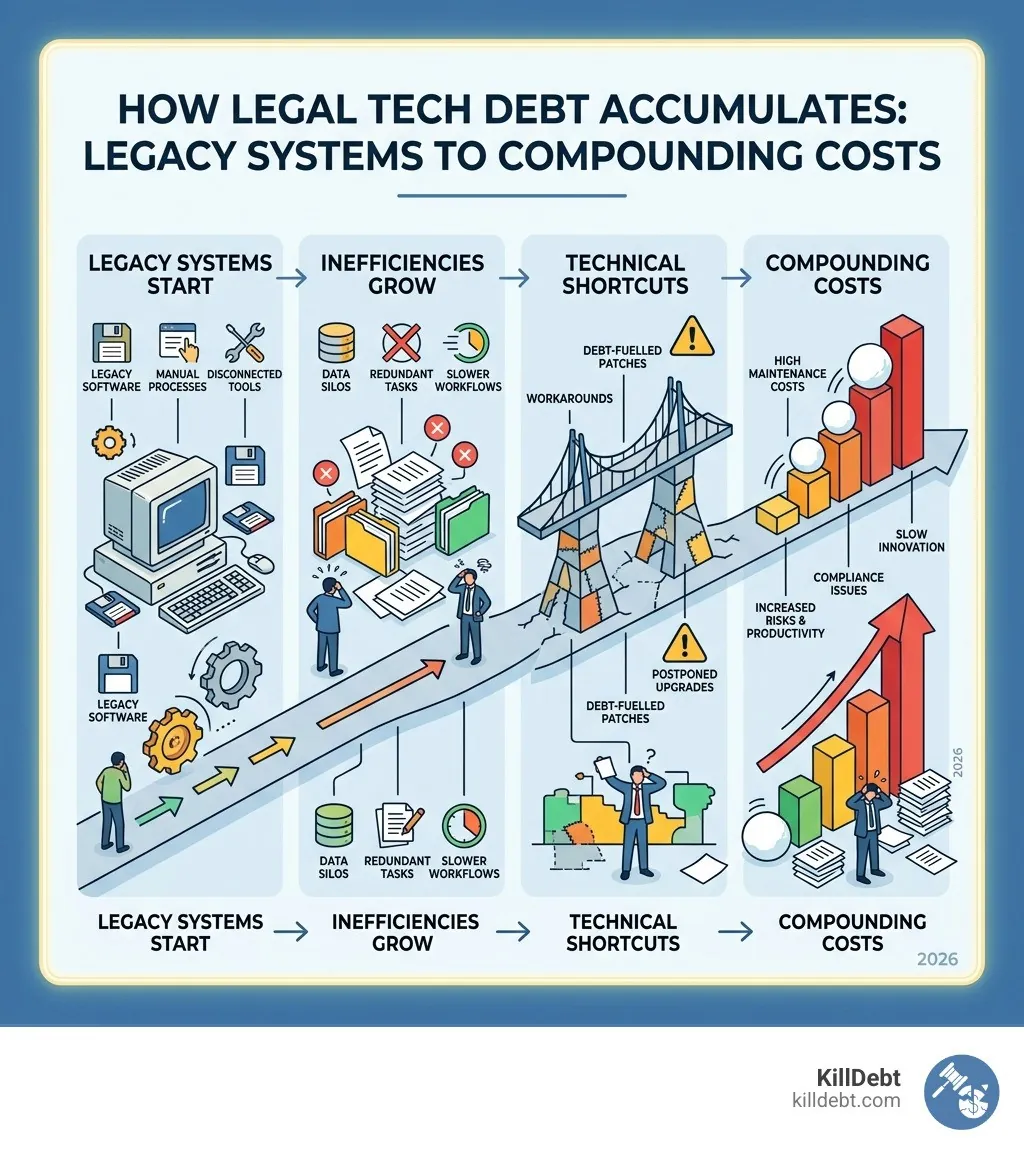

In April 2026, the stakes for ignoring legal tech debt tools are higher than ever. When we talk about "debt" in the legal technology world, we aren't just talking about money; we’re talking about the accumulation of vulnerabilities and inefficiencies that put your case-or your firm-at risk.
Legacy systems are often the weakest link in the chain. Outdated software frequently lacks the robust encryption and multi-factor authentication (MFA) required to protect sensitive financial data. For those in Florida or Michigan, staying compliant with the Fair Debt Collection Practices Act (opens in a new tab) (FDCPA) is a moving target. If your tools don't provide a clear audit trail of every communication and document, you're essentially walking into a courtroom with a blindfold on.
When you rely on manual processes-like hand-typing data from a court summons or manually checking court dockets-you’re accumulating "process debt." This leads to:
To see where your current documentation stands and identify where you might be vulnerable, our Debt Doc Audit can help you pinpoint exactly what’s missing from your defense strategy.
Modernizing your approach requires moving away from the "reckless" quadrant of technical debt—where solutions are thrown together without a plan—and toward "prudent" automation.
| Feature | Manual Workflows | Automated Legal Tech Debt Tools |
|---|---|---|
| Data Extraction | 15+ hours of manual entry per week | Instant AI-powered OCR extraction |
| Deadline Tracking | Hand-written or basic digital calendars | Rules-based, court-synced automation |
| Spending | Retroactive invoice review (hours) | Real-time AI visibility and compliance |
| Court Prep | Guessing based on general advice | AI-driven courtroom simulations |
In the past, only high-end law firms could afford sophisticated eDiscovery. Today, modern AI platforms have revolutionized how legal spend is managed. These platforms use AI to read every line item on a legal invoice, ensuring that billing guidelines are followed and that you aren't paying for "ghost hours" or inefficient manual tasks. For a deeper dive into how these costs stack up, check our latest Reports on the state of legal tech.
Missing a court date in Michigan or Florida is often an automatic loss. Advanced platforms have systems that calculate deadlines based on 80+ sets of court-specific rules. By integrating these directly into your Microsoft 365 or Google calendar, you eliminate the "calendaring debt" that leads to malpractice and lost cases.
Predictive budgeting tools allow for better financial planning. By analyzing thousands of pages of past litigation records, AI can predict how much a new case will cost based on historical trends. This transparency is vital for anyone trying to manage the financial burden of a legal dispute.

Artificial Intelligence is the primary engine behind the most effective legal tech debt tools. It’s no longer just about "searching" for keywords; it’s about "understanding" context.
For years, "Legal OCR" (Optical Character Recognition) was a headache. If a document didn't match a specific template, the software failed. Modern tools use layout-agnostic AI. This means the software "looks" at a document like a human does, identifying party names, case numbers, and dollar amounts regardless of how the page is formatted. This technology has been proven to reduce manual billing review from eight hours down to less than one.
For high-volume practices or individuals managing multiple debt claims, unified legal management platforms provide streamlined workflows. Instead of jumping between five different apps, these tools bring everything—contracts, invoices, and matter management—under one roof. This reduces the "interoperability debt" caused by software that refuses to talk to each other. You can learn more about these streamlined workflows in our collection of Ebooks.
Transcription is a massive area of technical debt. Relying on human transcribers for depositions or debtor phone calls is slow and expensive.
If you're curious about the cost-benefit of switching to automated transcription, our Pricing guide breaks down how these efficiencies save you money in the long run.
This is where the future of legal defense truly lives. At KillDebt, we’ve developed tools that don't just manage your debt—they help you defeat it.
ParkerGPT is our specialized AI co-counsel. Unlike a generic chatbot, ParkerGPT is trained on 30+ years of consumer debt law and real-world strategies from attorney Brian Parker. It doesn't just read your lawsuit; it analyzes it for weaknesses, such as missing chain of custody for the debt or expired statutes of limitations.
The newest addition to our arsenal is the Court Tester. This is an AI courtroom simulation built on your actual case documents.
This eliminates "research debt" and "experience debt." You don't need to have spent decades in a Florida, Michigan or your state's courtroom to know how a judge might react to your argument—you can test it first in a safe, digital environment. To see how this works for your specific situation, you can book a Consultation.
Choosing the right legal tech debt tools requires more than just looking at a feature list. You need to ensure the tool will solve your problems without creating new technical debt in the future.
Does the tool play well with others? If you use Microsoft 365, look for tools that integrate directly into the ecosystem. Look for tools with open APIs (Application Programming Interfaces) that allow data to flow seamlessly between your document management and your calendar.
In 2026, SOC 2 Type 2 certification is the gold standard. This ensures the company has been audited over a period of time to prove they actually follow their security claims. Furthermore, ensure the vendor has a policy against training their AI models on your private data. Your legal strategy should belong to you, not a machine-learning algorithm's training set.
Implementing new tech is as much about people as it is about code. Whether you are a solo practitioner or a large legal department, you need a plan for "digital transformation." This means documenting who has access to what, setting up automated backups, and having a clear business recovery plan.
The path to a debt-free legal future—both financially and technologically—starts with a single step. Digital transformation isn't about buying every new gadget; it's about choosing the right legal tech debt tools that provide long-term value.
By replacing manual entry with AI OCR, swapping static calendars for rules-based automation, and using simulations like Court Tester to prepare for trial, you turn your technology from a liability into an asset. You reduce the risk of default judgments, lower your operational costs, and finally level the playing field against big debt collectors.
Don't let legacy systems hold your future hostage. Whether you are in Florida or Michigan, the tools to defend yourself are more accessible and powerful than ever before. Visit https://killdebt.com/ today to start building your defense with the power of ParkerGPT.
Get started with KillDebt pricing
Important Legal Disclaimer
This educational content is based on general legal principles and my experience in debt collection defense. It is provided for informational purposes only and does not constitute legal advice. Laws vary by state and by local court. For specific legal advice, consult a qualified attorney licensed in your jurisdiction. No attorney-client relationship is created by reading this guide.
Critical Multi-State Variations: FDCPA applies uniformly at the federal level, but state consumer protection laws may provide additional rights and remedies. Statute of limitations periods vary significantly by state and debt type. What constitutes sufficient debt validation varies in practice across jurisdictions. State-specific rules on call frequency, written notice requirements, and permissible collector conduct may differ from federal minimums.

About the author
Brian Parker
I have over 30 years of experience defending consumers against debt collection lawsuits and have seen every tactic, threat, and pressure play that collectors use. Through KillDebt and ParkerGPT, I have systematized the proven defense strategies that actually work - so consumers can respond from a position of knowledge, not fear. My approach focuses on aggressive legal defense based on documented case success rather than false hope that leads to default judgments.