
News Break
Beat the Debt Buyers: Common Weaknesses in Collection Lawsuits
July 24, 2026
Blog / News Break
Sued by a Debt Collector? Here is How to Fight Back and Win - Learn about Winning debt collection lawsuit

Winning a debt collection lawsuit is possible — and more common than most people think. Here is what you need to do:
The single biggest mistake people make? Ignoring the summons entirely — and losing automatically.
If you just received a court summons, a collection letter, or a threat of wage garnishment, this guide is written for you. The moment that envelope arrives, a clock starts ticking. Miss the deadline and the debt collector wins — automatically — without having to prove a single thing. No evidence. No hearing. No chance for you to speak.
That outcome is called a default judgment, and it gives collectors the legal power to garnish your wages, freeze your bank account, and place liens on your property. The good news: it is entirely avoidable.
Most debt collection lawsuits — especially those filed by third-party debt buyers like Midland Credit, Portfolio Recovery, or LVNV Funding — are built on incomplete records and weak documentation. Debt buyers purchase old debts for as little as 4 cents on the dollar, and they often lack the original contracts, account statements, or chain of ownership needed to actually win in court. When you fight back, you change the entire power dynamic.
I'm Brian Parker, and for over 30 years I've been in the courtroom fighting creditors, debt buyers, and collection law firms — giving me a front-row seat to every strategy that leads to winning debt collection lawsuit cases. I founded KillDebt to put those same courtroom tools directly in your hands, so you can defend yourself with confidence, even without an attorney.
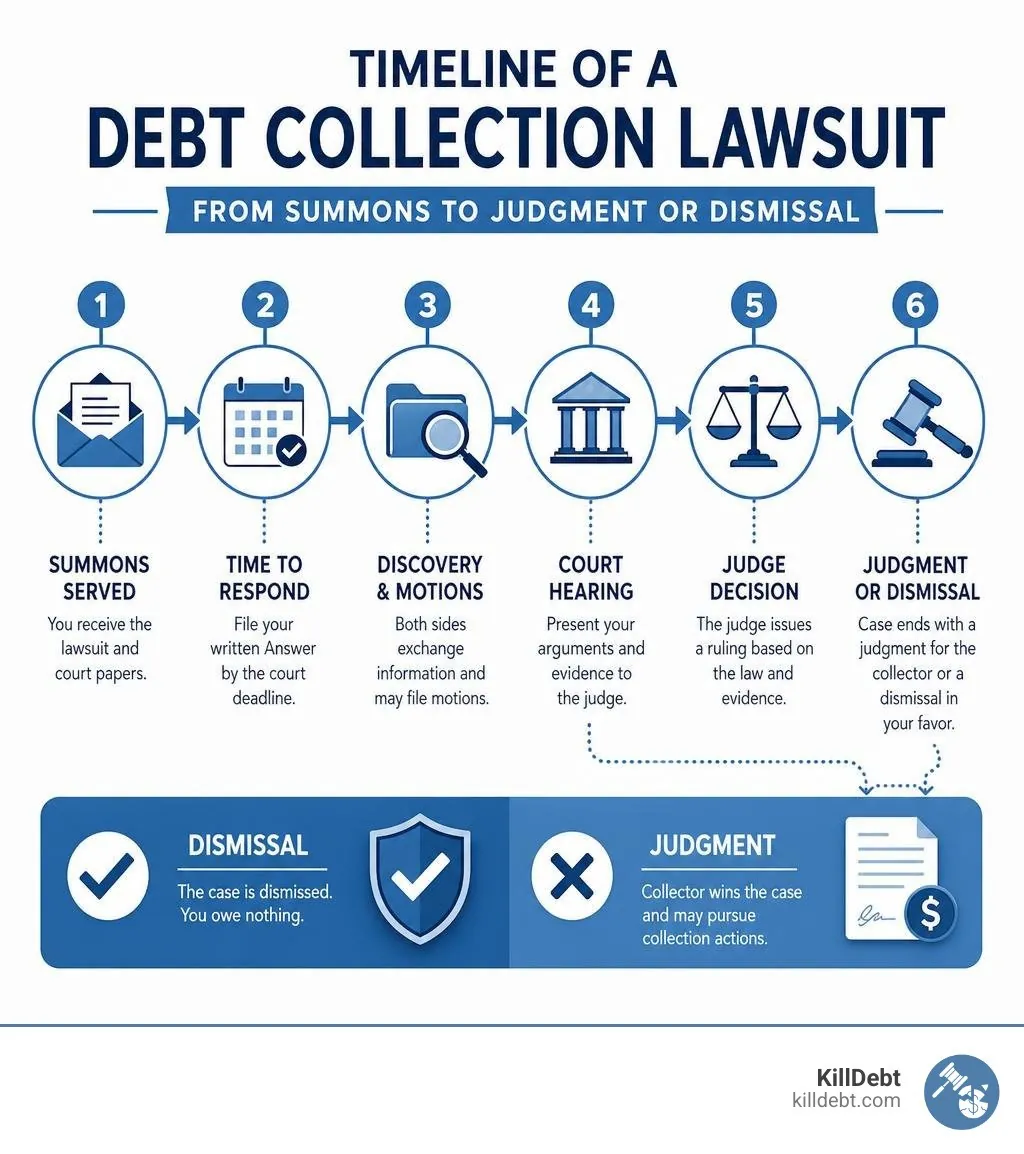
The moment you are served with a lawsuit, the clock starts. Many people believe that if they simply refuse to sign for the papers or avoid the process server, the lawsuit cannot move forward. This is a myth. Courts allow for alternative methods of service, and trying to "dodge" a server will only result in the case moving ahead without you.
Your absolute first priority is understanding What Happens After Summons and mapping out your state-specific response deadline.
If you miss this window, the collector will immediately file for a default judgment.
Ignoring a debt summons is the equivalent of waving a white flag. When you do not respond, the judge will sign a default judgment against you.
A default judgment legally certifies that you owe the exact amount the collector is claiming—including any inflated interest, late fees, and their attorney's fees. Armed with this judgment, the collector can legally:
If a default judgment has already been entered against you without your knowledge (a common result of improper service), you must act quickly to file a motion for Setting Aside Default Judgment to regain your right to defend yourself.
When you file your Answer, you must respond to the complaint paragraph by paragraph. The golden rule of drafting an Answer is simple: do not agree to any allegation in the complaint unless you are absolutely certain it is true.
For every numbered paragraph in the collector's complaint, you must state whether you:
For a comprehensive template, see our Sample Answer to Debt Collection Lawsuit.
Additionally, if you are being sued in Michigan on an "account stated" or "open account" (common in credit card lawsuits), the collector will often attach an affidavit claiming the balance is undisputed. To defeat this, you must file a notarized Counter Affidavit alongside your Answer. Failing to do so can allow the court to accept the collector's math as absolute truth. Learn how to protect your rights with our guide on Filing a Counter Affidavit When Answering a Debt Collection Lawsuit.
Once your Answer is filed, you are officially "in the game." Now, you must shift from defense to offense. The secret to winning debt collection lawsuit cases is understanding who is suing you and holding them to strict legal standards.
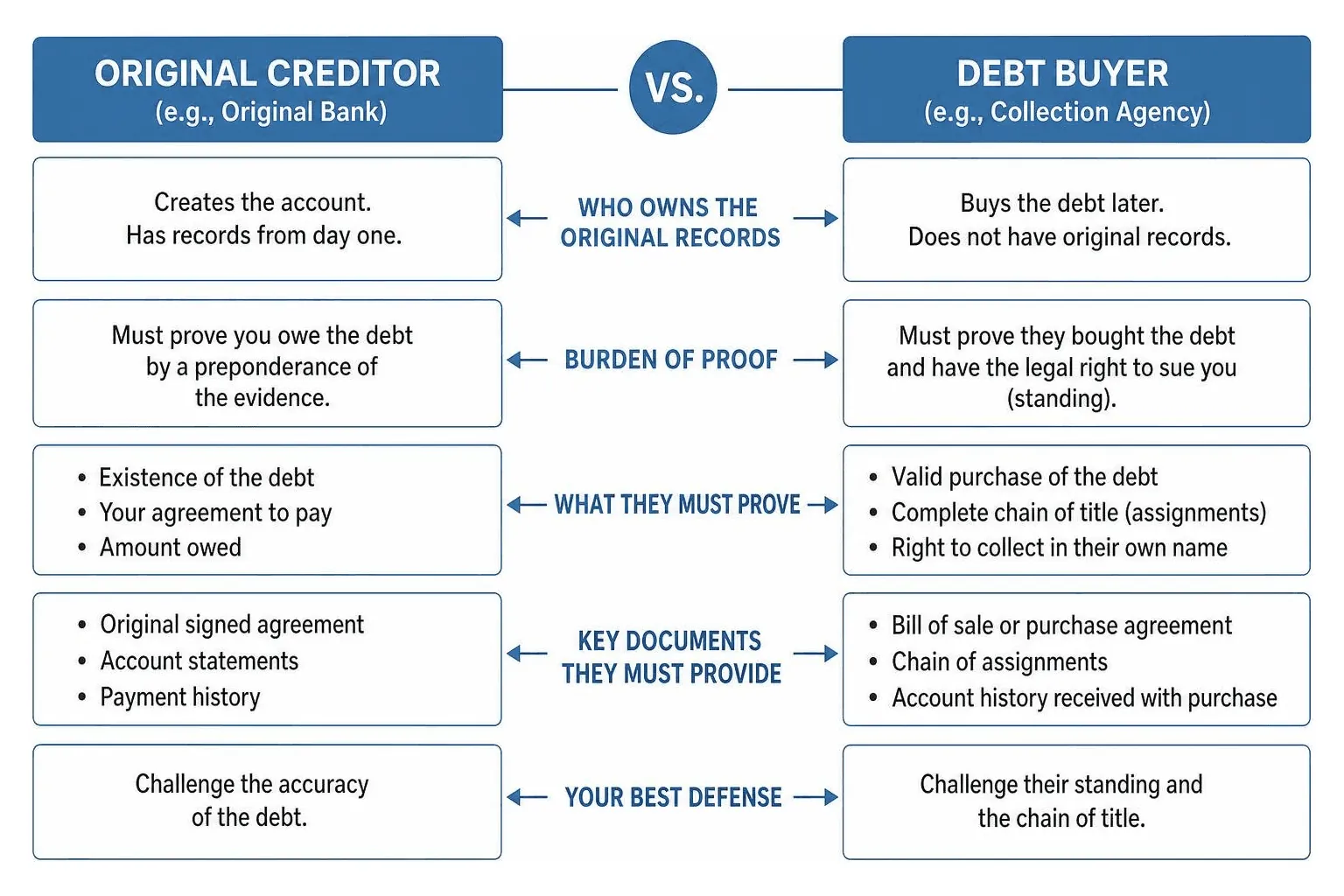
There is a massive difference between being sued by your original creditor (like Chase or Citibank) and a third-party debt buyer (like Midland Credit Management or LVNV Funding). Original creditors usually have the original contract and statements. Debt buyers, however, buy debts in massive portfolios containing millions of dollars in accounts, often receiving nothing more than a giant electronic spreadsheet.
To win, you must challenge their chain of title. This means demanding they prove they have the legal right to sue you. They must show an unbroken paper trail of assignments from the original creditor down to them.
If they are missing even one link in that chain, they Lack Standing Debt Suit. Always force them to produce the actual purchase agreements and specific assignments showing your account was part of the sale. Read our detailed guide on the Chain of Assignment Debt Collector to learn how to spot gaps in their documentation.
The statute of limitations is a legal expiration date on a creditor's right to sue you. If the collector files a lawsuit after this window has closed, the debt is considered "time-barred," and you can get the case dismissed.
Statute of limitations periods vary significantly depending on your state:
Warning: The statute of limitations clock typically starts from the date of your last payment or the date the account went into default. However, making even a tiny payment (even just $5) or signing a written acknowledgment of the debt can completely restart the clock, giving the collector a brand-new window to sue you.
Always evaluate if your debt is expired before communicating with a collector, and raise the Expired Debt Statute Defense in your initial Answer if the timeline has run out.
Sometimes, the best defense is a strong offense. Under the federal Fair Debt Collection Practices Act (FDCPA), debt collectors are strictly prohibited from using abusive, deceptive, or misleading tactics. If a collector violates the FDCPA during their collection efforts or within the lawsuit itself, you can sue them back.
In extreme cases, aggressive collectors cross the line into illegal asset seizure. In the landmark case Espinosa v. Metcalf (opens in a new tab), a debt collection firm wrongfully seized vehicles belonging to a father and son to satisfy an old default judgment. Because the vehicles were leased or belonged to a family member who did not owe the debt, the court ruled the seizure was illegal, constituting "conversion."
The court awarded thousands of dollars in damages for "loss of use" (calculated at the daily rental rate of a comparable vehicle) and emotional distress. Crucially, the court confirmed that expert medical testimony is not required to win emotional distress damages under the FDCPA; credible testimony regarding the real-world humiliation and disruption to your life is sufficient. If a collector has crossed these boundaries, check out our Sue Debt Collector Complete Guide.
If you decide to sue a collector in federal court for FDCPA violations, you must establish "Article III standing." Under recent federal rulings, simply being "confused" or "annoyed" by a misleading collection letter is not enough to sue. You must show a concrete, tangible harm.
In Tomaine v. Selip (opens in a new tab), the court analyzed these standing requirements. While a deceptive letter alone might not suffice, actions that cause physical or monetary harm—such as an overstated bank levy that temporarily deprives you of access to your money—constitute a concrete injury that gives you full standing to sue the collector for damages.
If you cannot get the lawsuit dismissed outright, your next best option is protecting your assets and negotiating a settlement on your own terms.
If a creditor attempts to freeze your bank account, you must act instantly. Under both federal and state laws, certain sources of income are completely exempt from garnishment. These include:
If your account contains solely exempt funds, you must immediately file a bank exemption form with your financial institution and the court to secure a release of your funds.
Because debt buyers purchase accounts for pennies on the dollar, they have immense flexibility to settle. It is highly common for collectors to accept a lump-sum payment of 40% to 60% of the original balance to resolve the case out of court.
When negotiating:
You do not need to spend thousands of dollars on a defense attorney to protect your finances. KillDebt provides a DIY legal defense system powered by ParkerGPT, an AI trained specifically on consumer debt law and real-world courtroom strategies developed over my 30+ years as a consumer defense attorney.
Unlike generic AI tools, ParkerGPT analyzes your actual lawsuit filings, identifies critical procedural and evidentiary weaknesses, and generates court-ready Answers and Counter Affidavits tailored to your case—all at a fraction of the cost of hiring a lawyer.
Best of all, we just rolled out Court Tester—our brand-new AI courtroom simulator. You can upload your actual lawsuit documents and, within minutes, practice arguing your motion in front of an AI judge, facing off against AI opposing counsel, while a private AI co-counsel whispers winning strategies directly to you.
Don't let debt collectors take your hard-earned money by default. Head over to our Pricing page, grab your defense tools, and start fighting back today.
IMPORTANT LEGAL DISCLAIMER
This educational content is based on general legal principles and my experience in debt collection defense. It is provided for informational purposes only and does not constitute legal advice. Laws vary by state and by local court. For specific legal advice, consult a qualified attorney licensed in your jurisdiction. No attorney-client relationship is created by reading this guide.
Critical Multi-State Variations: FDCPA applies uniformly at the federal level, but state consumer protection laws may provide additional rights and remedies. Statute of limitations periods vary significantly by state and debt type. What constitutes sufficient debt validation varies in practice across jurisdictions. State-specific rules on call frequency, written notice requirements, and permissible collector conduct may differ from federal minimums.

About the author
Brian Parker
I have over 30 years of experience defending consumers against debt collection lawsuits and have seen every tactic, threat, and pressure play that collectors use. Through KillDebt and ParkerGPT, I have systematized the proven defense strategies that actually work - so consumers can respond from a position of knowledge, not fear. My approach focuses on aggressive legal defense based on documented case success rather than false hope that leads to default judgments.