
News Break
Don't Get Defaulted by a Debt Collector
June 1, 2026
Blog / News Break
Missed your court date? Learn how to set aside default judgment fast and stop wage garnishment today.

Setting aside a default judgment is the legal process of asking a court to cancel a ruling that was entered against you because you didn't respond to a lawsuit or missed a court date.
If that's happened to you, here's the short version of what you need to know:
How to set aside a default judgment — quick overview:
A default judgment can feel like a punch to the gut. One day you're dealing with collection letters, and the next you find out a court has already ruled against you — and a creditor now has the legal power to garnish your wages, freeze your bank account, or put a lien on your property.
But a default judgment is not necessarily the end of the road.
Courts enter default judgments every day against people who were never properly served, who had a genuine emergency, or who simply didn't understand the legal process. The good news: the law in most states gives you a real path to fight back — if you move quickly.
My name is Brian Parker, and for over 30 years I've been in the courtroom fighting creditors, debt buyers, and collection law firms — I've helped thousands of consumers navigate the exact process of setting aside a default judgment. I'll walk you through everything you need to know to defend yourself, step by step.
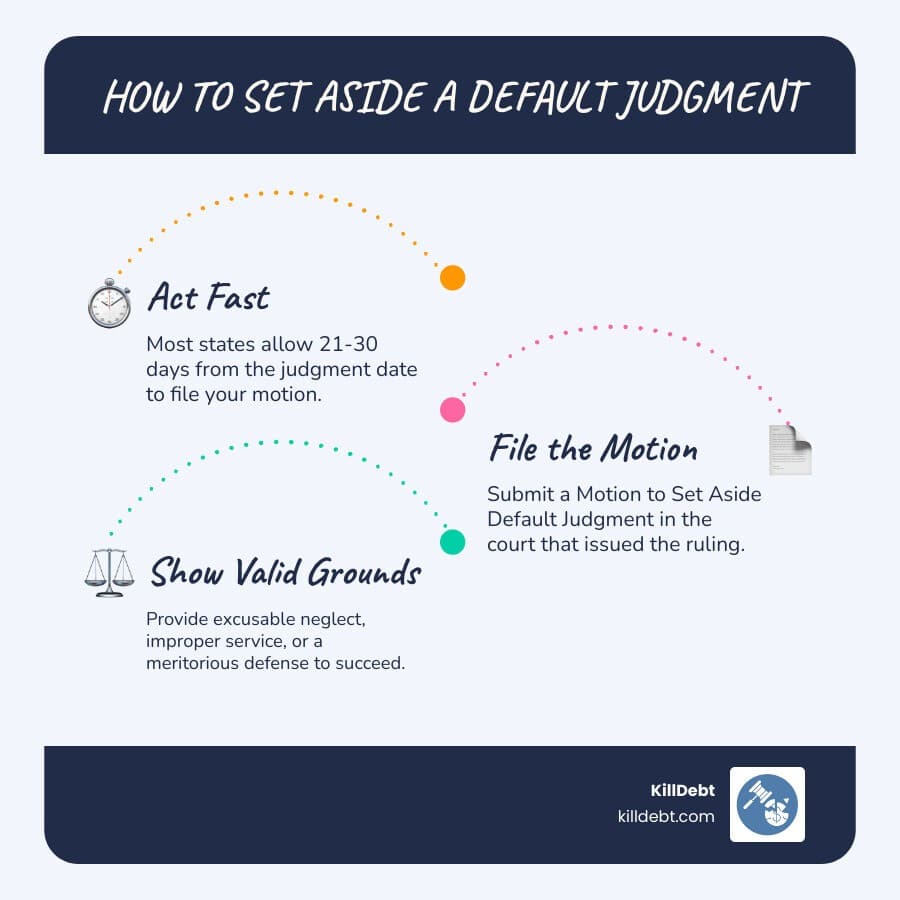

When we talk about setting aside default judgment, we aren't just asking the judge for a "do-over" because we’re unhappy with the result. Judges like finality; they don't enjoy reopening cases unless there is a compelling legal reason to do so. To succeed, you must fit your situation into specific "grounds" recognized by the law.
In our experience helping people in Florida and Michigan, the most common grounds fall into a few specific buckets. If you've recently discovered a judgment and are panicking, take a deep breath and see if your situation fits one of these:
If you’re wondering how this affects your specific debt, check out our guide on How to Remove Default Judgment Debt.
In most jurisdictions, especially in Michigan and Florida, just having a "good excuse" (Good Cause) isn't enough. The judge also wants to know that if they reopen the case, you actually have a chance at winning. This is called a Meritorious Defense.
Think of it like this: The judge doesn't want to waste the court's time reopening a case just so you can lose all over again. You need to show that you have a "real" defense.
What is NOT a meritorious defense?
What IS a meritorious defense?
To prove this, you'll often need to file a Key to Strong Answer in a Collection Lawsuit: Solid Counter-Affidavit. This is a sworn statement where you lay out the facts of your defense. In Michigan, for example, under MCR 2.603(D), you must file a verified statement of facts showing this defense before the court will even consider setting aside default judgment.
Time is your absolute worst enemy when a judgment is involved. In the legal world, "sleeping on your rights" is a fast way to lose them. While we specialize in Florida and Michigan, it’s helpful to see how these deadlines compare so you understand the urgency.
| State | Standard Deadline to File Motion | Special Notes |
|---|---|---|
| Michigan | 21 Days | From the date the default judgment was entered. |
| Florida | 1 Year | For excusable neglect or fraud; "Reasonable time" for others. |
| Texas | 30 Days | 14 days in Justice Court. |
| Nevada | 6 Months | From the date of written notice of entry of judgment. |
| Virginia | 2 Years | Specifically for fraud on the court. |
In Michigan, the rule is quite strict. According to MCR 2.603(D), you generally have only 21 days after the default judgment is entered to file your motion if you were personally served. If you wait until day 22, your path becomes much steeper, requiring a "Motion for Relief from Judgment" under MCR 2.612, which has a higher burden of proof.
In Florida, Rule 1.540(b) allows you up to one year to file for reasons like mistake, inadvertence, or excusable neglect. However, "one year" is the maximum. The law says you must file within a "reasonable time." If you find out about a judgment in January and wait until December to do something about it, the judge might decide that wasn't a "reasonable" delay and deny your motion.
For a deeper dive into the timing of these cases, see our Debt Collection Lawsuit Timeline: What Happens Next After You're Served. And remember, the clock starts ticking the moment the judge signs that order, not necessarily when you find out about it!
There are a few "get out of jail (mostly) free" cards when it comes to these deadlines. If you weren't personally served — meaning the papers weren't handed to you or a resident at your home — the rules often change.
If you’re confused about whether you were properly served, read our article on What Happens After Summons.

Now we get to the "how-to" part. If you're ready to fight, you'll need to prepare a package of documents for the court. Don't worry; we do this every day at KillDebt.
Step 1: Get the Case File. Go to the courthouse where the judgment was entered. Ask the clerk for a copy of the "Proof of Service" or "Affidavit of Service." This tells you who the creditor claims they served, when, and where. If it says they handed it to a 6-foot-tall man at your house, but you live alone and are 5-foot-2, you’ve found your first weapon.
Step 2: Draft the Motion to Set Aside Default Judgment. This is your formal request to the judge. It should clearly state:
Step 3: Prepare the Affidavit of Meritorious Defense. This is a sworn, notarized statement. You must explain why you would win if the case went to trial. In Michigan, this is a requirement under Setting Aside Judgments (opens in a new tab) rules. You can find a Sample Answer to Debt Collection Lawsuit to see how defenses are typically phrased.
Step 4: Draft a Proposed Order. Judges are busy. If you provide them with a "Proposed Order" that they can simply sign if they agree with you, it makes their life easier. It should simply say "The Motion to Set Aside Default Judgment is hereby GRANTED."
Step 5: Schedule the Hearing. In most courts, you can't just drop off papers and wait. You have to get a hearing date from the clerk and then "serve" notice of that hearing on the creditor's attorney.
Don't let a "technicality" ruin your chance at justice. There are a few boring but vital steps you must follow:
For a complete walkthrough of the defense process, check out our Fight Debt Collection Lawsuit Complete Guide and our specific advice for Justice Court Debt Answer.
If the judge smiles upon you and grants your motion, congratulations! But don't pop the champagne just yet. Setting aside a default judgment doesn't mean the debt goes away; it just means the "game is back on."
Here is what happens next:
For more on dealing with the creditor after the reset, see Debt Collector Suing Me Advice.
Facing a default judgment is stressful, but you don't have to face it alone. At KillDebt, we believe that everyone deserves a fair day in court, regardless of their bank balance.
We’ve built ParkerGPT, an AI trained specifically on consumer debt law and real court strategies developed over 30+ years by attorney Brian Parker. Unlike generic AI, ParkerGPT analyzes your actual lawsuit documents, identifies the procedural weaknesses, and generates court-ready motions with step-by-step instructions.
And if you’re nervous about that upcoming hearing? We just rolled out the Court Tester. It’s an AI courtroom simulation built on your actual case. You can upload your filings and, within minutes, find yourself arguing your motion in front of an AI judge. You'll face AI opposing counsel, while a private AI co-counsel whispers strategy only you can see. It’s the ultimate way to build confidence before you step into the real courtroom.
Don't let a debt collector take your hard-earned wages without a fight. The law gives you the tools to fight back—we just give you the power to use them.
Start your defense today and take the first step toward setting aside default judgment and reclaiming your financial future.

About the author
Brian Parker
I have over 30 years of experience defending consumers against debt collection lawsuits and have seen every tactic, threat, and pressure play that collectors use. Through KillDebt and ParkerGPT, I have systematized the proven defense strategies that actually work - so consumers can respond from a position of knowledge, not fear. My approach focuses on aggressive legal defense based on documented case success rather than false hope that leads to default judgments.