News Break
How to Use an Example Debt Validation Letter to Protect Your Wallet
April 28, 2026
Blog / News Break
Discover what happens after summons: respond in time, avoid default judgment, verify service & protect your rights now. Article Word Count 2,068 words Mention Competitors
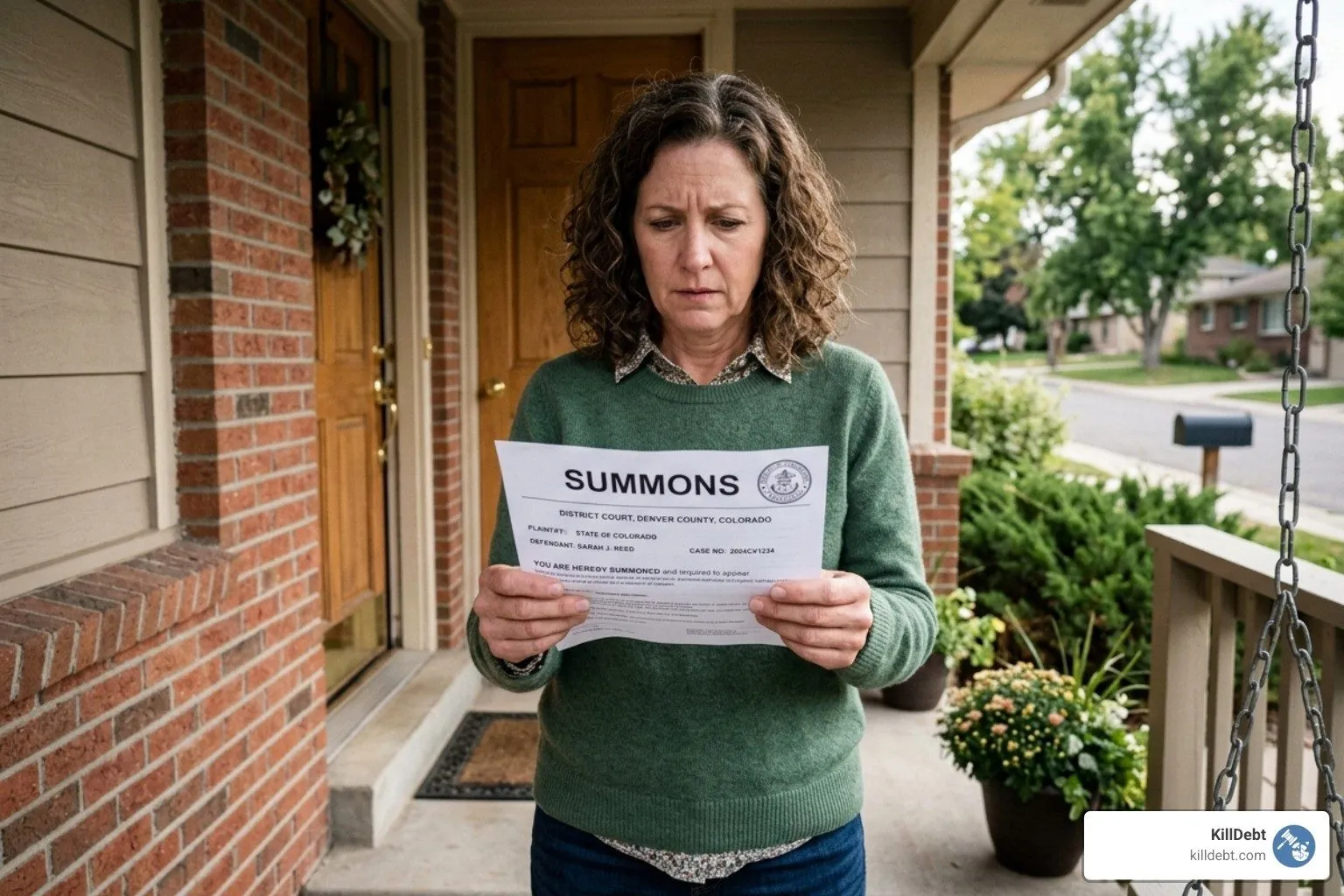
What happens after summons delivery is simpler to navigate than most people think — even if it feels overwhelming right now.
Here's what you need to know immediately:
Getting a summons in the mail — or handed to you by a process server — can make your stomach drop. You're not alone. Millions of Americans are sued for debt each year, and most of them feel exactly the same way you do right now: confused, stressed, and unsure what to do next.
But here's the truth: receiving a summons is not a judgment. It's a notification. It means someone is claiming you owe them something. You still have the right to respond, defend yourself, and even challenge the claim entirely.
The single biggest mistake people make? Doing nothing. Over 95% of people who don't respond to a debt lawsuit end up with a default judgment against them — meaning the collector wins automatically, without ever having to prove their case in court.
This guide walks you through every step of what comes next.
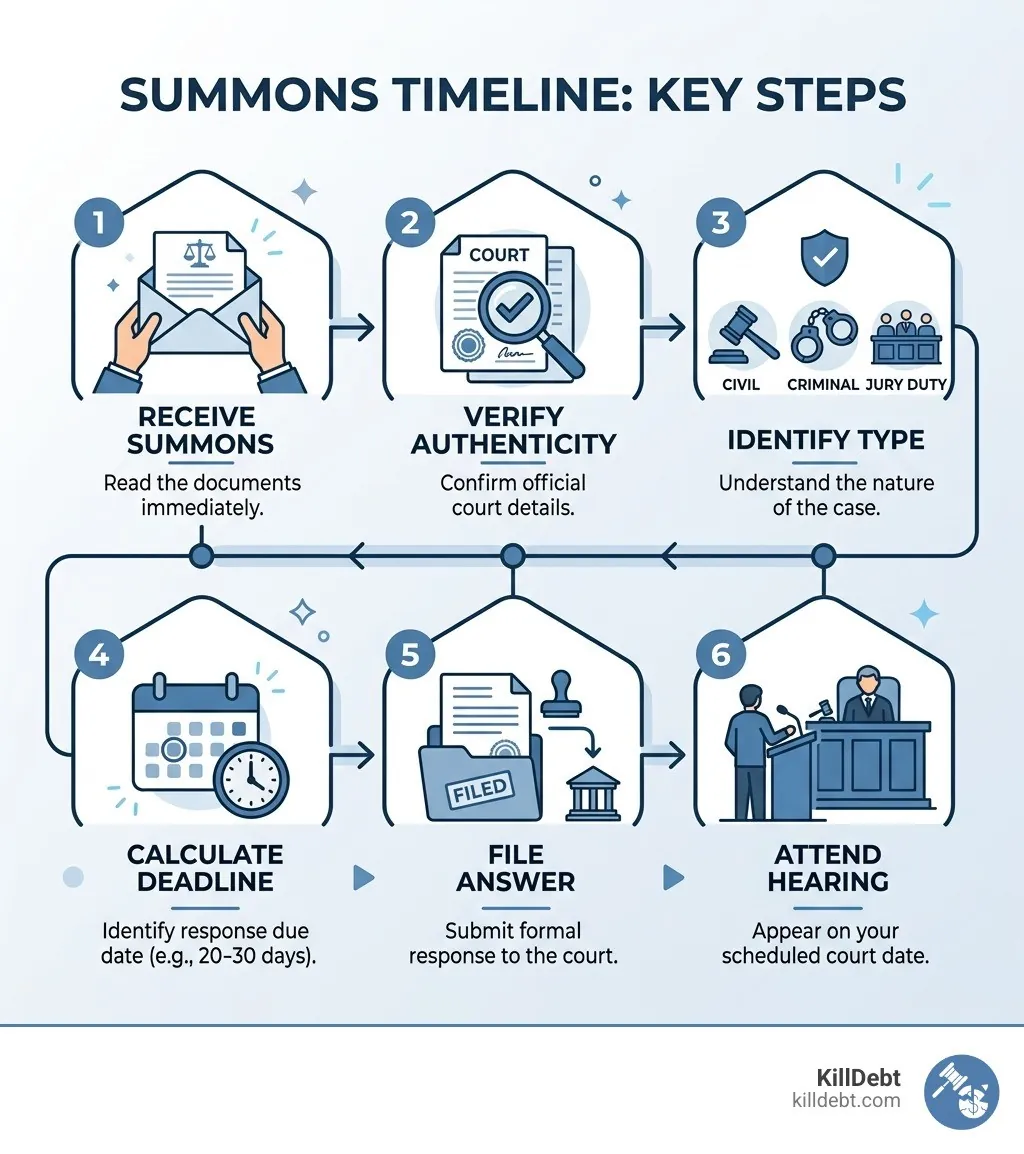
When that envelope arrives or the process server knocks, your first instinct might be to toss the papers in a drawer and forget about them. We get it. But what happens after summons service is a ticking clock. The very first thing we recommend is taking a deep breath and sitting down with the documents in a quiet room.
You need to verify exactly what you are looking at. A legitimate summons isn't just a letter from a collection agency; it is a formal court order. Look for the official court seal, the name of the court (such as the 17th Judicial Circuit in Florida or a District Court in Michigan), and a specific case number. If these elements are missing, it might just be a high-pressure collection letter designed to look like a legal document.
It is also vital to distinguish between the two documents you likely received. The Summons is the notice that you are being sued and tells you how long you have to respond. The Complaint is the list of specific allegations—the "story" of why the plaintiff thinks you owe them money. Understanding the Difference Between Summons & Complaint in Debt Collection Lawsuit is the first step in building your defense.

Not all summonses are created equal. Depending on what landed on your doorstep, your obligations change:
The "Response Window" is the most important date on your calendar right now. If you miss it, the plaintiff wins by default. While the Time to Respond Debt Collection Lawsuit varies, here is how it generally looks in our neck of the woods:
These are usually calendar days, not business days. If the deadline falls on a weekend or a court holiday, it usually moves to the next business day, but we always advise filing early to be safe.
Once you've marked your calendar, it's time to act. In a civil debt case, "responding" doesn't mean calling the plaintiff's lawyer to argue. It means filing a formal, written Answer with the court.
Your Answer is your opportunity to respond to every numbered paragraph in the Complaint. You generally have three choices for each claim:
You should also include Affirmative Defenses. These are legal reasons why you shouldn't have to pay even if the debt was originally yours—for example, the Statute of Limitations has expired, or the debt was already paid or discharged in bankruptcy. A Key to Strong Answer in a Collection Lawsuit is often providing a solid counter-affidavit if the creditor is using hearsay evidence.
After you file your Answer and send a copy to the plaintiff's attorney, the case enters a new phase. It doesn't go to trial immediately. Instead, you enter Discovery.
Discovery is the "information exchange" phase. The creditor might send you a "Request for Admissions," asking you to admit certain facts. You might send them a "Request for Production," demanding they show you the original contract or a full statement of account. In Michigan, you might request a "Bill of Particulars" to see exactly how they calculated the amount they say you owe.
This is also the prime time for Settlement Negotiations. Now that the creditor sees you are fighting back, they are often much more willing to settle for a fraction of the debt. They were hoping for an easy win; by filing an Answer, you've made their job a lot harder. You can track the full Debt Collection Lawsuit Timeline: What Happens Next After You’re Served to stay ahead of the game.
The main goal of your Answer is to prevent a Default Judgment. Think of a default judgment as a "forfeit" in sports. If you don't show up to play, the other team wins automatically.
If a judge signs a default judgment against you, the creditor gains powerful tools to collect the money, including:
Don't fall for Debt Collection Lawsuit Myths: 7 Things That Won’t Save You. Simply "not signing" for the papers or "moving to a new address" won't stop the process.
For a lawsuit to be valid, you must be "served" correctly. This is called Service of Process. It’s based on the idea of due process—you have a right to know you’re being sued.
Under Rule 4 of the Federal Rules of Civil Procedure (which many state rules like Florida and Michigan follow closely), there are specific ways a summons must be delivered. A Rule 4. Summons | Federal Rules of Civil Procedure explanation shows that service is usually handled by a professional process server or a sheriff.
| Service Method | How it Works | Validity in Florida/Michigan |
|---|---|---|
| Personal Service | Handed directly to you. | Gold standard; always valid. |
| Substituted Service | Left with a competent adult at your home. | Valid if they live with you. |
| Service by Mail | Sent via certified mail. | Often requires your signed waiver. |
| Publication | Printed in a local newspaper. | Only allowed if you can't be found. |
If a plaintiff can't find you, the case doesn't just disappear. In Florida and Michigan, plaintiffs usually have about 90 days to serve the summons after filing the complaint. If they fail, the court might dismiss the case "without prejudice" (meaning they can try again later).
However, if the plaintiff proves they tried their best, they can ask the court for a Motion for Alternative Service. This might allow them to post the notice on your door or publish it in a newspaper. This is why "hiding" from a process server rarely works; eventually, the court will allow the case to move forward without you.
What happens after summons service is entirely up to you. You can let the clock run out and face a default judgment, or you can stand your ground and force the creditor to prove their case. Most debt collectors count on you being too intimidated to fight back—don't give them that satisfaction.
At KillDebt, we believe everyone deserves a fair fight in the courtroom, regardless of their bank balance. Our DIY legal defense system is powered by ParkerGPT, an AI trained on real-world court strategies developed over 30 years by veteran attorney Brian Parker.
We don't just give you generic templates. Our platform analyzes your actual lawsuit documents and generates court-ready responses tailored to your specific case. And for those who want to feel truly prepared, our Court Tester allows you to simulate your hearing. You can argue your motion in front of an AI judge and face AI opposing counsel, all while your private AI co-counsel whispers winning strategies in your ear.
Don't let a summons be the end of your financial story. Take control, file your Answer, and let's get to work.
Ready to defend your rights? Explore KillDebt's AI-powered defense tools here.

About the author
Brian Parker
I have over 30 years of experience defending consumers against debt collection lawsuits and have seen every tactic, threat, and pressure play that collectors use. Through KillDebt and ParkerGPT, I have systematized the proven defense strategies that actually work - so consumers can respond from a position of knowledge, not fear. My approach focuses on aggressive legal defense based on documented case success rather than false hope that leads to default judgments.