News Break
Debt Validation 101: Templates to Make Collectors Back Off
May 5, 2026
Blog / News Break
Learn how to answer a debt summons step-by-step: calculate deadlines, draft defenses, file your response & avoid default judgment. DIY guide now!

How to answer a debt summons is something you need to know right now — before your deadline passes. Here's the short version:
Getting served with a debt lawsuit is genuinely frightening. One day you open your door or your mailbox, and suddenly you're holding legal papers demanding thousands of dollars — often from a company you've never even heard of.
Here's the thing most people don't know: debt collectors are counting on you to do nothing.
Many debt collection lawsuits are won by default — meaning the defendant simply never responded. When that happens, the court hands the creditor an automatic win called a default judgment. That judgment can be used to garnish your wages, freeze your bank account, or put a lien on your property.
But filing a written Answer changes everything. It forces the other side to actually prove their case with real evidence. And that's harder than it sounds — especially when the debt has been sold multiple times or the paperwork is incomplete.
The good news? You don't need an expensive attorney to respond. Thousands of people successfully defend themselves in debt collection lawsuits every year. This guide will show you exactly how.
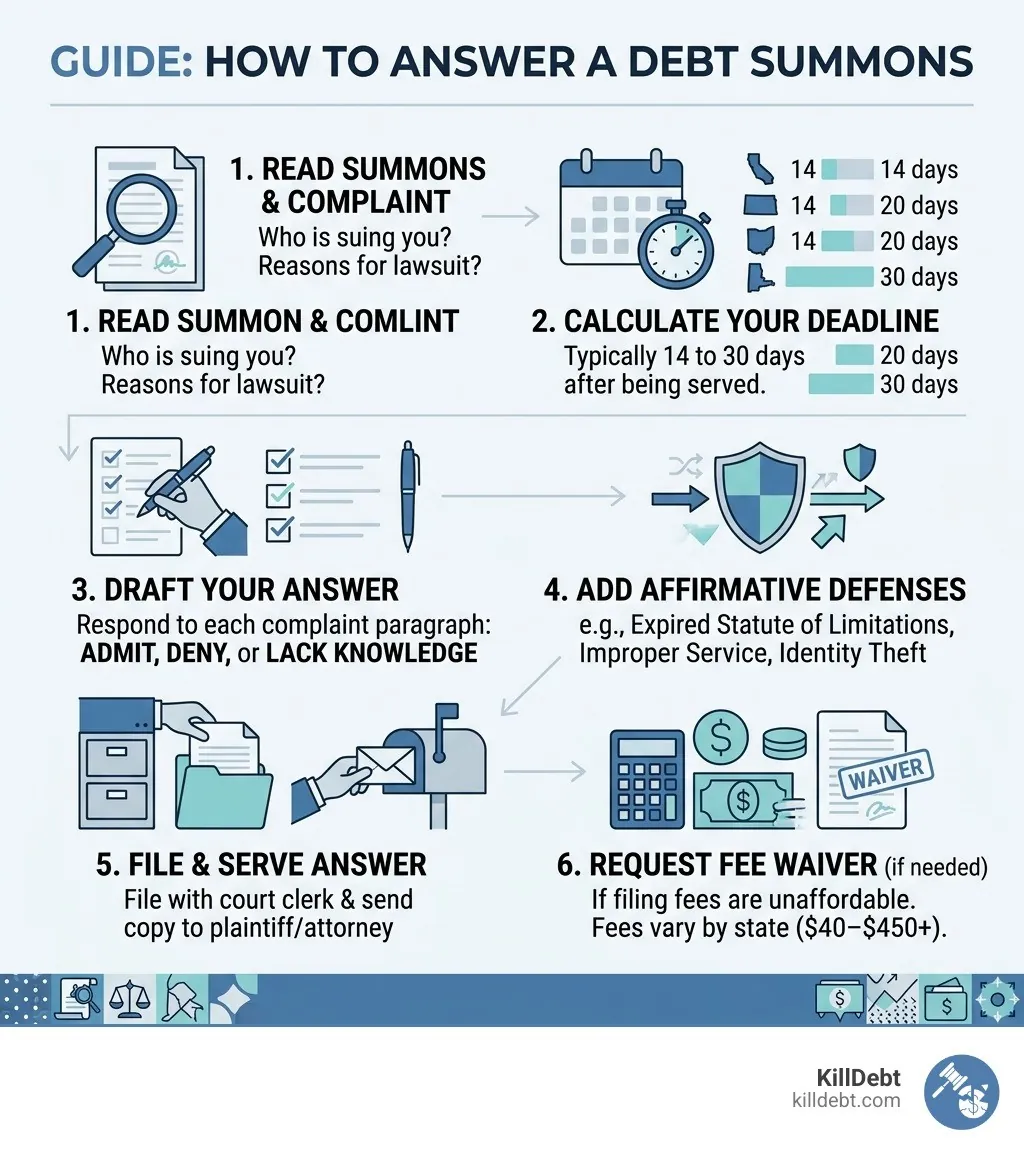
When you are sued for a debt, you won't just receive a single piece of paper. You will receive a package of legal documents, usually delivered by a process server or sent via certified mail. This is called "service of process." Understanding the Difference Between Summons & Complaint in Debt Collection Lawsuit is your first step toward building a defense. As noted by the Consumer Financial Protection Bureau (CFPB), ignoring these documents can lead to severe financial consequences.
The Summons is the court’s official notice to you. It tells you that you are being sued, identifies the court where the case is filed, and—most importantly—specifies how many days you have to respond. The Complaint (sometimes called a Petition) is the document where the person suing you (the Plaintiff) lists their grievances against you (the Defendant).
Don't panic if you don't recognize the name of the company suing you. Often, the original creditor (like a big bank) sells "charged-off" debt to a debt buyer. These companies purchase thousands of accounts for pennies on the dollar and then sue to collect the full amount.
Check the top of the Summons for the Case Number. You will need this for every document you file. Then, look at the Complaint. It will be broken down into numbered paragraphs. Each paragraph is an "allegation"—a statement the Plaintiff claims is true. Knowing Who is Suing Me? Original Creditor vs. Debt Buyer Explained helps you determine if the Plaintiff even has the legal right to sue you.
Ignoring these papers is the most expensive mistake you can make. If you don't file a written Answer, the Plaintiff will ask for a default judgment. Once they have this, they can:
There are many Debt Collection Lawsuit Myths: 7 Things That Won't Save You, but the biggest myth is that the problem will go away if you hide. It won't. It will only get more expensive as they add interest, court costs, and attorney fees to your bill.

You do not need a law degree to protect your rights. Defending yourself "Pro Se" (representing yourself) is a right guaranteed to you. By following our What to Do When Sued by a Debt Collector: Complete First Steps Guide, you can stop the debt collector in their tracks.
Your clock starts ticking the moment those papers touch your hand. Every state has different rules for the Time to Respond: Debt Collection Lawsuit.
If your deadline falls on a weekend or a court holiday, you usually have until the next business day, but we always recommend filing early to be safe. If you miss the deadline, check with the court clerk immediately. If the Plaintiff hasn't requested a default yet, you may still be able to file your Answer.
Your Answer is not the place to tell a long, emotional story. It is a formal response to the numbered paragraphs in the Complaint. For each paragraph, you have three options:
Next, you must list your Affirmative Defenses. These are legal reasons why the Plaintiff should lose even if the debt was originally yours. Common defenses include:
| Response Type | What it Means | Strategy |
|---|---|---|
| General Denial | Denying all or most allegations. | Forces the Plaintiff to provide strict proof for every claim. |
| Affirmative Defense | Bringing up new facts (like the debt is too old). | Can get the case dismissed entirely regardless of the debt's validity. |
A Key to Strong Answer in a Collection Lawsuit: Solid Counter-Affidavit is often required if the Plaintiff attached an affidavit to their Complaint. Denying their affidavit with one of your own is a powerful move.
Once your Answer is drafted, you must make copies. Usually, you need three: one for the court, one for the Plaintiff’s attorney, and one for your own records.
In some states, filing an Answer is free. In others, it can cost between $40 and $450. In Florida, fees vary by county and the amount of the debt. In Michigan, you can use form MC 03 to file your Answer.
If you cannot afford the fee, ask the court clerk for a Fee Waiver (sometimes called an "Affidavit of Indigency"). If your income is below a certain level or you receive public assistance, the court will likely let you file for free.
When you file, you must also include a Certificate of Service. This is a simple statement telling the court that you sent a copy of your Answer to the Plaintiff's attorney. We always recommend sending it via Certified Mail with Return Receipt Requested so you have proof of delivery. This is a critical step in Filing a Counter-Affidavit When Answering a Debt Collection Lawsuit.
Filing the Answer is just the beginning. It stops the automatic win and moves the case into the "Discovery" phase. This is where both sides exchange information. You can use this time to ask the Plaintiff for the original contract, payment history, and proof of debt ownership.
Our Debt Collection Lawsuit Timeline: What Happens Next After You're Served explains that most cases never actually go to a full trial. Once you show you are willing to fight, the debt collector's math changes. It becomes more expensive for them to pay a lawyer to fight you than to settle.
Filing an Answer gives you leverage. Now that the collector knows they have to work for the money, they may be open to:
If you reach an agreement, get it in writing before you pay a single dime. Ensure the agreement states that the lawsuit will be "Dismissed with Prejudice," which means they can never sue you for this specific debt again.
Knowing how to answer a debt summons is the difference between financial disaster and taking control of your future. You don't have to be a legal expert to stand up for yourself.
At KillDebt, we believe the legal system should be accessible to everyone, not just those who can afford $300-an-hour attorneys. Our DIY legal defense system is powered by ParkerGPT, an AI trained by attorney Brian Parker with over 30 years of consumer debt experience. We don't just give you a generic template; we analyze your specific lawsuit documents to find the "cracks" in the collector's case.
Want to see how you'd perform in front of a judge? Our new Court Tester tool allows you to upload your filings and practice your arguments against an AI judge and opposing counsel. It's the ultimate simulation to ensure you're ready for the real thing.
Don't let debt collectors win by default. Start your defense today and let us help you turn the tables.

About the author
Brian Parker
I have over 30 years of experience defending consumers against debt collection lawsuits and have seen every tactic, threat, and pressure play that collectors use. Through KillDebt and ParkerGPT, I have systematized the proven defense strategies that actually work - so consumers can respond from a position of knowledge, not fear. My approach focuses on aggressive legal defense based on documented case success rather than false hope that leads to default judgments.