News Break
The Essential Guide to Illinois Debt Collection Laws
April 16, 2026
Blog / News Break
Learn how to fight debt collection lawsuit: respond in time, build defenses, gather evidence & avoid default judgment to win in court.

To fight a debt collection lawsuit, take these steps immediately:
That knock at the door. The envelope with a court seal. The realization that someone is actually suing you for a debt.
It feels overwhelming. But here's the thing most people don't know: debt collectors win most cases not because their evidence is strong, but because defendants never respond.
In Ontario, claims of $35,000 or less go through Small Claims Court. Anything above that lands in the Ontario Superior Court of Justice. Either way, the rules are the same: you have 20 days to respond after being served, or the court can hand the collector a default judgment — no questions asked.
A default judgment is serious. It can lead to wage garnishment, frozen bank accounts, and liens on your property. And it all happens without you ever getting a chance to defend yourself.
The good news? You have more power than you think. Debt collectors — especially debt buyers — often lack the documentation to prove their case. The two-year limitation period in Ontario may have already expired. The amount claimed could be wrong. The agency suing you might not even have the legal right to collect.
This guide walks you through exactly how to fight a debt collection lawsuit in Ontario, step by step — without needing to spend thousands on a lawyer.
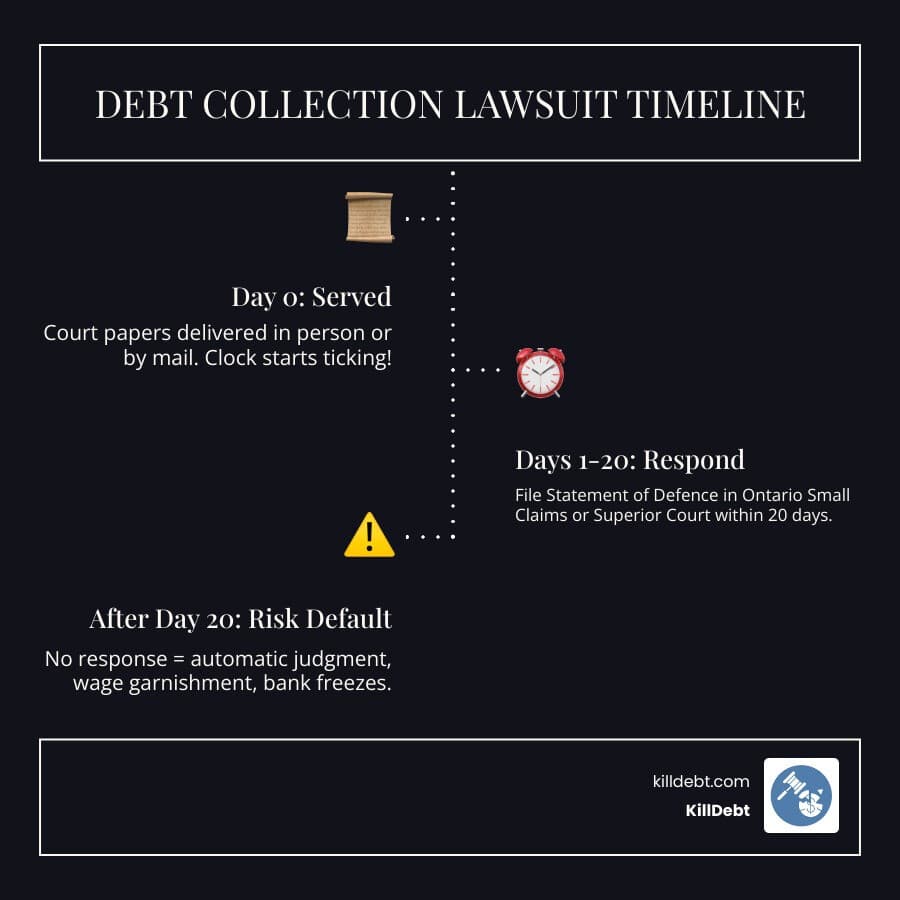
The moment those papers touch your hand, the clock starts ticking. In Ontario, the standard window to file a response is just 20 days. If you were served outside of Ontario (but within Canada or the USA), you might have 40 days, but for most local cases, three weeks is all you get.
The first thing we recommend is staying calm. A lawsuit is a civil matter, not a criminal one. You aren't going to "debtors' prison" because there is no such thing in Canada. However, you must treat the documents with respect. Look for the "Statement of Claim" or "Notice of Claim." This document outlines who is suing you, how much they want, and why they believe you owe it.
To effectively fight debt collection lawsuit actions, you need to understand the anatomy of the paperwork. You will typically receive a Summons and a Complaint (or Statement of Claim). The Summons is the court's way of saying, "Hey, show up or lose," while the Complaint lists the specific allegations against you.
Check for the court seal and the court file number. If these are missing, it might just be a high-pressure tactic from a collection agency, but if they are present, it is a formal legal proceeding. You should immediately:
For a deeper dive into these initial requirements, check out our What to Do When Sued by a Debt Collector: Complete First Steps Guide and understand the Time to Respond Debt Collection Lawsuit to ensure you don't miss your window. Understanding the Difference Between Summons & Complaint in Debt Collection Lawsuit is also vital for knowing exactly what you are responding to.

Winning isn't always about a dramatic "not guilty" verdict. In debt, winning often means getting the case dismissed because the collector can't prove their claims, or settling for pennies on the dollar because you showed you were willing to fight.
In Ontario, the venue depends on the dollar amount:
| Court Type | Claim Amount | Complexity |
|---|---|---|
| Small Claims Court | $35,000 CAD or less | Simplified procedures, often self-represented |
| Superior Court of Justice | Over $35,000 CAD | Formal rules of evidence, high legal costs |
To engage the court, you must file a Statement of Defence. This is your formal response where you admit, deny, or state you have "no knowledge" of the claims made. If you simply ignore the claims, the court assumes they are true. By filing a defence, you force the plaintiff to meet the burden of proof. They must show a signed contract, a complete chain of title (if they bought the debt), and an accurate accounting of the balance.
For more information on the formal response process, refer to What To Do if a Debt Collector Sues You | Consumer Advice (opens in a new tab) and learn about Filing a Counter-Affidavit When Answering a Debt Collection Lawsuit.
A "court-ready" response is your best weapon. You don't need to write a novel; you need to address each numbered paragraph in the plaintiff's claim. If they say you entered a contract on a certain date and you don't remember or don't have the record, you "deny" or "put the plaintiff to strict proof thereof."
Common strategies include:
Using a Key to Strong Answer in a Collection Lawsuit: Solid Counter-Affidavit can significantly strengthen your position by providing sworn testimony that disputes the collector's claims.
When you fight debt collection lawsuit attempts, your "Affirmative Defenses" are your shield. These are legal reasons why, even if the debt was yours at one point, the collector cannot win a judgment now.
The most powerful defense in Ontario is the Statute of Limitations. Under the Limitations Act, 2002, a creditor generally has only two years to start a legal proceeding from the day the debt was "discovered" (usually the date of your last payment or acknowledgment of the debt). If the debt is three years old and you haven't paid or written to them admitting you owe it, the debt is likely "statute-barred." They can still call you (within legal limits), but they cannot win in court if you raise this defense.
Evidence is the heart of your defense. You should look for:
Check out Who Is Suing Me? Original Creditor vs. Debt Buyer Explained to understand the different types of plaintiffs you might face. If you are unsure of your status, see Have You Been Sued by a Debt Collector? for more guidance.
We cannot stress this enough: do not ignore the lawsuit. About 70% to 90% of people sued for debt fail to respond, which is exactly what collectors count on. When you don't file a Statement of Defence, the collector files for a Default Judgment.
A judgment is a "super-debt." It lasts for years and gives the collector aggressive powers they didn't have before:
Don't fall for Debt Collection Lawsuit Myths: 7 Things That Won’t Save You. The reality is that Consumer Debt Lawsuits Are Surging Again, and being proactive is the only way to protect your assets.
Even after you file a defence, the door to negotiation isn't closed. In fact, filing a defence often makes a collector more likely to settle because they realize you aren't an easy target. It costs a creditor thousands of dollars to take a case to trial; they would often rather take a 40% or 50% lump sum payment today than spend $10,000 on lawyers.
Negotiation Tactics:
Learn more about the Debt Collection Lawsuit Timeline: What Happens Next After You’re Served to stay ahead of the process.
Facing a lawsuit is scary, but you don't have to face it alone or broke. At KillDebt, we believe the legal system shouldn't only work for those who can afford $400-an-hour attorneys.
Our DIY legal defense system is powered by ParkerGPT, an AI trained specifically on consumer debt law and real-world court strategies developed over 30+ years by veteran attorney Brian Parker. Unlike generic AI, ParkerGPT understands the nuances of Ontario and Michigan law, helping you identify weaknesses in a collector's case that a human might miss.
We’ve also just rolled out the Court Tester, an AI courtroom simulation. You can upload your actual filings and, within minutes, "argue" your case against an AI judge and opposing counsel. It’s like a dress rehearsal for the real thing, with a private AI co-counsel whispering winning strategies in your ear.
Whether you need to file a Statement of Defence, negotiate a settlement, or just understand your rights, we provide the tools to help you fight debt collection lawsuit actions and win.
Stop the stress and start your defense today. Visit us at https://killdebt.com/ to see how we can help you keep your cash. Still wondering if you can do this yourself? Read Do I Need a Lawyer for a Debt Collection Lawsuit? to find out.

About the author
Brian Parker
I have over 30 years of experience defending consumers against debt collection lawsuits and have seen every tactic, threat, and pressure play that collectors use. Through KillDebt and ParkerGPT, I have systematized the proven defense strategies that actually work - so consumers can respond from a position of knowledge, not fear. My approach focuses on aggressive legal defense based on documented case success rather than false hope that leads to default judgments.