News Break
Top Defenses to Use When Your Debt Is Ancient History
May 29, 2026
Blog / News Break
Learn how to vacate default judgment Florida with our step-by-step guide covering Rule 1.500, the three-prong test, and filing deadlines.

Vacating a default judgment in Florida is possible if you act quickly and meet three legal requirements set by Florida's Rules of Civil Procedure.
Here's how to vacate a default judgment in Florida (quick answer):
A lawsuit can move faster than most people expect. In Florida, you have just 20 days to respond after being served with a complaint. Miss that window, and the plaintiff can ask the court clerk to enter a default against you — often without any further notice. From there, a final default judgment can follow, giving creditors the legal power to garnish your wages, freeze your bank accounts, and place liens on your property.
The good news? Florida courts actually favor resolving cases on their merits, not on missed deadlines. That means a properly filed motion to vacate — backed by the right evidence — gives you a real shot at undoing a default judgment and getting back into the fight.
But the clock is ticking.
I'm Brian Parker, and for over 30 years I've fought debt collectors and collection law firms in courtrooms across the country — including countless cases involving vacating default judgments in Florida. I know exactly where people go wrong, and more importantly, how to fix it.
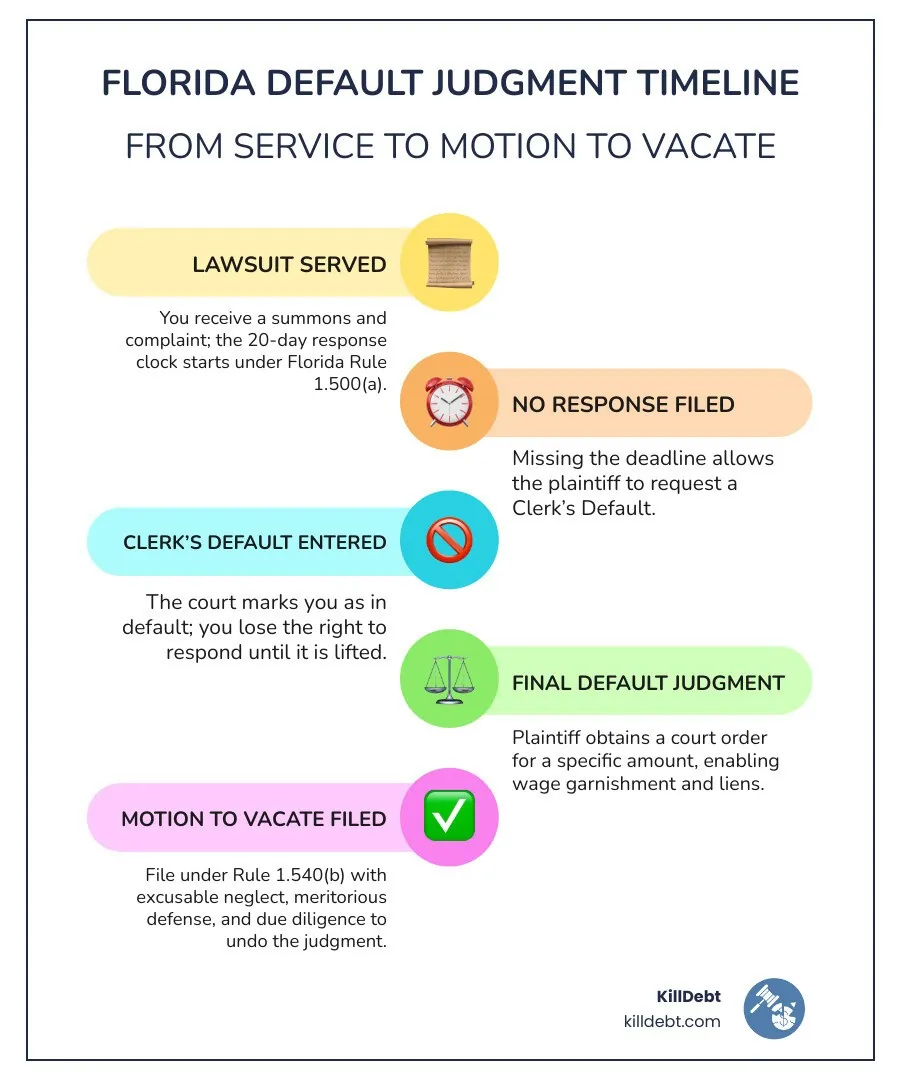
In Florida, the path to a default judgment follows a specific procedural ladder. It usually begins with a Clerk’s Default under Florida Rule of Civil Procedure 1.500(a). When you are served with a lawsuit, you are given a summons that clearly states you have 20 days to file a written response. If you fail to file any paper at all within those 20 days, the plaintiff (the person suing you) can ask the clerk of the court to "enter a default."
This clerk's default is essentially a "time-out" marker. It prevents you from filing anything else until the default is lifted. However, the clerk's default itself isn't the final blow—that comes with the Final Default Judgment. Once the default is entered, the plaintiff moves the court for a final judgment, which is the official court order stating you owe a specific amount of money.
Understanding the Debt Collection Lawsuit Timeline: What Happens Next After You're Served is critical because the strategy for fighting back changes depending on which stage you are in. If you've just received the papers, you need to know What Happens After Summons to prevent the default from happening in the first place.
There is a major legal difference between an "interlocutory" default (the clerk's entry) and a "final" default judgment signed by a judge.
Florida Rule of Civil Procedure 1.500(d) gives the court the power to set aside a default. Courts generally apply a "liberal policy" when a party tries to set aside a clerk's default before a final judgment is entered. At this stage, the standard of proof is slightly lower because the court wants to avoid the "finality" of a judgment if a case can still be heard on its merits.
However, once a Final Default Judgment is entered, it becomes a permanent record and an enforceable debt. At this point, you must move under Rule 1.540(b) to seek relief. This is a higher mountain to climb. Knowing How to Remove Default Judgment Debt requires a deep dive into the "three-prong test" that Florida judges use to decide your fate.
If you want to Vacate default judgment Florida, you can't just tell the judge you "forgot" or that the debt isn't yours. Florida law requires you to satisfy a strict three-prong test. If you miss even one of these three pillars, the court is legally required to deny your motion.
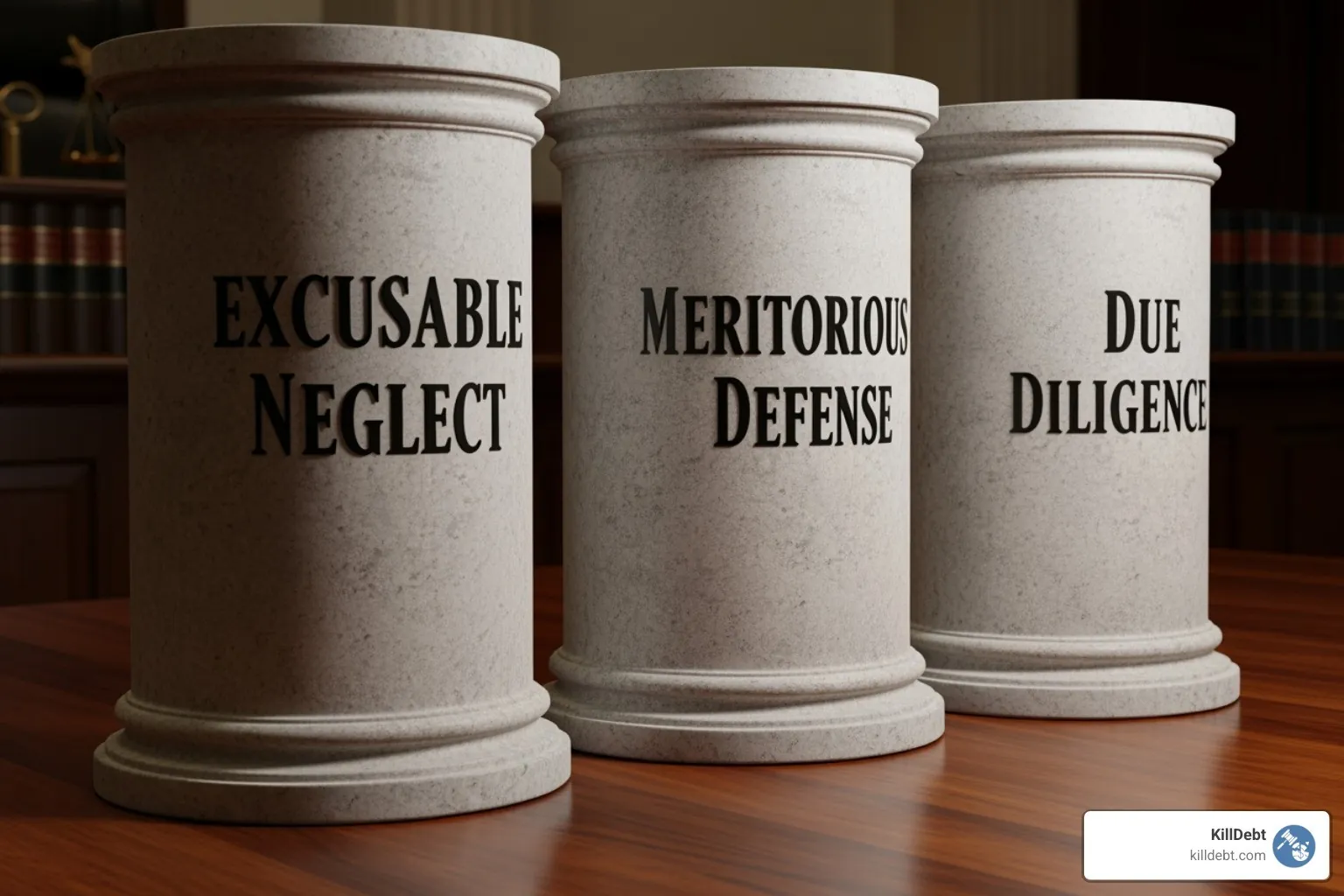
Under Florida Rule 1.540(b) and established case law, you must demonstrate:
The recent case of Nephatari P. Ford v. Princeton Groves FL Apartments (opens in a new tab) reminds us that while courts are liberal in vacating defaults, they expect you to follow the rules of procedure. In that case, the court noted that if a tenant raises a payment defense, the court must hold a hearing before entering a default.
Excusable neglect is the "why" behind your failure to respond. It isn't just any excuse; it must be a legally recognized one. Florida courts have defined excusable neglect as a "clerical error," "secretarial mistake," or a "system gone awry."
Common examples of excusable neglect include:
However, "I didn't think I had to respond" or "I didn't have money for a lawyer" are usually not considered excusable neglect. These fall under Debt Collection Lawsuit Myths: 7 Things That Won't Save You.
The second prong is showing that if the case were allowed to go to trial, you actually have a chance to win. You don't have to prove your case right now, but you must show a "colorable" or "meritorious" defense.
What counts as a meritorious defense?
You cannot simply file a "general denial" (a document saying "I deny everything"). For a final judgment, you must provide a verified answer or a sworn affidavit that outlines the specific facts of your defense. Our Debt Lawsuit Defense Guide can help you identify which defenses apply to your specific situation.
Due diligence is all about how fast you acted once you found out about the judgment. There is no "hard" deadline like a 30-day rule, but Florida courts generally look at a 20-day benchmark.
If you found out about a judgment today and waited two months to file a motion, the court will likely find that you lacked due diligence. In Verijet, Inc. v. Vision Leasing, the court found that acting within two weeks of discovering a default was diligent. Conversely, in other cases, waiting five or six weeks without a good reason has led to motions being denied.
You need to know Sued for a Debt? Here's Exactly What to Do in the First 7 Days because every day you wait makes it harder to prove you are being diligent.
To Vacate default judgment Florida, you must file a formal written motion. This isn't a letter to the judge; it's a legal pleading that must be supported by evidence.
| Requirement | Clerk's Default (Interlocutory) | Final Default Judgment |
|---|---|---|
| Legal Standard | Liberal / Discretionary | Strict Three-Prong Test |
| Evidence Needed | Motion + Proposed Answer | Motion + Sworn Affidavit + Verified Answer |
| Hearing | Often required | Almost always required |
| Timeframe | Before Final Judgment | Within "Reasonable Time" (Max 1 Year) |
In the case of WENDELL LOCKE vs LEVI WHITEHEAD and NICHOLA WHITEHEAD (opens in a new tab), the homeowners lost their chance to vacate because they waited over five months to act and couldn't prove excusable neglect. This highlights why having a sworn affidavit detailing the facts is non-negotiable.
The Ramagli Realty Co. v. Craver decision is a cornerstone of Florida default law. It established that once a "term of court" has ended (in modern terms, once the judgment is final), a trial court's power to simply "change its mind" is limited.
Unless the judgment is void (meaning the court never had jurisdiction or you were never served), the court can only vacate a judgment for very specific reasons like fraud, clerical mistakes, or the three-prong test we discussed. This is why we created the Fight Debt Collection Lawsuit: Complete Guide—to help you navigate these complex common law and statutory rules.
Ignoring a default judgment is like ignoring a fire in your kitchen—it will only get bigger and more destructive. In Florida, a judgment is not just a piece of paper; it is a powerful collection tool that lasts for 20 years.
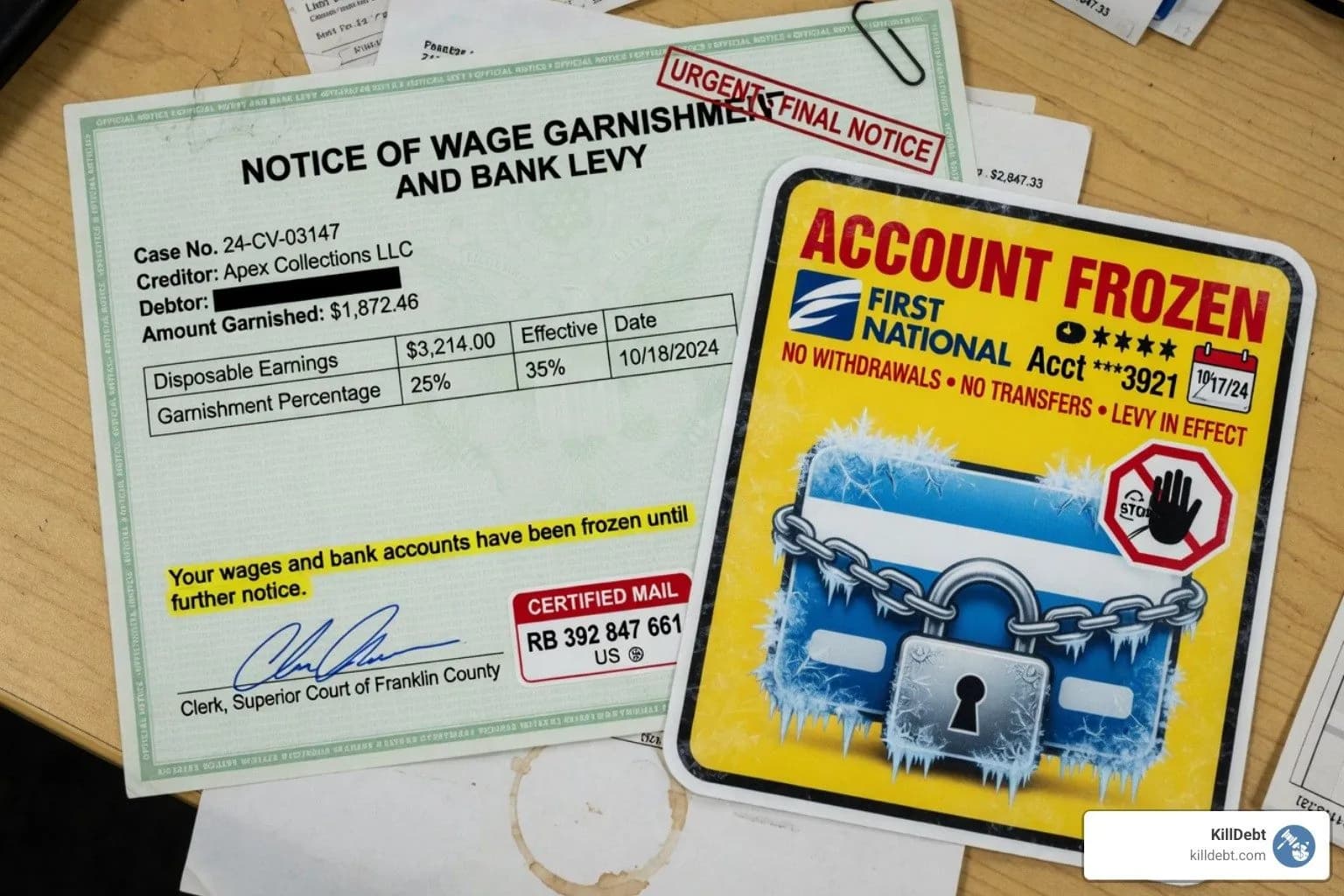
If you don't Vacate default judgment Florida, the creditor can:
If you've just realized a judgment exists, read our What to Do When Sued by a Debt Collector: Complete First Steps Guide immediately to understand your protection options.
Facing a default judgment feels like the end of the road, but in Florida, the law provides a "pound of cure" if you know how to use it. You don't have to be a legal expert to fight back.
At KillDebt, we provide a DIY legal defense system powered by ParkerGPT. This isn't just a chatbot; it's an AI trained on over 30 years of consumer debt law and real-world strategies developed by me, attorney Brian Parker. We help you analyze your lawsuit documents, identify the "excusable neglect" and "meritorious defenses" that Florida judges look for, and generate court-ready motions.
Want to see how your motion will hold up before you step into the courthouse? Try our Court Tester. It’s an AI courtroom simulation where you can upload your filings and argue your motion in front of an AI judge. You'll face AI opposing counsel while a private AI co-counsel whispers the winning strategy only you can see.
Don't let a default judgment ruin your financial future. Visit https://killdebt.com/pricing/ today and get the tools you need to vacate that judgment and win your case.

About the author
Brian Parker
I have over 30 years of experience defending consumers against debt collection lawsuits and have seen every tactic, threat, and pressure play that collectors use. Through KillDebt and ParkerGPT, I have systematized the proven defense strategies that actually work - so consumers can respond from a position of knowledge, not fear. My approach focuses on aggressive legal defense based on documented case success rather than false hope that leads to default judgments.