
News Break
Everything You Need to Know About Debt Assignment Chains
April 30, 2026
Blog / News Break
Sued by a debt collector? Get debt collector suing me advice: respond fast, file answer, challenge debt, avoid default judgment.

If you're looking for debt collector suing me advice, here is the short version: respond to the lawsuit before the deadline, or you automatically lose.
Quick Action Plan:
Getting served with a debt collection lawsuit is one of the most stressful things that can happen when you're already struggling financially. That thick envelope shows up — a Summons, a Complaint, legal language you've never seen before — and it's easy to freeze up.
That reaction is exactly what debt collectors count on.
Many collectors file lawsuits with incomplete records, knowing that most people won't respond. When you don't respond, the court hands them a default judgment automatically. That judgment gives them powerful tools: they can garnish your wages, freeze your bank account, or put a lien on your property — all without ever having to prove the debt in court.
The good news? Responding changes everything. It shifts the burden of proof onto them. It opens the door to negotiation. And it protects rights you didn't even know you had.
This guide will walk you through exactly what to do — step by step — so you can face this with clarity instead of panic.
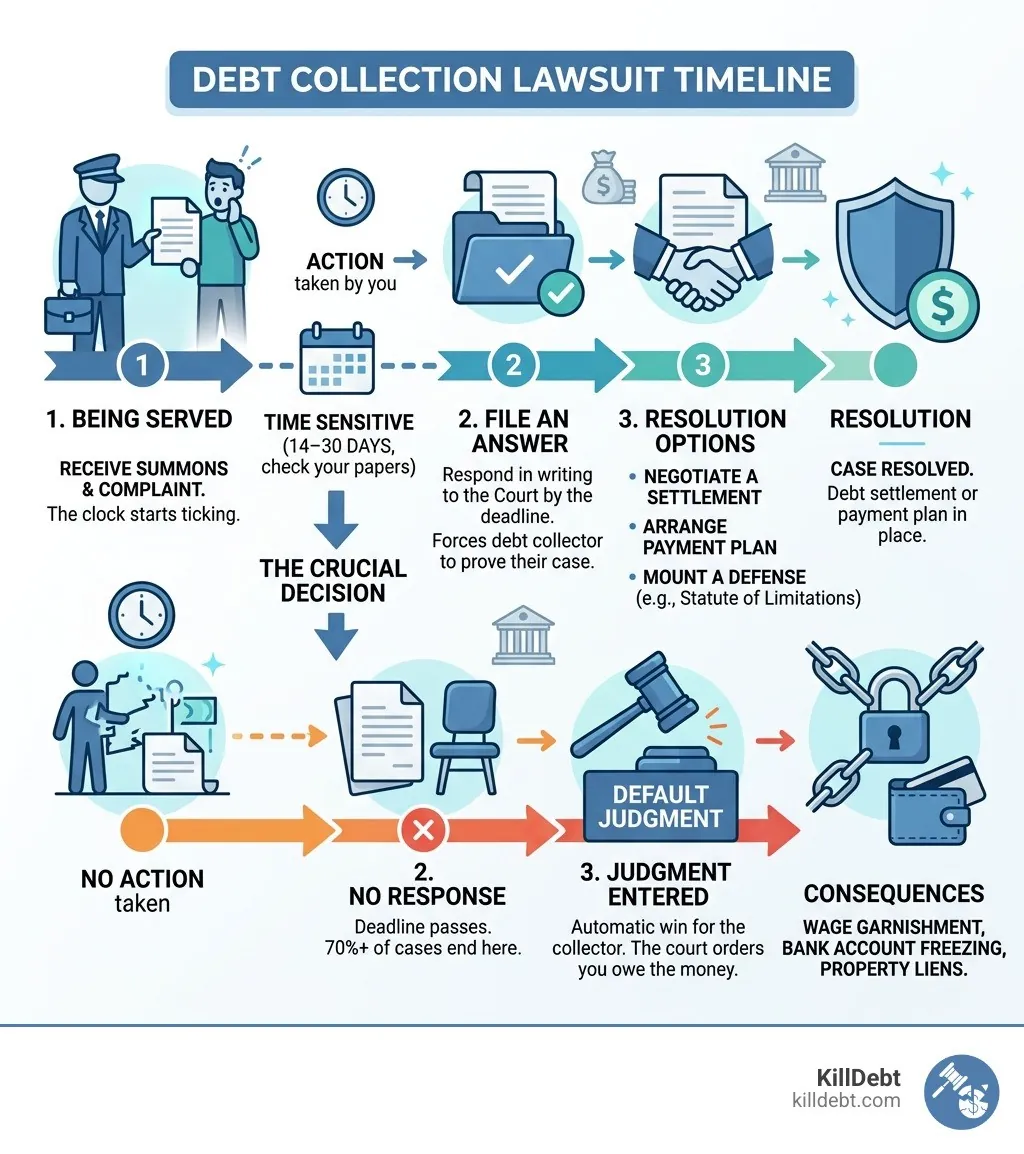
The moment a process server hands you those papers, the clock starts ticking. In the legal world, silence equals consent. If you don't say anything, the court assumes everything the debt collector says is 100% true.
Your first and most important piece of debt collector suing me advice is to find your deadline. This isn't a suggestion; it’s a hard cutoff.
If you miss this window, the collector can file for a "Default," which is the legal equivalent of winning a game because the other team didn't show up. We want to make sure you're on the field and ready to play. For a deeper dive into these initial moments, check out our What to Do When Sued by a Debt Collector: Complete First Steps Guide or review the official guidance from the Consumer Financial Protection Bureau.

When you open that envelope, you’ll find two primary documents. They might look like gibberish at first, but they serve very specific purposes.
You are the "Defendant." The company suing you is the "Plaintiff." Sometimes the Plaintiff is a company you recognize (like a big bank), but often it’s a "debt buyer"—a company that bought your old debt for pennies on the dollar and is now trying to collect the full amount. Understanding the Difference Between Summons & Complaint in Debt Collection Lawsuit is key to knowing how to fight back.
We mentioned earlier that more than 70% of debt collection cases result in a default judgment. This is a staggering statistic. It means millions of people lose their cases simply because they were too intimidated or confused to file a piece of paper.
A default judgment is essentially a "blank check" for the debt collector. Once they have it, they can:
Ignoring the problem won't make it go away; it only makes the collector's job easier. To understand the full scope of what they can take, read Can Debt Collectors Take My Wages and Bank Account.
The most empowering thing you can learn is this: The burden of proof is on them. In a debt collection lawsuit, the debt collector must prove three things:
Often, debt buyers have very little paperwork. They might have a spreadsheet with your name on it, but they may lack the original contract or the "chain of title" showing how the debt moved from the original bank to them. If you don't challenge them, the court won't ask for this proof. If you do challenge them, they might realize they can't win and drop the case entirely.
Your "Answer" is your formal response to the Complaint. For every numbered paragraph in their Complaint, you must respond. In Michigan and Florida, you generally have three choices for each allegation:
In addition to responding to their claims, you can raise "Affirmative Defenses." These are legal reasons why you shouldn't have to pay, even if the debt was originally yours. Common defenses include the statute of limitations or that the debt was already paid. A Key to Strong Answer in a Collection Lawsuit: Solid Counter-Affidavit can be the difference between a win and a loss.
Don't take the collector's word for it. Errors are incredibly common in the debt industry. Sometimes they sue the wrong person with a similar name, or they try to collect an amount that includes illegal fees and interest.
You have the right to demand "Discovery." This is a pre-trial phase where you can ask the Plaintiff for documents, such as the original signed agreement or a full breakdown of the account history. If they can't produce these, their case starts to crumble. It’s also vital to know Who is Suing Me: Original Creditor vs. Debt Buyer Explained, as your strategy might change depending on who is across the aisle.
One of the most powerful tools in your arsenal is the Statute of Limitations. This is a law that sets a time limit on how long a creditor has to sue you. Once that time passes, the debt is "time-barred."
| Debt Type | Michigan | Florida |
|---|---|---|
| Written Contracts | 6 Years | 5 Years |
| Oral Agreements | 6 Years | 4 Years |
| Open-Ended Accounts (Credit Cards) | 6 Years | 4 Years |
Note: In some cases, making a small payment or even acknowledging the debt in writing can "restart the clock." This is why you should be very careful about communicating with collectors before you have a plan.
The FDCPA is a federal law that protects you from abusive, deceptive, and unfair debt collection practices. Even if you owe the money, the collector must follow the rules. If they don't, you might be able to sue them for damages up to $1,000 plus your attorney fees.
Common violations include:
If a collector has been harassing you, keep a log of every call and save every letter. These are pieces of evidence that can be used as a counterclaim in your lawsuit.
"Standing" is a legal term that basically means "Do you have the right to be here?" When a debt buyer like Midland Funding or Portfolio Recovery Associates sues you, they must prove they own the debt. This requires a "Chain of Assignment"—a paper trail showing the debt moving from the original creditor to them.
If there is a gap in that trail, they lack standing. You can challenge this by Filing a Counter-Affidavit When Answering a Debt Collection Lawsuit. This forces them to produce the actual purchase agreement, which they often don't want to show because it reveals how little they paid for your account.
The most important debt collector suing me advice we can give you is this: you have more power than you think. Debt collectors rely on your fear and your silence. When you stand up and demand proof, you break their business model.
At KillDebt, we believe that everyone deserves a fair fight, regardless of their bank account balance. That’s why we created a DIY legal defense system powered by ParkerGPT.
ParkerGPT isn't just a chatbot; it’s an AI trained on consumer debt law and real-world strategies developed over 30 years by veteran attorney Brian Parker. It doesn't just give you generic advice—it analyzes your specific lawsuit documents, identifies the collector's weaknesses, and helps you generate court-ready responses.
And for those who want to be truly prepared, we recently introduced the Court Tester. This is an AI courtroom simulation built on your actual case. You can upload your filings and, within minutes, "argue" your motion in front of an AI judge and against AI opposing counsel. It’s like a dress rehearsal for your defense, complete with a private AI co-counsel whispering strategy only you can see.
Don't let a debt collector dictate your financial future. Take the first step, file your Answer, and show them you aren't part of that 70% who gives up.
Ready to fight back? Learn more about our DIY legal defense services and start your journey toward being debt-free today.

About the author
Brian Parker
I have over 30 years of experience defending consumers against debt collection lawsuits and have seen every tactic, threat, and pressure play that collectors use. Through KillDebt and ParkerGPT, I have systematized the proven defense strategies that actually work - so consumers can respond from a position of knowledge, not fear. My approach focuses on aggressive legal defense based on documented case success rather than false hope that leads to default judgments.