News Break
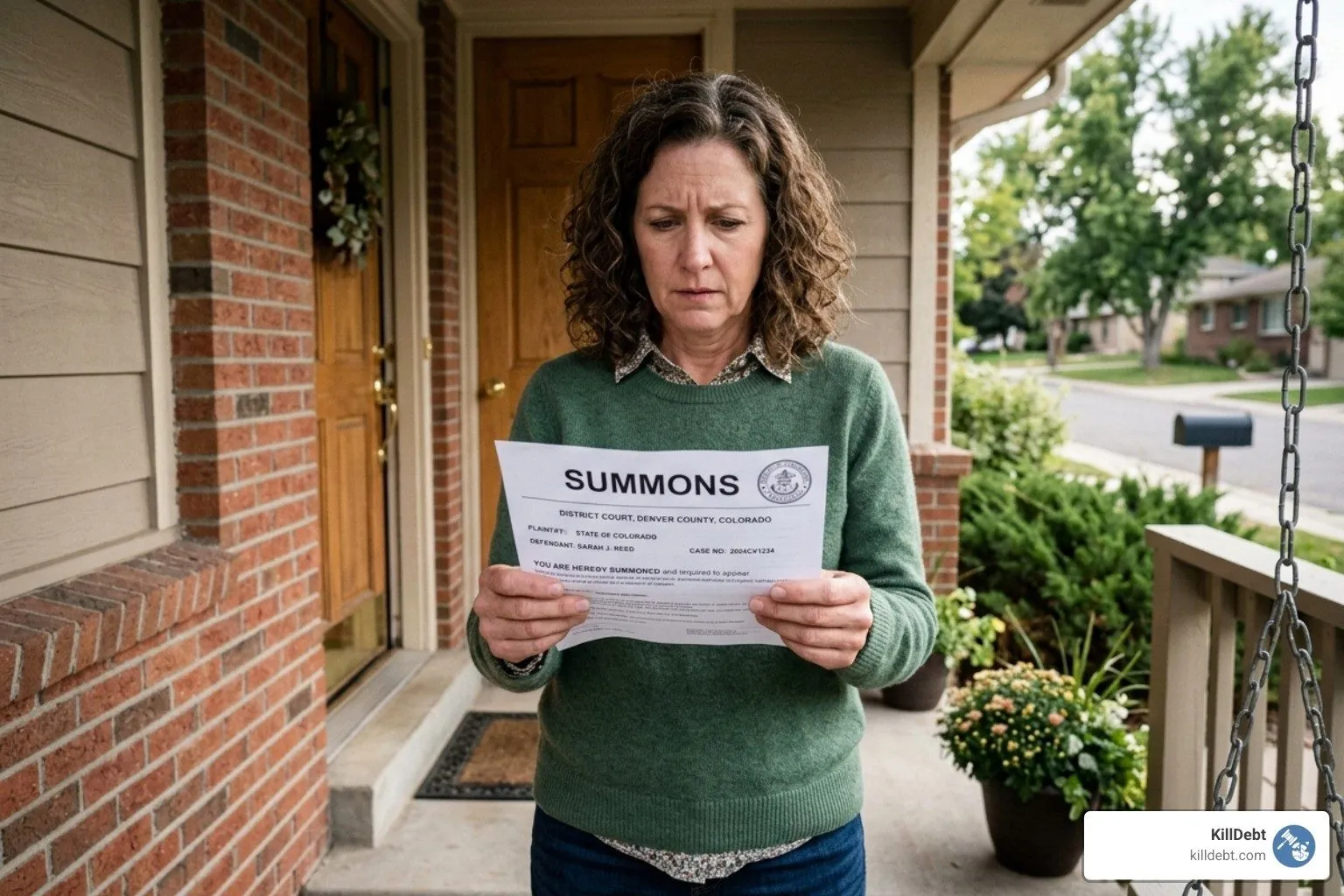
What Happens After a Summons Lands on Your Doorstep
April 29, 2026
Blog / News Break
Learn how chain of assignment debt collector lawsuits work, demand proof of ownership, and win with defenses against incomplete chains.

A chain of assignment debt collector is a third-party company that purchased your debt from the original creditor — or from another buyer who purchased it first — and must prove every step of that ownership transfer before they can legally collect from you.
Here's the quick answer:
Imagine getting a court summons from a company you've never heard of. They claim you owe money — but the name on the paperwork isn't your bank, your credit card company, or anyone you ever signed a contract with.
This happens millions of times every year.
What most people don't realize is that the company suing them may have bought your debt for as little as 4 cents on the dollar — often as part of a massive bundle of thousands of accounts. Along the way, critical paperwork identifying your specific account can get lost, incomplete, or never transferred at all.
That's where the chain of assignment becomes your most powerful defense tool.
Billions of dollars are collected annually on debts where the ownership record is broken, disputed, or simply unverifiable. Courts in multiple states are now requiring debt buyers to prove far more than they used to.
You have more rights here than you probably think.
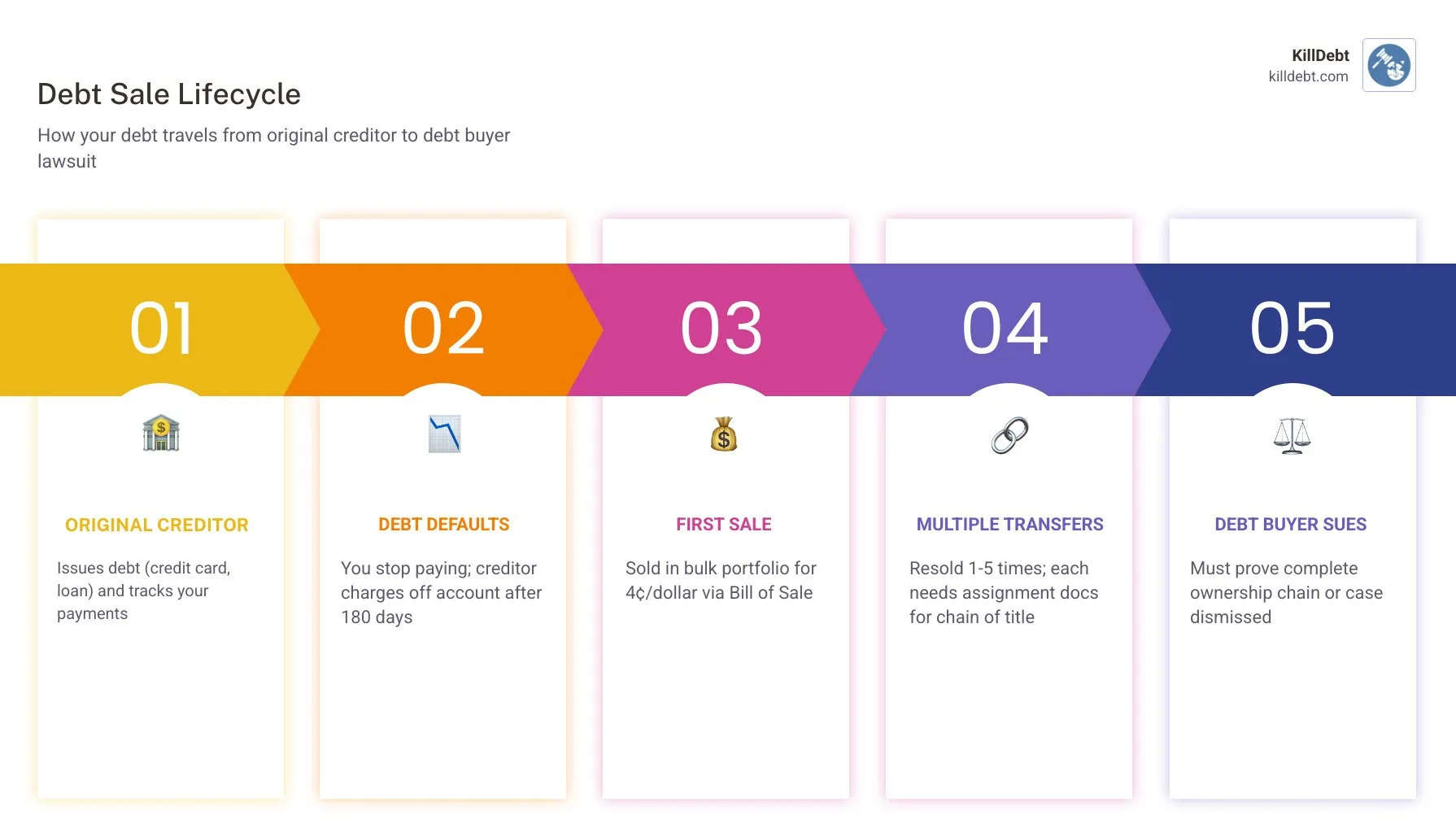
When we talk about a "chain of title" in a debt collection case, we aren't talking about a physical chain (though it might feel like you're being dragged by one). We are talking about the documented history of who has owned the debt from the moment you first swiped that credit card until the moment a debt buyer decided to sue you.
In legal terms, a debt is a "chose in action." This is just fancy lawyer-speak for an intangible right to sue someone for money. Because you can't hold a debt in your hand like a gold bar, the only way to prove you own it is through a paper trail. This is where the concept of Assignment: Involves Transfer of Rights to Collect Outstanding Debts | Anderson Aylwin Begg & Co. (opens in a new tab) comes into play.
There is a massive difference between being sued by the bank that gave you the loan and a company that bought the loan later. We often explain this in our guide on Who is Suing Me? Original Creditor vs. Debt Buyer Explained.
If Capital One sues you, they don't need a chain of assignment because they are the "original creditor." They were there at the beginning. But if a company like Midland Funding or Portfolio Recovery Associates sues you, they are a chain of assignment debt collector. They must prove they have "standing to sue."
Standing is the legal right to initiate a lawsuit. To have standing, a debt buyer must show an "absolute assignment" — a total transfer of rights — in writing. If there is a single gap in that chain — say, the debt went from Bank A to Buyer B, and then Buyer C sues you without proving the transfer from B to C — the chain is broken. No chain, no standing. No standing, no lawsuit.
If a debt buyer wants to win in court, they can't just point at you and say, "They owe us money!" They need receipts. Specifically, they need a series of documents that link them back to your original contract.
The most common documents required include:
As we discuss in Credit Card Debt Collection: How Banks Sell Your Account, these documents are often generic. When a consumer asks, Q: What docs must a debt collector provide to validate assignment of ... (opens in a new tab), the answer is clear: they must provide enough evidence to identify your specific account as part of that mass sale.
The "Account Schedule" is the most important document you’ve probably never seen. When a bank sells 10,000 accounts, they attach a digital file (the schedule) that lists the names, social security numbers, and balances of every person in that bundle.
Without this schedule, a Bill of Sale is just a piece of paper. It proves a sale happened, but it doesn't prove your debt was part of it. Debt buyers hate showing these schedules because they often contain private information of thousands of other people, or worse, they don't actually have the specific data for your account.
In the modern era, debt buyers are increasingly relying on electronic records and third-party registries like the Global Debt Registry to track these transfers. While courts are becoming more comfortable with digital records, the 1.4.7.4 Chain of Title | Fair Debt Collection | NCLC Digital Library (opens in a new tab) still requires that these records meet the "business records exception" to be admissible in court. This means the collector must prove the records were made at or near the time of the event by someone with knowledge of the transaction.
If you are being sued, your job isn't necessarily to prove you don't owe the money. Your job is to force the chain of assignment debt collector to prove they have the right to collect it.
| Feature | Original Creditor | Debt Buyer |
|---|---|---|
| Proof of Ownership | Direct (Original Contract) | Indirect (Chain of Assignments) |
| Document Quality | High (Original Statements) | Variable (Summaries/Affidavits) |
| Standing Challenge | Difficult | Highly Effective |
| Hearsay Risk | Low | High |
The most common weakness is a "missing link." If a debt was sold from Chase to Buyer A, then to Buyer B, then to Buyer C, Buyer C must produce three separate Bills of Sale. If they only have the last one, they lose.
Another defense is challenging "hearsay." If a debt buyer brings an affidavit from their own employee to "verify" the records of the original bank, you can object. That employee doesn't work for the bank; they have no idea how the bank's computers work or if the bank's data entry was accurate. This is a common reason why Why Debt Collectors Buy Old Debts for so little — they know the records are often a mess.
If the collector can't provide the paperwork, you can file a Motion to Dismiss for lack of standing or a Motion for Summary Judgment. As noted in What Happens When a Debt Buyer Can't Prove Chain of Title (opens in a new tab), if the court finds the evidence is insufficient, the case is over.
Because KillDebt focuses on Florida and Michigan, we need to look at the specific hurdles collectors face in these states.
In Florida, the law is quite protective of consumers regarding debt assignments. Under The 2025 Florida Statutes - Online Sunshine (opens in a new tab), specifically Florida Statute 559.715, an assignee (the debt buyer) must give the debtor written notice of such assignment within 30 days of the assignment.
Furthermore, Florida courts generally require the debt buyer to attach the assignment documents to the complaint itself. If they don't, the complaint might be "facially deficient," meaning it can be kicked out of court before you even argue the facts.
Michigan has also stepped up its game. Recent changes in Michigan Courts Increase Requirements of Proof of Assignment in ... (opens in a new tab) show that judges are no longer accepting "trust me" as a valid legal argument. Debt buyers in Michigan must now provide more granular evidence of the transfer. If the paperwork is generic or the affidavit is "robo-signed" (signed by a machine or someone who didn't read it), Michigan courts are increasingly likely to dismiss the case.
You don't have to wait for a lawsuit to demand proof of the chain of assignment. In fact, you should start the moment you get that first "validation notice."
Under the Fair Debt Collection Practices Act (FDCPA), a collector must send you a notice within five days of their first contact. This notice tells you how much you owe and who the original creditor was. You then have a 30-day window to dispute the debt in writing.
When you dispute, you aren't just saying "I don't owe this." You are demanding verification. For a chain of assignment debt collector, this means they should provide:
We break down these rights further in our guide: What is a Debt Collector Under the FDCPA? Your Rights Explained.
If they sue you, the "discovery" phase begins. This is your chance to demand:
The chain of assignment debt collector relies on one thing above all else: your silence. They bank on the fact that 90% of people sued for debt never show up to court. When you show up and demand a valid chain of title, you change the math of the entire case.
At KillDebt, we believe you shouldn't need a law degree to defend your rights. That’s why we created ParkerGPT, an AI legal defense system trained specifically on consumer debt law and real-world strategies developed over 30 years by attorney Brian Parker.
Whether you are in Florida or Michigan, our platform analyzes your lawsuit documents, identifies the exact "missing links" in the collector's chain, and generates court-ready responses.
Want to see how you'd do in front of a judge? Our brand-new Court Tester tool is an AI courtroom simulation. You can upload your actual filings and "practice" your arguments against an AI opposing counsel, with a private AI co-counsel (trained by Brian Parker) whispering winning strategies in your ear.
Don't let a broken chain pull you down. Visit KillDebt.com today and start building your defense.

About the author
Brian Parker
I have over 30 years of experience defending consumers against debt collection lawsuits and have seen every tactic, threat, and pressure play that collectors use. Through KillDebt and ParkerGPT, I have systematized the proven defense strategies that actually work - so consumers can respond from a position of knowledge, not fear. My approach focuses on aggressive legal defense based on documented case success rather than false hope that leads to default judgments.