The Credit Card Charge-Off Process Explained

What Happens When You Stop Paying

From my analysis of bank charge-off procedures, missed credit card payments trigger a standardized timeline designed to maximize recovery value rather than resolve the debt.

A typical charge-off sequence looks like this:

  • Months 1–3: Internal collection calls and letters

  • Months 4–5: Account classified as seriously delinquent, fees and interest continue to accrue

  • Month 6: Account is “charged off” for accounting purposes, but the debt remains legally enforceable

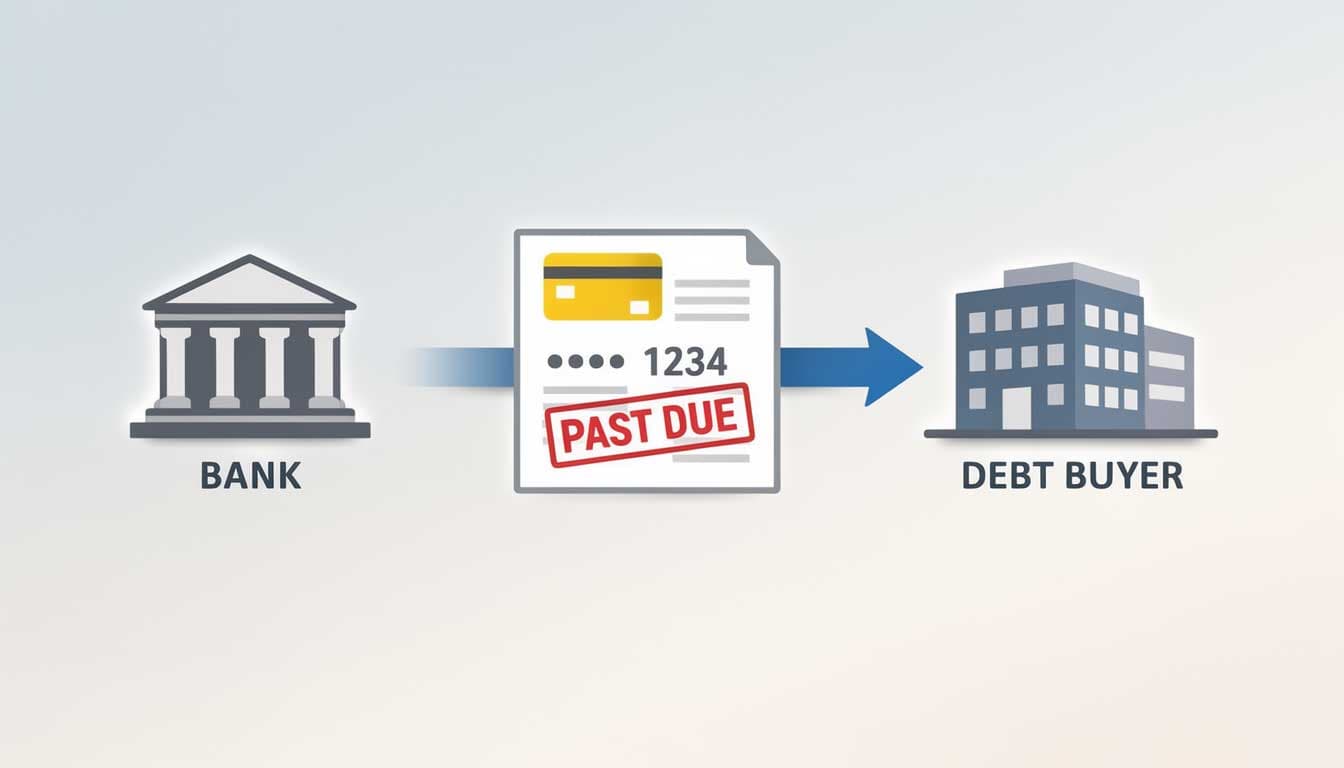
  • After charge-off: Account is sold to debt buyers or assigned to third-party collectors

The critical distinction is this: a charge-off is an accounting event, not debt forgiveness. Banks write the debt off for tax and reporting purposes while continuing to monetize it through sale or assignment.

Why Banks Sell Instead of Collect

Banks typically sell charged-off credit card accounts rather than continue internal collection because:

  • Immediate cash flow: Selling produces guaranteed revenue instead of uncertain recovery

  • Regulatory limits: Banks face stricter collection compliance obligations than debt buyers

  • Cost reduction: Selling eliminates staffing and operational collection expenses

  • Risk transfer: Collection risk shifts to the purchaser

  • Balance sheet cleanup: Non-performing accounts are removed from reported assets

From industry data, banks often profit twice—first through accounting write-offs, then through portfolio sales to debt buyers purchasing accounts for a fraction of face value.

The Bank to Debt Buyer Pipeline

How Major Banks Package Your Debt

Major credit card issuers follow nearly identical procedures when selling charged off accounts.

Banks such as Bank of America, Chase, Capital One, and Wells Fargo typically does the following:

  • Portfolio aggregation: Thousands of charged off accounts are bundled together

  • Data compilation: Electronic files are created with limited account level data

  • Minimal documentation: Original applications and full statement histories are rarely included

  • Bulk sales: Entire portfolios are sold without individual account verification

From my motion to dismiss strategy analysis, this bulk sale process is the root cause of most debt buyer failures. It prioritizes speed and volume over documentation integrity.

The Documentation Problem Created by Sales

When banks sell credit card accounts, the materials transferred usually consist of:

  • Electronic spreadsheets with basic account data

  • Summary payment histories

  • Generic affidavits not tied to specific accounts

  • Bills of sale covering thousands of accounts at once

What debt buyers typically do not receive:

  • The original signed credit card application or agreement

  • Monthly statements actually mailed to the consumer

  • Transaction level records with merchant details

  • Customer service records reflecting disputes or adjustments

This creates the core litigation problem. Debt buyers must prove ownership of your specific account and the accuracy of the balance, but they are rarely given the documents required to do so.

The Chain of Title Disaster

Perfect vs Broken Chains of Title

In debt collection litigation, a perfected chain of title requires complete documentation showing continuous ownership from the original creditor to the current plaintiff.

A proper chain includes:

  • The original credit agreement

  • Complete account statements from opening to charge off

  • A specific assignment of your individual account

  • Authorized signatures for each transfer

Why Bank Sales Create Broken Chains

In practice, these requirements are rarely met.

From thousands of defended cases, the most common failures include:

  • Missing originals: Banks transfer electronic data, not physical account files

  • Bulk assignments: Bills of sale reference portfolios, not individual accounts

  • Multiple resales: Each transfer introduces new documentation gaps

  • Without recourse language: Sale documents often disclaim any warranty of ownership

Authentication problems compound these defects. Debt buyers frequently rely on witnesses who sign documents for multiple entities without personal knowledge of the account or authority to authenticate records, creating evidentiary failures under both federal and state rules.

In one recent motion to dismiss against LVNV Funding, a documented chain of title challenge resulted in a settlement call within twenty four hours. Once ownership defects are exposed, litigation risk shifts sharply against the debt buyer.

The Securitization Complication

How Modern Credit Card Debt Is Securitized

Most credit card accounts are securitized shortly after origination, creating ownership structures that are rarely disclosed in collection lawsuits.

The typical structure looks like this:

  • Credit card accounts are originated by the bank

  • Receivables are transferred and sold to securitization trusts

  • Trusts hold the economic ownership of the accounts

  • Banks continue servicing but no longer own the receivables

  • Charge off occurs after ownership has already transferred

The American Express Example

In a recent defended case, American Express sued a consumer claiming ownership of three credit card accounts.

However, its own SEC filings told a different story.

  • AMEX Form 10 K disclosures confirmed ongoing asset securitization

  • Those filings defined securitization as the transfer and sale of receivables to a trust

  • Receivables were identified as transferred to the American Express Credit Account Master Trust

  • Trust documents stated the receivables were available only to pay trust investors

Despite this, an AMEX witness certified under oath that the accounts had not been sold or assigned.

Why Securitization Matters for Your Defense

Securitization creates overlapping and conflicting ownership claims:

  • Banks claim ownership for collection purposes

  • Trusts hold the actual receivables

  • Debt buyers claim purchase rights from banks

  • Servicers present themselves as owners

The strategic advantage is clear. Most debt buyers cannot explain or document securitization history, making standing and ownership challenges especially effective when raised early.

FDCPA Implications of Bank Sales

When Banks Become Debt Collectors

Original creditors collecting their own debts are generally exempt from the FDCPA. That exemption ends the moment a bank sells an account.

Once a debt is sold, the purchaser is collecting a debt owed to another and is fully subject to the FDCPA.

Debt buyers must comply with:

  • Validation requirements under 15 U.S.C. § 1692g

  • Communication restrictions under 15 U.S.C. § 1692c

  • Prohibitions on false or misleading representations under 15 U.S.C. § 1692e

  • Statutory liability of up to $1,000 per action plus attorney fees

This distinction is critical. Many defenses and counterclaims only exist because the account was sold.

Common FDCPA Violations in Bank Sold Debt Cases

From my systematic case analysis, debt buyers regularly violate the FDCPA when collecting bank sold accounts.

Common violations include:

  • False ownership claims (§ 1692e(2)(A))

    • Claiming ownership without adequate documentation or where securitization trusts retain ownership interests.

  • Inadequate validation (§ 1692g)

    • Responding to validation requests with internal computer printouts instead of account level documentation from the original creditor.

  • Mini Miranda violations (§ 1692e(11))

    • Including “this communication is from a debt collector” language in legal pleadings, where such language is prohibited and misleading.

  • Improper venue (§ 1692e(10))

    • Filing lawsuits in locations convenient for the collector rather than legally proper venues.

These violations are not incidental. They stem directly from the way bank sold debts are documented and litigated.

How to Challenge Bank Sold Debt Cases

The Motion to Dismiss Strategy

My standing challenge framework focuses on exposing ownership and evidentiary failures at the earliest stage.

Effective challenges include:

  • Filing a Motion to Dismiss for lack of standing, often paired with an alternative Motion for More Definite Statement

  • Preparing a counter affidavit using the collector’s own exhibits to expose assignment and authentication defects

  • Presenting a one page chain of title synopsis showing missing or defective transfers

  • Raising securitization conflicts that create competing ownership claims

When documentation gaps are made clear to the court, debt buyers frequently disengage rather than litigate.

The SEC Filing Challenge Strategy

Bank originated debts often leave a paper trail outside the courtroom. In the American Express example, SEC filings contradicted sworn litigation claims.

Effective use of regulatory filings includes:

  • Searching EDGAR for Forms 10 K and securitization prospectuses

  • Identifying disclosures referencing securitization, trusts, transfers, or receivables

  • Comparing those disclosures to affidavit claims made in court

  • Challenging witnesses who assert personal knowledge inconsistent with public filings

Courts take these contradictions seriously when properly presented.

Key Documentation and Authentication Challenges

From repeated motion practice, the most effective attacks focus on:

  • Bills of sale that fail to identify your individual account

  • Affidavits offered as sole proof of ownership without personal knowledge

  • Assignment language disclaiming warranties of ownership

  • Missing links in the chain of title from the original bank forward

Authentication failures are systemic:

  • Witnesses lack knowledge of original bank records

  • Records are recreated in debt buyer systems

  • Chain of custody between entities is undocumented

  • Signatories cannot establish authority across multiple entities

In the AMEX litigation, a witness claimed knowledge of account origination, transaction history, and ownership determinations he never participated in, without laying any evidentiary foundation.

The Economics Behind Bank Sales

Why the System Is Designed to Exploit Consumers

The financial structure explains the behavior.

  • Bank profit: Tax write off plus portfolio sale proceeds

  • Debt buyer cost: Roughly $200 for a $5,000 account

  • Lawsuit demand: $7,500 to $10,000 with added fees

  • Default rate: Approximately 70 percent

  • Return: 1,500 to 5,000 percent when uncontested

The system only works if consumers do not respond

How Banks Structure Sales to Favor Debt Buyers

Bank sales are engineered for speed, not accuracy:

  • Electronic data transfers without original records

  • Generic affidavits covering thousands of accounts

  • No verification of individual account accuracy

  • Broad assignment language attempting to transfer all rights

  • “As is” disclaimers shielding banks from downstream challenges

This structure creates the very documentation gaps that make debt buyer cases vulnerable when properly challenged.

Your Defense Strategy Against Bank Sold Debt

Use this checklist to evaluate and pressure a bank sold debt case.
Each item corresponds to weaknesses created by bulk sales, missing documentation, and securitization issues discussed above.

Phase 1: Immediate Case Analysis

[ ] Identify the original creditor bank and research its standard debt sale practices

[ ] Review the alleged chain of title for gaps, bulk assignments, or missing links

[ ] Assess whether securitization may apply to the account

[ ] Calculate the statute of limitations based on the last payment or acknowledgment to the bank

Phase 2: Documentation Challenge Development

[ ] Demand the complete account file originating from the bank

[ ] Challenge authentication of all business records and affidavits

[ ] Attack bulk sale documents that fail to specifically transfer your account

[ ] Identify securitization conflicts that undermine ownership claims

Phase 3: FDCPA Violation Identification

  • [ ] Document false ownership representations

  • [ ] Identify inadequate or non compliant validation responses

  • [ ] Challenge venue selection used for collector convenience

  • [ ] Preserve Mini Miranda violations appearing in pleadings

Phase 4: Motion Practice and Resolution

  • [ ] File a Motion to Dismiss challenging standing and chain of title

  • [ ] Prepare counter affidavits using the collector’s own exhibits

  • [ ] Force judicial review through hearing or briefing

  • [ ] Negotiate from strength using documentation failures and FDCPA exposure

This checklist is not theoretical. It reflects how bank sold debt cases are actually dismantled in court.

Using KillDebt Against Bank Sold Debt Cases

I built KillDebt as a comprehensive consumer debt defense platform based on 30+ years of handling real debt collection cases. It's not limited to one tactic or one type of dispute—it's designed to solve debt collection problems the way they unfold in actual litigation. 

At the core of KillDebt is ParkerGPT, the AI analysis system trained on real debt collection cases, court filings, and litigation documents I've developed and used over decades. ParkerGPT doesn't guess or improvise. It analyzes cases by applying proven legal patterns, court-tested documents, and continuously updated procedural rules to the facts in front of it—exactly the way I would if you hired me to defend your case.

How KillDebt Can Help You with Bank Sold Debt Cases

Bank sold debt cases fail for predictable reasons: bulk transfers, electronic only records, broken chains of title, and undisclosed securitization conflicts.

KillDebt is designed to surface those issues immediately.

ParkerGPT evaluates bank sold debt cases for:

  • Chain of title defects created by bulk portfolio sales

  • Assignment language that fails to transfer individual accounts

  • Securitization conflicts common in major bank credit card programs

  • Authentication weaknesses in bank to debt buyer affidavits

  • FDCPA violations triggered by false ownership and inadequate validation

Members use this analysis to:

  • Identify dismissal leverage early

  • Build standing challenges grounded in bank sale mechanics

  • Preserve FDCPA counterclaims alongside procedural defenses

  • Avoid reactive litigation and force resolution on favorable terms

KillDebt does not replace legal judgment. It systematizes it so consumers can respond to industrial debt buying with the same level of sophistication used against them.

Summary

When banks charge off credit card accounts, the debt is rarely forgiven. Instead, it is sold through bulk portfolio transactions to debt buyers who attempt to collect the full balance through lawsuits and aggressive collection tactics. These sales prioritize speed and volume over documentation, creating broken chains of title, authentication failures, and undisclosed securitization conflicts.

Understanding how bank sold debt works reveals why debt buyers struggle to prove ownership, standing, and balance accuracy when challenged. By identifying documentation gaps, raising FDCPA violations, and exposing inconsistencies between regulatory filings and court claims, consumers can dismantle debt buyer cases and force dismissals or favorable settlements.

Fighting back is not about delay or denial. It is about exploiting the structural weaknesses built into the bank to debt buyer pipeline.

Next Steps in Your Bank-Sold Debt Defense Journey

Understanding how banks sell your account is crucial to effective defense against debt buyers. Your next learning priority should focus on: (Coming Soon)

Who Is Suing Me? Original Creditor vs. Debt Buyer Explained - Distinguishing bank-sold debt from original creditor collection (Coming Soon)

Why Debt Collectors Buy Old Debts: The $200 to $10,000 Trap - Understanding the debt buyer business model that profits from bank sales (Coming Soon)

What to Do When Sued by a Debt Collector: Complete First Steps Guide - Immediate action plan for bank-sold debt buyer lawsuits

About Brian Parker

I have over 30 years of experience defending consumers against debt collection lawsuits and have seen every myth, excuse, and misconception that prevents people from taking effective action. Through KillDebt and ParkerGPT, I've systematized the proven defense strategies that actually defeat debt collectors while debunking the dangerous myths that lead to default judgments. My approach focuses on aggressive legal defense based on documented case success rather than false hope that destroys financial futures.



Frequently Asked Questions (FAQ)

What does it mean when a credit card account is charged off?

A charge off is an accounting decision, not debt forgiveness. The bank writes the account off for tax and reporting purposes but the debt remains legally enforceable and is often sold to debt buyers.

Why do banks sell credit card debt instead of collecting it themselves?

Banks sell charged off accounts to generate immediate cash, reduce regulatory exposure, eliminate internal collection costs, and clean non performing assets from their balance sheets.

What documents do debt buyers usually receive from banks?

Debt buyers typically receive electronic spreadsheets, summary payment data, and generic bills of sale. They rarely receive original signed agreements, full account statements, or transaction level records.

How does selling debt create legal problems for debt buyers?

Bulk sales create broken chains of title, missing assignments, authentication failures, and conflicts with securitization trusts. These defects undermine standing and ownership claims in court.

Are debt buyers subject to the FDCPA?

Yes. Once a bank sells an account, the purchaser is collecting a debt owed to another and must comply with FDCPA requirements, including validation, communication limits, and prohibitions on false representations.

Can securitization affect who actually owns my credit card debt?

Yes. Many credit card receivables are securitized and transferred to trusts. This can create conflicts between bank claims, trust ownership, and debt buyer assertions that are critical in litigation.

What is the most effective way to challenge bank sold debt?

What is the most effective way to challenge bank sold debt?

The strongest challenges focus on standing, chain of title defects, authentication failures, FDCPA violations, and contradictions between court filings and public regulatory disclosures.

IMPORTANT LEGAL DISCLAIMER

This educational content is based on general legal principles and my experience in debt collection defense. It is provided for informational purposes only and does not constitute legal advice. Laws vary by state and by local court. For specific legal advice, consult a qualified attorney licensed in your jurisdiction. No attorney-client relationship is created by reading this guide.

Critical Multi-State Variations:

  • Statute of limitations periods: Vary significantly by state for credit card debts (3-10 years typically)

  • Standing requirements: Proof of debt ownership standards vary between jurisdictions for bank-sold accounts

  • Discovery procedures: State court rules for compelling bank records differ substantially

  • FDCPA enforcement: Federal law is uniform, but state consumer protection acts provide additional violation categories

  • Securitization law: State UCC requirements for perfecting assignments vary between jurisdictions

  • Authentication standards: Evidence admission requirements differ between state and federal courts

State-Specific Legal Requirements:

  • Debt collection laws, bank sale challenges, and standing requirements vary significantly by state and local jurisdiction

  • Specific legal requirements for challenging bank-sold debt ownership and documentation differ between jurisdictions

  • Individual case circumstances involving securitization and complex bank structures may require different analysis than described

  • Some challenge strategies may be more or less effective in particular jurisdictions