
News Break
The Power of Asking Questions: Why Validating Old Debt is Your Best Defense
July 17, 2026
Blog / News Break
Choose a legal tech validation platform to verify AI accuracy and avoid hallucinations in debt defense filings.
If you're trying to figure out which legal tech validation platform actually does what it claims, here's a quick breakdown of the top options:
| Platform | Best For | Key Feature |
|---|---|---|
| QEL (Qualified Evidence Layer) | High-stakes AI output review | Claim-admission firewall, evidence mapping |
| FactProof | Multi-source claim verification | 30+ sources, cryptographic audit trails |
| L.I.O.N. Lab | Vendor certification | Independent trust badge for legal tech software |
| LaunchReady Verified | AI app trust signals | Ongoing automated re-verification |
| Lenavix | AI regulatory due diligence | Multi-jurisdiction compliance mapping |
The legal tech market is exploding. It's projected to double in size by 2027, and AI tools are being plugged into legal workflows faster than anyone can properly vet them.
That's a problem.
Not all AI is created equal — especially when a court deadline is on the line. Generic AI tools can hallucinate facts, invent case citations, and produce responses that look legitimate but fall apart the moment a judge reviews them. In 2023, a federal court sanctioned attorneys in Mata v. Avianca for filing AI-fabricated citations. That case became a warning shot for the entire industry.
For everyday people facing a debt lawsuit summons, a collection letter, or a looming court date, the stakes couldn't be higher. Choosing the wrong AI tool — one that hasn't been independently tested and validated — can mean a default judgment against you before you even get a fair shot.
I'm Brian Parker, founder of KillDebt and a consumer debt defense attorney with over 30 years of courtroom experience fighting creditors, debt buyers, and collection law firms. I've seen what happens when people use unvalidated tools in high-stakes legal situations, which is why understanding what makes a legal tech validation platform trustworthy is something I take seriously. Let's break down exactly what to look for — and which tools are worth your trust.
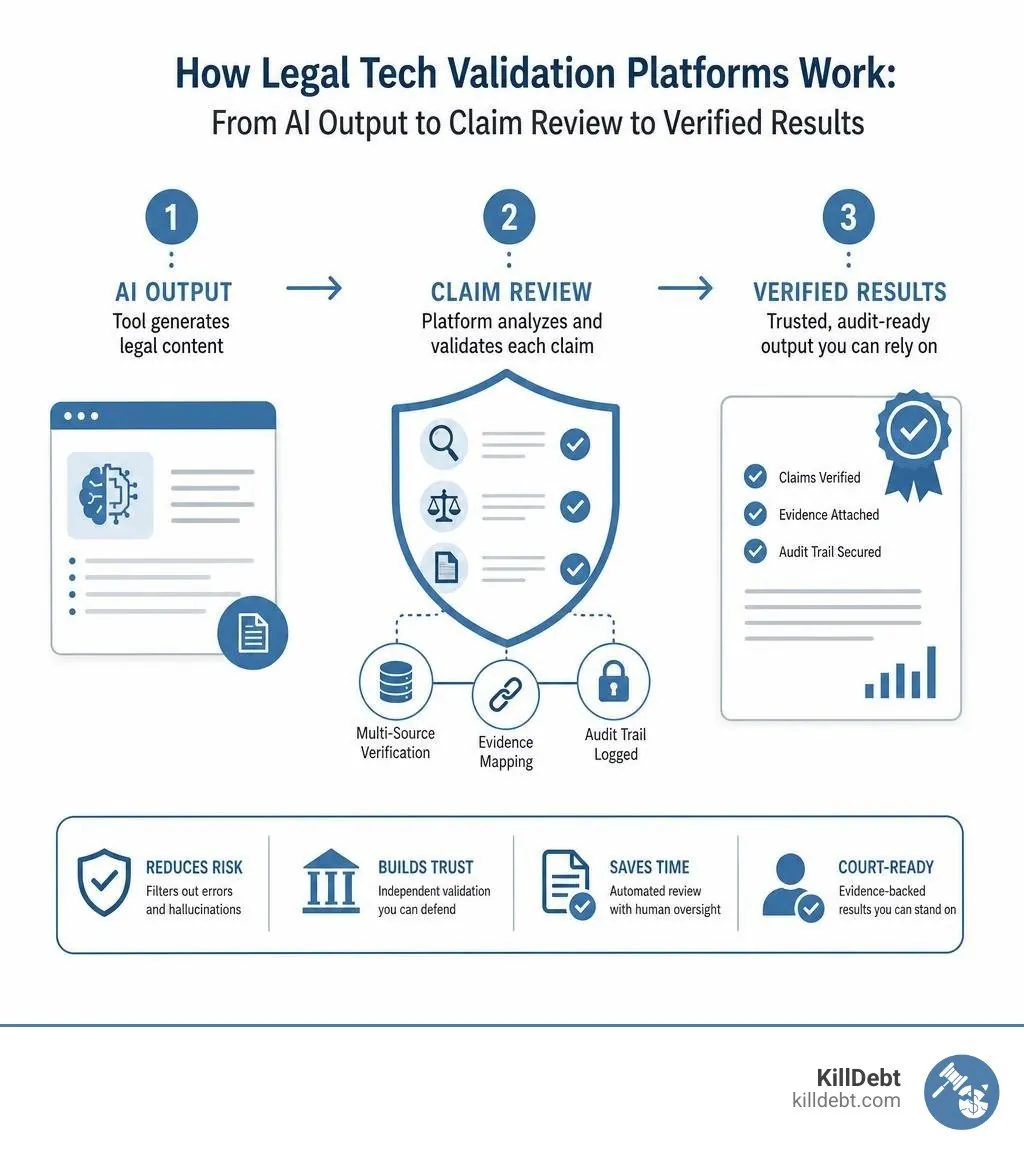
A legal tech validation platform is a specialized software environment designed to independently test, verify, and certify the reliability, compliance, and accuracy of legal technology tools. Unlike standard legal software that performs tasks like document generation or case management, a validation platform acts as the "verifier of the verifiers." It ensures that the underlying AI, automation logic, and data sources are operating within strict legal and ethical guardrails.

In an era where two-thirds of legal leaders plan to accelerate their tech investments, the lack of independent certification has created a trust gap. When we talk about "software evaluation," we aren't just asking if a tool has a clean user interface. We are asking:
Independent validation establishes objective "trust badges." Platforms like Why Choose L.I.O.N. ® Lab? (opens in a new tab)have emerged to bridge the gap between vendors making grand efficiency claims and purchasers who need verifiable proof of concept. By replacing lengthy, repetitive manual demos with standardized testing packages, validation platforms confirm that a tool actually does what it claims.
To understand how these platforms operate, we have to look under the hood. A modern, robust validation platform is not just a checklist; it is an active testing environment utilizing several advanced mechanism layers:
For consumer-facing legal defense, verifying accuracy is even more critical. When we use automated tools to draft a response to a debt collector, we cannot afford a single error. That is why having a structured, validated process is the only way to safely leverage AI in the courtroom.
It is easy to assume that because an AI assistant like ChatGPT can write a persuasive email, it can also draft a court motion. This is a dangerous assumption.
General AI operates on probability. It predicts the most likely sequence of words based on its training data. If it doesn't know an answer, it may hallucinate — fabricating a case name or a statute that sounds incredibly realistic.
Validated legal AI, on the other hand, is grounded in closed, authoritative databases. It uses services like vLex (Part of Clio) | AI Legal Research Tools for Lawyers (opens in a new tab)to reference actual case law and dockets. More importantly, validated legal AI is wrapped in a validation layer that checks the output before it ever reaches your screen. If the validation layer cannot verify a citation against a live database, the citation is stripped out. This is the difference between a tool that is merely "smart" and one that is legally defensible.
The legal field is notoriously conservative, and for good reason. A mistake in a medical document can harm a patient; a mistake in a legal filing can strip a person of their rights, freeze their bank accounts, or result in severe court sanctions.
For law firms and corporate legal departments, adopting AI is a balance of risk and reward. While Forrester Consulting found a massive 344% ROI over three years for large law firms adopting validated legal AI solutions, and a 284% ROI for corporate legal departments, the fear of "vendor risk" keeps many sitting on the sidelines. They need independent proof that these systems respect data privacy, protect client data, and maintain workflow integrity.
The infamous Mata v. Avianca case in 2023 changed the conversation around legal AI forever. An attorney used a generic AI tool to draft a brief, and the AI fabricated multiple court decisions, complete with fake docket numbers and internal citations. The attorney, trusting the output without verification, submitted it to a federal judge. The result? Public embarrassment, court sanctions, and a ruined professional reputation.
This risk is not exclusive to attorneys. If you are a consumer defending yourself against a debt buyer, filing a document with a fake citation will destroy your credibility with the judge.
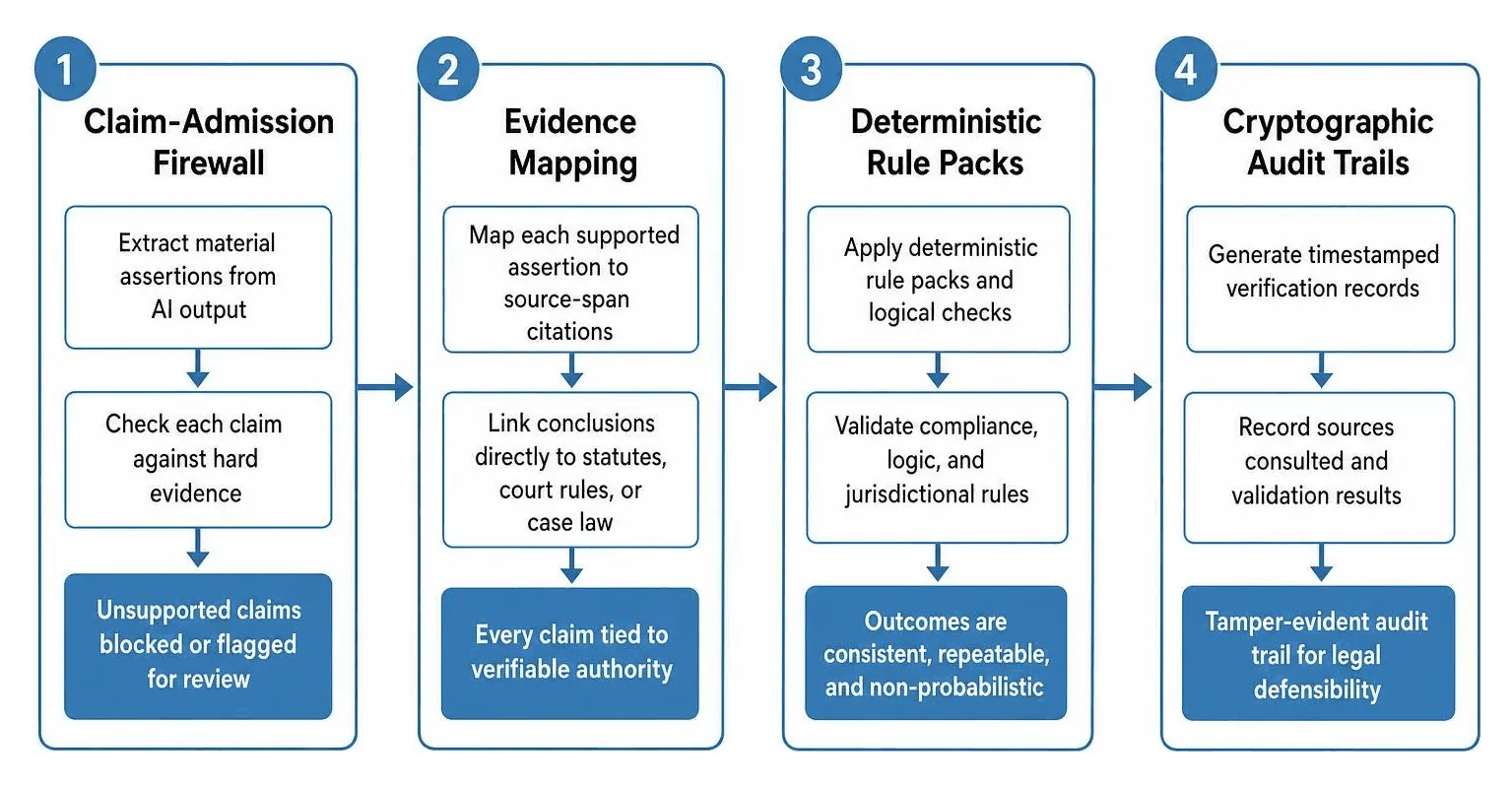
Validation platforms solve this by using multi-source cross-verification. For example, FactProof parallel-runs queries across 30+ independent authoritative sources, including PACER, CourtListener, and state dockets, in under 18 seconds to ensure that every citation matches a real, active court decision.
Another major hurdle for any legal tech tool is navigating the complex web of Unauthorized Practice of Law (UPL) regulations. These rules vary significantly by state. What is perfectly acceptable self-help in Michigan might face strict regulatory scrutiny in another state.
For example, the Florida Bar Enters Novel Partnership With Legal AI Platform | Law.com (opens in a new tab)shows how state bars are beginning to collaborate with validated platforms to establish clear boundaries. Similarly, publications like the Michigan AI Legal Ethics: A Practical Guide for Small Law Firms (opens in a new tab)help clarify how small practices can ethically adopt these tools.
To remain compliant, validated DIY platforms must:
By staying within these guidelines, validated platforms empower consumers to defend themselves without crossing ethical or regulatory lines.
When you are facing a debt collector, your legal workflow has to be airtight. If you miss a deadline or fail to address a specific allegation in a summons, you can lose your case by default.
Standard AI tools treat legal documents like generic text files. They don't understand the procedural rules of court. A legal tech validation platform solves this by enforcing workflow integrity, ensuring that every document analyzed and generated meets the exact structural requirements of the court.
| Feature | Standard AI Tools | Validated Legal Tech Platforms |
|---|---|---|
| Primary Data Source | Open internet / general LLM training | Closed, verified legal databases |
| Hallucination Risk | High (frequently invents citations) | Extremely Low (grounded in live dockets) |
| UPL Compliance | None (often gives generic, unsafe advice) | High (built-in ethical and regional guardrails) |
| Audit Capabilities | None (cannot prove where data came from) | Cryptographic audit trails with cited sources |
| Workflow Integrity | Treats documents as generic text | Maps to specific court rules and timelines |
Let's look at how a validation platform handles a real-world scenario. Imagine you receive a debt collection lawsuit. The debt buyer claims you owe $5,000, but they haven't attached the original contract or any proof that they actually own the debt.
A generic AI might draft a response that says: "I don't think I owe this money."
A validated system using a claim-admission firewall, like QEL, will break down the collector's lawsuit into individual material claims. It then runs these claims against a "missing-evidence register." It asks:
If the collector's claims lack supporting evidence, the validation system flags these gaps. The "survived output" that you actually file in court will specifically target these evidentiary weaknesses, forcing the debt collector to produce the original documents or face dismissal.
For corporate legal teams and investors, managing vendor risk is a continuous challenge. Tools like Lenavix — The AI Regulatory Operating System (opens in a new tab)automate this process by mapping AI tools against regulatory frameworks such as the EU AI Act, NIST AI RMF, and state-specific privacy laws.
By keeping your diligence files "audit-ready," these validation platforms ensure that any automated tool you integrate into your workflow complies with consumer protection standards and data security laws. This level of rigor is what turns a simple software tool into a legally defensible asset.
If you are looking to adopt a legal tech tool — whether you are a small law firm, a corporate department, or an individual defending yourself — you need a systematic way to evaluate your options.

When evaluating any legal tech software, ask yourself these five critical questions:
For deeper academic insights on these evaluation criteria, resources like the Legal Tech Series | Other Publication Series (opens in a new tab)from the University of Michigan Law School provide excellent frameworks for understanding how technology intersects with traditional legal standards.
At KillDebt, we know how terrifying it is to receive a court summons. Debt collectors rely on fear and confusion to win default judgments. In fact, the vast majority of consumers sued by debt collectors never show up to court, resulting in automatic wins for the collectors.
Using unvalidated AI tools to draft your response is incredibly risky. That is why we built our DIY legal defense system around ParkerGPT, an AI trained specifically on consumer debt law and real court strategies developed over 30+ years of active practice.
Unlike generic AI, ParkerGPT doesn't guess. It analyzes the actual lawsuit documents you upload, identifies procedural and evidentiary weaknesses, and generates court-ready responses tailored to your case.
If you are dealing with a collector who has sent you a confusing collection letter, your first step should always be to demand verification of the debt. You can learn more about this in our guide on Debt Validation Letters: Your First Line of Defense Against Collectors. To ensure the documents the collector sent you are actually legitimate, you can run them through our Debt Doc Audit, which acts as a specialized validation layer to spot missing chain-of-title records and expired statutes of limitations.
Technology is changing the legal landscape rapidly, but we cannot let speed replace accuracy. Whether you are a law firm looking to optimize your practice or an individual trying to save your hard-earned money from aggressive debt buyers, choosing validated tools is the only way to protect yourself.
At KillDebt, we are committed to bringing the power of validated, expert-backed legal technology to everyday consumers. We don't believe you should have to spend thousands of dollars on an attorney just to get a fair hearing in court.
That is why, in addition to our specialized Parker GPT tool, we have rolled out our brand-new Court Tester platform.
Court Tester is an AI courtroom simulation built on your actual case. You simply upload your real lawsuit filings, and within minutes, you are arguing your motion in front of an AI judge, against an AI opposing counsel, with a private AI co-counsel whispering strategy in your ear that only you can see. It is the ultimate validation tool for your courtroom strategy, giving you the practice and confidence you need before you ever step foot in a real courtroom.
Don't let debt collectors bully you into a default judgment. Empower yourself with tools that have been tested, validated, and built on decades of real-world courtroom experience.
Ready to take control of your case? Explore our DIY legal defense system and start fighting back today at Defend Yourself Against Debt Collectors with KillDebt.
Get started with KillDebt pricing
IMPORTANT LEGAL DISCLAIMER
This educational content is based on general legal principles and my experience in debt collection defense. It is provided for informational purposes only and does not constitute legal advice. Laws vary by state and by local court. For specific legal advice, consult a qualified attorney licensed in your jurisdiction. No attorney-client relationship is created by reading this guide.
Critical Multi-State Variations: FDCPA applies uniformly at the federal level, but state consumer protection laws may provide additional rights and remedies. Statute of limitations periods vary significantly by state and debt type. What constitutes sufficient debt validation varies in practice across jurisdictions. State-specific rules on call frequency, written notice requirements, and permissible collector conduct may differ from federal minimums.

About the author
Brian Parker
I have over 30 years of experience defending consumers against debt collection lawsuits and have seen every tactic, threat, and pressure play that collectors use. Through KillDebt and ParkerGPT, I have systematized the proven defense strategies that actually work - so consumers can respond from a position of knowledge, not fear. My approach focuses on aggressive legal defense based on documented case success rather than false hope that leads to default judgments.