News Break
Beginner's Guide to AI Mock Trial Services
June 3, 2026
Blog / News Break
Learn how to sue debt collector for FDCPA violations and recover damages with this step-by-step legal guide.
If you're trying to figure out how to sue a debt collector, here's the short answer:
Debt collectors count on you feeling too overwhelmed to fight back. But federal law is firmly on your side.
The FDCPA gives every consumer — even those who genuinely owe the debt — the right to sue collectors who break the rules. And the numbers show people are using it. Consumers filed over 12,000 FDCPA lawsuits in federal court in 2022 alone, a 9% jump from the year before. The CFPB received more than 82,700 debt collection complaints that same year.
Whether you just got a threatening phone call, received a court summons, or are staring down a wage garnishment threat, you have real legal options — and real money you can recover.
I'm Brian Parker, founder of KillDebt, and for over 30 years I've been in courtrooms across the country fighting debt collectors, debt buyers, and collection law firms — and I've used every tool the FDCPA offers to help consumers how to sue a debt collector and win. Below, I'll walk you through exactly what I've seen work.
Before you can head to court, you need to know what constitutes a "winable" case. The Fair Debt Collection Practices Act (FDCPA) is a powerful federal shield that defines exactly what a collector can and cannot do. If you want to understand the full scope of your protection, start by checking out FDCPA Explained.
Many people ask, "Who exactly am I suing?" Generally, the FDCPA applies to third-party debt collectors and debt buyers—those who purchase "zombie" debts for pennies on the dollar. It usually doesn't apply to the original creditor (like the bank that gave you the credit card), but once they hand it off to a collection agency, the rules change. You can find a deeper dive into this in What Is a Debt Collector Under the FDCPA: Your Rights Explained.
According to Debt Collection FAQs | Consumer Advice (opens in a new tab), the law covers personal, family, and household debts, including credit cards, medical bills, student loans, and mortgages.
Harassment isn't just a "feeling"—it's a legal violation. If a collector is calling you repeatedly with the intent to annoy or abuse, they are breaking the law. Specifically, the CFPB notes that calling more than seven times within a seven-day period is a major red flag.
Common harassment tactics include:
If you’re dealing with this right now, our guide on Debt Collector Harassment Stop provides immediate tactics to shut them down.
Collectors often try to "shame" consumers into paying by involving others. This is a massive FDCPA violation. A collector cannot:
If they call you at 6:00 a.m. or midnight, they’ve just handed you a reason to sue. For a step-by-step response to these calls, see What to Do When a Debt Collector Calls: Your Complete Action Plan.

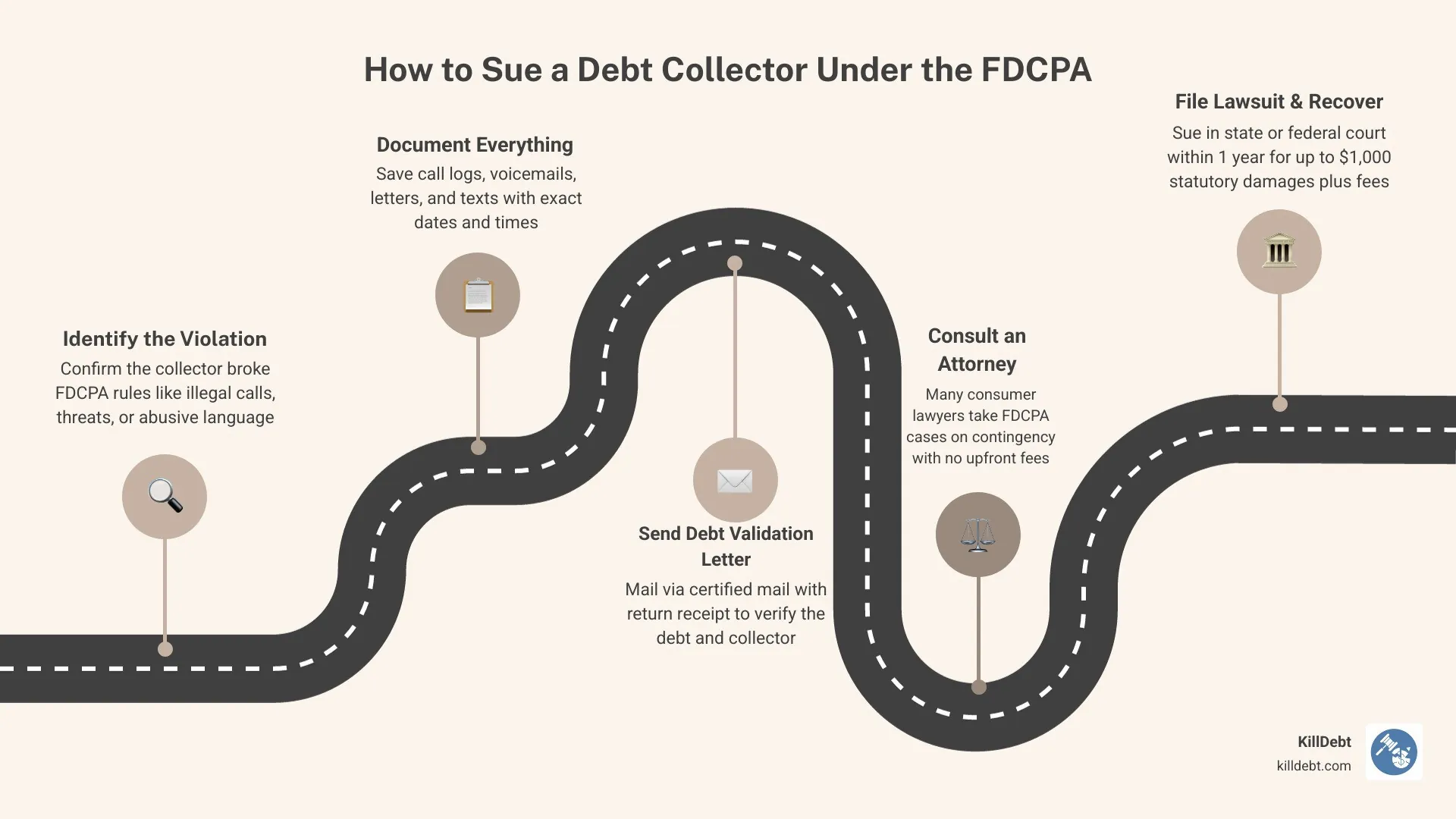
Knowing how to sue a debt collector requires a bit of organization. You aren't just telling a story to a judge; you are presenting evidence of a statutory violation. According to How to Sue a Debt Collector for Harassment - Consumer Attorneys (opens in a new tab), the strongest cases are built on a solid paper trail. If you're ready to escalate, you should also know How to Report a Collection Agency to the FTC and CFPB to create an official record of the abuse.
You have the option to file in either state or federal court.
Many consumers wonder, "Do I Need a Lawyer for a Debt Collection Lawsuit?" While you can represent yourself (pro se), having an expert can significantly increase your payout, especially since the collector usually ends up picking up the tab for your legal help.
Your "evidence locker" should include:
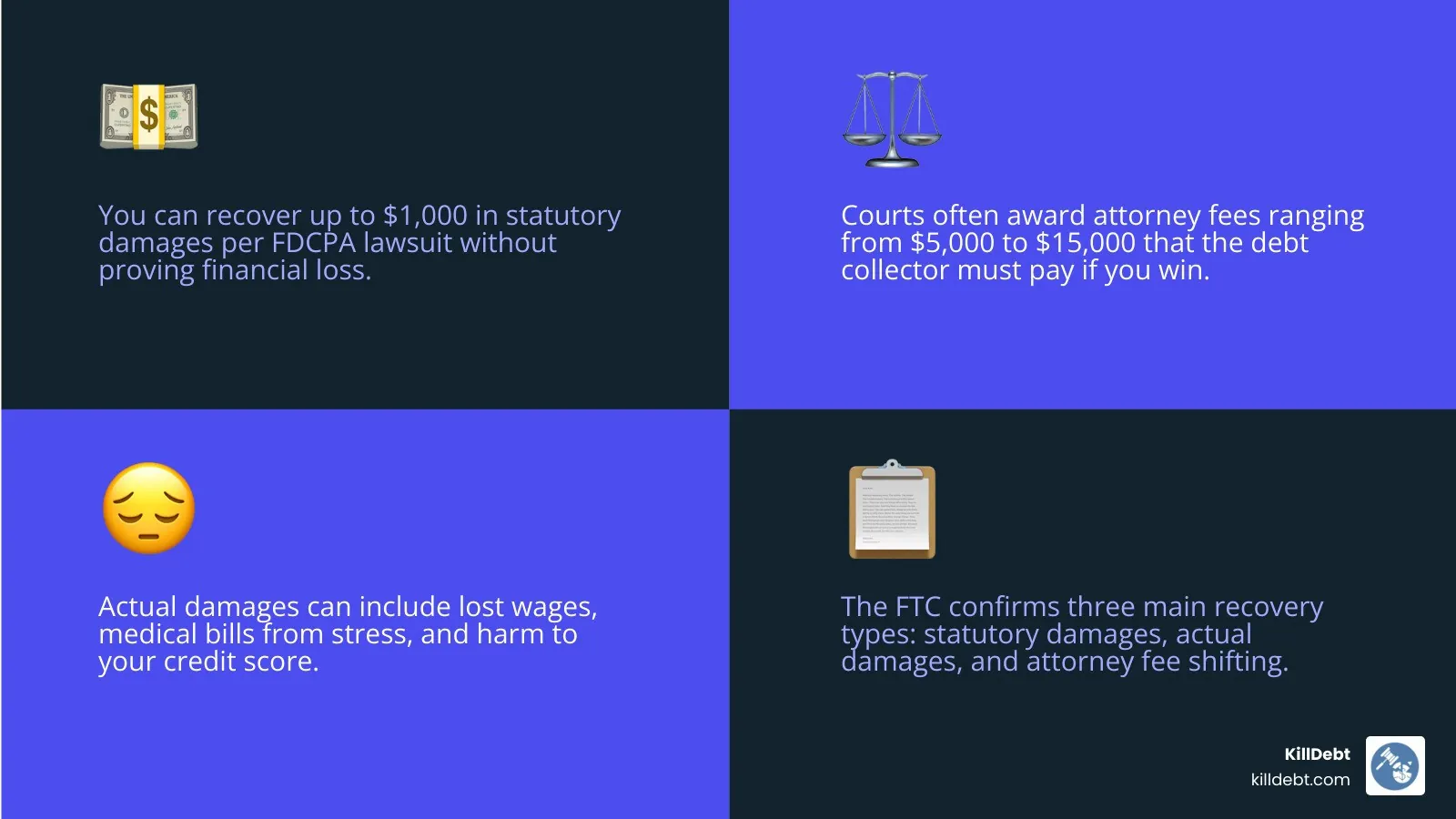
When you sue, you aren't just looking for an apology. You are looking for financial compensation. According to Debt Collection FAQs - FTC Consumer Advice (opens in a new tab), there are three main types of recovery.
Under the FDCPA, you can be awarded up to $1,000 in statutory damages per lawsuit. The best part? You don't have to prove you lost money to get this. The mere fact that the collector broke the law is enough. Additionally, the "fee-shifting" provision is vital—it ensures that even if your case is "only" worth $1,000, an attorney can still take the case because the collector will pay their $5,000–$15,000 in fees. If you're feeling the pressure, read more about Struggling with Debt Collectors.
If the collector's behavior caused you real-world harm, you can sue for "actual damages." This includes:
Sometimes, the best defense is a good offense. If a collector sues you, you can often "counter-sue" within the same case for FDCPA violations. As What To Do if a Debt Collector Sues You | Consumer Advice (opens in a new tab) points out, the worst thing you can do is ignore the summons. Between 70% and 90% of consumers lose by default because they don't show up. If you've been served, you need to act fast—see Sued for a Debt? Here's Exactly What to Do in the First 7 Days.
You must file a written "Answer" with the court. This isn't just a letter; it's a formal legal document where you admit or deny their claims. You should also include "affirmative defenses"—reasons why they shouldn't win even if the debt is yours. We provide a How to Answer a Debt Summons guide and a Sample Answer to Debt Collection Lawsuit to help you through this.
Many debt buyers sue on "zombie debt"—debts that are past the statute of limitations. In Florida and Michigan, once a debt is "time-barred," they cannot legally sue you for it. Furthermore, they must prove they actually own the debt. If they can't show a clear "chain of title," the case should be dismissed. Learn how to beat these at How to Win Zombie Lawsuit and understand the Chain of Assignment Debt Collector.
While the FDCPA is federal, state laws often provide extra layers of protection. KillDebt focuses specifically on Florida and Michigan, where we have deep roots and specific expertise.
Note: While Maryland has strong laws, we focus our primary defense tools on Florida and Michigan residents. In Florida, the Florida Consumer Collection Practices Act (FCCPA) is even stronger than the federal FDCPA in some ways. For example, it can apply to original creditors, not just third-party collectors. If you're in the Sunshine State, check out How to Protect Yourself: Debt Collections | My Florida Legal (opens in a new tab) and be aware of the rules for About Small Claims Collection Lawsuits - The Florida Bar (opens in a new tab).
In Michigan, the statute of limitations for most contract debts is six years. Michigan courts have very specific local rules about how evidence must be presented. If you're a Michigander, you'll want to review Michigan Debt Collections Attorney: Stop Debt Collectors! (opens in a new tab) and Michigan Court Debt Cases to understand the local landscape. For those in neighboring areas, the Illinois Debt Collection Statute also provides a good comparison of regional rights.
Suing a debt collector doesn't have to be a sweat-inducing nightmare. With the right tools and a clear understanding of your rights, you can turn the tables on abusive agencies. At KillDebt, we've revolutionized this process with ParkerGPT, our AI legal defense system. Trained on over 30 years of my personal trial experience, ParkerGPT analyzes your specific lawsuit documents and helps you draft court-ready responses that identify the collector's weakest points.
We’ve also just launched Court Tester, an AI courtroom simulation. You can upload your actual filings and "practice" your motion in front of an AI judge before you ever step foot in a real courthouse. Don't let debt collectors bully you into silence. Whether you're in Florida or Michigan, we're here to help you fight back.
Ready to take the next step? Check out our Fight Debt Collection Lawsuit Complete Guide or Take Control of Your Case Today by letting ParkerGPT build your defense.

About the author
Brian Parker
I have over 30 years of experience defending consumers against debt collection lawsuits and have seen every tactic, threat, and pressure play that collectors use. Through KillDebt and ParkerGPT, I have systematized the proven defense strategies that actually work - so consumers can respond from a position of knowledge, not fear. My approach focuses on aggressive legal defense based on documented case success rather than false hope that leads to default judgments.