News Break
Defeating the undead debt in a court of law
May 7, 2026
Blog / News Break
Learn how to report a collection agency for FDCPA violations, harassment, scams. Stop illegal calls, threats—file CFPB/FTC complaints & sue today!

Knowing how to report a collection agency is one of the most powerful things you can do when a debt collector breaks the law.
Here's a quick answer if you need it now:
How to report a collection agency:
Debt collection problems are among the most common complaints received by the CFPB and the FDIC. That tells you something important: you are not alone, and this happens all the time.
The law is on your side. The Fair Debt Collection Practices Act (FDCPA) makes it illegal for debt collectors to use abusive, unfair, or deceptive practices when they collect debts. Collectors cannot call before 8 AM or after 9 PM. They cannot threaten arrest or deportation. They cannot pretend to be attorneys or government officials.
But here's the hard truth: some collectors do all of those things anyway — because they're counting on you not knowing your rights.
If a collector has threatened you, lied to you, or called you at all hours, that's not just rude. It may be illegal — and you can report it.
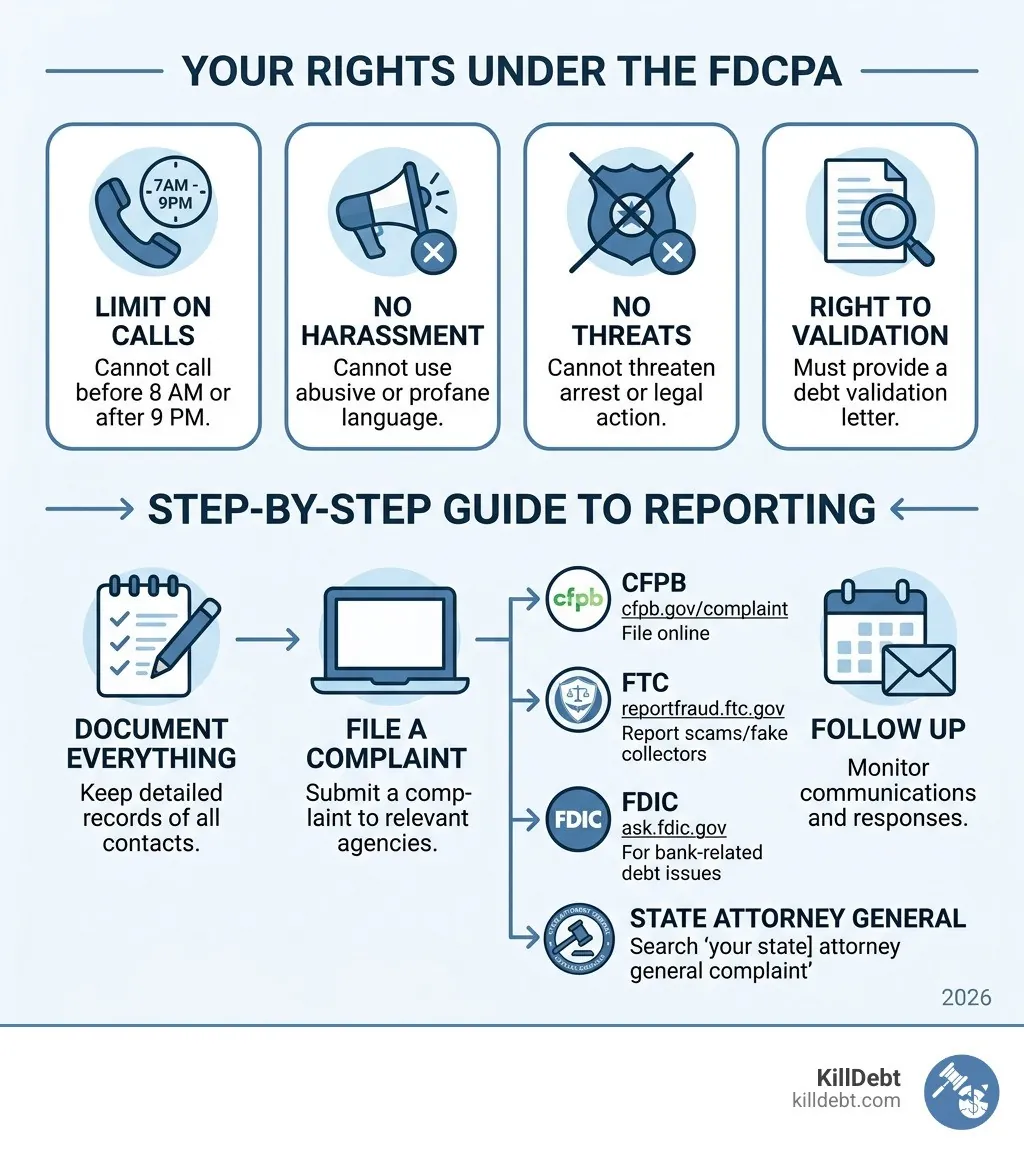
The Fair Debt Collection Practices Act (FDCPA) is your primary shield. It is a federal law that dictates exactly what third-party debt collectors can and cannot do. It covers personal, family, and household debts—things like your credit card balances, auto loans, medical bills, and mortgages. It does not, however, cover debts you ran up for a business.
One of the most important things to realize is what is a debt collector under the FDCPA. Generally, it’s someone working for a collection agency or an attorney who regularly collects debts for others.
Under the FDCPA, collectors must follow strict communication rules:
If you’re feeling pressured, you have the right to know your rights and avoid scams. Legitimate collectors are required to send you a "validation notice" within five days of first contacting you. this notice must tell you how much money you owe, the name of the creditor, and what to do if you don't think you owe the money.
Not every annoying phone call is illegal, but many common tactics used by "bottom-feeder" agencies absolutely are. If you experience any of the following, it is time to look into how to report a collection agency.
If these tactics sound familiar, you need to learn how to make the debt collector harassment stop. Even if you truly owe the money, you do not deserve to be bullied. Furthermore, be on high alert for fake and abusive debt collectors who may be trying to collect on "phantom debts" that don't even exist.
If you are being harassed, your best weapon is documentation. You shouldn't just get mad; you should get even by keeping a meticulous paper trail.
When you're ready to take action, you have three main federal "big brothers" who want to hear from you.
The Consumer Financial Protection Bureau (CFPB) is arguably the most effective place to start. Each week, the CFPB sends more than 100,000 complaints to financial companies for a response.
If the "collector" refuses to give you a mailing address, threatens you with immediate arrest, or demands payment via wire transfer or gift cards, you are likely dealing with a scammer.
In these cases, reporting to the FTC is crucial. You can visit reportfraud.ftc.gov to file a report. This helps the government track patterns and shut down large-scale fraud rings. You should also check our Reports section to see if the agency contacting you has a history of shady behavior.
If the debt involves a bank or a bank-regulated entity, you can also file a complaint with the FDIC. They provide specialized assistance for debt collection issues involving banks.
While federal laws provide a baseline, many states have even tougher consumer protection laws.
Sometimes, filing a report with a government agency isn't enough to make you "whole." If a collector has caused you actual distress or financial loss, you have the right to sue them in state or federal court.
Under the FDCPA, if you win your case, you can be awarded:
That you generally have only one year from the date of the violation to file a lawsuit. If you are struggling with debt collectors, consulting with a consumer law attorney or using a DIY legal tool can help you determine if a lawsuit is the right move.
Before you hit "submit" on that government complaint, make sure you've taken these defensive steps. They will make your report much stronger.

| Feature | Debt Validation | Debt Dispute |
|---|---|---|
| Purpose | Forces collector to prove the debt is real | Tells collector you disagree with the debt |
| Timing | Must be sent within 30 days of first notice | Can be sent anytime (but 30 days is best) |
| Legal Effect | Collector must stop until they provide proof | Collector must mark the debt as "disputed" |
| Best For | Finding out if the debt is a scam | Fixing errors on your credit report |
Reporting a collection agency is a vital step in protecting your peace of mind and your financial future. But sometimes, reporting isn't enough—especially if the agency decides to sue you.
That’s where we come in. At KillDebt, we believe that everyone deserves a fair fight in the courtroom, regardless of their bank account balance. Our platform is powered by ParkerGPT, an AI trained on the real-world strategies of attorney Brian Parker, who has over 30 years of experience fighting debt collectors.
We don't just give you generic advice. Our system analyzes your specific lawsuit documents, identifies the collector's weaknesses, and helps you generate court-ready responses. We’ve even introduced the Court Tester, an AI courtroom simulation where you can practice your motion in front of an AI judge before you ever step foot in a real courthouse.
Don't let the bullies win. Whether you need to send a validation letter or defend yourself against a billion-dollar collection firm, we have the tools to help you stand your ground.
Ready to fight back? Start your defense today at KillDebt.com and show them you aren't an easy target.

About the author
Brian Parker
I have over 30 years of experience defending consumers against debt collection lawsuits and have seen every tactic, threat, and pressure play that collectors use. Through KillDebt and ParkerGPT, I have systematized the proven defense strategies that actually work - so consumers can respond from a position of knowledge, not fear. My approach focuses on aggressive legal defense based on documented case success rather than false hope that leads to default judgments.