News Break
Don't Ignore It: How to Fill Out a Civil Complaint Answer Form
July 8, 2026
Blog / News Break
Learn how to handle default judgement collections, challenge judgments, protect assets, and negotiate settlements with collectors.

Default judgment collections happen when a creditor sues you for a debt, you don't respond in time, and the court automatically rules against you — giving the creditor legal power to garnish your wages, freeze your bank account, or place a lien on your property.
Here's a quick breakdown of what that means and what you can do:
| Situation | What It Means |
|---|---|
| You were sued and didn't respond | Court enters a default judgment against you |
| Judgment is entered | Creditor can garnish wages, levy bank accounts, place property liens |
| You missed the deadline | You may still file a motion to vacate — but act fast |
| You have exempt income | Social Security, certain wages may be protected from seizure |
| You want to fight back | You can challenge the judgment or negotiate a settlement |
The stakes are real. A judgment is typically valid for 10 years and can be renewed. Interest keeps adding up. And in California alone, 56% of debt collection cases end in a default judgment — with only 2.3% of consumers having a lawyer on their side.
If you just received a court notice, a garnishment letter, or discovered a judgment against you, you are not out of options. But time matters — sometimes you have as little as 14 days to act.
I'm Brian Parker, and for over 30 years I've fought creditors, debt buyers, and collection law firms in courtrooms across the country — handling hundreds of default judgment collections cases and seeing how these cases play out when consumers don't know their rights. In this guide, I'll walk you through exactly what happens, what your options are, and how to defend yourself — step by step.
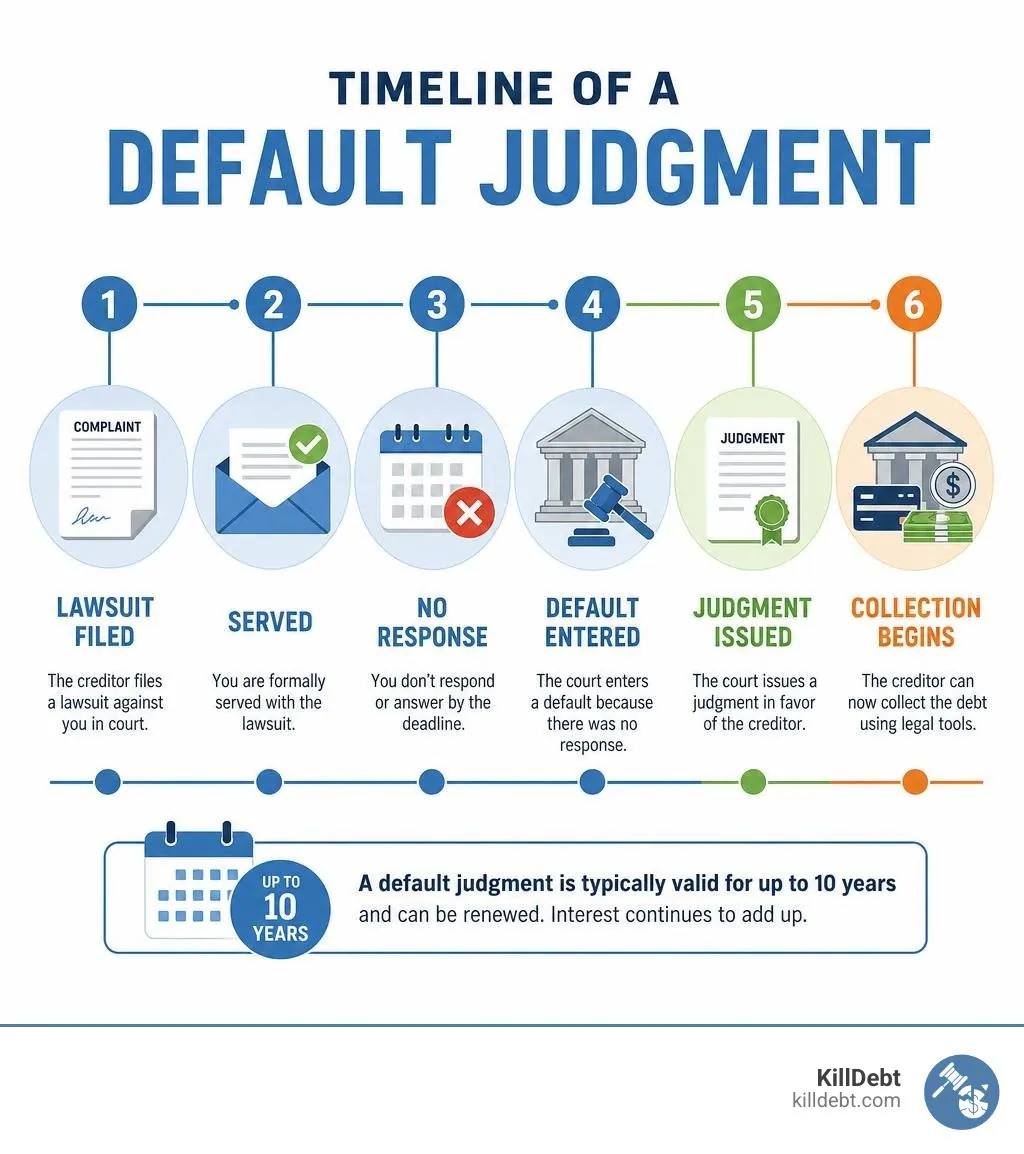
To understand how default judgment collections work, we have to look at how the court system treats unanswered lawsuits. When a creditor or a third-party debt buyer wants to force you to pay, they cannot simply reach into your bank account on their own. They must first obtain a court order.
The process begins when the creditor files a Summons and Complaint. The Summons is the official notice that you are being sued, and the Complaint outlines why they believe you owe them money. Once you are formally served with these documents, the clock starts ticking.
In our primary states of practice, the timelines are strict:
If you fail to file a formal response within this window, you lose your right to present a defense. The plaintiff (the creditor) will then ask the court clerk to enter a "default" against you.
There is a technical difference between an entry of default and a default judgment:
For a deeper look at what to do immediately after being handed these papers, read our What to Do When Sued by a Debt Collector Complete First Steps Guide.
Once the response deadline passes, the creditor moves quickly to turn their temporary advantage into a permanent legal weapon. They submit a formal application for a default judgment.
In states like Florida, the creditor must submit a motion for default along with several supporting documents:
If the creditor is a third-party debt buyer (someone who bought your old debt from a credit card company or bank), they must also show a clear "chain of assignment." This means they must prove they actually own the specific account they are suing you over.
To understand the exact sequence of events from service to judgment, check out our guide on the Debt Collection Lawsuit Timeline What Happens Next After You're Served. You can also learn more about how creditors approach this step in Default Judgments and Garnishments - Brian P. Parker PC.
It is incredibly common for consumers to ignore or miss a debt collection lawsuit. In fact, industry data shows that only about 5.5% of defendants in consumer debt cases ever file a formal answer. Why is this rate so low?
The most common reason is improper service, often referred to in the legal world as "sewer service." This happens when a process server falsifies court records, claiming they handed you the papers when they actually threw them in the trash or mailed them to an address where you haven't lived in years.
Other reasons include:
If you suspect you were never properly served, you may have excellent grounds to wipe the slate clean.
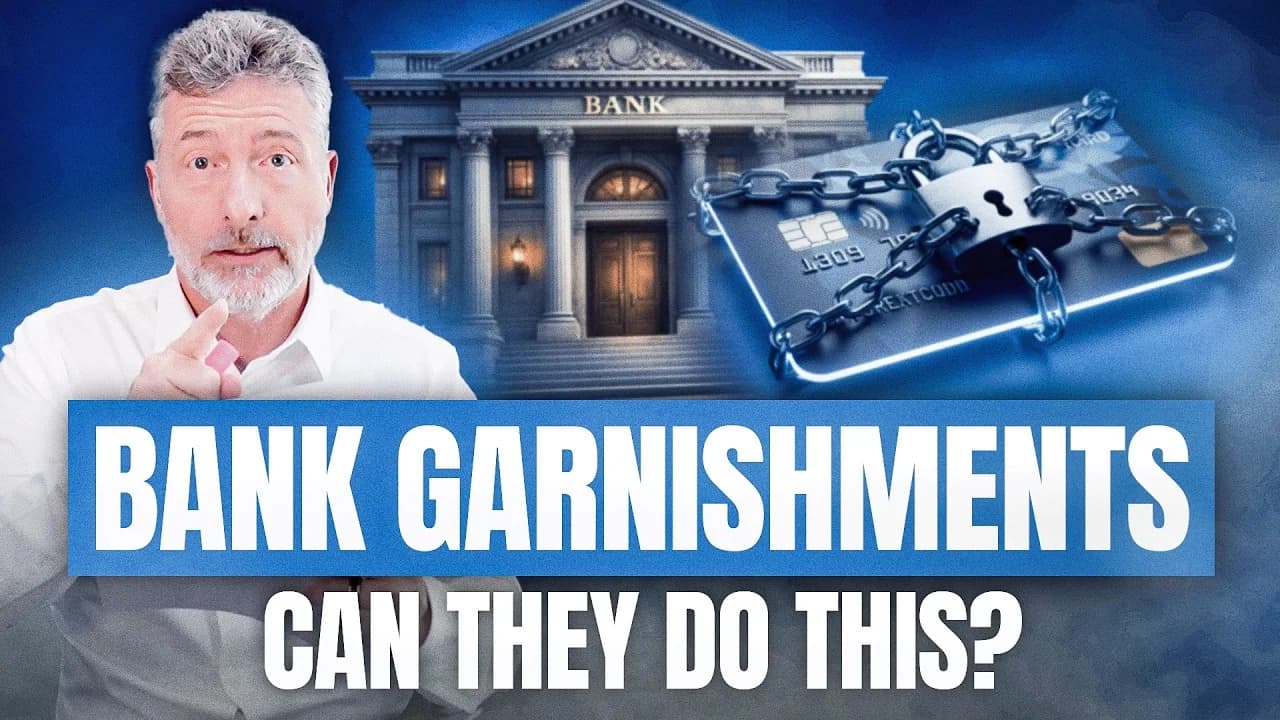
Many consumers believe that if they don't have the money to pay, a default judgment is just a harmless piece of paper. This is a dangerous misconception. A default judgment is a powerful court order that gives the creditor aggressive, state-sanctioned collection tools.
As soon as the judgment is signed, the creditor can initiate post-judgment discovery. They can send you written questions (interrogatories) and requests for documents, forcing you to disclose:
If you ignore these post-judgment discovery requests or fail to show up for a court-ordered debtor’s examination, the judge can hold you in contempt of court, which can eventually lead to an arrest warrant.
In both Florida and Michigan, a judgment is valid for 10 years and can easily be renewed for another 10 years before it expires. This means a debt collector can wait until you get a better job, buy a home, or rebuild your savings years down the road before they strike.
Once a creditor has a judgment, they don't ask nicely for payment anymore. They use the power of the local sheriff and the banking system to take what they are owed.
To learn more about how local courts handle these collections, you can review the guide on [PDF] HOW TO COLLECT A JUDGMENT - Eighth Judicial Circuit.
The damage of a default judgment extends far beyond your bank account. While credit reporting agencies voluntarily stopped listing civil judgments on consumer credit reports a few years ago, judgments remain a matter of public record.
Lenders, mortgage companies, and background check agencies routinely search public court records. If you apply for a home loan, a car lease, or even certain professional licenses, an outstanding judgment will show up and can result in an immediate denial.
Furthermore, interest continues to accrue on the judgment balance at state-mandated rates every single year. A small $3,000 credit card debt can easily double or triple over a decade of non-payment. This long-dormant threat is illustrated in cases like Yohannes v. Olympic Collection Inc. (OCI), where a consumer discovered a decade-old default judgment only when their wages were suddenly garnished years later.
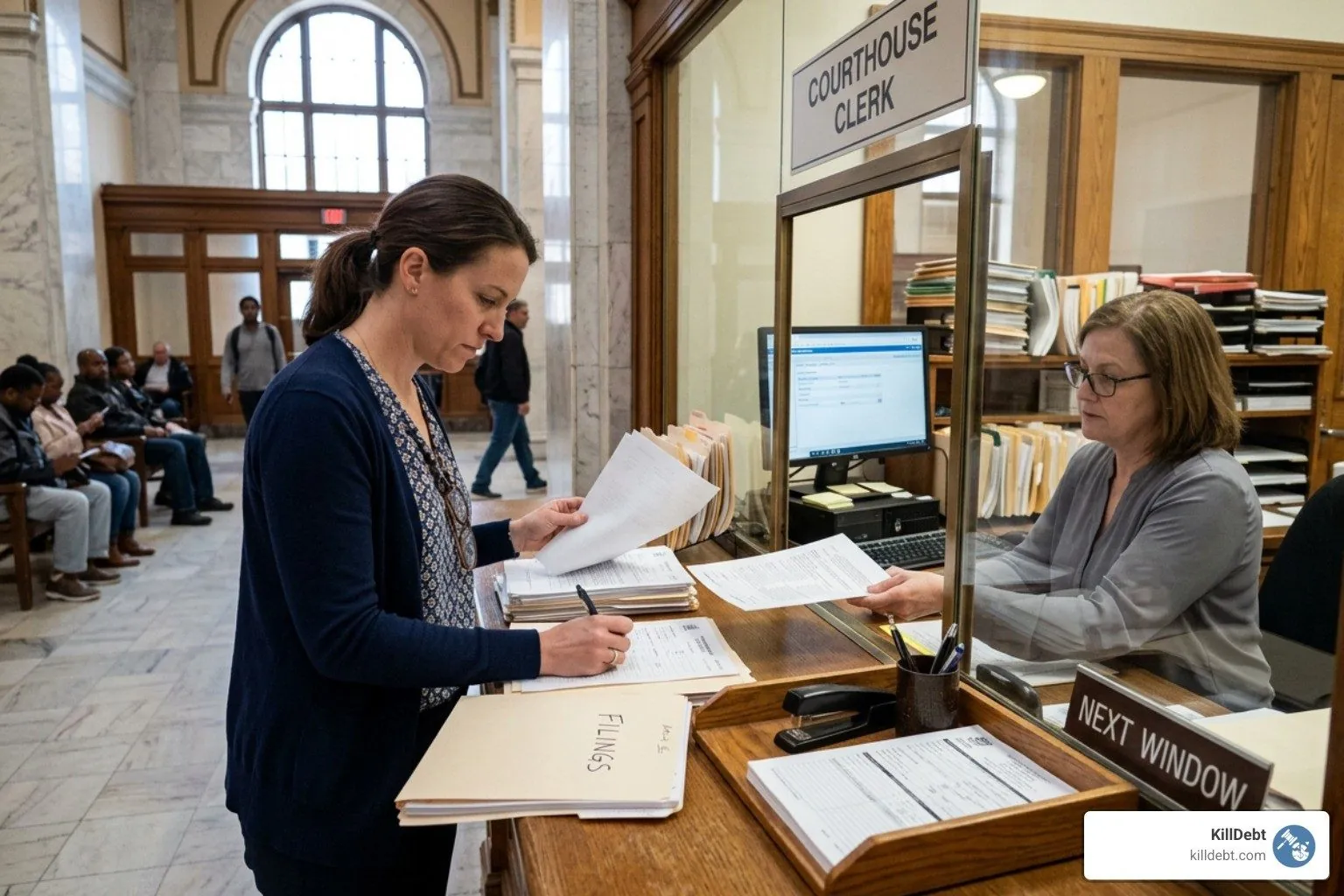
If you discovered a default judgment against you, do not lose hope. You can ask the court to erase the judgment and reopen the case by filing a Motion to Vacate or a Motion to Set Aside Default Judgment.
If the court grants this motion, the judgment is wiped out, any active garnishments are stopped, and you are given a second chance to defend yourself on the merits of the case. However, courts will not vacate a judgment simply because you ask nicely. You must generally prove two things:
To dive deeper into this legal process, read our comprehensive guides on Setting Aside Default Judgment and How to Vacate Judgment.
Timing is absolutely critical when dealing with default judgments. If you wait too long after discovering the judgment, the court may rule that you waived your rights.
For state-specific instructions on navigating Florida's rules, see our guide on Vacate Default Judgment Florida.
If you challenge the judgment, the burden shifts back to the creditor to prove their case. This is where debt buyers often fail. They buy thousands of charged-off accounts in bulk for pennies on the dollar, and they rarely receive the complete documentation required to win a contested case.
To uphold a judgment, or to get a new one if the default is vacated, the creditor must produce:
If they cannot produce these documents, their case falls apart. We specialize in identifying these evidentiary gaps to help consumers beat debt buyers in court.
If a creditor is actively trying to collect on a default judgment, you must understand what property and income are legally protected (exempt) from seizure under federal and state laws.
| Asset/Income Type | Florida Exemptions | Michigan Exemptions |
|---|---|---|
| Wages | 100% exempt for "Head of Family" (earning $750/wk or less). | Protected up to 75% of disposable earnings (federal floor). |
| Primary Residence | Homestead Exemption (virtually unlimited value protection). | Homestead protection up to $46,125 (or $69,200 if elderly/disabled). |
| Personal Property | Up to $1,000 (or up to $4,000 if you do not claim a homestead). | Up to $4,500 in household goods, utilities, and books. |
| Retirement Accounts | ERISA-qualified plans, IRAs, and 401(k)s are 100% exempt. | IRAs and qualified pensions are 100% exempt. |
| Government Benefits | Social Security, Disability, VA benefits are 100% exempt. | Social Security, Disability, VA benefits are 100% exempt. |
If all of your assets and income fall under these exempt categories, you are considered judgment proof. This does not mean the debt disappears, but it means the creditor cannot legally take anything from you to satisfy the judgment.
Even if your income is exempt, a creditor can still freeze your bank account if they don't know the source of the funds. Once a bank receives a writ of garnishment, they are legally required to freeze the account first and ask questions later. To protect yourself:
Many consumers believe that once a judgment is entered, negotiation is off the table. This is not true. In fact, many creditors prefer a guaranteed lump-sum settlement today over the hassle of trying to garnish someone who might change jobs or file for bankruptcy.
In our experience, creditors are often willing to settle outstanding judgments for 50% to 70% of the total judgment balance if you can offer a lump-sum payment. If you cannot afford a lump sum, you can negotiate a structured monthly payment plan.
If you are facing a judgment in a Florida limited civil court, you can also file a formal motion to pay the judgment in installments. This stops aggressive collection actions like bank levies as long as you make your court-ordered payments on time.
To learn more about removing this debt for good, check out our guide on How to Remove Default Judgment Debt. For specialized bankruptcy and debt advice in Florida, you can also read Debt Collection Judgement? Talk With Chad Van Horn.
The absolute best way to handle default judgment collections is to prevent them from happening in the first place. When you receive a summons, you must take a proactive approach. Do not ignore the lawsuit, even if you know you owe the money.
By filing a timely answer, you force the creditor to prove their case, buy yourself time to negotiate a favorable settlement on your terms, and completely eliminate the threat of sudden wage garnishments or frozen bank accounts.
To build a winning defense, read our Court Debt Defense Strategy and our comprehensive Debt Lawsuit Defense Guide.
Facing a default judgment is stressful, but you do not have to navigate this complex legal maze alone. At KillDebt, we have leveled the playing field.
We provide a powerful, DIY legal defense system powered by ParkerGPT — an AI trained specifically on consumer debt law and real-world court strategies developed over my 30+ years as a consumer defense attorney. Unlike generic AI tools, ParkerGPT analyzes your actual lawsuit documents, uncovers hidden procedural weaknesses, and generates professional, court-ready responses and motions to vacate at a fraction of the cost of a traditional lawyer.
We also recently introduced our groundbreaking Court Tester tool. Court Tester is an AI courtroom simulation built directly on your actual case. You simply upload your court filings, and within minutes, you can practice arguing your motion in front of an AI judge, face off against AI opposing counsel, and receive private, real-time strategic advice from an AI co-counsel.
Don't let debt collectors take control of your hard-earned income. Take action today, explore our KillDebt Pricing, and let us help you fight back and reclaim your financial peace of mind.
IMPORTANT LEGAL DISCLAIMER
This educational content is based on general legal principles and my experience in debt collection defense. It is provided for informational purposes only and does not constitute legal advice. Laws vary by state and by local court. For specific legal advice, consult a qualified attorney licensed in your jurisdiction. No attorney-client relationship is created by reading this guide.
Critical Multi-State Variations: FDCPA applies uniformly at the federal level, but state consumer protection laws may provide additional rights and remedies. Statute of limitations periods vary significantly by state and debt type. What constitutes sufficient debt validation varies in practice across jurisdictions. State-specific rules on call frequency, written notice requirements, and permissible collector conduct may differ from federal minimums.

About the author
Brian Parker
I have over 30 years of experience defending consumers against debt collection lawsuits and have seen every tactic, threat, and pressure play that collectors use. Through KillDebt and ParkerGPT, I have systematized the proven defense strategies that actually work - so consumers can respond from a position of knowledge, not fear. My approach focuses on aggressive legal defense based on documented case success rather than false hope that leads to default judgments.