
News Break
The Ultimate Guide to Motions to Compel, Judgment on Pleadings, and Striking Affidavits
July 7, 2026
Blog / News Break
Master debt lawsuit deposition prep with proven strategies to protect your rights and strengthen your defense during an EBT.
Debt lawsuit deposition prep is the process of organizing your documents, reviewing your case facts, and learning how to answer questions under oath - before a creditor's attorney gets the chance to question you.
If you have a deposition coming up in a debt collection case, here is what you need to know right now:
Getting a deposition notice in a debt lawsuit is stressful. You may feel like the creditor's attorney already has everything figured out and you are walking into a trap. That feeling is understandable — but it is not accurate.
Debt collection lawsuits are won and lost long before trial. In fact, fewer than 1% of civil cases ever reach a jury. That means the deposition is often the most important moment in your entire case. What you say — and how you say it — can determine whether the case settles in your favor, gets dismissed, or results in a judgment against you.
The good news? Preparation levels the playing field.
I'm Brian Parker, founder of KillDebt. Over 30 years of fighting debt collectors, debt buyers, and collection law firms in courtrooms across the country has given me a front-row seat to every deposition tactic collectors use — and I built KillDebt specifically so that people facing debt lawsuit deposition prep without an attorney can access those same insights. This guide walks you through everything you need, step by step.
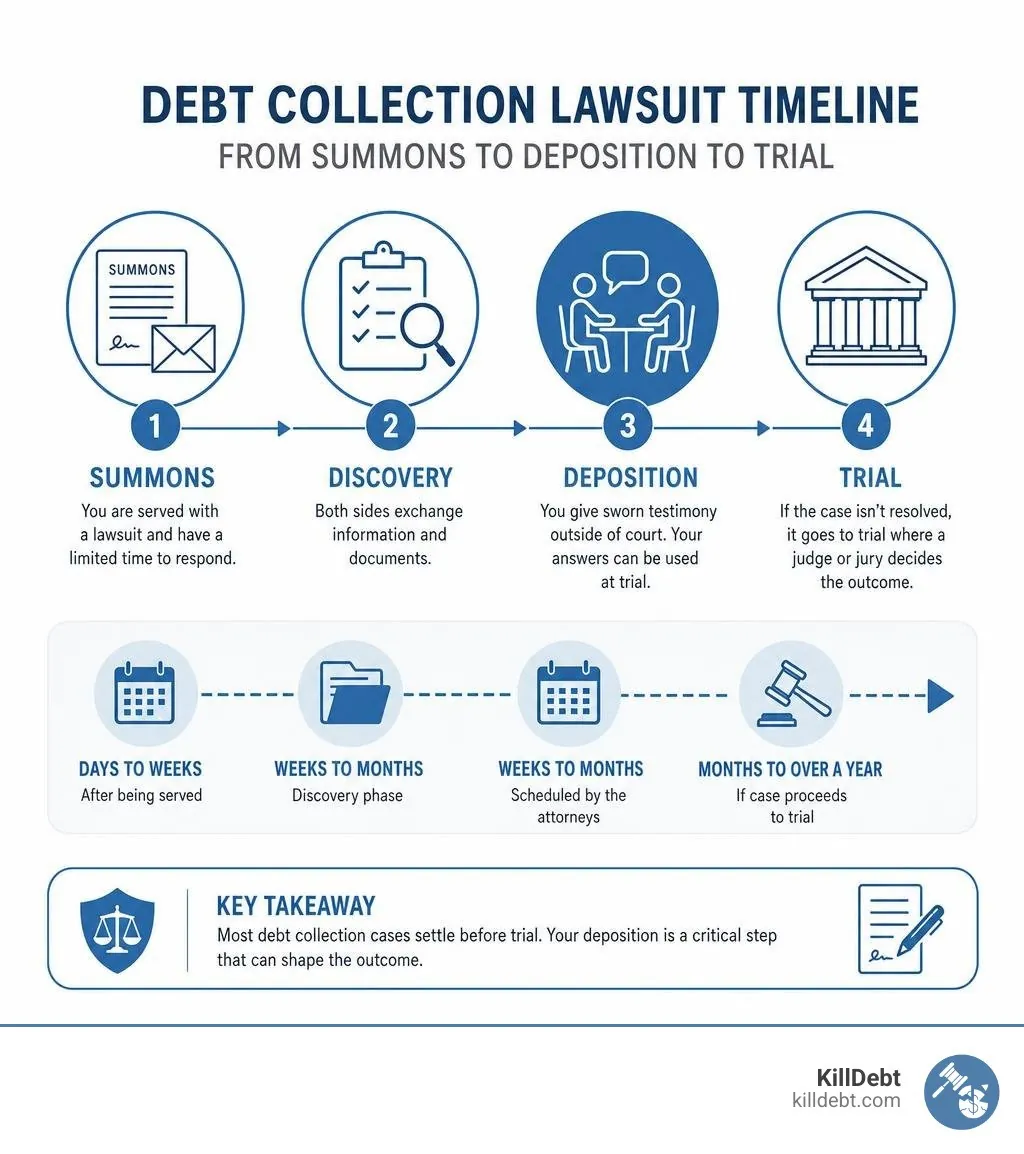
An Examination Before Trial (EBT)—commonly known as a deposition—is a formal, out-of-court session where one party to a lawsuit questions the other party or a witness under oath. It is a critical component of the formal discovery process, which is the second stage of civil litigation.
During a deposition, you will sit in a conference room (or a virtual Zoom room) with the creditor's attorney, your own attorney (if you have one), and a licensed court reporter. The court reporter’s job is to record every single word spoken and produce an official written transcript of the proceeding.
Even though there is no judge in the room, a deposition is a formal legal proceeding. The oath you take to tell the truth has the exact same legal weight as if you were standing in a courtroom.
Understanding how a deposition fits into your broader case strategy is essential. If you are just starting to navigate the litigation process, check out our What to Do When Sued by a Debt Collector: Complete First Steps Guide to build a solid foundation.
To understand why depositions are so high-leverage, it helps to look at how they differ from a standard trial:
| Characteristic | Deposition (EBT) | Trial |
|---|---|---|
| Location | Law office conference room or remote video conference | Courtroom |
| Who Presides | No judge is present; attorneys run the questioning | Judge (and potentially a jury) |
| Primary Goal | Fact-finding, testing witness credibility, and locking in testimony | Presenting a finalized case for a binding decision |
| Rules of Evidence | Much broader; opposing counsel can ask questions that might not be admissible at trial | Strict; only highly relevant, non-hearsay evidence is allowed |
| Use of Testimony | Used to draft summary judgment motions, force settlements, or impeach witnesses | Used to determine the final winner of the lawsuit |
As we explore in our guide on Depositions In a Debt Collection Case, the creditor's attorney is using this session to size you up. They want to see if you are a credible witness, find inconsistencies in your story, and lock you into a specific narrative that they can later tear apart in court.

When we prepare for a deposition, we are building a defense shield. You cannot wing a deposition. If you show up unprepared, the collector’s attorney will exploit your memory gaps, confuse you with technical financial jargon, and potentially trick you into admitting you owe a debt that the collector cannot legally prove you owe.
Effective consumer defense requires careful document organization and a deep understanding of your case facts. You must review your records to verify the validity of the alleged debt, find any potential violations of the Fair Debt Collection Practices Act (FDCPA), and identify evidentiary holes in the collector's paperwork. For a deeper dive into evaluating the collector's evidence, read our guide on Debt Case Document Review.
If you are pursuing counterclaims under the FDCPA due to collector harassment, we highly recommend reviewing the FDCPA Deposition Preparation Guide to learn how to turn the tables on abusive collectors.
The absolute most critical step in your preparation is a thorough, page-by-page case review. You must review every document that has been filed in the lawsuit so far, including the summons, the complaint, your written answer, and any responses to interrogatories.
This is where consistency becomes your greatest asset. The opposing attorney will compare your verbal deposition answers to your written court filings. If there is even a minor contradiction, they will use it to destroy your credibility.
To prevent this, we focus on refreshing your memory. We want to align your testimony with your overall Court Debt Defense Strategy. If you wrote in your answer that you "lack knowledge or information sufficient to form a belief as to the truth of the allegations," you must be prepared to explain why during the deposition without contradicting that stance.
In Florida and Michigan, the statute of limitations is one of your strongest shields. However, collectors will actively try to get you to restart the clock during your testimony.
During your debt lawsuit deposition prep, you must nail down your payment history. Find the exact date of your last voluntary payment. The collector's attorney may ask: "Have you made any payments or promises to pay since [Date]?"
Be extremely careful. In many jurisdictions, making even a tiny $5 payment—or writing a letter promising to pay—can reset the statute of limitations clock back to zero, reviving a debt that was legally dead. If you have previously sent a debt validation letter or disputed the account in writing, keep those documents organized and ready.

When testifying, your demeanor and adherence to the "golden rules" of depositions are just as important as the facts of your case. As experienced litigators often emphasize in resources like the guide on Preparing Plaintiffs for Depositions, a witness who is polite, precise, and guarded is incredibly difficult for an opposing attorney to crack.
Here are the four golden rules to live by during your deposition:
The "Listen-Pause-Answer" method is a simple but incredibly powerful behavioral tool.
Debt buyer attorneys use highly calculated, "friendly" questioning styles to lower your guard. They want you to view them as a conversational partner rather than an adversary. Do not fall for it.
Here are some common trap questions and how to handle them:
The "Do You Owe This Debt?" Trap:
The "Is That All You Remember?" Trap:
The "Exaggeration" Trap:
To beat a debt collector, you have to understand how they operate. Most debt lawsuits are filed by third-party debt buyers (like Midland Funding, Portfolio Recovery Associates, or LVNV Funding) who bought your alleged debt for pennies on the dollar.
When they buy these debts, they rarely receive the actual underlying contracts, complete payment histories, or dispute records. Instead, they buy massive electronic spreadsheets with basic information like names, addresses, and balances.
To win their lawsuit, they must present a witness—a "creditor representative"—to authenticate these documents at a deposition or trial. This is where their case is most vulnerable.
Under the rules of evidence in both Florida and Michigan, documents are considered hearsay unless they fall under a specific exception, such as the Business Records Exception (Florida Statutes Section 90.803(6) or Michigan Rules of Evidence 803(6)).
To qualify for this exception, the creditor's representative must testify under oath that:
Here is the catch: A debt buyer's representative cannot easily authenticate the original creditor's records. They do not work for Chase, Citibank, or Capital One. They have no personal knowledge of how those original databases were maintained, how errors were corrected, or how the original bills were generated.
If you are deposing their representative, or defending your own deposition, look for these evidentiary holes:
Once the deposition is over, you cannot just go home and forget about it. The weeks immediately following the session are critical for locking in your defense and utilizing your newfound leverage.
First, the court reporter will prepare the written transcript. In most jurisdictions, the witness’s attorney has 60 days to review the transcript for accuracy. If you went into the deposition pro se (representing yourself), you must ensure you receive this transcript.
Second, if the opposing attorney asked you to provide additional documents during the deposition (known as post-EBT demands), you typically have 30 days to respond in writing. If you need to force the other side to hand over documents they promised but withheld, review our guide on How to Compel Discovery Debt Case.
When you receive your transcript, read it line by line. Do not skip this step. Court reporters are human, and they make mistakes—especially with numbers, dates, and legal terms.
If you find an error, or if you realize you misspoke under pressure, you must use an errata sheet. This is a specific document where you list:
Be warned: making major substantive changes to your testimony on an errata sheet (like changing a "Yes" to a "No") can look highly suspicious and may be used by the creditor's attorney to attack your credibility at trial. Keep corrections focused on genuine mistakes and transcription errors.
Facing a debt lawsuit deposition can feel like standing on a trapdoor. But with the right debt lawsuit deposition prep, you can transform a stressful interrogation into a powerful defense mechanism. By organizing your documents, mastering the Listen-Pause-Answer method, and identifying the collector's evidentiary holes, you take control of the narrative.
At KillDebt, we believe you shouldn't have to spend thousands of dollars on an attorney just to stand up for your rights. That's why we built our DIY legal defense system powered by ParkerGPT—an AI trained specifically on consumer debt law and real-world strategies that I've developed over 30+ years of active litigation.
Unlike generic AI tools, ParkerGPT analyzes your actual lawsuit filings, exposes the collector's weaknesses, and helps you draft court-ready documents.
We also just rolled out our brand-new Court Tester tool. Court Tester is an AI courtroom simulation built directly on your actual case. You upload your real filings, and within minutes, you are arguing your motion in front of an AI judge, against an AI opposing counsel, with a private AI co-counsel whispering tailored strategy that only you can see. It is the ultimate mock deposition and hearing prep tool.
Ready to take control of your case? Explore our affordable KillDebt Pricing plans and start building your winning defense today.
IMPORTANT LEGAL DISCLAIMER
This educational content is based on general legal principles and my experience in debt collection defense. It is provided for informational purposes only and does not constitute legal advice. Laws vary by state and by local court. For specific legal advice, consult a qualified attorney licensed in your jurisdiction. No attorney-client relationship is created by reading this guide.
Critical Multi-State Variations: FDCPA applies uniformly at the federal level, but state consumer protection laws may provide additional rights and remedies. Statute of limitations periods vary significantly by state and debt type. What constitutes sufficient debt validation varies in practice across jurisdictions. State-specific rules on call frequency, written notice requirements, and permissible collector conduct may differ from federal minimums.

About the author
Brian Parker
I have over 30 years of experience defending consumers against debt collection lawsuits and have seen every tactic, threat, and pressure play that collectors use. Through KillDebt and ParkerGPT, I have systematized the proven defense strategies that actually work - so consumers can respond from a position of knowledge, not fear. My approach focuses on aggressive legal defense based on documented case success rather than false hope that leads to default judgments.
