
News Break
How Do I Get a Paid Collection off My Credit Report? (Yes, It's Possible)
July 6, 2026
Blog / News Break
Learn proven Debt Collection Defense strategies to respond to a lawsuit, avoid default judgment, and protect your assets before it's too late.
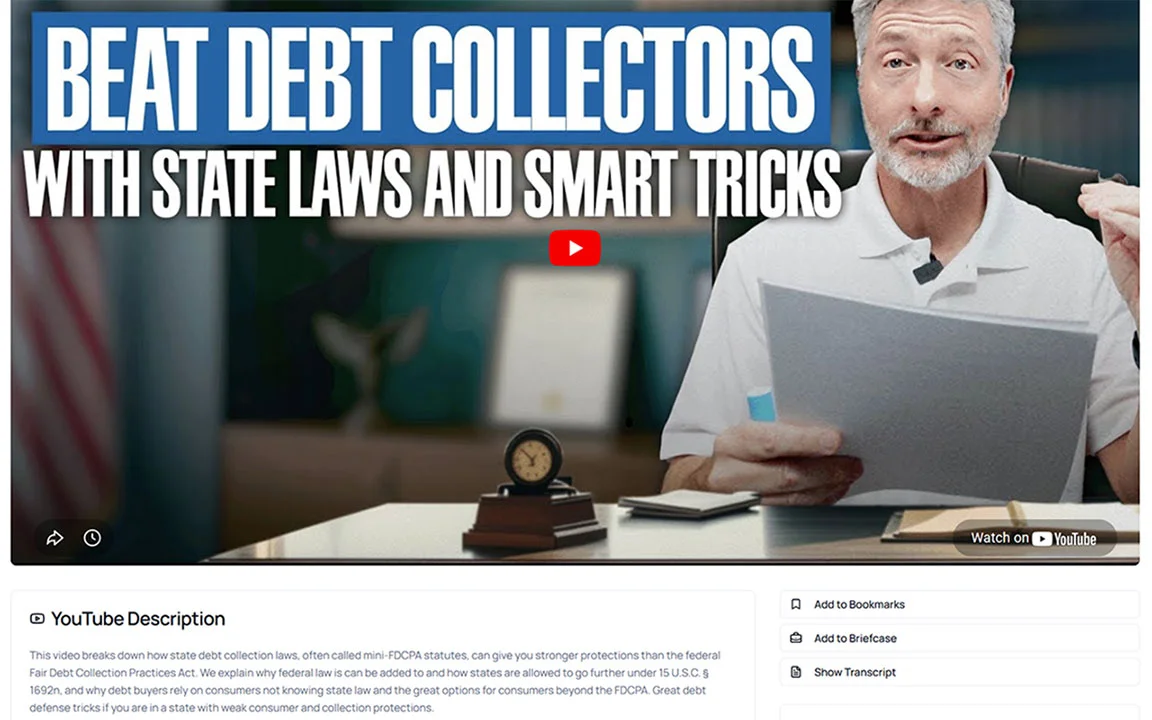
Debt collection defense is the set of legal strategies, rights, and actions you can use to fight back when a debt collector comes after you — whether through letters, phone calls, or a court summons.
Here is what you need to know right now:
The numbers here are sobering. Between 2 and 4.7 million debt collection lawsuits are filed in the United States every year — roughly one in every four civil cases. And somewhere between 70% and 90% of defendants never respond at all, handing collectors an automatic win without a single day in court.
You don't have to be one of them.
It usually starts simply: a text from a number you don't recognize, a letter from a company you've never heard of, or a stranger at your door handing you court papers. In that moment, most people freeze. That pause — doing nothing — is exactly what debt collectors are counting on.
My name is Brian Parker, and for over 30 years I've been in the courtroom fighting creditors, debt buyers, and collection law firms — which is exactly why I built KillDebt to make debt collection defense accessible to everyone, not just those who can afford a $400-per-hour attorney. In the sections below, I'll walk you through every key strategy, right, and tool you need to fight back — starting with what to do the moment you receive that summons.
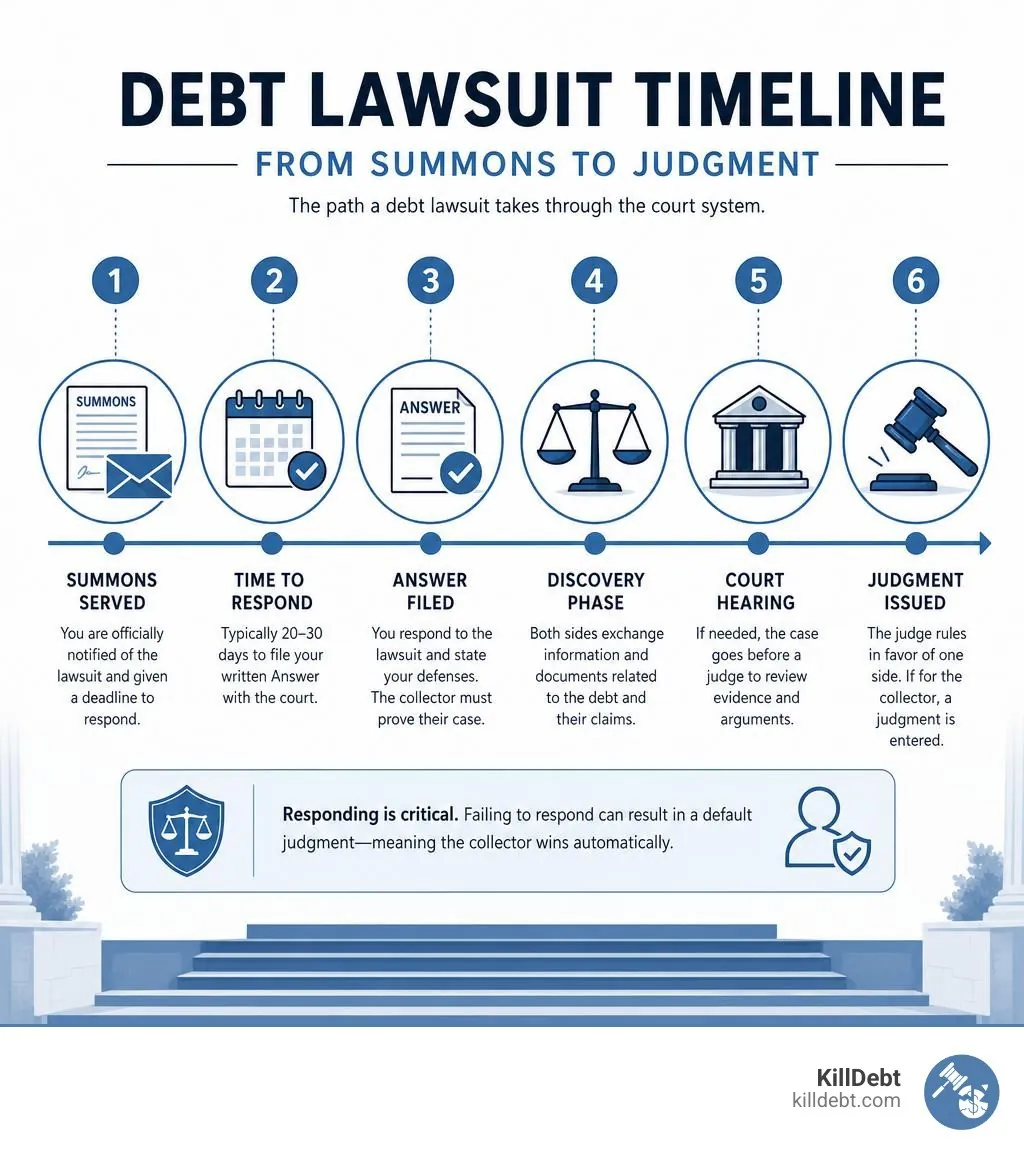
The second those lawsuit papers land in your hands, the clock starts ticking. In Florida, you generally have just 20 calendar days to respond. In Michigan, you have 21 days if you were served in person, or 28 days if you were served by mail or outside the state.
These papers consist of two critical documents:
Ignoring these documents is the single biggest mistake you can make. When you do nothing, the court enters a default judgment against you. This means the collector wins automatically. With a default judgment in hand, collectors can freeze your bank accounts, place liens on your property, garnish your wages (subject to state limits), and severely damage your credit score for up to a decade.
If you are facing this stressful situation, your immediate priority is to understand What To Do if a Debt Collector Sues You | Consumer Advice. To protect your financial future, you must learn How to Answer a Debt Summons and submit a timely, formal response to the court.
Filing an Answer is your formal response to the allegations listed in the Complaint. You do not need to prove your entire case in this document; you simply need to address each numbered paragraph in the Complaint by choosing one of three responses:
Your Answer must use professional, court-ready formatting. Many local courts charge a filing fee to submit an Answer, which can range from $50 to $250 depending on the jurisdiction and the amount of the debt. If you cannot afford this fee, you can request fee waiver forms directly from the court clerk.
To ensure your response meets all local court standards, we recommend utilizing a structured Sample Answer to Debt Collection Lawsuit to draft a defense that protects your legal rights.
When building your debt collection defense, you must understand the powerful consumer protection laws at both the federal and state levels.
The federal Fair Debt Collection Practices Act (FDCPA) is a shield that applies to third-party debt collectors and collection attorneys nationwide. However, it does not typically cover the original creditor (the company that originally extended you the credit).
Fortunately, state laws in our primary service areas offer even broader protections:
The following table highlights the differences between these critical consumer protection laws:
| Feature / Protection | Federal FDCPA | Florida FCCPA | Michigan RCPA |
|---|---|---|---|
| Applies to Third-Party Collectors | Yes | Yes | Yes |
| Applies to Original Creditors | No | Yes | Yes |
| Prohibits Harassment & Abuse | Yes | Yes | Yes |
| Statutory Damages Limit | Up to $1,000 | Up to $1,000 | Up to $1,000 (or triple actual damages) |
| Covers Business Debts | No | No | No |
If a collector violates any of these laws—such as by calling you more than seven times in seven days, using deceptive threats, or contacting you after you sent a cease-and-desist letter—you can report them to the Federal Trade Commission (FTC) or file a counterclaim for damages. For a deeper look at your federal rights, review the Debt Collection FAQs | Consumer Advice.
Under the FDCPA, you have a 30-day "dispute window" from the moment a collector first contacts you. During this time, you have the absolute right to send a written validation letter demanding that they verify the debt.
When you send this dispute letter, always use certified mail with a return receipt requested. This creates an official, legally binding paper trail proving the collector received your request. Once they receive your dispute, they must halt all collection efforts until they provide written verification of the debt.
If the collector fails to verify the debt but continues trying to collect, or if they report inaccurate information to credit bureaus, they are violating federal law. You can use this failure to launch a comprehensive credit bureau dispute to remove the collection account from your credit report entirely. To learn more about how to execute this strategy, check out our Fight Debt Collection Lawsuit: Complete Guide.
When you are sued, you have the opportunity to raise affirmative defenses and counterclaims. An affirmative defense is a legal reason why you should not be held liable for the debt, even if the collector's factual allegations are true. A counterclaim is your own lawsuit against the collector for violating consumer protection laws.

Common affirmative defenses in debt lawsuits include:
To properly raise these arguments in your Answer, you must review the legal mechanics explained in Affirmative Defenses in a Debt Lawsuit.
The rise of third-party debt buyers has completely changed the landscape of consumer debt litigation. Companies buy portfolios of charged-off debts for 1 to 4 cents on the dollar. These portfolios are often delivered as simple digital spreadsheets with little to no supporting documentation.
To win a lawsuit, a debt buyer must prove a complete chain of title showing how the debt was assigned from the original creditor down to them. If they are missing even one assignment agreement, they lack the legal standing to sue you.
Furthermore, debt buyers frequently try to introduce billing statements using an "Affidavit of Debt" signed by an employee who has never seen the original creditor's records. You can challenge this evidence as inadmissible hearsay because the records were not created in the regular course of the collector's business. For step-by-step guidance on how to dismantle a debt buyer's case, consult our Debt Lawsuit Defense Guide.
The statute of limitations is the legally mandated deadline for a creditor to file a lawsuit against you. Once this period passes, the debt becomes "time-barred." While the collector may still try to contact you to request voluntary payment, suing you over a time-barred debt is a direct violation of federal law.
Be extremely careful: making a partial payment or acknowledging the debt in writing can restart the statute of limitations clock. If you believe your debt is old, you must raise the statute of limitations as an affirmative defense in your Answer, or the court will consider the defense waived. Read more about how to execute this strategy in our guide on the Expired Debt Statute Defense.
If a creditor does manage to get a judgment against you, they cannot simply take everything you own. Both federal and state laws exempt certain types of property from seizure to ensure you can maintain a basic standard of living.

Asset protection vary significantly between our primary states of operation:
Federal benefits, including Social Security, Supplemental Security Income (SSI), Veterans benefits, and federal civil service retirement benefits, are completely exempt from garnishment for consumer debts in all states. For a comprehensive breakdown of how to keep your property safe, read How to Protect Your Assets from Debt Collectors.
Mistaken identity and identity theft are rampant in the debt collection industry. In fact, a famous FTC investigation into major agencies revealed that up to 80% of the money some collectors brought in came from consumers who never owed the original debt.
Collectors frequently sue the wrong person simply because they share a common name with the actual debtor. Courts have repeatedly ruled (such as in the landmark Massachusetts cases Herman v. Fine and Deutsch v. Ormsby) that matching a name alone is not enough to prove liability.
If you are a victim of mistaken identity or identity theft:
Facing a debt collection lawsuit can make you feel powerless, but the law is designed to protect you—if you choose to fight back. You do not have to navigate this complex legal system alone or spend thousands of dollars on a traditional defense attorney.
At KillDebt, we provide a DIY legal defense system powered by ParkerGPT, an advanced AI trained specifically on consumer debt law and real courtroom strategies developed over 30+ years by our founding attorney, Brian Parker. Unlike generic AI models, ParkerGPT analyzes your actual lawsuit documents, uncovers hidden procedural errors, and generates court-ready Answers tailored to Florida and Michigan state laws.
We have also just introduced our brand-new Court Tester—an AI-powered courtroom simulation built around your unique case. By uploading your court filings, you can practice arguing your motion in front of an AI judge, face off against an AI opposing counsel, and receive real-time strategic advice from a private AI co-counsel.
Take control of your financial future, force the collectors to prove their claims, and Protect your assets with KillDebt today.
Get started with KillDebt pricing
Important Legal Disclaimer
This educational content is based on general legal principles and my experience in debt collection defense. It is provided for informational purposes only and does not constitute legal advice. Laws vary by state and by local court. For specific legal advice, consult a qualified attorney licensed in your jurisdiction. No attorney-client relationship is created by reading this guide.
Critical Multi-State Variations: FDCPA applies uniformly at the federal level, but state consumer protection laws may provide additional rights and remedies. Statute of limitations periods vary significantly by state and debt type. What constitutes sufficient debt validation varies in practice across jurisdictions. State-specific rules on call frequency, written notice requirements, and permissible collector conduct may differ from federal minimums.

About the author
Brian Parker
I have over 30 years of experience defending consumers against debt collection lawsuits and have seen every tactic, threat, and pressure play that collectors use. Through KillDebt and ParkerGPT, I have systematized the proven defense strategies that actually work - so consumers can respond from a position of knowledge, not fear. My approach focuses on aggressive legal defense based on documented case success rather than false hope that leads to default judgments.