News Break
Florida Rules of Court Procedure for Beginners
July 3, 2026
Blog / News Break
Find expert debt recovery tribunal lawyers to defend your assets and fight DRT notices before the 30-day deadline.

If you've just received a notice and need debt recovery tribunal lawyers fast, here's what matters most right now:
Quick Answer: How to Find and Use a DRT Lawyer
Debt Recovery Tribunals handle some of the most high-stakes financial disputes in India — cases involving unpaid loans, bank defaults, and enforcement of security interests worth lakhs or crores. When a bank or financial institution comes after you, the process moves fast. Very fast. Interim orders can freeze bank accounts within 48 to 72 hours of a case being filed — often before you even know a case exists.
The confusion is real. The pressure is real. And the consequences of missing a deadline or ignoring a notice can be devastating.
I'm Brian Parker, and for over 30 years I've fought creditors, debt buyers, and collection law firms in courtrooms across the country — giving me a front-row seat to every tactic used against people facing debt recovery tribunal lawyers and institutional lenders. At KillDebt, I've turned that experience into tools and guidance that put you back in control, fast.
To effectively defend yourself, we must first look at what a Debt Recovery Tribunal (DRT) actually is and why it exists. Established under the Recovery of Debts and Bankruptcy Act, 1993 (formerly known as the RDDBFI Act), the DRT’s primary purpose is to provide a highly specialized, fast-track forum for banks and financial institutions to recover their outstanding dues.
Before 1993, banks had to file traditional civil suits to recover unpaid loans. These civil court cases dragged on for decades, locking up vital capital in Non-Performing Assets (NPAs). The DRT system bypassed this gridlock completely. Today, any debt claim by a bank or notified financial institution that exceeds ₹20 lakhs is legally barred from ordinary civil courts and must be filed directly before the DRT.
But the DRT does not operate in a vacuum. It works hand-in-hand with a powerful piece of legislation: the SARFAESI Act (Securitisation and Reconstruction of Financial Assets and Enforcement of Security Interest Act, 2002).
Under the SARFAESI Act, secured creditors have the immense power to enforce their security interest (such as taking physical possession of and auctioning your mortgaged property) without any prior court intervention. However, the law provides a crucial check and balance: Section 17 of the SARFAESI Act allows borrowers to challenge these aggressive measures by filing a Securitisation Application (SA) directly before the DRT.
This creates a complex, dual-track environment. A bank can pursue an Original Application (OA) under the RDDB Act to obtain a money judgment, while simultaneously executing out-of-court enforcement under the SARFAESI Act. Navigating this legal minefield requires deep, specialized knowledge. That is why having the right representation is critical. Experienced advocates, such as those providing Expert Debt Recovery Tribunal (DRT) Advocacy Services or working as a dedicated Debt Recovery Tribunal Lawyer - Advocate Rudra Vikram Singh, specialize in finding procedural loopholes in the bank's actions to halt auctions and protect your assets.
Understanding the difference between the DRT and the DRAT (Debt Recovery Appellate Tribunal) is vital for anyone facing a high-value debt dispute. Think of the DRT as the trial court where the facts are argued, evidence is presented, and the initial judgment is passed. The DRAT, on the other hand, is the appellate forum where you go if you need to challenge an unfair or legally flawed order passed by the DRT.
Across India, there are 39 DRT benches, but only 5 DRAT benches. This means the appellate level is highly concentrated and moves under strict, unforgiving rules:
Because of this pre-deposit rule, specialized debt recovery tribunal lawyers are indispensable. A skilled advocate knows how to draft and argue a strategic waiver application under Section 21 of the Act, convincing the appellate tribunal to reduce this pre-deposit requirement to the statutory minimum of 25% based on financial hardship or glaring legal errors in the DRT's original judgment.
Firms with nationwide reach, like DRT Lawyer India | All 39 DRT Tribunals | Unified Chambers and senior specialists like Advocate Subodh Bajpai | Debt Recovery Lawyer | UC, focus heavily on building an airtight record at the DRT level so that any potential appeal to the DRAT has the strongest possible foundation.

When a formal notice, demand letter, or legal summons arrives, panic is a natural reaction. But in the legal world, silence is consent. If you ignore a summons from a DRT, the tribunal will proceed ex-parte (in your absence), accept the bank's claims as absolute truth, and issue a Recovery Certificate. Once that certificate is issued, a Recovery Officer can attach your bank accounts, garnish your business receivables, and auction your property.
If you are a borrower in India, or if you are dealing with aggressive debt collection lawsuits in US states like Florida or Michigan, the rules of urgent self-defense remain remarkably similar:
When defending against institutional creditors, you are not helpless. Banks and debt buyers make procedural and administrative mistakes constantly. A seasoned attorney will scrutinize the creditor's filings to identify viable defenses:
| Borrower Defense | Creditor Claim / Action | How a Lawyer Helps |
|---|---|---|
| Limitation Barred | Claim filed after the 3-year (India) or 4-5 year (US) limit. | Files a motion to dismiss the entire action as time-barred. |
| Procedural Violations | Improper notice delivery or lack of mandatory 30-day auction notice. | Files a Securitisation Application (SA) to set aside the asset possession. |
| Account Discrepancies | Inflated penal interest and unapproved banking fees. | Demands a forensic audit and forces the bank to recalculate the actual dues. |
| Lack of Chain of Title | Debt buyers suing without proving they own the original loan contract. | Demands proof of assignment and the original wet-signature contract. |

Choosing the right advocate is the single most important decision you will make in your debt defense journey. A general practitioner who handles divorces, property registrations, and criminal bails will likely be overwhelmed by the dense financial regulations of the DRT or state-specific collection laws.
When vetting potential debt recovery tribunal lawyers, look for these key qualifications:
If you are a US consumer looking for representation in Florida or Michigan, utilizing official state bar directories is an excellent starting point to locate licensed consumer protection attorneys who specialize in debt defense.
Before signing a retainer agreement or handing over any money, schedule a consultation and ask these direct questions:
If you are facing collection actions in Michigan, understanding local court rules and seeking specialized consumer defense resources can provide clear answers regarding flat-fee structures and defense strategies against aggressive collection agencies.
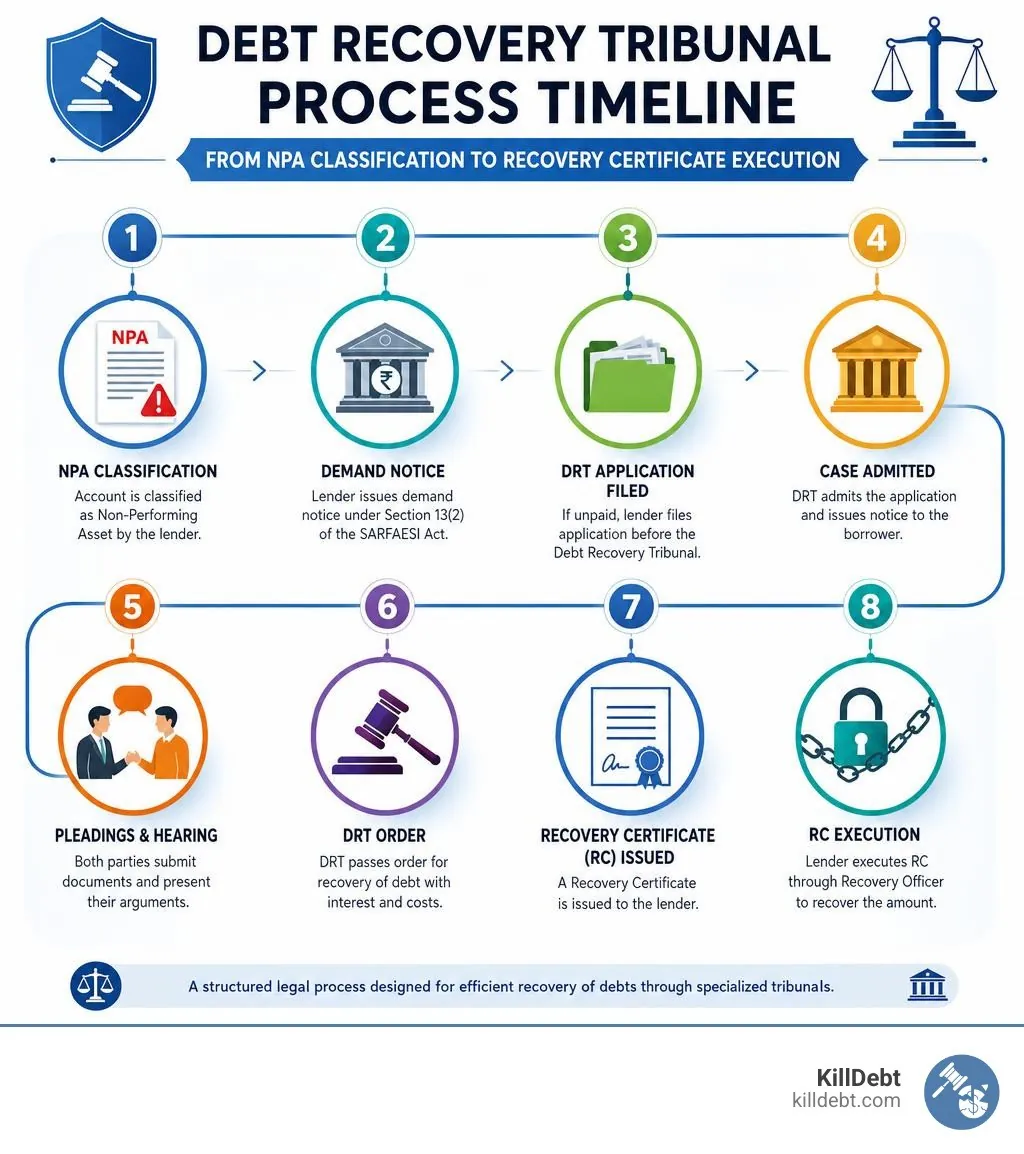
The life cycle of a DRT case is highly structured, moving through several distinct phases. Whether you are a creditor seeking recovery or a borrower defending your rights, understanding this timeline is essential:
The process begins when a bank or financial institution files an Original Application (OA) under Section 19 of the Recovery of Debts and Bankruptcy Act. The application must detail the loan agreements, the default history, the NPA classification date, and the exact outstanding amount.
Simultaneously with the OA, the bank’s legal team will almost always file an application under Section 19(7) for urgent interim relief. This is the creditor's protective shield. If they can convince the Presiding Officer that you might dispose of your assets to evade recovery, the DRT can issue an ex-parte interim order freezing your bank accounts or restraining you from selling your properties—often within 48 to 72 hours of filing.
Once the OA is admitted, the DRT issues a formal summons to the defendant. Upon receiving this summons, you have a strict statutory timeline (usually 30 days) to file your Written Statement (your formal legal defense). This is where your lawyer will raise defenses like the statute of limitations, incorrect interest calculations, or procedural violations.
Unlike traditional civil courts, the DRT relies heavily on written evidence. Both parties submit their Evidence Affidavits along with cross-examinations conducted via written interrogatories. This speeds up the process significantly, keeping the case focused on documents rather than lengthy oral testimonies.
If the Presiding Officer rules in favor of the bank, the tribunal passes a final order and issues a Recovery Certificate (RC). The RC is the ultimate legal document that certifies the exact amount you owe and authorizes the court to recover it.
Once the RC is issued, the case is transferred from the Presiding Officer to the Recovery Officer. The Recovery Officer has immense, administrative powers to execute the certificate, including:
Facing institutional creditors, aggressive collection agencies, or a formal DRT summons can make you feel completely powerless. The complex legal language, strict deadlines, and the threat of losing your hard-earned assets are designed to force you into submission. But as we have shown, you have rights, you have defenses, and you do not have to navigate this alone.
While hiring traditional debt recovery tribunal lawyers is highly recommended for multi-crore disputes, many consumers and small business owners find themselves priced out of high-quality legal representation.
That is why we built KillDebt.
We provide a revolutionary, DIY legal defense system powered by ParkerGPT—an AI trained specifically on consumer debt law and real-world court strategies developed over 30+ years by veteran attorney Brian Parker. Unlike generic AI tools, ParkerGPT analyzes your actual lawsuit documents, identifies critical procedural weaknesses in the creditor's claims, and generates court-ready responses and step-by-step instructions at a fraction of the cost of a traditional lawyer.
To give you the ultimate edge, we have also introduced the Court Tester—an advanced AI courtroom simulation built directly on the facts of your actual case. By uploading your real filings, you can practice arguing your motion in front of an AI judge, face off against AI opposing counsel, and receive real-time, strategic whispers from your private AI co-counsel.
Do not let default judgments dictate your financial future. Empower your debt defense with KillDebt and fight back with the power of elite legal intelligence today.
Get started with KillDebt pricing
Important Legal Disclaimer
This educational content is based on general legal principles and my experience in debt collection defense. It is provided for informational purposes only and does not constitute legal advice. Laws vary by state and by local court. For specific legal advice, consult a qualified attorney licensed in your jurisdiction. No attorney-client relationship is created by reading this guide.
Critical Multi-State Variations: FDCPA applies uniformly at the federal level, but state consumer protection laws may provide additional rights and remedies. Statute of limitations periods vary significantly by state and debt type. What constitutes sufficient debt validation varies in practice across jurisdictions. State-specific rules on call frequency, written notice requirements, and permissible collector conduct may differ from federal minimums.

About the author
Brian Parker
I have over 30 years of experience defending consumers against debt collection lawsuits and have seen every tactic, threat, and pressure play that collectors use. Through KillDebt and ParkerGPT, I have systematized the proven defense strategies that actually work - so consumers can respond from a position of knowledge, not fear. My approach focuses on aggressive legal defense based on documented case success rather than false hope that leads to default judgments.