News Break
Lawyers, Courts, and Cash: Navigating Debt Recovery Tribunals
July 3, 2026
Blog / News Break
Learn how to remove paid debt credit from your report after paying collections with proven legal strategies.
If you're trying to remove paid debt from your credit report, here's the short answer:
Paying off a collection does NOT automatically remove it from your credit report. It stays listed — sometimes for up to seven years — even with a zero balance. But you do have options to get it removed faster.
Quick ways to remove a paid collection:
The most important thing to know: About 90% of lenders still use FICO Score 8, which counts paid collections against you — so "paid" on your report is not the same as "gone."
A single collection account can drop your credit score by 50 to 110 points. Even after you pay it, that damage lingers. Most people assume the problem is solved once the balance hits zero. It isn't.
I'm Brian Parker, founder of KillDebt, and over the past 30 years fighting debt collectors and collection law firms in courtrooms across the country, I've helped thousands of consumers understand exactly how to remove paid debt from their credit files — and I've built KillDebt to put those same strategies directly in your hands.
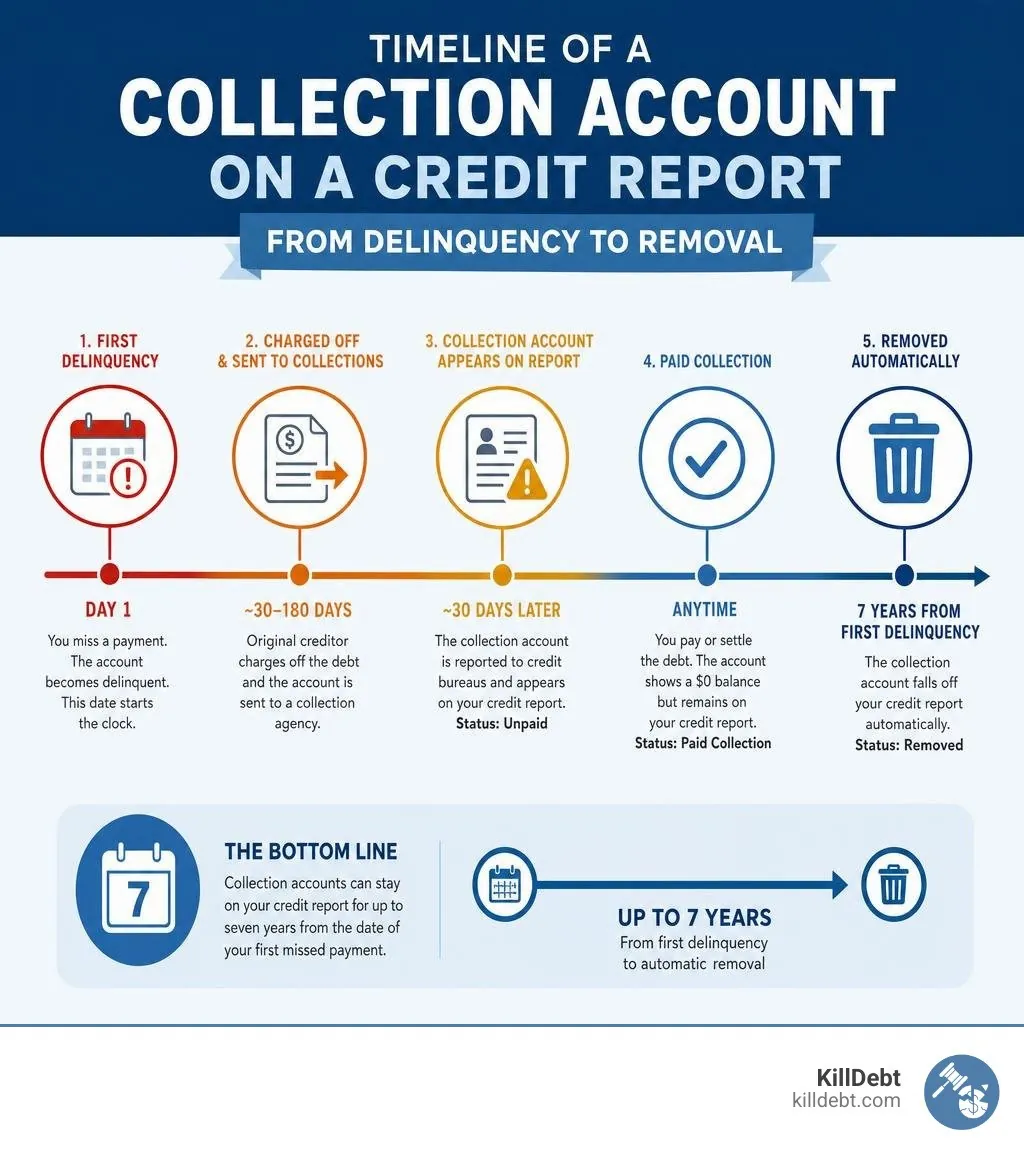
The short answer is no. Under the Fair Credit Reporting Act (FCRA), negative information — including collection accounts — can legally remain on your credit report for up to seven years from the date of the first delinquency (the original missed payment that led to the charge-off). When you pay off a collection account, the debt collector simply updates the status of the account to "Paid Collection" or "Settled Collection" and updates the balance to $0.
For many consumers, this is a frustrating surprise. You did the responsible thing by paying, yet the black mark remains on your record. This occurs because credit bureaus are designed to track historical financial behavior, not just your current status.
However, the impact of a paid collection depends heavily on which credit scoring model a lender uses:
Understanding these rules is the first step in learning How to Legally Remove Collections from Your Credit Report After Paying Off Debt. If you are dealing with traditional consumer debt, such as credit cards, personal loans, or utility bills, you will need to take proactive measures to clean up your credit history.

If you have already paid off your debt and are looking to remove paid debt from your credit file, you cannot rely on the credit bureaus to do it for you. You must actively pursue one of several proven legal and administrative strategies.
When we help consumers clean up their credit profiles, we look at four primary methods:
Let's break down the most effective post-payment strategies in detail.
A goodwill letter is a formal written request sent to the collection agency or the original creditor asking them to remove the paid collection as a gesture of "goodwill."
Because the debt is already paid, the collector has no financial incentive to keep reporting it. In fact, keeping the negative mark on your report doesn't benefit them at all. A goodwill letter explains the circumstances that led to the original delinquency (such as a medical emergency, job loss, or divorce) and highlights your subsequent on-time payment history and financial responsibility.
To write an effective goodwill letter, you should:
While debt collectors are not legally required to grant goodwill deletions, many smaller or midsize agencies will accommodate these requests to maintain good relations and avoid ongoing administrative overhead.
Under Section 611 of the Fair Credit Reporting Act (FCRA), credit reporting agencies must investigate any information on your credit report that you dispute as inaccurate or incomplete. If the credit bureau cannot verify the accuracy of the disputed item within 30 days (or 45 days in some circumstances), they are legally required to delete the entry entirely.
When a debt is paid, collectors often make mistakes in how they report the updated account. You should carefully review your credit reports from Equifax, Experian, and TransUnion to look for common errors, such as:
If you find any discrepancy, you can submit a formal dispute. We highly recommend mailing a physical dispute letter via certified mail rather than using online dispute portals. Online portals often force you to choose from pre-written options and may waive your right to sue the credit bureau if they fail to correct the error.
To initiate this process, you can use a Dispute Invalid Debt Notice to clearly lay out the inaccuracies to the credit bureaus and demand immediate correction or deletion.

If you have not yet paid the collection account, you hold a massive amount of leverage. The single most common mistake consumers make is paying the debt first and asking for credit repair help later. Once the collector has your money, your leverage drops to zero.
A pay-for-delete agreement is a negotiation strategy where you offer to pay the debt (either in full or a settled percentage) on the strict condition that the collection agency completely removes the negative tradeline from all three major credit bureaus.
Here is how the pay-for-delete process works in 2026:
For practical guidelines on handling these conversations safely, you can review resources like How to Deal with Debt Collectors, which outlines your rights and standard communication protocols.
Navigating the credit reporting system can feel like playing a game where the rules are stacked against you. But remember: you do not have to accept a damaged credit score as a permanent reality. Whether you choose to dispute reporting errors, negotiate a pay-for-delete agreement, or send a goodwill letter, taking action to remove paid debt from your credit report is one of the smartest financial moves you can make.
If a debt collector goes beyond credit reporting and actually sues you in court, that is where we come in.
At KillDebt, we provide an AI-powered platform featuring ParkerGPT — an AI model trained specifically on consumer debt law and real-world court strategies developed over 30+ years by attorney Brian Parker. If you are facing a debt lawsuit in Florida or Michigan, ParkerGPT can analyze your lawsuit documents, identify legal weaknesses in the collector's case, and generate court-ready responses at a fraction of the cost of hiring a traditional lawyer.
We also just rolled out our brand-new tool: Court Tester. Court Tester is an advanced AI courtroom simulation built directly on your actual case. You can upload your real court filings and practice arguing your motions in front of an AI judge, against an AI opposing counsel, while a private AI co-counsel whispers winning strategies only you can see.
Don't let debt collectors dictate your financial future. Take control of your credit and protect your rights today by visiting the KillDebt DIY Legal Defense Platform.
Get started with KillDebt pricing
IMPORTANT LEGAL DISCLAIMER
This educational content is based on general legal principles and my experience in debt collection defense. It is provided for informational purposes only and does not constitute legal advice. Laws vary by state and by local court. For specific legal advice, consult a qualified attorney licensed in your jurisdiction. No attorney-client relationship is created by reading this guide.
Critical Multi-State Variations: FDCPA applies uniformly at the federal level, but state consumer protection laws may provide additional rights and remedies. Statute of limitations periods vary significantly by state and debt type. What constitutes sufficient debt validation varies in practice across jurisdictions. State-specific rules on call frequency, written notice requirements, and permissible collector conduct may differ from federal minimums.

About the author
Brian Parker
I have over 30 years of experience defending consumers against debt collection lawsuits and have seen every tactic, threat, and pressure play that collectors use. Through KillDebt and ParkerGPT, I have systematized the proven defense strategies that actually work - so consumers can respond from a position of knowledge, not fear. My approach focuses on aggressive legal defense based on documented case success rather than false hope that leads to default judgments.