
News Break
The pro se answer template every defendant needs
June 8, 2026
Blog / News Break
Learn how to answer interrogatories debt case correctly, avoid sanctions, and protect yourself with this step-by-step guide.
Knowing how to answer interrogatories in a debt case could be the difference between winning your defense and handing the debt collector an easy victory.
Here's the quick version of what you need to do:
Miss any of these steps, and the debt collector's attorney can use your silence — or your words — against you.
Debt collectors file over 4 million lawsuits in the U.S. every year. After you file your Answer to the lawsuit, many of them immediately send interrogatories — written questions you must answer under oath. They're counting on you not knowing what to do next. Most defendants either ignore them entirely or accidentally admit things they didn't have to admit. Both mistakes can lead directly to a summary judgment against you.
This guide gives you the exact steps to respond the right way and fight back.
I'm Brian Parker, and over the past 30+ years in the courtroom, I've seen debt collectors use interrogatories as a trap to get defendants to answer interrogatories in a debt case in ways that sink their own defense — and I built KillDebt specifically to make sure that doesn't happen to you.
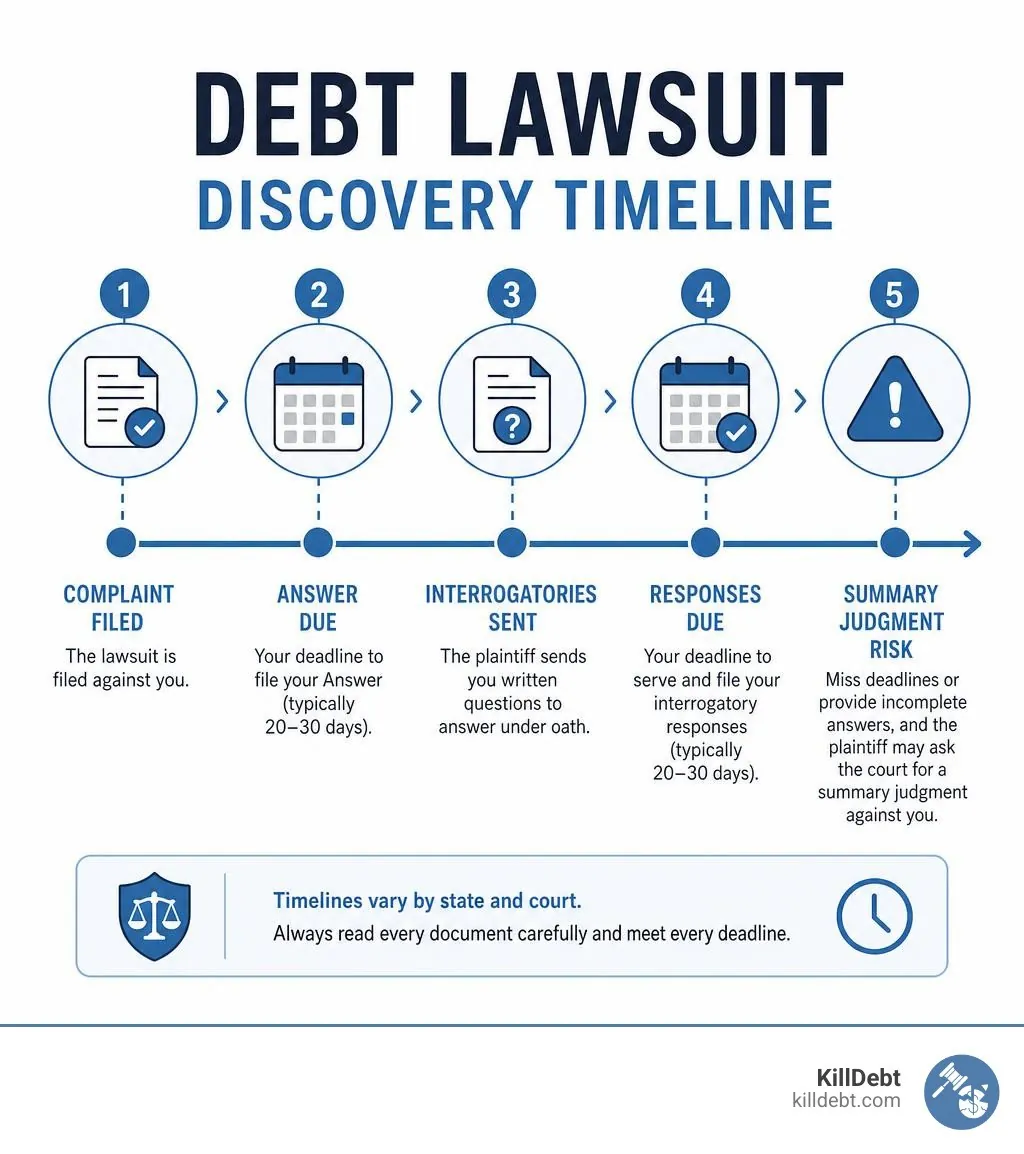
When a debt collector or a "junk debt buyer" (a company that buys old debts for pennies on the dollar) sues you, the lawsuit doesn't go straight to trial. Instead, it enters a phase called discovery. This is the formal, court-governed process where both sides must lay their cards on the table.
Interrogatories are one of the primary tools used during discovery. Simply put, they are formal, written questions that one party sends to another. When you receive them, you are legally required to answer them in writing, and you must swear under penalty of perjury that your answers are true.
Because debt collection lawyers only get paid when they collect, they want quick, cheap victories. They rarely want to pay for expensive court reporters or spend hours in a room taking your deposition. Instead, they use interrogatories because they are incredibly cheap to send out as template forms. They use them as a fishing expedition, hoping you will trip up and admit to owing the debt.
To understand where interrogatories fit in the grand scheme of your lawsuit, it helps to look at the broader debt collection lawsuit timeline. They are sent after you file your initial Answer to the complaint but before the case goes to trial.
It is easy to confuse the different discovery tools. Here is how they stack up against each other:
| Discovery Tool | What It Is | How It Works | Cost & Effort |
|---|---|---|---|
| Interrogatories | Written questions | You type out your answers and objections under oath. | Low cost, high strategic value. |
| Depositions | Live, oral questioning | You answer questions spoken by their lawyer in front of a court reporter. | High cost, highly stressful. |
| Requests for Admission (RFA) | Statements to admit or deny | You must explicitly "admit" or "deny" specific facts. | Low cost, high risk if ignored. |
In a typical debt case, the plaintiff (the debt collector) has the burden of proof. They must prove two things: that you are the person who owes the debt, and that the exact amount they are suing you for is correct down to the penny. Junk debt buyers notoriously lack the original paperwork to prove this. Therefore, they use interrogatories to force you to provide the proof they are missing.
Answering interrogatories is not like replying to a casual email. It requires strict adherence to legal formatting and court procedures. If you format your response incorrectly, the court may reject it, or the debt collector's attorney might claim you failed to respond at all.

Here is how to draft your responses:
Your response must look like a formal court document. At the very top, you must include the court caption. This includes:
This information must match the original summons and complaint exactly.
You cannot simply write a numbered list of answers. You must type out the exact question (the "interrogatory") first, and then write your answer or objection directly beneath it.
Example:
INTERROGATORY NO. 1: State your full name, current address, and date of birth.
RESPONSE TO INTERROGATORY NO. 1: Defendant objects to this interrogatory to the extent that it requests sensitive personal identifying information, such as date of birth, which is irrelevant to the claims or defenses in this action. Subject to and without waiving this objection, Defendant responds as follows: [Your Name], [Your Address].
For every single question, you must decide whether to answer it, object to it, or do a combination of both (answering "subject to" your objection). We will cover common objections in detail below. If you are answering, keep it as brief and direct as possible. Do not volunteer stories, excuses, or context.
Answering interrogatories requires a verification under oath. At the end of your document, you must include a statement declaring under penalty of perjury that your responses are true and correct to the best of your knowledge. In many jurisdictions, such as Florida, your signature on this verification page must be signed in front of a notary public. Without this signed verification, your answers are legally invalid.
If you are feeling overwhelmed by the paperwork, our debt lawsuit defense guide can walk you through the entire process of structuring your defense from start to finish.
It might be tempting to ignore these questions, write "N/A" on everything, or stretch the truth to make yourself look better. Do not do it.
When consumer defendants represent themselves, they often fall into the same predictable traps. Here are the top mistakes we see:
You do not have to answer every question the debt collector throws at you. You have a legal right to object to questions that violate court rules. However, you cannot just write "I object" because you don't like the question. You must state specific, legally recognized grounds for your objection.
If you are in Michigan, for example, your discovery rights and limitations are governed strictly by the Michigan Court Rules on Discovery (opens in a new tab). Knowing these rules helps you identify when a debt collector is overstepping.
Here is a list of the most common legal objections used in consumer debt defense:
Vague and Ambiguous: Use this when the question is so poorly written or broad that you cannot tell what they are actually asking.
Overly Burdensome / Oppressive: Use this if answering the question would require an unreasonable amount of effort, time, or expense that outweighs its value to the case.
Irrelevant: The question must be reasonably calculated to lead to evidence that matters to the lawsuit.
Attorney-Client Privilege: You cannot be forced to disclose confidential communications between you and your legal counsel.
When objecting, the best practice is to state your objection clearly, and then provide a limited answer "subject to" that objection. This shows the judge you are acting in good faith while still protecting your rights.
Discovery deadlines are strict, and missing them can be fatal to your case. The exact timeline depends on your jurisdiction:
Note: If the discovery documents were served to you by regular mail, many states grant an additional 3 to 5 days to account for mailing time. Always check your local rules to be absolutely sure.
Once your document is drafted, formatted, and signed (and notarized if required), you must deliver it to the opposing party.
Most consumer defendants do not realize that discovery is a two-way street. You do not just have to defend; you can go on the offensive. By sending your own interrogatories to the debt collector, you can force them to prove their case—or expose the fact that they cannot.

When junk debt buyers purchase portfolios of old accounts, they rarely get the original contracts, complete account statements, or the "chain of title" (the legal paperwork proving they actually own your specific debt). When you force them to answer questions under oath about these missing links, they often choose to dismiss the case or settle for a tiny fraction of the debt rather than face a judge.
To get an idea of what professional consumer defense looks like, you can review the NCLC Sample Interrogatories PDF (opens in a new tab) to see standard questions used to challenge debt collectors.
Here are highly effective questions you should consider sending to them:
If the debt collector ignores your questions or sends back evasive answers, you can take control of the courtroom by learning how to compel discovery. Filing a Motion to Compel forces the debt collector to explain to the judge why they are hiding evidence.
Navigating the discovery phase of a lawsuit can feel like walking through a minefield. One wrong admission can instantly end your case. But you do not have to pay thousands of dollars to a defense lawyer to protect your rights.
At KillDebt, we have built a DIY legal defense system powered by ParkerGPT—an AI trained specifically on consumer debt law and real-world courtroom strategies developed over my 30+ years as a consumer defense attorney.
Unlike generic AI tools that just write letters, ParkerGPT:
We have also just rolled out our brand new tool: the Court Tester. This is an AI courtroom simulation built directly on your actual case. You simply upload your real court filings, and within minutes, you can practice arguing your motions in front of an AI judge, facing off against AI opposing counsel, while a private AI co-counsel whispers winning strategies directly to you.
Do not let debt collectors bully you into an easy judgment. Visit KillDebt today and turn the tables on your debt collector.

About the author
Brian Parker
I have over 30 years of experience defending consumers against debt collection lawsuits and have seen every tactic, threat, and pressure play that collectors use. Through KillDebt and ParkerGPT, I have systematized the proven defense strategies that actually work - so consumers can respond from a position of knowledge, not fear. My approach focuses on aggressive legal defense based on documented case success rather than false hope that leads to default judgments.