
News Break
Michigan Debt Law: Your Guide to FDCPA Violations and Lawsuits
July 22, 2026
Blog / News Break
Sued the wrong party? Learn what if sued wrong party: fix misnomers, use relation back doctrine, amend complaints & defend yourself fast.

What if sued the wrong party in a lawsuit? Here's the short answer:
Suing the wrong party — or being sued as one — is more common than most people realize. Debt buyers purchase old accounts in bulk for pennies on the dollar, and critical account details get "lost in translation" along the way. A middle initial gets dropped. A similar name gets matched to the wrong file. Suddenly, someone who never opened a credit card is holding a court summons.
The consequences can be severe on both sides. A personal injury firm in New York once spent nine years litigating a construction accident case — only for it to be dismissed with prejudice because they had sued the wrong defendant the entire time. The plaintiff was then completely time-barred from suing the correct party. The firm ended up facing a legal malpractice lawsuit.
That story is an extreme example. But the core risk it illustrates — a procedural mistake turning into a permanent loss — applies to everyday debt collection lawsuits too.
I'm Brian Parker, founder of KillDebt, and I've spent over 30 years in the courtroom fighting debt collectors, debt buyers, and collection law firms who have sued the wrong party more times than I can count. In the sections below, I'll walk you through exactly what happens — and what to do — whether you're the one who made the filing error or the one who received a summons that was never meant for you.
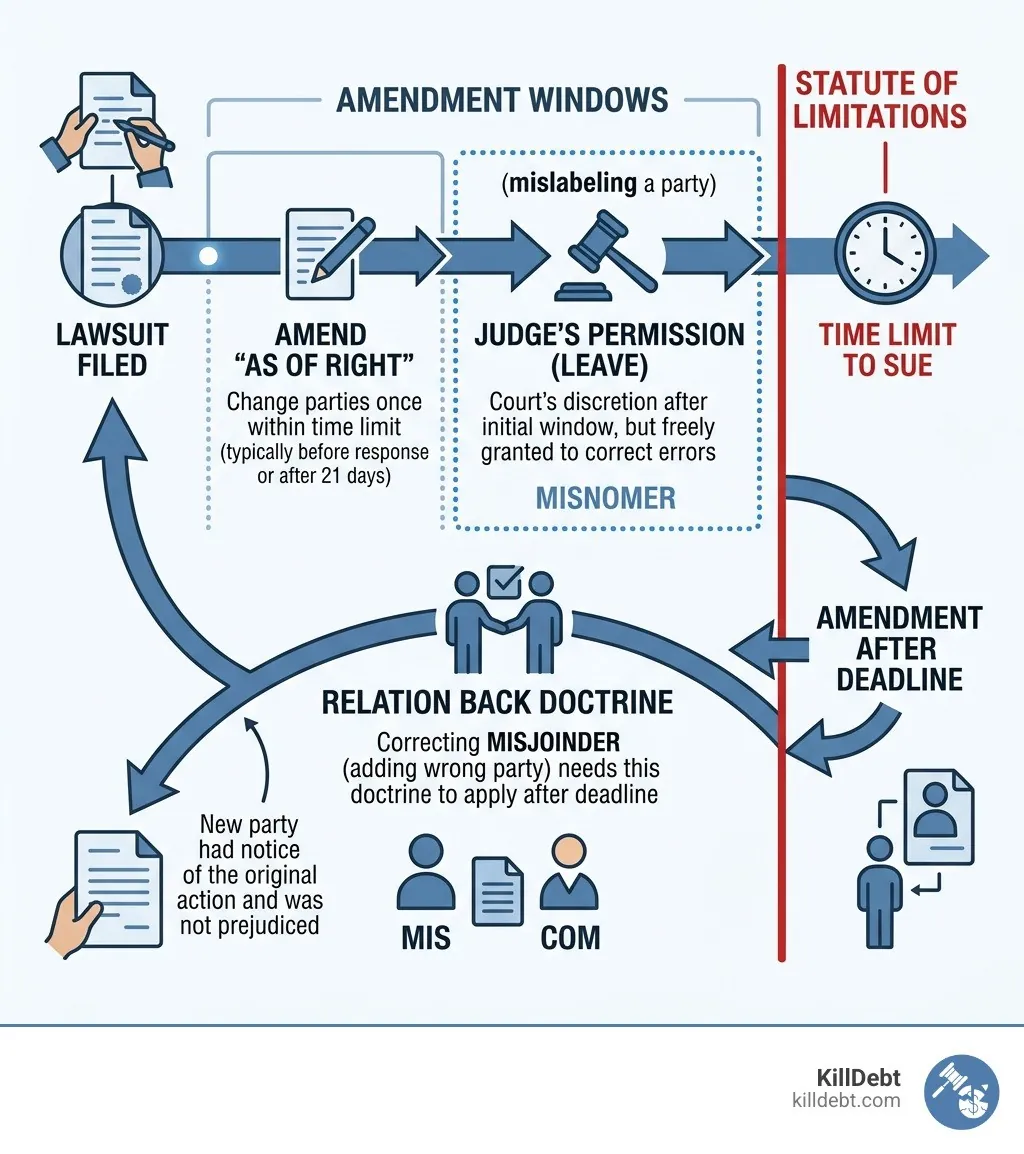
When a legal error occurs regarding the parties in a case, courts generally categorize the mistake into one of two buckets: Misnomer or Misjoinder. Understanding the difference is vital because the remedy for one is a simple fix, while the other can lead to your case being thrown out entirely.
In Florida and Michigan, courts look at whether you simply got the name wrong for the right person, or if you dragged a completely innocent party into the lion's den. As noted in the Suing the Wrong Entity (opens in a new tab) analysis, failure to distinguish between these can result in permanent dismissal.
A misnomer is essentially a clerical error. It’s when you have the right person or entity in mind, you serve the right person, but you simply misspelled their name or used a trade name (d/b/a) instead of the formal corporate name. For example, if you sue "John’s Debt Collection" instead of "John’s Debt Recovery, LLC," the court usually views this as a minor "oops" that can be corrected through an amendment.
Misjoinder, on the other hand, is a much bigger problem. This occurs when you name a completely incorrect party who has no legal connection to the events. This often happens in debt collection when a debt buyer sues someone with a similar name or a family member of the actual debtor.
| Feature | Misnomer | Misjoinder |
|---|---|---|
| Definition | Right party, wrong name | Wrong party entirely |
| Typical Remedy | Amendment of the complaint | Dismissal of the party |
| Court View | Clerical/Technical error | Substantive legal error |
| Effect on Suit | Case continues after correction | Requires new action against correct party |
The stakes are high. If you realize you've sued the wrong person after the statute of limitations has passed, you might not be able to "swap" them for the right person. In the case of Plaintiff Sues Attorney, Firm Who Accidentally Sued Wrong Defendant (opens in a new tab), a nine-year delay in correcting the defendant led to a dismissal with prejudice. This meant the plaintiff could never sue the correct party again because the time had run out.
For a plaintiff, this leads to litigation costs down the drain and potential malpractice. For a defendant, being wrongly named means stress, potential credit damage, and the need to file motions to exit a case they never should have been in.
What happens if you discover the mistake after the deadline to sue has passed? This is where the "Relation Back" doctrine becomes your best friend—or your worst enemy.

In states like Florida and Michigan, the statute of limitations for debt and personal injury is a hard wall. For instance, Michigan generally has a six-year limit for most debt claims, while Florida’s is usually five years. If you sue the wrong person and the clock runs out, you generally can't just add the right person later.
Under Federal Rule 15 (and similar state rules), an amendment to correct a defendant's name can "relate back" to the original filing date. This means the court treats the correction as if it happened on day one. However, this isn't automatic. To qualify for relation back, you must prove:
Our Debt Lawsuit Defense Guide explains that notice is the key. If the right party had no idea the suit existed, the court will likely deny the amendment.
Under Rule 15, you can amend your pleading once "as a matter of course" within 21 days of serving it. After that, you need the court's permission (leave of court) or written consent from the other side. Courts are instructed to "freely give leave when justice so requires," but they will deny it if the delay causes "prejudice"—meaning it unfairly hurts the defendant’s ability to defend themselves.
As seen in Oops! I Sued the Wrong Party and Need to Amend the Complaint (opens in a new tab), the "litigation finger" must have been pointing at the right person, even if the name on the paper was wrong.
If you realize you've made a mistake, you must act immediately. Delay is the number one reason judges deny motions to amend.
If you are responding to a suit where you were misnamed, you should include this as an affirmative defense in your Sample Answer to Debt Collection Lawsuit.
Some states have "renewal statutes" that act as a safety net. For example, if a case is voluntarily dismissed, a plaintiff may have a six-month window to refile. However, as shown in the Aaron v. Jekyll Island case, these statutes usually do not allow you to add new defendants who weren't in the original timely filing. You can't use a renewal to fix a misjoinder if the statute of limitations has already expired.
It’s a nightmare scenario: you get a knock on the door, and a process server hands you papers for a $10,000 credit card debt you’ve never heard of. Maybe you share a name with the real debtor, or maybe you're a victim of identity theft.
If you are the wrong defendant, do not ignore it. The debt collector doesn't care if they have the wrong person; if you don't show up, they get a default judgment. Here is how we recommend fighting back:
Ignoring a summons is the "hard way" to handle being the wrong party. If a default judgment is entered, the creditor can:
Even if you are "judgment proof" (meaning you have no assets), a judgment stays on your record for years and can be renewed. Don't fall for the Debt Collection Lawsuit Myths that say "if it's not my debt, I don't have to go."
Whether you are a plaintiff who made a clerical error or a defendant wrongly accused of a debt, the legal system has pathways to fix the mistake—but you have to be the one to drive the process.
At KillDebt, we’ve built the tools to help you navigate these messy situations without the $300-an-hour attorney fees. Our DIY legal defense system is powered by ParkerGPT, an AI trained on 30+ years of real-world court strategies from attorney Brian Parker. We don't just give you a template; we analyze your specific lawsuit documents to find the weaknesses that lead to dismissals.
Ready to see how your case holds up? Try our Court Tester. It’s an AI courtroom simulation where you can argue your motion in front of an AI judge before you ever step foot in a real courthouse. Don't let a procedural error ruin your financial future.
Protect your rights and get your case dismissed today
Get started with KillDebt pricing
Important Legal Disclaimer
This educational content is based on general legal principles and my experience in debt collection defense. It is provided for informational purposes only and does not constitute legal advice. Laws vary by state and by local court. For specific legal advice, consult a qualified attorney licensed in your jurisdiction. No attorney-client relationship is created by reading this guide.
Critical Multi-State Variations: FDCPA applies uniformly at the federal level, but state consumer protection laws may provide additional rights and remedies. Statute of limitations periods vary significantly by state and debt type. What constitutes sufficient debt validation varies in practice across jurisdictions. State-specific rules on call frequency, written notice requirements, and permissible collector conduct may differ from federal minimums.

About the author
Brian Parker
I have over 30 years of experience defending consumers against debt collection lawsuits and have seen every tactic, threat, and pressure play that collectors use. Through KillDebt and ParkerGPT, I have systematized the proven defense strategies that actually work - so consumers can respond from a position of knowledge, not fear. My approach focuses on aggressive legal defense based on documented case success rather than false hope that leads to default judgments.