
News Break
The DIY Debt Lawsuit Response Template Checklist
July 21, 2026
Blog / News Break
File an FDCPA violations Michigan lawsuit to stop debt collector harassment and protect your rights.

FDCPA violations in Michigan lawsuits are legal claims consumers file when a debt collector breaks the rules set by the Fair Debt Collection Practices Act — and they can result in up to $1,000 in statutory damages plus attorney fees, even if you weren't financially harmed.
Quick answer — the most common grounds for an FDCPA lawsuit in Michigan:
If you just received a court summons, a collection letter, or a call threatening legal action, you likely have rights under both federal and Michigan state law — and you may be able to fight back.
The FDCPA is a federal law that sets strict limits on how third-party debt collectors can behave. Michigan adds its own layer of protection through the Regulation of Collection Practices Act (RCPA), which can provide additional remedies including treble damages for willful violations. Together, these laws give Michigan consumers some of the strongest debt collection protections in the country.
Real Michigan cases show what's at stake. In 2018, a federal court approved a $7.5 million class action settlement involving nearly 250,000 Michigan homeowners who received misleading foreclosure letters from a debt collection law firm. In another case, a consumer's disputed debt flag was never removed from her credit report — causing her home equity loan to be denied — and a Michigan federal court allowed that case to proceed to trial.
You don't have to feel powerless when a debt collector comes after you.
I'm Brian Parker, and for over 30 years I've faced debt collectors, debt buyers, and collection law firms in courtrooms across the country — including handling FDCPA violations in Michigan lawsuits and cases just like the ones you're reading about here. I built KillDebt to put those same strategies directly in your hands, without the attorney price tag.
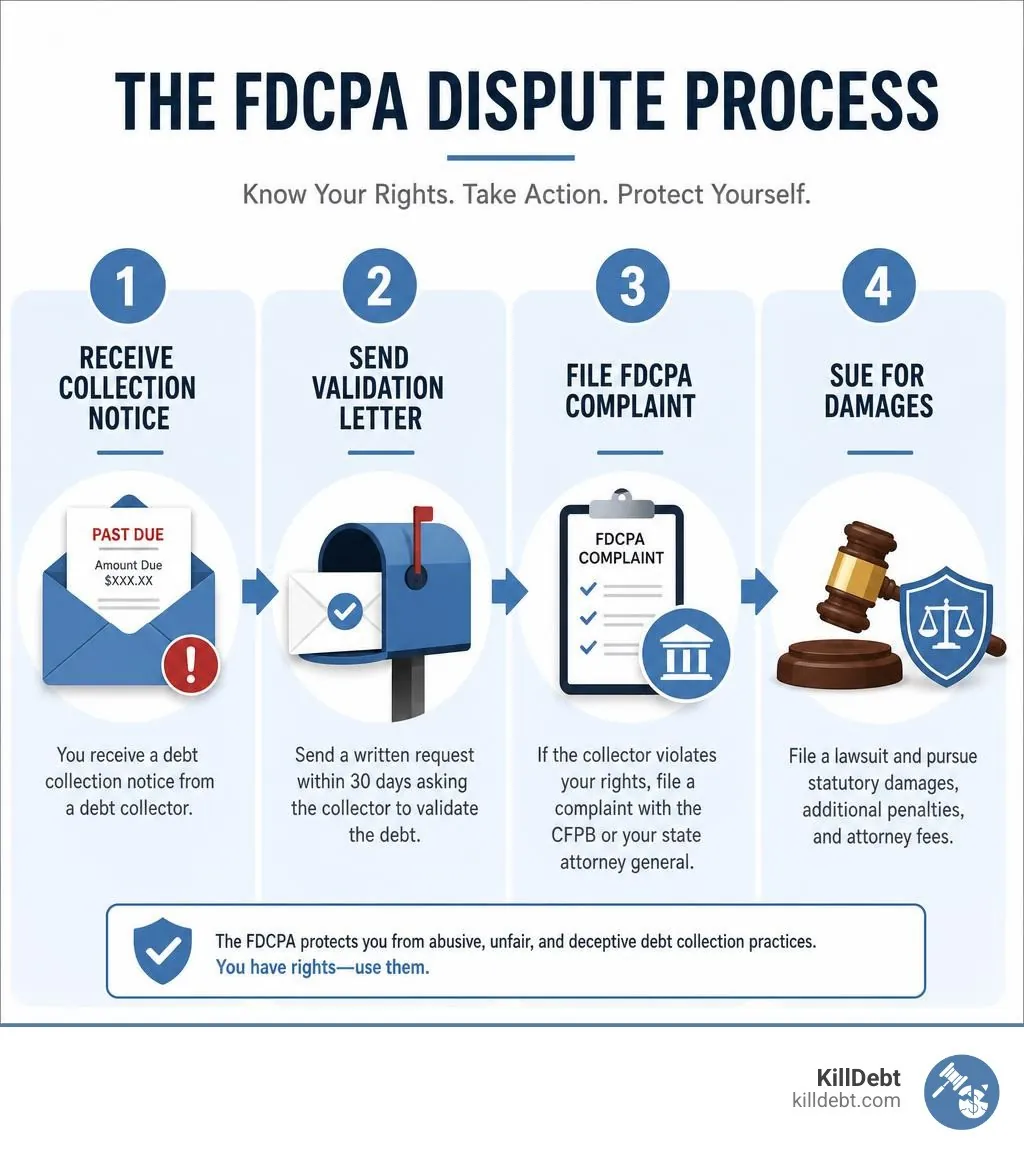
To beat a debt collector, you first have to understand the rules they are supposed to play by. In Michigan, consumers are protected by a powerful combination of federal and state laws.
The primary shield is the federal Fair Debt Collection Practices Act (FDCPA). This law was enacted to eliminate abusive, deceptive, and unfair debt collection practices. If you want to understand how this law functions at a foundational level, you can read our deep dive on FDCPA Explained.
One of the most critical aspects of the FDCPA is that it only applies to "debt collectors." Under federal law, a debt collector is generally defined as a third-party agency collecting debts on behalf of someone else, or a debt buyer who purchases defaulted accounts. Original creditors (like the credit card company or bank that originally gave you the loan) are typically exempt. To see if the company contacting you qualifies, check out our guide on What is a Debt Collector Under the FDCPA: Your Rights Explained.
But what about original creditors who act like bullies? That is where Michigan state law steps in.
Under the Michigan Regulation of Collection Practices Act (RCPA) (found in Michigan Compiled Laws § 445.251-445.257), state-level protections extend to both third-party collectors and original creditors. This means if an original creditor uses misleading tactics or harasses you in the Great Lakes State, you still have legal recourse. You can learn more about how local courts handle these disputes in our overview of Michigan Court Debt Cases.
When a collector crosses the line, you do not have to just take it. Filing an FDCPA violations Michigan lawsuit is one of the most effective ways to make the harassment stop permanently.
If a collector is repeatedly calling your workplace, threatening you with arrest, or using obscene language, you can take legal action to protect yourself. Read our guide on Debt Collector Harassment Stop to learn how to document these violations, and find out How to Report a Collection Agency to regulatory bodies like the CFPB and FTC.
Sometimes, these violations are so widespread that they affect thousands of people at once. A prime example is the landmark Michigan case Martin, et al. v. Trott Law, et al. (E.D. Mich. 2018). In this case, nearly 250,000 Michigan homeowners received misleading foreclosure letters from a debt collection law firm. The letters suggested that an attorney had personally reviewed their files when no such review had taken place, and they included unauthorized fees masked under confusing terminology. The litigation resulted in a massive $7.5 million class action settlement, proving that Michigan courts will hold debt collectors accountable when they use deceptive form letters.
If you decide to file a lawsuit or assert an FDCPA counterclaim, you must establish four key elements to succeed:
To evaluate these violations, Michigan federal courts apply the "least sophisticated consumer" standard. This is an objective metric designed to protect the uninformed, naive, or trusting consumer, while still shielding collectors from bizarre or idiosyncratic interpretations of their letters.
The application of this standard is highlighted in Johnston v. Midland Credit Management, Inc. et al, No. 1:2016cv00437 - Document 42 (W.D. Mich. 2017) :: Justia (opens in a new tab). In Johnston, the consumer received a collection letter that offered a 90% discount but accidentally printed a "$0.00" monthly payment option due to a typographical error. The Western District of Michigan ruled that even the "least sophisticated consumer" would recognize this as an obvious printing error rather than a genuine offer to settle for nothing, meaning the letter was not materially misleading.
In recent years, federal courts have tightened the rules on who has the right to sue. Under the Supreme Court's ruling in Spokeo, Inc. v. Robins, a plaintiff must show a "concrete injury" to have Article III standing in federal court. A bare procedural violation of the FDCPA—without any real-world harm—is no longer enough to win a federal lawsuit.
However, real-world consequences easily satisfy this standard. In Evans v. Merchants and Medical Credit Corp., a Michigan district court denied summary judgment because there was a genuine dispute over whether a debt collector properly instructed a credit bureau to remove a disputed debt flag. The consumer was denied a home equity loan because the disputed flag remained on her credit report. The court ruled that this loan denial constituted a concrete, tangible financial injury, giving her full standing to proceed to a jury trial.
Credit reporting and debt validation are the two biggest battlegrounds in consumer debt litigation.
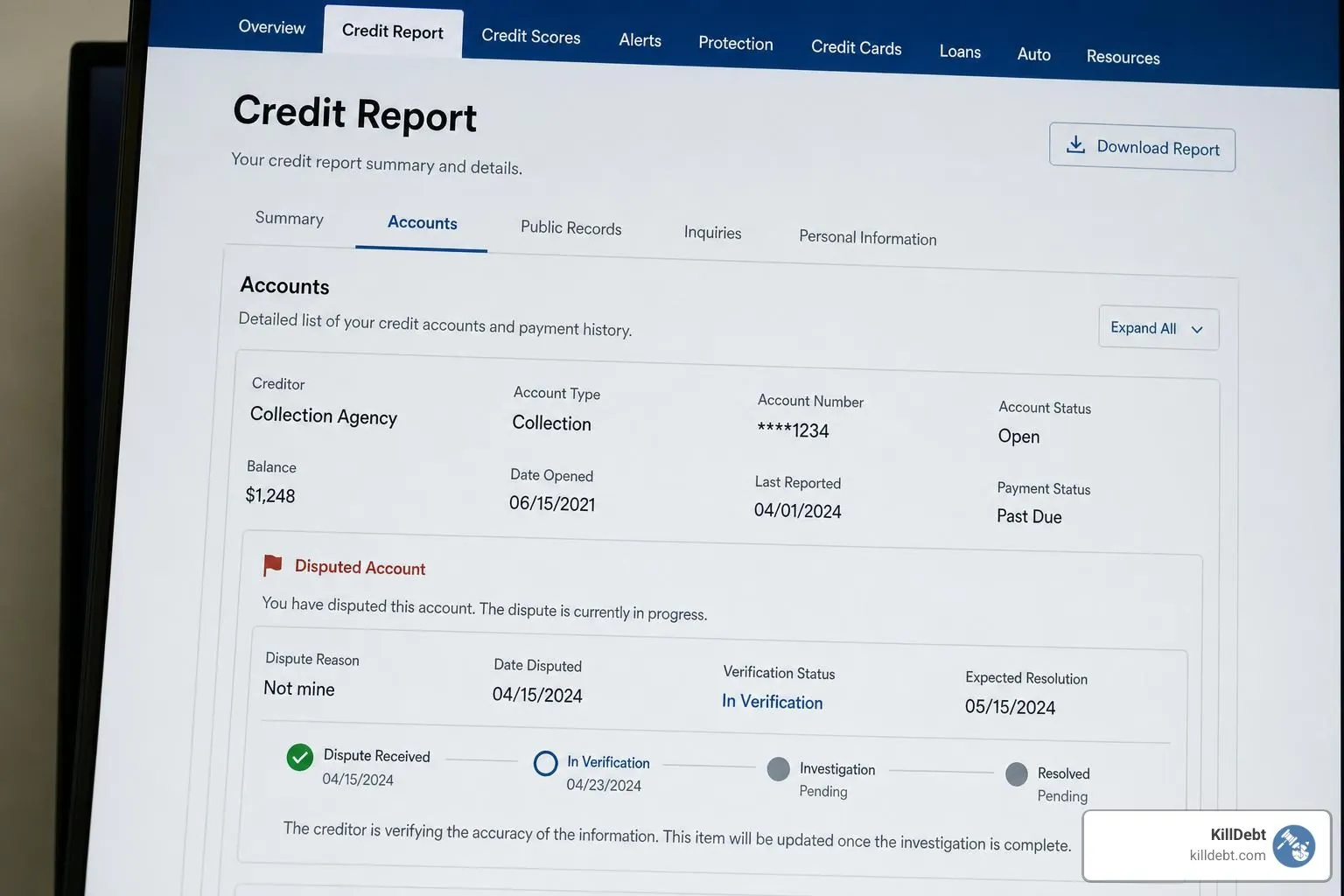
When a debt collector first contacts you, they must send you a "G-notice" containing the amount of the debt, the name of the creditor, and a statement notifying you of your right to dispute the debt within 30 days. If you send a written dispute and validation request within that 30-day window, the collector must cease all collection activities until they obtain verification of the debt and mail it to you.
But what if the collector sends a letter that is confusing about your dispute rights? Under the FDCPA, you have the right to dispute a debt orally or in writing. In the Michigan case Nitzkin v. Craig, the Michigan Court of Appeals confirmed that a collection letter stating a consumer must dispute the debt in writing to contest its validity violates Section 1692g(a)(3) of the FDCPA, because the federal statute allows oral disputes of debt validity.
Another common point of confusion is how collectors report static, non-accruing debts. In Edwards v. National Enterprise Systems, Inc., No. 2:2022cv12022 - Document 24 (E.D. Mich. 2024) (opens in a new tab), a consumer sued a debt collector for failing to explicitly state whether interest was continuing to accrue on a static debt, and for failing to disclose that the statute of limitations on the debt had expired.
The Eastern District of Michigan dismissed the case, ruling that the FDCPA does not require debt collectors to make unnecessary disclosures about non-accruing interest on static debts, nor are they required to disclose an expired statute of limitations unless the collection letter explicitly threatens litigation or contains deceptive statements about enforceability.
If you prove a debt collector violated the law, you are entitled to financial remedies. Below is a comparison of what you can recover under the federal FDCPA versus the Michigan state RCPA:
| Remedy Type | Federal FDCPA | Michigan State RCPA |
|---|---|---|
| Statutory Damages | Up to $1,000 per lawsuit | Greater of actual damages or $50 |
| Actual Damages | Out-of-pocket costs, emotional distress | Out-of-pocket costs, emotional distress |
| Willful Violations | Standard statutory cap applies | Treble damages (up to 3x actual damages or $150) |
| Attorney Fees & Costs | Fully recoverable by successful plaintiffs | Fully recoverable by successful plaintiffs |
Debt collectors often try to escape liability by claiming they made an honest mistake. This is known as the bona fide error defense. To win on this defense, the collector must prove by a preponderance of the evidence that:
Simply having a general policy to "follow the law" is not enough. As established in Nitzkin v. Craig, a thinly specified internal policy does not satisfy the strict "procedures" requirement of the bona fide error defense. Collectors must show they have actual, systematic checks in place to prevent the specific error that occurred.
Timing is everything when filing an FDCPA violations Michigan lawsuit:
Warning: If you make a partial payment or explicitly acknowledge in writing that a debt is yours, you can accidentally reset the six-year clock on an expired debt!
Facing debt collectors in Michigan can feel overwhelming, but the law is heavily on your side if you know how to use it. Whether you are dealing with a deceptive collection letter, a damaged credit report from an unremoved dispute, or an active court summons, you have the right to fight back and demand accountability.
At KillDebt, we believe that legal defense shouldn't only be for those who can afford expensive attorneys. Our DIY legal defense platform is powered by ParkerGPT—an AI trained directly on consumer debt law and real-world courtroom strategies developed over my 30+ years as a consumer defense attorney. ParkerGPT analyzes your lawsuit documents, spots violations, and drafts professional, court-ready responses.
We also just rolled out our brand-new tool: the Court Tester. This AI courtroom simulation allows you to upload your actual case filings and practice arguing your motions in front of an AI judge, facing off against AI opposing counsel, while a private AI co-counsel whispers winning strategies only you can see.
Don't let debt collectors bully you into a default judgment. Take control of your case and protect your financial future today.
Get started with KillDebt and let's beat them together.
Important Legal Disclaimer
This educational content is based on general legal principles and my experience in debt collection defense. It is provided for informational purposes only and does not constitute legal advice. Laws vary by state and by local court. For specific legal advice, consult a qualified attorney licensed in your jurisdiction. No attorney-client relationship is created by reading this guide.
Critical Multi-State Variations: FDCPA applies uniformly at the federal level, but state consumer protection laws may provide additional rights and remedies. Statute of limitations periods vary significantly by state and debt type. What constitutes sufficient debt validation varies in practice across jurisdictions. State-specific rules on call frequency, written notice requirements, and permissible collector conduct may differ from federal minimums.

About the author
Brian Parker
I have over 30 years of experience defending consumers against debt collection lawsuits and have seen every tactic, threat, and pressure play that collectors use. Through KillDebt and ParkerGPT, I have systematized the proven defense strategies that actually work - so consumers can respond from a position of knowledge, not fear. My approach focuses on aggressive legal defense based on documented case success rather than false hope that leads to default judgments.