
News Break
How to Master Debt Recovery Through the Courts Without Going Broke
July 21, 2026
Blog / News Break
Use this debt lawsuit response template checklist to beat default judgment and protect your assets before your court deadline.

A debt lawsuit response template is the fastest way to protect yourself when a creditor or debt collector sues you. Here is exactly what you need to know right now:
Quick answer — what a debt lawsuit response template includes:
Why this matters right now:
You do not need an expensive attorney to respond. You just need to act fast and use the right template.
I'm Brian Parker, founder of KillDebt. For over 30 years I've defended consumers against creditors, debt buyers, and collection law firms in courtrooms across the country — and a well-filed debt lawsuit response template is always the first line of defense. In this guide, I'll walk you through exactly what to include, which defenses apply to your situation, and how to file before your deadline.
IMPORTANT LEGAL DISCLAIMER
This educational content is based on general legal principles and my experience in debt collection defense. It is provided for informational purposes only and does not constitute legal advice. Laws vary by state and by local court. For specific legal advice, consult a qualified attorney licensed in your jurisdiction. No attorney-client relationship is created by reading this guide.
Critical Multi-State Variations: FDCPA applies uniformly at the federal level, but state consumer protection laws may provide additional rights and remedies. Statute of limitations periods vary significantly by state and debt type. What constitutes sufficient debt validation varies in practice across jurisdictions. State-specific rules on call frequency, written notice requirements, and permissible collector conduct may differ from federal minimums.
When you are served with a Summons and Complaint, it means a legal action has officially started against you. The "Answer" is your formal, written response to those court papers. It is your opportunity to address the allegations line-by-line and state your defenses.
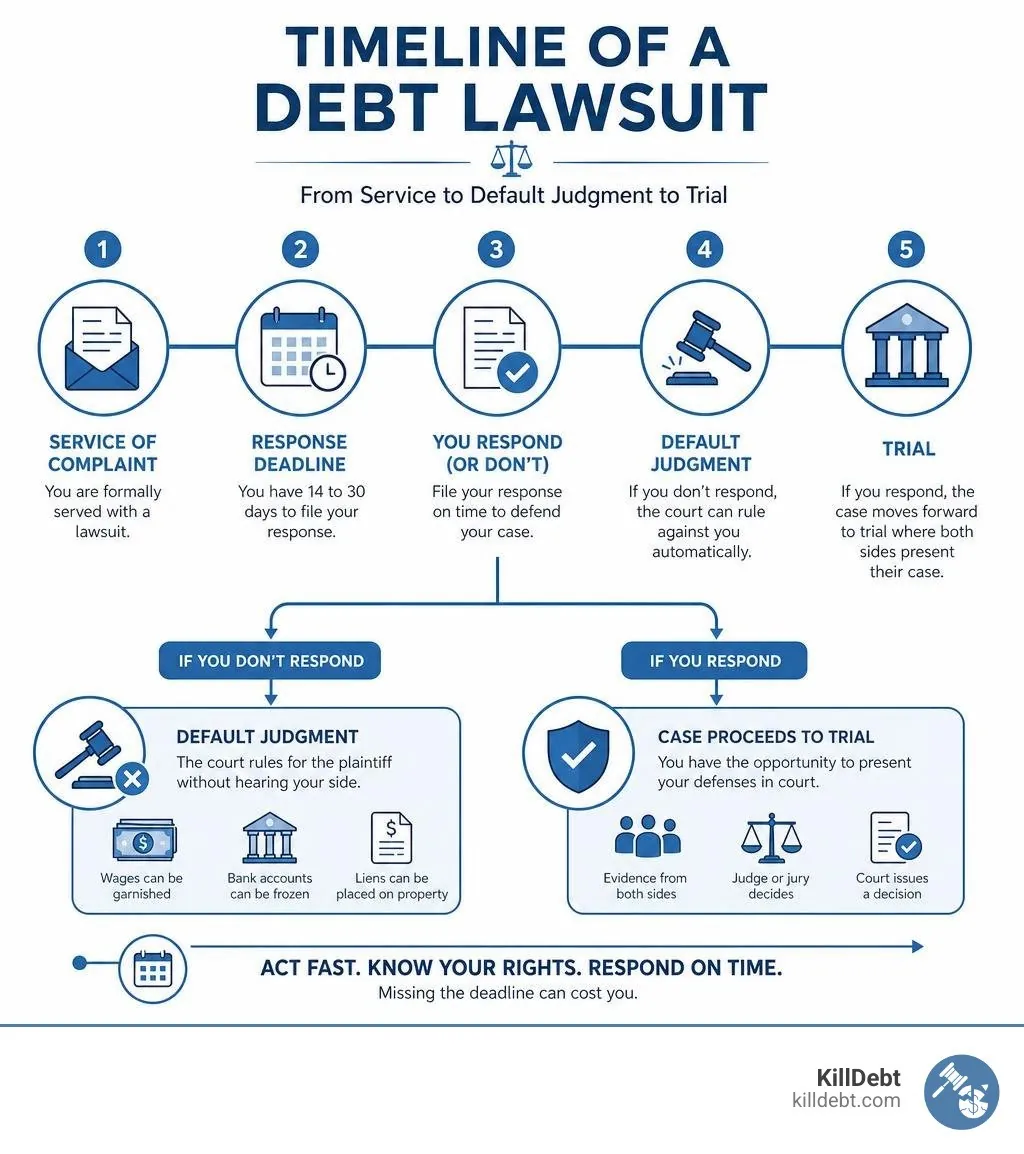
Filing an Answer is critical because of how civil litigation works. In any lawsuit, the plaintiff (the party suing you) bears the burden of proof. They must present concrete evidence to prove that you owe the exact amount claimed and that they have the legal right to collect it. However, if you fail to file a written response, the court assumes you agree with everything the plaintiff claims.
This results in a default judgment. With a default judgment in hand, a debt collector can legally:
By utilizing a proper response strategy, you halt the automatic default process. You force the debt collector to actually show up, produce original contracts, and prove their case. For a detailed breakdown of how this process works, read our guide on Responding to Civil Complaint.
Taking this first step changes the entire dynamic of the case. It shifts the leverage back to you, making it far easier to negotiate a favorable settlement or even get the case dismissed. If you are ready to take action, check out how to Respond to Debt Lawsuit to protect your hard-earned assets.
Time is your absolute biggest enemy when you are served with court papers. You cannot afford to put the envelope on your kitchen counter and ignore it. Depending on the state and court, your deadline to file an Answer typically ranges from 14 to 30 days.
Let’s look at the specific rules for our primary service states:
If you miss these strict windows, the plaintiff will quickly file a motion for default. To understand how to calculate your timeline precisely, review our resources on the legal deadline to answer a lawsuit and the general Time to Respond Debt Collection Lawsuit.
If you are a Michigan resident looking for the official state form, you can review the MC 03, Answer (Civil) - Michigan Courts (opens in a new tab)to see what the court expects.
Not all debt lawsuits are created equal. The strategy you choose depends heavily on who is suing you. There is a massive difference between being sued by your original creditor (like the bank that issued your credit card) versus a third-party junk debt buyer.
Original creditors usually have direct access to your account history, signed agreements, and payment records. Debt buyers, on the other hand, purchase expired or delinquent accounts in bulk for pennies on the dollar. They often receive nothing more than a digital spreadsheet containing your name, address, and a balance. They rarely have the original contract or a complete chain of custody proving they actually own your specific debt.
When defending against a debt buyer, your strongest weapon is challenging their "standing" to sue. You do this by demanding that they produce the complete chain of assignment from the original creditor down to them. If they cannot prove they own the debt, they cannot legally win a judgment against you.
In many debt collection cases, a "general denial" is the safest approach. A general denial states that you deny all allegations in the complaint and demand strict proof of every claim. This forces the collector to work for their money, rather than allowing them to win on a technicality. You can learn more about this approach by reading our article on the General Denial Answer Form and downloading a Sample Answer to Debt Collection Lawsuit.
| Feature | Original Creditor Lawsuit | Debt Buyer Lawsuit |
|---|---|---|
| Who is suing? | The bank/company you originally borrowed from | A third-party company (e.g., Midland Funding, Portfolio Recovery) |
| Documentation | Usually possesses original contracts and statements | Often lacks original signed contracts and statements |
| Key Defense Strategy | Dispute balance calculations or raise statute of limitations | Challenge standing, chain of custody, and demand original contracts |
| Settlement Leverage | Moderate (may settle for 20% to 70% of balance) | High (often settles for 10% to 35% due to weak evidence) |
When drafting your response, you must follow standard civil procedure formatting rules. The court will not accept a casual, emotional letter explaining why you cannot pay. You must use a structured legal format.
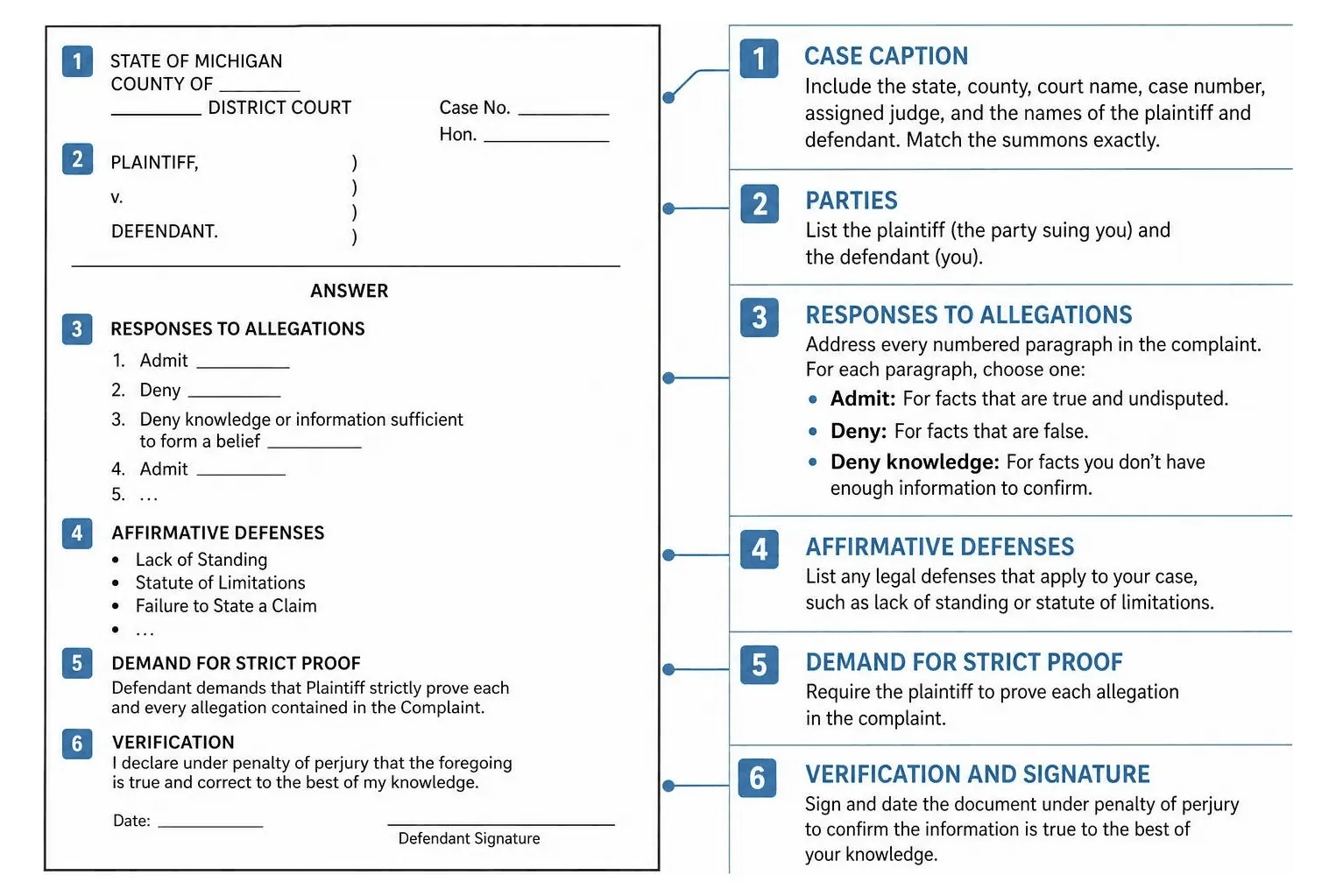
Here is your step-by-step checklist of what to include in your debt lawsuit response template:
The Case Caption: This goes at the very top of your document. It must match the summons exactly. It includes the state, county, court name, the names of the plaintiff and defendant, the case number, and the assigned judge.
Responses to Allegations: Address every single numbered paragraph in the complaint. For each paragraph, you have three legal options:
Affirmative Defenses: You must list these in your initial Answer. If you do not raise them now, you waive your right to use them later.
Demand for Documentation: Expressly demand that the plaintiff produce the original signed contract and an itemized accounting of the alleged debt.
Certificate of Service: A statement at the bottom of your Answer certifying that you sent a copy of the document to the plaintiff's attorney on a specific date.
Wet Signature: Sign the document physically with a pen. Many courts will reject electronic or typed signatures on self-represented pleadings.
For a deeper dive into drafting these sections, check out our guides on how to write an answer to a credit card lawsuit, Responding to Credit Card Lawsuit, and view a Sample Answer to Complaint.
An affirmative defense is a legal reason why the plaintiff cannot win, even if the basic facts of their complaint are true. Here are the most common affirmative defenses you can include in your template:
Statute of Limitations: The legal time limit for suing on a debt has expired.
Lack of Standing: The plaintiff is a debt buyer and cannot prove they legally own your account through a complete, unbroken chain of assignments.
Improper Service: You were not served with the summons and complaint in accordance with state civil procedure rules.
Debt Paid or Discharged: You already paid the debt, settled it, or it was discharged in a prior bankruptcy proceeding.
Failure to State a Cause of Action: The complaint lacks the necessary legal elements or required attachments (such as the original contract or charge-off statement) to support a lawsuit.
In some jurisdictions, attaching a sworn affidavit is a powerful way to reinforce your denials and defenses. Learn more about this by reading our articles on filing a counter affidavit when answering a debt collection lawsuit and utilizing the Key to Strong Answer in a Collection Lawsuit Solid Counter Affidavit.
Once your Answer is drafted and signed, you must complete the filing and service process. Simply writing the response is not enough; it must be legally filed with the court and served on the opposing side.
Make Copies: Print at least three copies of your completed and signed Answer. Keep one copy for your personal records.
File with the Court Clerk: Take the original and one copy to the court clerk's office listed on your summons. The clerk will stamp your copy and keep the original.
Serve the Plaintiff: You must deliver a copy of the stamped Answer to the plaintiff’s attorney. The safest way to do this is by mailing it via Certified Mail with Return Receipt Requested. This provides you with a physical green card proving they received your response.
For step-by-step regional filing instructions, you can consult the Jacksonville Legal Aid Guide on How to Answer a Complaint (opens in a new tab) for Florida cases, or use the interactive Do-It-Yourself Civil Answer (opens in a new tab) portal if you are navigating a Michigan case.
Sometimes, a debt lawsuit is based on completely incorrect information. If you are facing a special situation, your defense strategy must adapt.
If the debt was opened fraudulently in your name, or if the collector has sued the wrong "John Doe," you must deny the debt entirely. File an identity theft report with the Federal Trade Commission (FTC) at IdentityTheft.gov, and attach a copy of that official report to your Answer. This provides the court with immediate, credible evidence that you are a victim, not a debtor.
J.D. Power-level debt buyers often try to sue on "zombie debt"—debts that are past the legal statute of limitations.
WARNING: Never make a partial payment on an extremely old debt before checking the statute of limitations. In both Florida and Michigan, making even a $5 payment can legally "restart" the statute of limitations clock, giving the collector a brand-new window to sue you.
If the debt is expired, clearly list the "Statute of Limitations" as an affirmative defense in your Answer. For more customized guidance on these situations, read our articles on how to answer summons from debt collector, download a Debt Summons Response Letter Sample, or learn How to Answer a Debt Summons.
Facing a debt collection lawsuit is stressful, but you do not have to navigate the complex legal system alone. At KillDebt, we provide a DIY legal defense system designed to level the playing field.
Our platform features ParkerGPT, an advanced AI trained on consumer debt law and real-world court strategies developed over 30+ years of active practice. Unlike generic legal document generators, ParkerGPT analyzes your actual lawsuit papers, exposes the collector's procedural weaknesses, and drafts a customized, court-ready Answer with step-by-step filing instructions.

We also recently rolled out Court Tester—an AI courtroom simulation built directly from your actual case documents. With Court Tester, you can upload your lawsuit filings and, within minutes, practice arguing your motions in front of an AI judge, facing off against AI opposing counsel, while a private AI co-counsel whispers winning legal strategies directly to you.
Do not let a debt collector win by default. Explore our Court Answer Drafting Service or get started today with the KillDebt DIY Legal Defense platform to fight back and win.
Get started with KillDebt pricing
This educational content is based on general legal principles and my experience in debt collection defense. It is provided for informational purposes only and does not constitute legal advice. Laws vary by state and by local court. For specific legal advice, consult a qualified attorney licensed in your jurisdiction. No attorney-client relationship is created by reading this guide.
Critical Multi-State Variations: FDCPA applies uniformly at the federal level, but state consumer protection laws may provide additional rights and remedies. Statute of limitations periods vary significantly by state and debt type. What constitutes sufficient debt validation varies in practice across jurisdictions. State-specific rules on call frequency, written notice requirements, and permissible collector conduct may differ from federal minimums.

About the author
Brian Parker
I have over 30 years of experience defending consumers against debt collection lawsuits and have seen every tactic, threat, and pressure play that collectors use. Through KillDebt and ParkerGPT, I have systematized the proven defense strategies that actually work - so consumers can respond from a position of knowledge, not fear. My approach focuses on aggressive legal defense based on documented case success rather than false hope that leads to default judgments.