News Break
How to Get Rid of Court-Ordered Debt Fast
June 19, 2026
Blog / News Break
Learn responding to credit card lawsuit: file answer, challenge debt buyer standing, avoid default judgment in 20-30 days.

Responding to a credit card lawsuit is something millions of Americans face every year — and most of them lose before the fight even starts, simply by doing nothing.
Here's the quick answer if you need it now:
What to do when responding to a credit card lawsuit:
In 2022 alone, an estimated 2.5 million debt collection lawsuits were filed in the United States. Americans are carrying over $1.2 trillion in collective credit card debt — and the companies chasing that money are counting on one thing: that you won't fight back.
Most people don't. Over 70% of debt collection lawsuits end in default judgment — not because the collector had a strong case, but because the defendant simply never responded.
Here's what's important to understand: the lawsuit is not a verdict. Being served with papers does not mean you've lost. Many debt buyers — companies that purchase old debts for pennies on the dollar — file lawsuits with thin documentation, hoping you'll stay quiet. When you respond, you force them to actually prove their case.
That's the core idea behind the "No Thanks" defense — and it starts the moment you decide to show up.
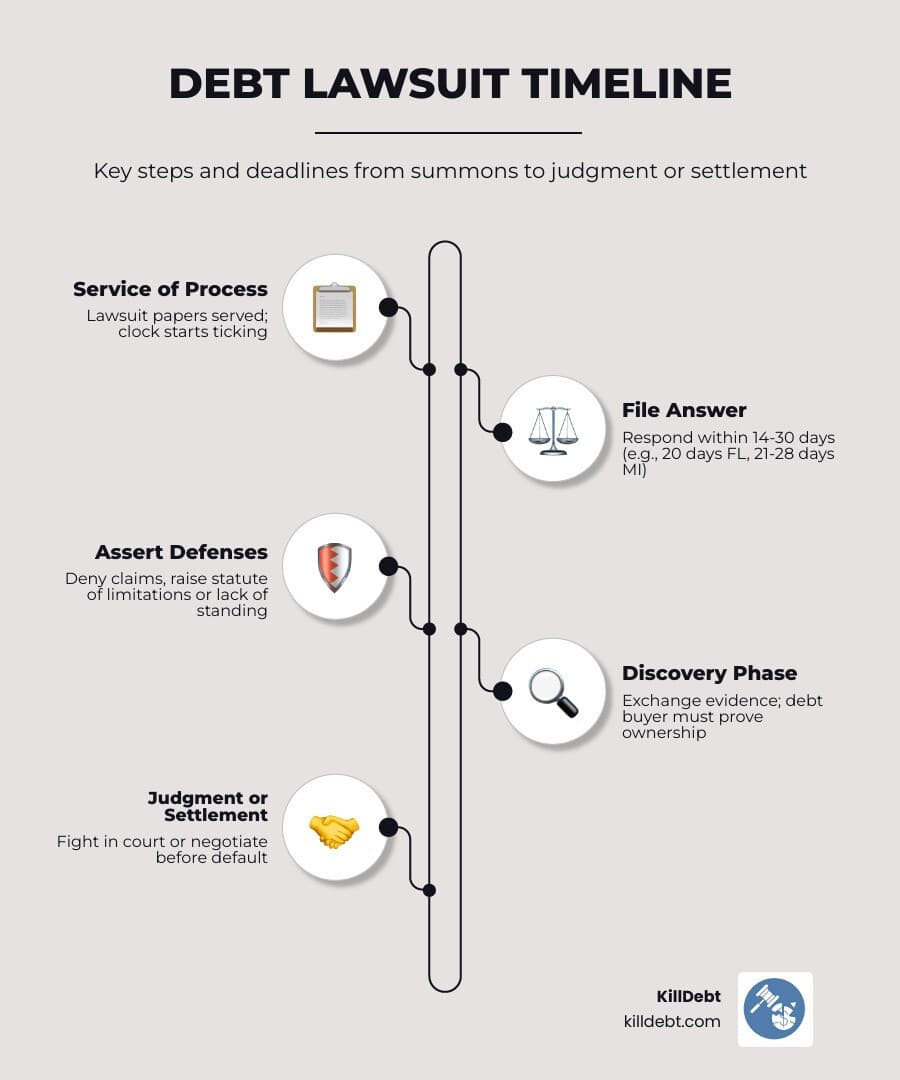
The moment a process server knocks on your door or you find legal papers taped to your entrance, the clock starts ticking. This is known as "service of process." While it feels like a punch to the gut, your first priority must be clarity, not panic.
In Florida and Michigan, the response window is relatively tight. Generally, you have 20 days in Florida and 21 days (if served personally) or 28 days (if served by mail) in Michigan to file a formal response. If you miss this window, the creditor wins by default.
You will typically receive two main documents: the Summons and the Complaint.
Understanding the difference between a summons and complaint is vital because the Summons tells you when to act, while the Complaint tells you what you are fighting.
Don't guess the deadline. Count the days starting from the day after you were served. If the 20th or 21st day falls on a weekend or a legal holiday, the deadline usually moves to the next business day. For a detailed breakdown of what to do first, check out our complete first steps guide.

We see it all the time: people think that if they don't have the money to pay, there is no point in responding. This is perhaps the most expensive mistake you can make. When you ignore a lawsuit, the court assumes everything the debt collector said is true and enters a default judgment against you.
A default judgment is essentially a "blank check" from the court to the debt collector. With this judgment in hand, the collector can:
| Feature | Responding to the Lawsuit | Ignoring the Lawsuit |
|---|---|---|
| Outcome | You force them to prove the debt. | Automatic loss (Default Judgment). |
| Garnishment | Can be prevented or negotiated. | Likely and immediate. |
| Credit Impact | Contested; potential for dismissal. | Long-term damage; public record. |
| Fees | You can challenge added interest/fees. | Collector adds legal fees and high interest. |
Ignoring the problem won't make it go away; it only makes the debt grow larger through court costs and statutory interest. There are many debt collection lawsuit myths that lead people to inaction, but the truth is that the law only protects those who show up.
Filing an "Answer" is your formal response to the court. It is not the place to tell your life story or explain why you fell behind on payments. It is a technical document where you address the specific claims made in the Complaint.
In Michigan, you can often find do-it-yourself civil answer resources, while Florida residents should be aware of small claims collection rules if the debt is under $8,000. Regardless of the state, the process follows a similar structure.
The Complaint will have numbered paragraphs. Your Answer must correspond to these numbers. For each paragraph, you have three choices:
Pro Tip: Never admit to the amount owed unless you have verified every penny. Debt buyers often add unauthorized fees or interest that they cannot legally prove. By denying, you shift the "burden of proof" onto them. For an even stronger defense, consider filing a counter-affidavit to challenge any affidavits the collector attached to their complaint.
An affirmative defense is a reason why, even if the debt was yours, the collector should still lose. You must list these in your initial Answer, or you may lose the right to use them later.
Most credit card lawsuits aren't filed by the bank you originally signed up with (like Chase or Citi). Instead, they are filed by debt buyers. These companies buy thousands of "charged-off" accounts for a fraction of their value.
The problem for the debt buyer is that they often receive very little paperwork during the sale. To win a lawsuit, they are legally required to show a clear "Chain of Title"—a paper trail showing the debt moving from the original creditor to Buyer A, then to Buyer B, and finally to the company suing you.
If there is a single break in that chain, or if they only have a "Bill of Sale" that mentions a bulk purchase of 5,000 accounts without listing your specific name and account number, you have a massive advantage. We call this challenging the chain of title. When you demand admissible evidence, many debt buyers will simply drop the case because it’s too expensive to track down the original records.
Once you file your Answer, the case enters the Discovery phase. This is the legal process where both sides exchange information. You can send "Requests for Production" demanding the debt buyer produce the original signed credit card agreement and a complete history of all payments and charges.
Many consumers find that the debt collection lawsuit timeline slows down here. Collectors like "easy wins" (defaults). When they realize you are going to make them work for it, they often become much more willing to talk.
You can negotiate a settlement at any time—even on the courthouse steps.
If the idea of drafting legal documents and researching statutes feels overwhelming, you don't have to do it alone—and you don't have to spend thousands on a traditional law firm.
At KillDebt, we provide a DIY legal defense system powered by ParkerGPT. This isn't just a chatbot; it’s an AI trained specifically on consumer debt law and real-world court strategies developed over 30+ years by veteran attorney Brian Parker.
Our platform allows you to:
We believe that everyone deserves a fair fight, regardless of their bank balance. By using the "No Thanks" defense and forcing debt buyers to prove their claims, you can protect your wages, your credit, and your peace of mind.
Ready to take control of your case? Visit KillDebt.com to start your defense today.
Get started with KillDebt pricing
Important Legal Disclaimer
This educational content is based on general legal principles and my experience in debt collection defense. It is provided for informational purposes only and does not constitute legal advice. Laws vary by state and by local court. For specific legal advice, consult a qualified attorney licensed in your jurisdiction. No attorney-client relationship is created by reading this guide.
Critical Multi-State Variations: FDCPA applies uniformly at the federal level, but state consumer protection laws may provide additional rights and remedies. Statute of limitations periods vary significantly by state and debt type. What constitutes sufficient debt validation varies in practice across jurisdictions. State-specific rules on call frequency, written notice requirements, and permissible collector conduct may differ from federal minimums.

About the author
Brian Parker
I have over 30 years of experience defending consumers against debt collection lawsuits and have seen every tactic, threat, and pressure play that collectors use. Through KillDebt and ParkerGPT, I have systematized the proven defense strategies that actually work - so consumers can respond from a position of knowledge, not fear. My approach focuses on aggressive legal defense based on documented case success rather than false hope that leads to default judgments.