News Break
Auto Loan Repo Lawsuits and How to Fight Back
June 5, 2026
Blog / News Break
File your General denial answer form fast to avoid default judgment in debt lawsuits.

When you are sued, the "burden of proof" is on the person suing you (the plaintiff). However, if you don't show up to the fight, they win by default. That is where the general denial answer form comes in. It is your way of saying to the court, "I disagree with everything they said, and I want them to prove it."
In civil procedure, a general denial is a broad stroke. Instead of answering paragraph one, then paragraph two, then paragraph three, you simply deny the entire complaint in its entirety. This is a powerful procedural tool because it forces the plaintiff to produce actual evidence for every single claim they’ve made—from the amount of the debt to their right to sue you in the first place.
For many defendants, especially those dealing with debt collectors, using a General Denial (PLD-050) (opens in a new tab) or a similar state-specific template is the most efficient way to respond. It stops the clock on a default judgment and buys you the time needed to build a real defense. If you are feeling overwhelmed by the paperwork, our Debt Lawsuit Defense Guide can help you navigate the initial shock of being served. Knowing how to answer a debt summons is the difference between losing your wages to garnishment and keeping your financial freedom.
While the concept of a general denial is similar across the country, the "fine print" varies wildly depending on where you live. Because KillDebt specializes in helping folks in Florida and Michigan, we want to pay extra close attention to how these states handle your response.
In Florida, you have a strict 20-day window to file your answer. If you miss this, the creditor can move for a default judgment almost immediately. Florida courts generally require you to respond to each allegation, but a "General Denial" can be effective if you truly dispute every material fact. Under Florida Rule 1.110, you must be careful—any allegation you don't deny is considered "admitted" by the court.
In Michigan, the process is governed by specific court rules that require a bit more detail. While you can deny allegations generally, Michigan courts often prefer the use of the MC 03, Answer (Civil) (opens in a new tab). This form allows you to check boxes or write in your denials.
Here is a quick look at the landscape:
| State | Rule Reference | Key Deadline |
|---|---|---|
| Florida | Rule 1.140 | 20 Days |
| Michigan | MCR 2.108 | 21 Days (28 if served by mail) |
| Texas | Rule 92 | 20 days + Monday @ 10 AM |
| Alabama | Rule 12(a)(1) | 30 Days |
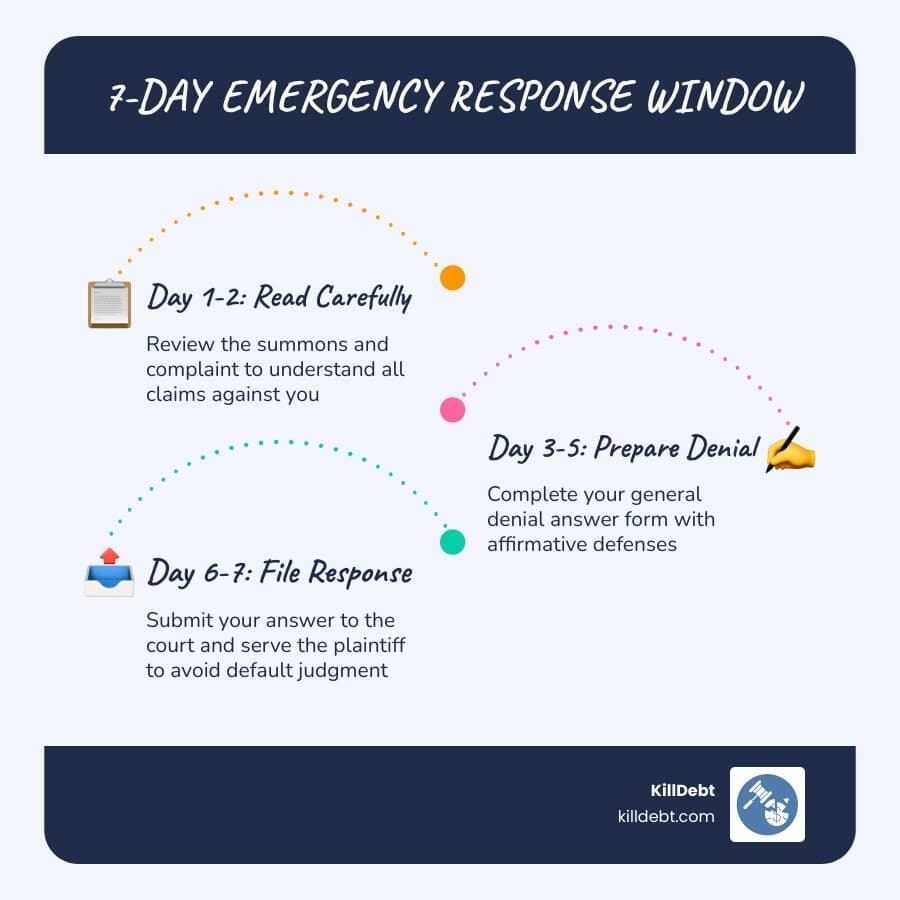
Regardless of where you are, the timeline of a debt collection lawsuit moves fast. You need to know exactly what to do in the first 7 days to ensure you don't waive your rights.
Not every case allows for a general denial answer form. You have to look at the "Complaint" or "Petition" you were served with.
If you are unsure which one to use, it is usually safer to use a specific denial format where you address each paragraph. Our Fight Debt Collection Lawsuit: Complete Guide breaks down these nuances so you don't get tripped up by technicalities.
A valid answer is more than just a piece of paper that says "I didn't do it." To be "court-ready," your general denial answer form should include:
We provide a Sample Answer to Debt Collection Lawsuit that shows exactly how these pieces fit together. In some cases, you may also need to include a counter-affidavit if the plaintiff attached a "sworn account" to their lawsuit.
Filing your general denial answer form is just the beginning. The real "teeth" of your defense lie in your Affirmative Defenses.
An affirmative defense is a fact that, if proven, defeats the plaintiff's claim even if everything they said is true. Common examples include:
If you don't list these defenses in your initial answer, you might waive them forever. That means you can't bring them up later at trial. This is why a solid counter-affidavit and a well-drafted list of defenses are so critical. Once the answer is filed, the case moves into "Discovery," where you can demand the plaintiff show you the original contract and the chain of title for the debt.

The biggest risk in a lawsuit isn't losing at trial—it's losing because you didn't show up. If you fail to file a general denial answer form on time, or if you file it incorrectly (like forgetting to serve the other side), the court will enter a Default Judgment.
A default judgment is a "win" for the debt collector by forfeit. With that judgment in hand, they can:
Many people fall for debt collection lawsuit myths, believing that if they ignore the papers, the problem will go away. It won't. The only way to stop the "Judgment Entered" stamp is to take action. If you've just been served, follow our First Steps Guide to protect your assets.
Facing a lawsuit is stressful, but you don't have to do it alone. The general denial answer form is your first line of defense, and at KillDebt, we’ve built the tools to make sure that defense is ironclad.
Our system is powered by ParkerGPT, an AI trained on over 30 years of real-world debt defense strategies from attorney Brian Parker. We don't just give you a generic template; we analyze your specific lawsuit documents to find the weaknesses the debt collectors are trying to hide.
Want to see how you'll fare in court? Use our brand new Court Tester. It’s an AI courtroom simulation where you can upload your filings and argue your motion in front of an AI judge. You'll face AI opposing counsel while a private AI co-counsel whispers winning strategies directly to you. It’s the ultimate "practice run" before the real deal.
Don't let a debt collector take your hard-earned money by default. Take control of your defense today and fight back with the expertise of a seasoned attorney at a fraction of the cost.

About the author
Brian Parker
I have over 30 years of experience defending consumers against debt collection lawsuits and have seen every tactic, threat, and pressure play that collectors use. Through KillDebt and ParkerGPT, I have systematized the proven defense strategies that actually work - so consumers can respond from a position of knowledge, not fear. My approach focuses on aggressive legal defense based on documented case success rather than false hope that leads to default judgments.