News Break
Demystifying the Deposition: How to Prepare When a Debt Collector Sues
July 7, 2026
Blog / News Break
Learn how to respond to a civil complaint and file your answer before the deadline to avoid default judgment.

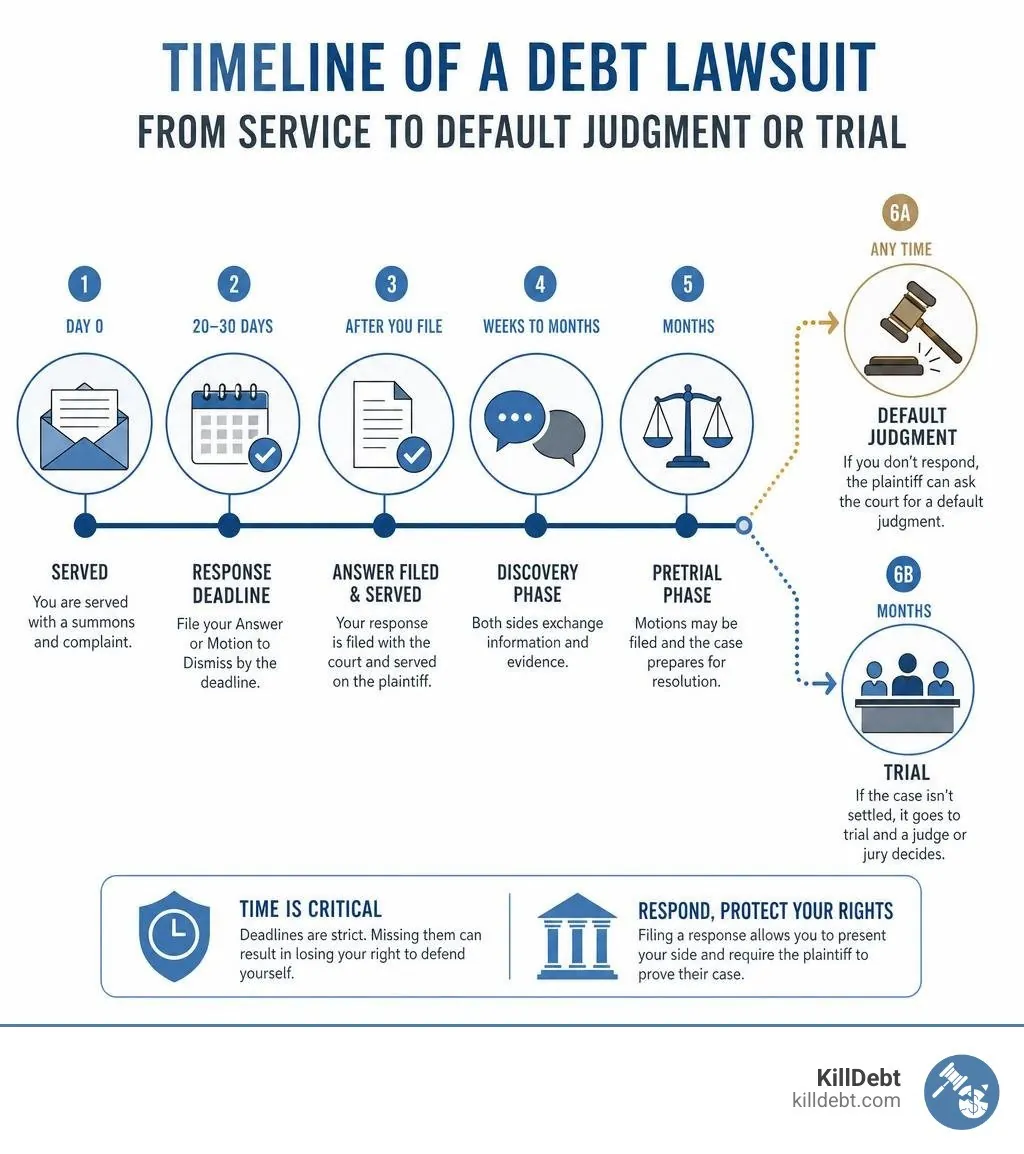
Responding to a civil complaint is one of the most time-sensitive things you'll ever do. Miss the deadline, and the court can rule against you without ever hearing your side of the story.
Here's the short version of what you need to know:
How to respond to a civil complaint — quick overview:
Getting that summons in the mail is a gut-punch moment. Most people freeze. Some hope it goes away on its own. It won't — and the clock is already running.
The good news? Filing a response forces the plaintiff to prove their case. You don't need to be a lawyer to do that. You just need to know the rules and follow them.
I'm Brian Parker, and I've spent over 30 years in the courtroom battling debt collectors, debt buyers, and collection law firms — which means responding to civil complaints is something I've done thousands of times. I founded KillDebt to put those same tools directly in your hands, so keep reading for a clear, step-by-step breakdown of exactly what to do next.
IMPORTANT LEGAL DISCLAIMER
This educational content is based on general legal principles and my experience in debt collection defense. It is provided for informational purposes only and does not constitute legal advice. Laws vary by state and by local court. For specific legal advice, consult a qualified attorney licensed in your jurisdiction. No attorney-client relationship is created by reading this guide.
Critical Multi-State Variations: FDCPA applies uniformly at the federal level, but state consumer protection laws may provide additional rights and remedies. Statute of limitations periods vary significantly by state and debt type. What constitutes sufficient debt validation varies in practice across jurisdictions. State-specific rules on call frequency, written notice requirements, and permissible collector conduct may differ from federal minimums.
When a debt collector or credit card company decides to sue you, they initiate a formal lawsuit. To understand what you are looking at, you must first grasp the Difference Between Summons Complaint in Debt Collection Lawsuit.
The Summons is the official notice from the court telling you that you are being sued, where the lawsuit is filed, and how long you have to respond. The Complaint is the document containing the specific allegations against you—the "who, what, why, and how much" of the lawsuit.

When it comes to responding to a civil complaint, you generally have two paths to choose from: filing a written Answer or filing a pre-answer Motion. Making the right choice is critical because your response strategy dictates the entire trajectory of your case. For a deeper look into this strategic fork in the road, you can read about Responding to a Complaint in Federal Court: Answer or Motion? (opens in a new tab).
The single most important rule in civil litigation is simple: never miss your deadline. If you fail to respond within the court’s strict timeframe, the plaintiff can immediately ask the court for a default.
To understand the severe consequences of letting this clock run out, see our guide on What Happens After Summons.
Because we focus our operations on helping consumers in Florida and Michigan, you must pay close attention to the specific timelines of these jurisdictions:
Do not assume weekends or holidays pause this countdown. If your deadline falls on a Saturday, Sunday, or legal holiday, your response is typically due on the next business day. However, waiting until the final hours is a recipe for disaster.
An Answer is your formal, paragraph-by-paragraph response to the allegations. It is the most common way to respond.
A Motion to Dismiss, on the other hand, is a request for the judge to throw the case out before you even file an Answer. You would typically file a Motion to Dismiss under specific legal circumstances, such as:
If you are unsure of which route to take, we break down the pros and cons in our guide on how to Respond to Debt Lawsuit. If you file a Motion to Dismiss and the judge denies it, you will still be required to file an Answer shortly after the ruling.
If you decide to file an Answer, you need to draft a document that matches the court's strict formatting standards. The document must be printed on standard 8.5" x 11" white paper, double-spaced, with clear margins.
To see what a completed response looks like, you can review a Sample Answer to Complaint.

Every formal Answer consists of three primary sections:
While general self-help resources like the Fill out Answer form to respond | California Courts | Self Help Guide (opens in a new tab)offer general structural tips, you must use forms and language approved for your local Florida or Michigan court.
The body of the Complaint will consist of numbered paragraphs. In your Answer, you must address every single paragraph individually. You cannot ignore a paragraph. For each numbered allegation, you have three legal options:
If you are dealing with a simple case, you might be tempted to look for a General Denial Answer Form. However, general denials are rarely permitted in debt collection lawsuits in Florida and Michigan. Instead, you must go paragraph by paragraph.
For federal cases, templates like the Instructions: Answer – Responding to the Complaint – District of Nevada (opens in a new tab)show how courts expect you to list your paragraph-by-paragraph responses clearly (e.g., "Defendant denies the allegations in Paragraphs 4, 5, and 6").
After responding to the numbered paragraphs, you must list your Affirmative Defenses. An affirmative defense is a legal reason why the plaintiff should lose, even if their basic facts are true.
If you do not raise these defenses in your initial Answer, you legally waive them and cannot bring them up later in the lawsuit. To learn how to spot these opportunities, read our comprehensive Debt Lawsuit Defense Guide.
| Affirmative Defense | What It Means | Real-World Debt Example |
|---|---|---|
| Statute of Limitations | The legal time limit for filing a lawsuit has expired. | A debt buyer sues you in Florida on a credit card debt where the last payment was made over 5 years ago. |
| Lack of Standing | The plaintiff does not have the legal right to sue you. | A junk debt buyer sues you but cannot produce the chain of title proving they purchased your specific account. |
| Accord and Satisfaction | The debt was already settled and paid. | You settled the debt with the original creditor for 50% of the balance, and they accepted it as payment in full. |
| Failure to State a Claim | The complaint lacks the necessary legal elements to win. | The collector sues you for breach of contract but fails to attach a copy of the contract or account statements. |
Once your Answer is filled out, you must follow the correct procedure to file it with the court and serve it to the plaintiff. Failing to complete both steps properly can result in a default judgment.
To make sure you don't miss a step, read our guide on How to Answer a Debt Summons.
Here is the process you must follow:
If you are a low-income consumer in Florida, resources like the CONSUMER RESOURCES - Jacksonville Area Legal Aid (opens in a new tab)offer detailed guides on local service rules and how to ask the court to waive your filing fees if any apply.
Every county and courthouse has its own local rules. For example, some judges require specific cover sheets, while others have strict electronic filing mandates.
Before you submit your documents, call the local county clerk's office or visit their website to confirm if there are any additional local forms you must attach. To navigate these local quirks, consult our Fight Debt Collection Lawsuit Complete Guide.
Responding to a civil complaint doesn't have to be terrifying. By understanding the deadlines, answering each paragraph honestly, and asserting your affirmative defenses, you level the playing field and force the debt collector to prove their case.
At KillDebt, we provide a DIY legal defense system powered by ParkerGPT—an AI trained specifically on consumer debt law and real-world court strategies developed over 30+ years by defense attorney Brian Parker. We analyze your lawsuit documents, identify legal weaknesses, and generate customized, court-ready responses for a fraction of the cost of a traditional attorney.
Even better, we just rolled out our brand-new tool: Court Tester. This is an AI courtroom simulation built directly around your actual case. You can upload your real court filings, and within minutes, you'll practice arguing your case in front of an AI judge, facing off against an AI opposing counsel, while a private AI co-counsel whispers winning strategies that only you can see.
Don't let debt collectors win by default. Get started with KillDebt today and take control of your legal defense.
Get started with KillDebt pricing
IMPORTANT LEGAL DISCLAIMER
This educational content is based on general legal principles and my experience in debt collection defense. It is provided for informational purposes only and does not constitute legal advice. Laws vary by state and by local court. For specific legal advice, consult a qualified attorney licensed in your jurisdiction. No attorney-client relationship is created by reading this guide.
Critical Multi-State Variations: FDCPA applies uniformly at the federal level, but state consumer protection laws may provide additional rights and remedies. Statute of limitations periods vary significantly by state and debt type. What constitutes sufficient debt validation varies in practice across jurisdictions. State-specific rules on call frequency, written notice requirements, and permissible collector conduct may differ from federal minimums.

About the author
Brian Parker
I have over 30 years of experience defending consumers against debt collection lawsuits and have seen every tactic, threat, and pressure play that collectors use. Through KillDebt and ParkerGPT, I have systematized the proven defense strategies that actually work - so consumers can respond from a position of knowledge, not fear. My approach focuses on aggressive legal defense based on documented case success rather than false hope that leads to default judgments.