
News Break
Laches, Florida Statutes, and Improper Service: Your Debt Defense Toolkit
June 10, 2026
Blog / News Break
Learn how to draft a sample answer to complaint and respond to debt lawsuit allegations before the deadline to avoid default judgment.
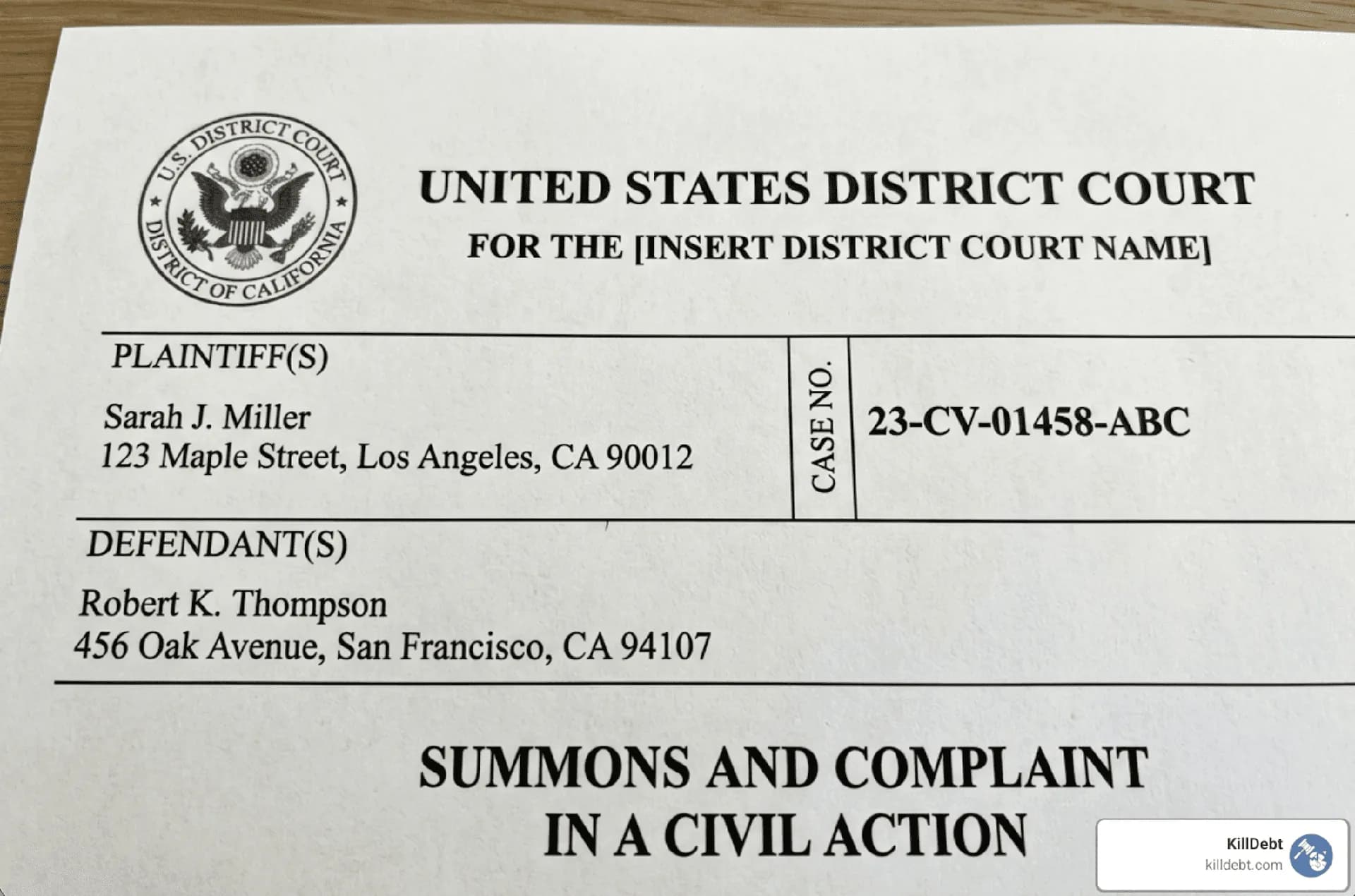
A sample answer to complaint is a formal written response you file with the court after being served with a lawsuit — and if you've just received a summons, you may have as little as 21 days to file one before a default judgment is entered against you.
Here's the core structure of a sample answer to complaint at a glance:
| Section | What It Does |
|---|---|
| Caption | Lists the court, parties, and case number |
| Paragraph Responses | Admits, denies, or states lack of knowledge for each allegation |
| Affirmative Defenses | Legal reasons the plaintiff's claim should fail |
| Counterclaims (if any) | Claims you bring against the plaintiff |
| Prayer for Relief | States what you want the court to do |
| Certificate of Service | Confirms you sent a copy to the other side |
| Signature Block | Your signed certification under Rule 11 |
Missing even one of these sections — or filing even one day late — can cost you the case before it starts.
This guide walks you through every part of the process: how to read the complaint you were served, how to respond paragraph by paragraph, which affirmative defenses apply to your situation, and how to file correctly.
I'm Brian Parker, founder of KillDebt, and I've spent over 30 years in the courtroom fighting debt collectors, debt buyers, and collection law firms — drafting and reviewing countless answers to complaints along the way. I know exactly what works, what gets defendants into trouble, and how to give you the same edge in this guide.
IMPORTANT LEGAL DISCLAIMER
This educational content is based on general legal principles and my experience in debt collection defense. It is provided for informational purposes only and does not constitute legal advice. Laws vary by state and by local court. For specific legal advice, consult a qualified attorney licensed in your jurisdiction. No attorney-client relationship is created by reading this guide.
Critical Multi-State Variations: FDCPA applies uniformly at the federal level, but state consumer protection laws may provide additional rights and remedies. Statute of limitations periods vary significantly by state and debt type. What constitutes sufficient debt validation varies in practice across jurisdictions. State-specific rules on call frequency, written notice requirements, and permissible collector conduct may differ from federal minimums.
When a debt collector decides to take legal action, they do not just send a scary letter. They initiate a formal lawsuit. This process begins when you are served with two distinct but deeply connected documents: the Summons and the Complaint.
Understanding the Difference Between Summons and Complaint in Debt Collection Lawsuit is your very first line of defense.
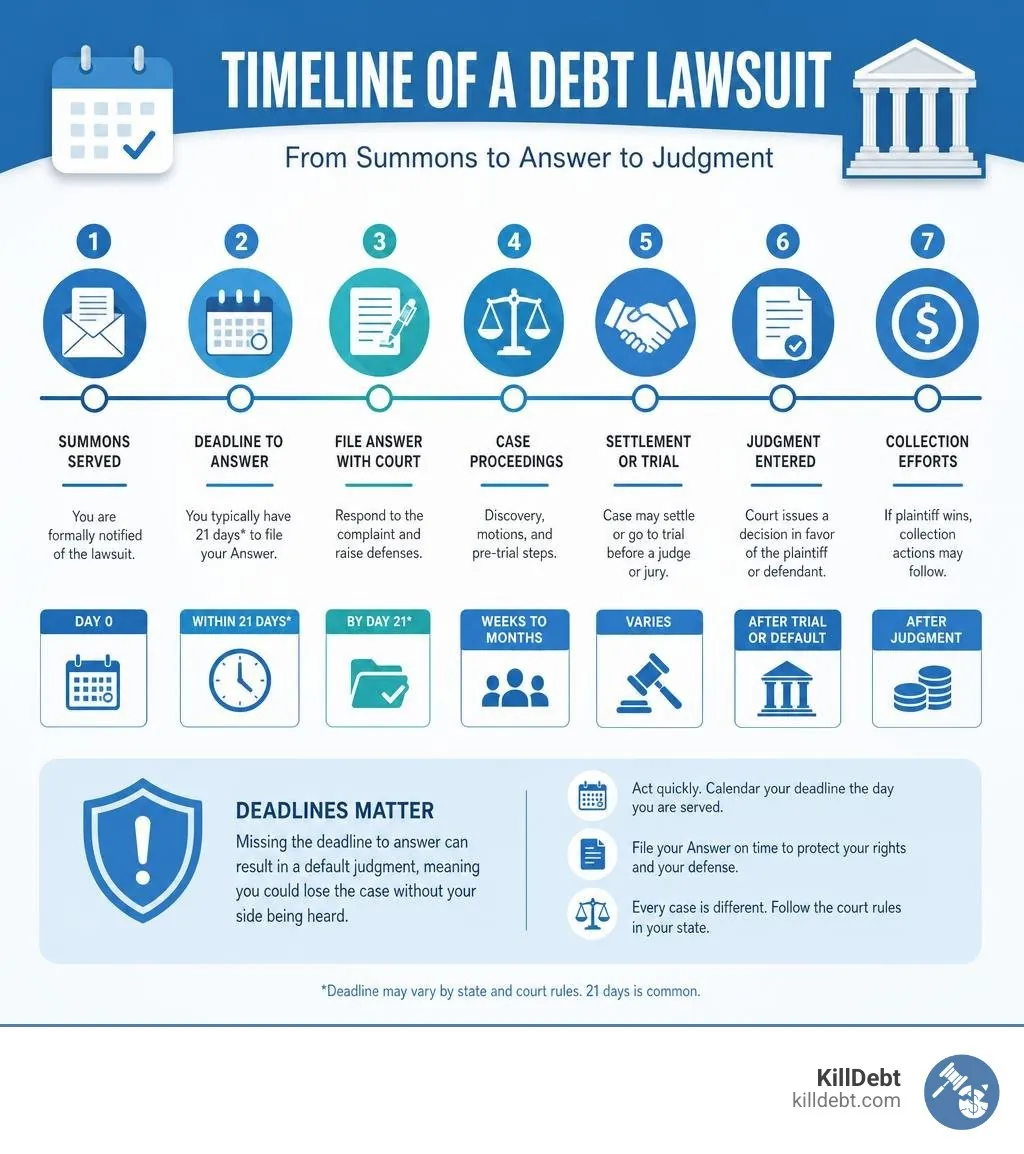
Under Federal Rule of Civil Procedure (FRCP) 12(a), a defendant in federal court must serve an answer within 21 days after being served with the summons and complaint. If you are in state court, the timelines vary but remain incredibly strict:
If you fail to file a timely response, the plaintiff can immediately ask the court for a default judgment. A default judgment means the debt collector wins automatically. With this judgment in hand, they can legally garnish your wages, freeze your bank accounts, and place liens on your property.
To prevent this, you must learn How to Answer a Debt Summons and file a formal response. Your answer is not a place to explain your life story or complain about your financial hardships; it is a highly structured legal document designed to address the plaintiff's allegations systematically.
A proper response must follow standard legal formatting. If you look at a professional The Defendant’s Answer to the Complaint (opens in a new tab), you will notice that it is broken down into clear, organized sections.
Every sample answer to complaint must include these essential components:
The most critical part of drafting your response is addressing the allegations. Under FRCP 8(b) (and corresponding state rules in Florida and Michigan), you must respond to every single numbered paragraph in the plaintiff's complaint.
For each paragraph, you have exactly three options:
When customizing a Sample Answer to Debt Collection Lawsuit, you must match your answers exactly to the paragraph numbers of the complaint. If the complaint has 15 paragraphs, your answer must have 15 corresponding responses.
Pro Tip: A common mistake made by self-represented defendants is failing to deny legal conclusions or requests for damages. If a paragraph says, "Defendant owes Plaintiff $5,000," you must explicitly deny that paragraph. If you leave any paragraph unaddressed, the court will legally treat your silence as an admission of that fact under FRCP 8(b)(6).
Your document must comply with standard court rules to be accepted by the court clerk. Under Federal Rule of Civil Procedure 10 (and local state equivalents), your answer must use numbered paragraphs, standard margins, and clear, legible fonts.
When learning How to Write an Answer to a Credit Card Lawsuit, keep these formatting rules in mind:
An answer is your primary—and often only—opportunity to present affirmative defenses. An affirmative defense is a legal reason why the plaintiff’s claim must fail, even if you did not pay the debt in question. If you do not raise these defenses in your initial answer, you legally waive them forever.
Common affirmative defenses in consumer debt cases include:
In complex litigation, defendants frequently assert a wide array of defenses to protect their rights. For example, in the federal wage case 3:13-cv-01461-G, the defendants asserted 23 separate affirmative defenses. In another federal case, 2:19-CV-00219-SAB, the defendant asserted 15 affirmative defenses. While you should not throw random defenses at the wall hoping they stick, you must be thorough.
Additionally, you can assert Counterclaims if the debt collector violated consumer protection laws—such as the Fair Debt Collection Practices Act (FDCPA) or state-specific laws like the Michigan Regulation of Collection Practices Act (MRCPA) or the Florida Consumer Collection Practices Act (FCCPA).
To understand your options fully, consult a comprehensive Debt Lawsuit Defense Guide and review the official federal guidelines on RESPONDING TO A COMPLAINT (opens in a new tab).
| Feature | Affirmative Defense | Counterclaim |
|---|---|---|
| Definition | A legal shield that defeats or mitigates the plaintiff's claim. | An offensive legal claim asserting that the plaintiff harmed you. |
| Goal | To get the plaintiff's lawsuit dismissed. | To win monetary damages or statutory penalties from the plaintiff. |
| Examples | Statute of Limitations, Lack of Standing, Prior Payment. | FDCPA violations, illegal robo-calling, harassment. |
| Waiver Risk | Waived permanently if not raised in your Answer. | May be brought later if not "compulsory," but best filed with the Answer. |
Receiving a court summons is stressful, but ignoring it is the only guaranteed way to lose. By using a structured sample answer to complaint and asserting your legal rights, you force the debt collector to play by the rules and prove their case—something third-party debt buyers often cannot do.
At KillDebt, we believe that everyone deserves access to a powerful, professional legal defense without paying thousands of dollars in attorney fees. Our platform features ParkerGPT, an advanced AI trained on consumer debt law and real-world defense strategies developed over 30+ years by veteran consumer defense attorney Brian Parker.
Unlike generic document generators, KillDebt analyzes your specific lawsuit papers, uncovers hidden procedural defects, and builds a customized, court-ready answer tailored for Florida and Michigan courts.
Ready to see how your case holds up? We just introduced Court Tester, our brand-new AI courtroom simulation built on the actual facts of your case. Simply upload your lawsuit documents, and within minutes, you will be practicing your arguments in front of an AI judge, facing AI opposing counsel, and receiving strategic, real-time advice from a private AI co-counsel.
Don't let debt collectors run over you. Protect your rights with KillDebt today and turn the tables on collection lawsuits.
IMPORTANT LEGAL DISCLAIMER
This educational content is based on general legal principles and my experience in debt collection defense. It is provided for informational purposes only and does not constitute legal advice. Laws vary by state and by local court. For specific legal advice, consult a qualified attorney licensed in your jurisdiction. No attorney-client relationship is created by reading this guide.
Critical Multi-State Variations: FDCPA applies uniformly at the federal level, but state consumer protection laws may provide additional rights and remedies. Statute of limitations periods vary significantly by state and debt type. What constitutes sufficient debt validation varies in practice across jurisdictions. State-specific rules on call frequency, written notice requirements, and permissible collector conduct may differ from federal minimums.

About the author
Brian Parker
I have over 30 years of experience defending consumers against debt collection lawsuits and have seen every tactic, threat, and pressure play that collectors use. Through KillDebt and ParkerGPT, I have systematized the proven defense strategies that actually work - so consumers can respond from a position of knowledge, not fear. My approach focuses on aggressive legal defense based on documented case success rather than false hope that leads to default judgments.