News Break
Homestead Exemptions: Your Legal Umbrella for a Rainy Debt Day
June 4, 2026
Blog / News Break
Learn how to write an answer to a credit card lawsuit: respond on time, deny claims, raise defenses & avoid default judgment.

Knowing how to write an answer to a credit card lawsuit could be the difference between keeping your paycheck and losing it to wage garnishment.
Here's the short version of what you need to do:
If you miss the deadline, the court can enter a default judgment against you — an automatic win for the creditor. That means they can garnish your wages, levy your bank account, or place a lien on your property. No trial needed.
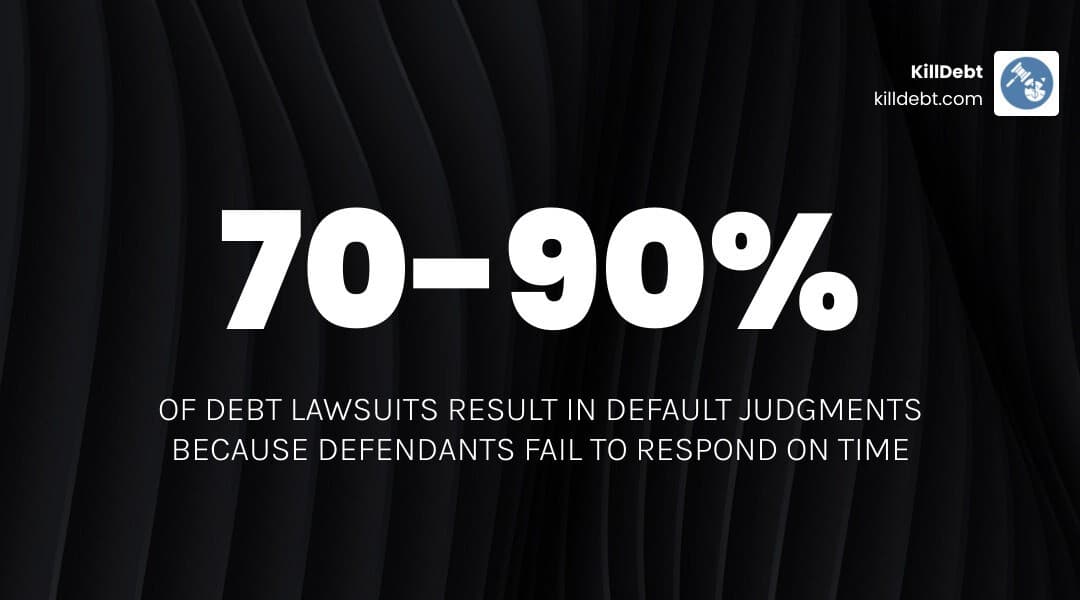
More than 70% of people sued for debt lose by default simply because they didn't respond. You don't have to be one of them.
Receiving a summons is stressful. The legal language is confusing, the deadlines are tight, and the stakes are real. Debt collection law firms often file hundreds of lawsuits a day, counting on the fact that most people won't fight back. But here's the truth: simply filing an Answer forces the plaintiff to prove their case — and many collectors can't do that.
I'm Brian Parker. For over 30 years, I fought creditors, debt buyers, and collection law firms in courtrooms across the country, and I built KillDebt specifically to teach everyday people exactly how to write an answer to a credit card lawsuit — using the same strategies I used to protect thousands of consumers. Let's walk through it step by step.
When a process server knocks on your door or you find a thick envelope in your mail in May 2026, you aren't just looking at "paperwork." You are looking at the opening move in a legal battle. To understand how to write an answer to a credit card lawsuit, you first have to understand the two documents you just received.
The Summons is the court’s way of saying, "Hey, we’re talking to you." It identifies the court where the case was filed, the parties involved, and—most importantly—the deadline. In Florida and Michigan, this clock starts ticking the moment you are served.
The Complaint (sometimes called a Petition) is where the Plaintiff (the credit card company or debt buyer suing you) lists their Allegations. These are numbered paragraphs claiming that you opened an account, spent money, and failed to pay it back.
It is vital to understand the Difference Between Summons Complaint in Debt Collection Lawsuit so you don't get overwhelmed. The Complaint is not a "fact" yet; it is a list of claims that the Plaintiff must prove. If you don't show up to challenge them, the court assumes every word is true. This is why knowing What Happens After Summons is the first step toward winning.

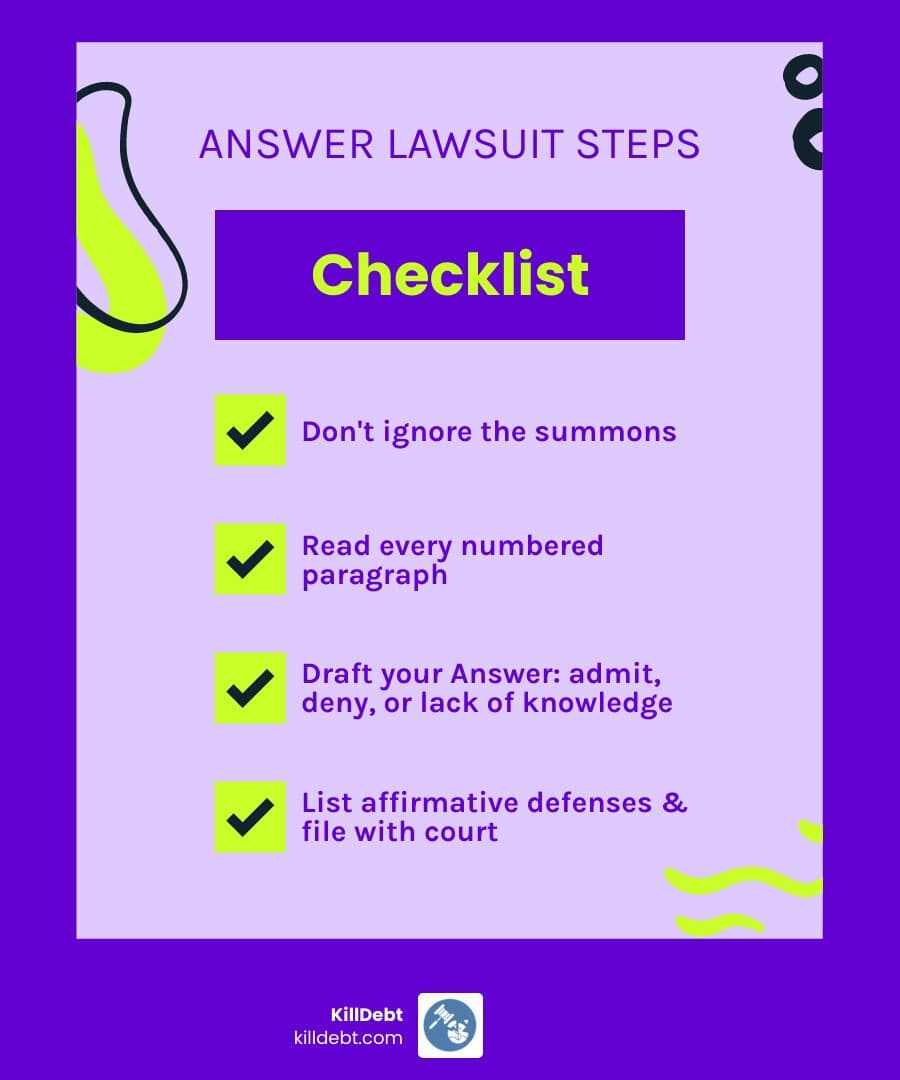
Writing a legal response doesn't require a law degree, but it does require following a specific structure. Think of the Answer as your formal "counter-move." You aren't telling your life story here; you are responding to the Plaintiff's specific claims.
At the top of your Answer, you must copy the "Caption" from the Complaint exactly. This includes:
If you get the case number wrong, the clerk might not be able to file your document, which could lead to a default judgment.
Your Answer should mirror the Complaint. If the Complaint has 15 numbered paragraphs, your Answer should have 15 numbered responses. For every single paragraph, you have three legal options.
| Response | When to Use It | Legal Effect |
|---|---|---|
| Admit | When the statement is 100% true (like your name or address). | You agree this fact is true; the Plaintiff no longer has to prove it. |
| Deny | When the statement is wrong, or you want the Plaintiff to prove it. | The "Burden of Proof" stays on the Plaintiff to show evidence. |
| Lack Knowledge | When you don't have enough info to say if it's true or false. | This acts as a legal denial, forcing the Plaintiff to prove the claim. |
Many people feel guilty about clicking "Deny," but in the legal world, denying an allegation is simply saying, "Prove it." According to How to Answer a Credit Card Lawsuit (with Pictures) - wikiHow Legal (opens in a new tab), if you aren't 100% sure about the exact dollar amount or the "chain of custody" of the debt, you should deny it or state that you lack sufficient knowledge.
When you sit down to write, take it one number at a time.
Paragraph 1: "The Defendant is a resident of Oakland County, Michigan."
Paragraph 2: "The Defendant owes Plaintiff the sum of $4,852.14."
Why deny? Because credit card companies often add hidden fees, incorrect interest rates, or "zombie" charges. By denying, you force them to produce the original contract and a full accounting of the balance. If you are in Michigan, you can find helpful templates at Do-It-Yourself Civil Answer - Michigan Legal Help (opens in a new tab).
We see the same errors over and over again. Avoiding these will put you ahead of 90% of other defendants:

This is where the real magic happens. An Affirmative Defense is a legal reason why the Plaintiff shouldn't win, even if some of their allegations are true. You must list these in your Answer, or you may waive your right to use them later.
This is the "expiration date" on debt. In Florida and Michigan, the statute of limitations for credit card debt (breach of contract) is typically 5 years in Florida and 6 years in Michigan. If the last time you made a payment or used the card was longer ago than that, the debt is "time-barred." You can ask the judge to dismiss the case entirely.
If "Global Debt Recovery LLC" is suing you for a "Chase Bank" card, they must prove they bought your specific debt. Often, these companies buy debts in bulk (thousands of accounts at once) for pennies on the dollar. They might have a bill of sale for the bulk purchase, but not the specific "Assignment" for your account. If they can't prove they own it, they have no "Standing" to sue you.
If the process server just threw the papers on your lawn or gave them to your 10-year-old child, you might have a defense for improper service. However, be careful: this usually only delays the case rather than ending it.
If the debt isn't yours, or you were a victim of fraud, this is a powerful affirmative defense. You should include a police report or FTC affidavit if possible. For a deeper dive, check our Debt Lawsuit Defense Guide.
In some cases, you might even need to file a Filing a Counter-Affidavit When Answering a Debt Collection Lawsuit if the Plaintiff attached a sworn statement to their Complaint.
Once your Answer is written, you aren't done. You have to get it into the hands of the court and the Plaintiff’s attorney.
You must file the original Answer with the Clerk of the Court listed on your Summons.
You are legally required to send a copy of your Answer to the Plaintiff's attorney. This is usually done via Certified Mail with a Return Receipt Requested. This gives you a "green card" signature proving they received it.
At the very bottom of your Answer, you must include a "Certificate of Service." This is a short paragraph where you swear to the court that you sent a copy to the Plaintiff. It looks like this:
"I HEREBY CERTIFY that a true and correct copy of the foregoing was served via U.S. Mail to [Attorney Name and Address] this [Date] day of May, 2026."
Many people wonder, Do I Need a Lawyer for a Debt Collection Lawsuit? While a lawyer is helpful, many people successfully file their own Answers using DIY tools to save on the $1,500–$5,000 in fees an attorney might charge.
Since KillDebt is based in Florida and Michigan, let's look at the specific nuances of these two states.
For those outside these areas, such as the West Coast, the California Debt Lawsuit Answer process has its own unique forms (like PLD-C-010), but the core principles of admitting and denying remain the same.
Learning how to write an answer to a credit card lawsuit is an empowering first step, but you don't have to do it alone. At KillDebt, we provide a DIY legal defense system that levels the playing field.
Our platform is powered by ParkerGPT, an AI trained specifically on consumer debt law and real-world strategies developed over 30 years by attorney Brian Parker. Unlike a search engine, ParkerGPT doesn't just give you general advice; it analyzes your actual lawsuit documents, identifies specific legal weaknesses in the Plaintiff's case, and generates court-ready responses.
Introducing Court Tester: We’ve just rolled out our most powerful tool yet—Court Tester. It’s an AI courtroom simulation built on the facts of your actual case. You can upload your filings and, within minutes, "argue" your motion in front of an AI judge. You'll face an AI opposing counsel, while a private AI co-counsel whispers strategies and tips that only you can see. It’s like having a dress rehearsal for your day in court, ensuring you are prepared, confident, and ready to win.
Don't let a credit card company bully you into a default judgment. Whether you are in Florida, Michigan, or anywhere else, you have rights. Protect your rights and fight back today with the tools and technology designed to help you win.

About the author
Brian Parker
I have over 30 years of experience defending consumers against debt collection lawsuits and have seen every tactic, threat, and pressure play that collectors use. Through KillDebt and ParkerGPT, I have systematized the proven defense strategies that actually work - so consumers can respond from a position of knowledge, not fear. My approach focuses on aggressive legal defense based on documented case success rather than false hope that leads to default judgments.