
News Break
How to Choose the Best Legal Tech Validation Tools Without Losing Your Mind
July 17, 2026
Blog / News Break
Learn how a sample of letter to collect payment can improve cash flow and navigate the debt collection escalation timeline.

A sample of letter to collect payment is one of the most searched documents in personal finance — and for good reason. Whether you're a business owner trying to recover unpaid invoices, or a consumer who just opened an envelope from a debt collector, the stakes are real.
Here's a fast answer to what you're looking for:
Quick Reference: The 4 Core Collection Letter Types
| Stage | Timing | Tone | Purpose |
|---|---|---|---|
| 1. Friendly Reminder | 14 days past due | Polite | Assume oversight, prompt payment |
| 2. Second Notice | 28 days past due | Firm | State consequences, request contact |
| 3. Urgent Action | 42 days past due | Serious | Warn of service restriction or escalation |
| 4. Final Demand | 56 days past due | Legal | Last chance before collections or lawsuit |
Late payments are not a rare edge case. According to a 2025 QuickBooks survey, 56% of U.S. small businesses are owed money from unpaid invoices, with the average balance sitting at $17,500. More than 60% of B2B buyers regularly struggle to meet payment terms.
That pressure cuts both ways. Businesses need cash flow. Consumers need to know their rights.
If you received a collection letter and are worried about what happens next — this guide covers both sides of the equation.
I'm Brian Parker, founder of KillDebt, and for over 30 years I've fought debt buyers, collection law firms, and creditors in courtrooms across the country. I've reviewed thousands of payment collection letters — and I know exactly what a legally sound sample of letter to collect payment looks like, and more importantly, where collectors overstep the line.
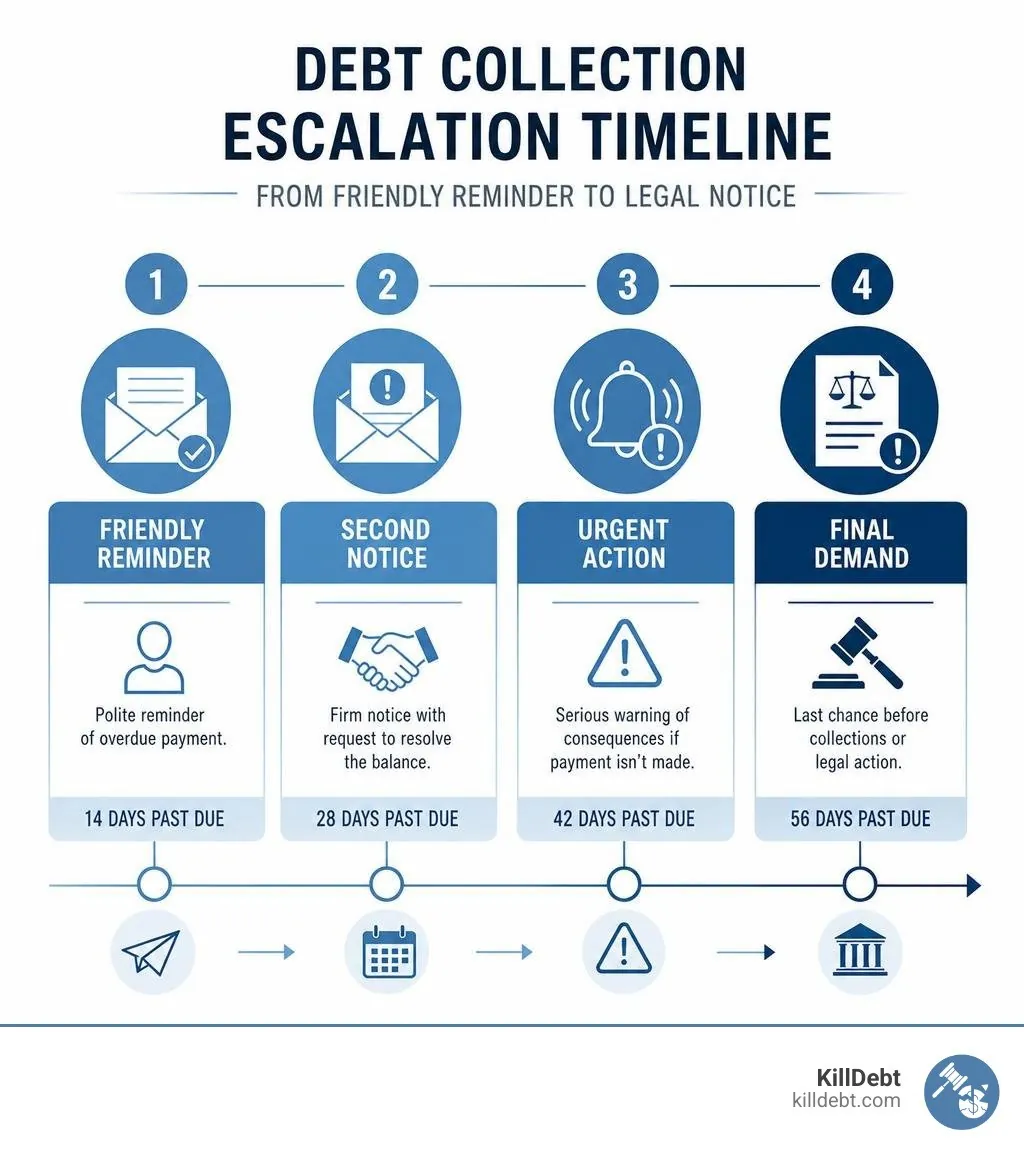
If you are running a business, establishing a systematic dunning process is vital. Many organizations see a 15-20% reduction in Days Sales Outstanding (DSO) after implementing a consistent collection letter strategy. Letting outstanding invoices age without a clear follow-up structure is a recipe for cash flow stagnation.
At the same time, understanding the timing of these letters is crucial for debtors. It helps you recognize where you stand in a creditor's escalation path and when a threat of legal action is real versus when it is a premature scare tactic.
A collection letter is a formal written reminder sent to individuals or companies regarding past-due payments. It notifies the recipient of their outstanding account status, requests payment by a specific date, and provides clear transaction instructions.
For businesses, using a structured template ensures consistent, professional messaging. As highlighted in Indeed's Guide on Business Collection Letters (opens in a new tab), a good collection letter balances the need to recover outstanding revenue with the desire to preserve positive client relationships. Often, an unpaid invoice is simply the result of an administrative oversight—such as a member of the client's accounts payable department leaving the company—rather than an intentional refusal to pay.
For detailed templates designed for various business situations, resources like 17 Strong Sample Letters for Outstanding Payment Requests - RequestLetters (opens in a new tab)show how to adapt your message depending on the specific industry and client history.
A professional collection strategy does not start with legal threats. Instead, we recommend a sequence of letters spaced at 14-day intervals to gradually build urgency.
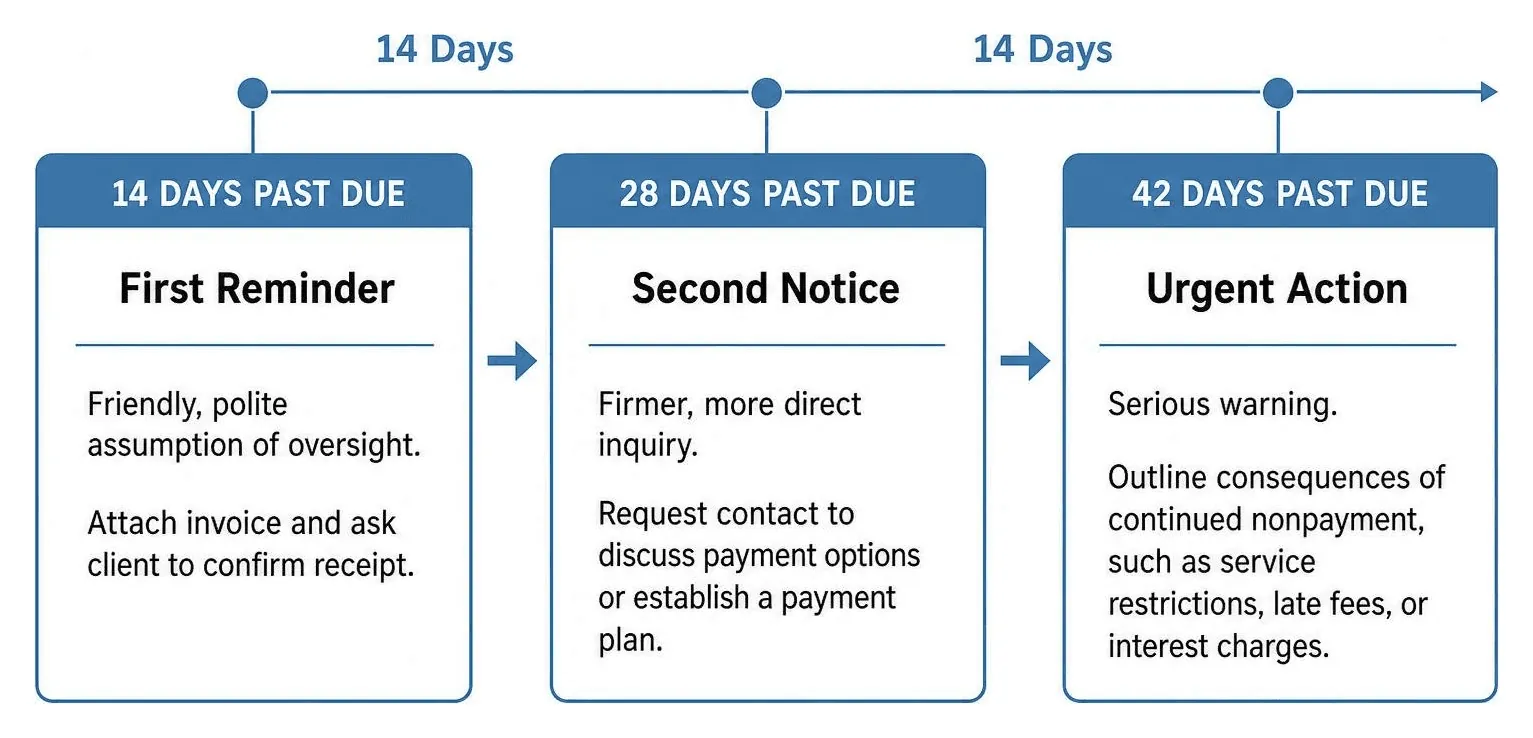
Here is how the timeline breaks down:
Whether you are drafting a sample of letter to collect payment or analyzing one you received, certain core elements must be present to make the document professional and legally sound. According to the Demand Letter for Money Owed Guide (opens in a new tab), clarity and documentation are the most effective tools for resolving payment disputes without resorting to expensive litigation.
To ensure there is no confusion, a payment request letter must include:
The language within your collection sequence must transition from a polite, cooperative tone to a formal, legally minded demand.
In the early stages, the tone assumes good faith. For instance, a first reminder might state: "We understand how busy things can get, and this may have simply slipped through the cracks."
By the final stage, the tone shifts to strict business policy. A final notice—such as the templates found in Final Notice Email Before Collections: Firm Wording + Proof Checklist - RequestLetters (opens in a new tab)—must make the consequences of nonpayment absolutely clear: "If payment is not received by [Date], we will have no choice but to suspend your services and refer your account to our collections department or legal counsel."
If you are on the receiving end of a collection letter, do not panic, and do not ignore it. Ignoring a collection letter is the fastest way to find yourself facing a default judgment or wage garnishment. Instead, look at this as an opportunity to assert your consumer rights and force the collector to prove their claims.
When you receive a demand for payment, your very first step should be to demand proof. Under federal law, you have a 30-day dispute window from the moment a third-party debt collector first contacts you.
You can use our Debt Validation Letter Template to draft a formal response. Your letter should demand that the collector provide:
If you want a comprehensive look at how this process works, read our Credit Debt Validation Letter Guide 2026. Demanding validation shifts the burden of proof entirely back onto the collector. If they cannot produce the proper documentation—which is common when old debts are sold multiple times—they are legally required to stop collection activities.
Third-party debt collectors must follow strict rules under the Fair Debt Collection Practices Act (FDCPA). When analyzing the letter you received, look closely for common violations:
To learn more about your federal protections, check out our guide on Fdcpa Explained. If a collector violates these rules, you may be entitled to statutory damages of up to $1,000 plus attorney's fees.
Debt collection is not a lawless frontier. Both federal and state laws draw strict boundaries around what creditors and third-party collectors can say and do. Understanding these boundaries is your strongest defense when dealing with collections.
The FDCPA applies strictly to third-party debt collectors—companies that buy old debts or are hired to collect outstanding balances on behalf of another creditor. Original creditors collecting their own debts are generally not subject to the FDCPA, but there are major exceptions.
For example, California's Rosenthal Act extends FDCPA-style protections to original creditors. Furthermore, federal rules like Regulation F, enforced by the Consumer Financial Protection Bureau (CFPB), place strict limits on how often collectors can call you and how they can communicate digitally.
One of the most critical rules under Regulation F is that collectors are legally prohibited from suing or threatening to sue on a statute-barred debt (a debt where the statute of limitations has expired). Doing so is a direct federal violation. For a deeper dive into using validation as your shield, read Debt Validation Letters Your First Line of Defense Against Collectors.
Because we operate in Florida and Michigan, let's focus on the critical laws governing these two states:
If you ignore a collection letter or if a settlement cannot be reached, the creditor or debt buyer may decide to take you to court. If you receive a summons and complaint, the clock starts ticking immediately.

The absolute worst thing you can do when served with a lawsuit is nothing. If you fail to file a written answer with the court within the required timeframe—typically 20 days in Florida and 21 days in Michigan—the creditor will win a default judgment. This allows them to freeze your bank accounts, garnish your wages, or place liens on your property.
To protect yourself, you must file a formal written response. Your response should include:
A General Denial: Denying the allegations forces the plaintiff (the debt collector) to prove every single claim they are making, including the exact balance and their legal right to sue you.
Affirmative Defenses: These are legal reasons why the collector should not win the lawsuit. Common defenses include:
For a step-by-step walkthrough on drafting your response, see our guide on How to Answer a Debt Summons.
Going to court as a pro se litigant (representing yourself) can feel overwhelming, but you have powerful tools at your disposal. Debt buyers often purchase old accounts in massive portfolios for pennies on the dollar, frequently lacking the core documentation required to win a contested lawsuit.
Your defense strategy should focus on exploiting these weaknesses:
For an exhaustive roadmap to defending yourself in court, read our Debt Lawsuit Defense Guide.
Whether you are a business owner trying to recover your hard-earned revenue or a consumer facing an aggressive debt collector, the key to success is structured, legally compliant communication.
If you are a consumer struggling with debt collectors, you do not have to navigate this complex legal landscape alone. At KillDebt, we provide a DIY legal defense system powered by ParkerGPT—an AI trained specifically on consumer debt law and real-world court strategies developed over 30+ years by attorney Brian Parker.
Unlike generic AI tools, ParkerGPT can analyze your lawsuit documents, identify legal weaknesses in the collector's case, and generate court-ready responses with step-by-step instructions.
And if you want to practice your defense before stepping foot in a courtroom, our brand-new Court Tester tool allows you to run an AI courtroom simulation based on your actual case. You can upload your filings, argue your motion in front of an AI judge, and refine your strategy with a private AI co-counsel guiding you every step of the way.
Don't let debt collectors bully you into a default judgment. Visit KillDebt Home today to take control of your financial future.
Get started with KillDebt pricing
IMPORTANT LEGAL DISCLAIMER
This educational content is based on general legal principles and my experience in debt collection defense. It is provided for informational purposes only and does not constitute legal advice. Laws vary by state and by local court. For specific legal advice, consult a qualified attorney licensed in your jurisdiction. No attorney-client relationship is created by reading this guide.
Critical Multi-State Variations: FDCPA applies uniformly at the federal level, but state consumer protection laws may provide additional rights and remedies. Statute of limitations periods vary significantly by state and debt type. What constitutes sufficient debt validation varies in practice across jurisdictions. State-specific rules on call frequency, written notice requirements, and permissible collector conduct may differ from federal minimums.

About the author
Brian Parker
I have over 30 years of experience defending consumers against debt collection lawsuits and have seen every tactic, threat, and pressure play that collectors use. Through KillDebt and ParkerGPT, I have systematized the proven defense strategies that actually work - so consumers can respond from a position of knowledge, not fear. My approach focuses on aggressive legal defense based on documented case success rather than false hope that leads to default judgments.