
News Break
Sample of Letter to Collect Payment to Keep Your Business Afloat
July 20, 2026
Blog / News Break
Learn how to fight debt collector lawsuit with proven defenses, answer templates, and settlement strategies to protect your rights and avoid default judgment.

Knowing how to fight a debt collector lawsuit could be the difference between losing your paycheck and walking away free. The stakes are real: between 70% and 90% of people sued by debt collectors lose automatically — not because they owe the money, but because they never respond.
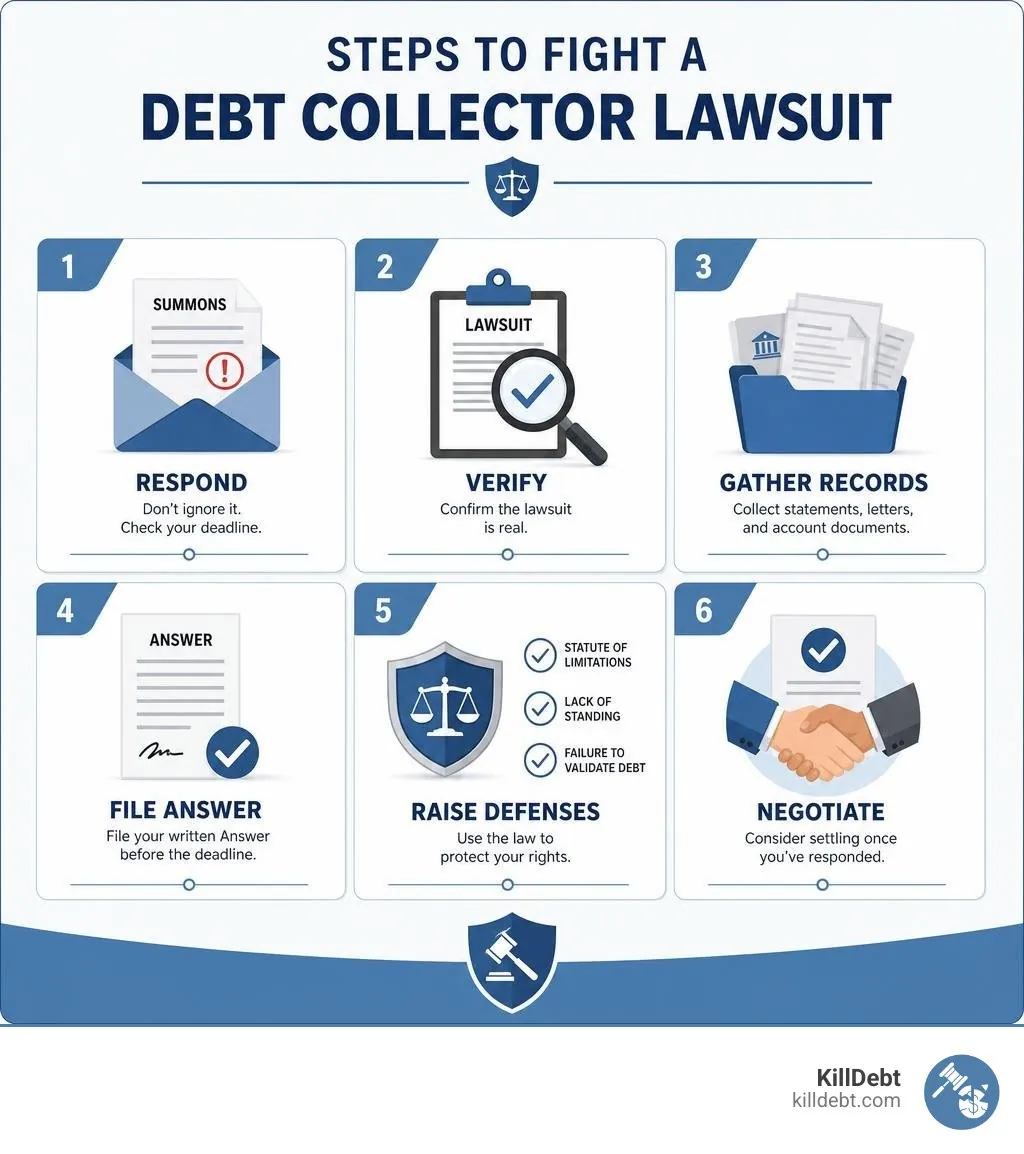
If you just got served, here is what you need to do right now:
You do not need to be a lawyer to defend yourself. You need a plan and the right tools.
Debt collectors are counting on you to do nothing. They buy old debts for pennies on the dollar — sometimes as little as 4 cents per dollar — and file lawsuits in bulk, knowing most people won't show up. When you respond, you completely change that calculation.
This guide walks you through every step: from the moment you receive the summons to filing your Answer, raising defenses, and negotiating a resolution.
I'm Brian Parker, founder of KillDebt. For over 30 years, I've been in courtrooms across the country fighting creditors, debt buyers, and collection law firms — and I've helped thousands of consumers learn exactly how to fight a debt collector lawsuit using the same strategies professional attorneys use. Everything in this guide comes from real courtroom experience, distilled into steps you can act on today.

The moment a process server knocks on your door or you find a stack of legal papers attached to your front gate, your adrenaline spikes. It feels like an absolute emergency—and in many ways, it is. However, the worst thing you can do is let panic freeze you into inaction.
When you are served with a lawsuit, you receive two primary documents: a Summons and a Complaint.
Legal jeopardy does not begin when the debt collector decides to write up the papers; it officially begins when you are legally served through a recognized service of process method. Once served, the clock starts ticking toward a potential default judgment. If you fail to respond, the judge will almost certainly sign an order giving the collector everything they asked for, which can lead to wage garnishment or bank account seizures.
To take control immediately, check out our comprehensive Fight Debt Collection Lawsuit: Complete Guide to map out your defense.
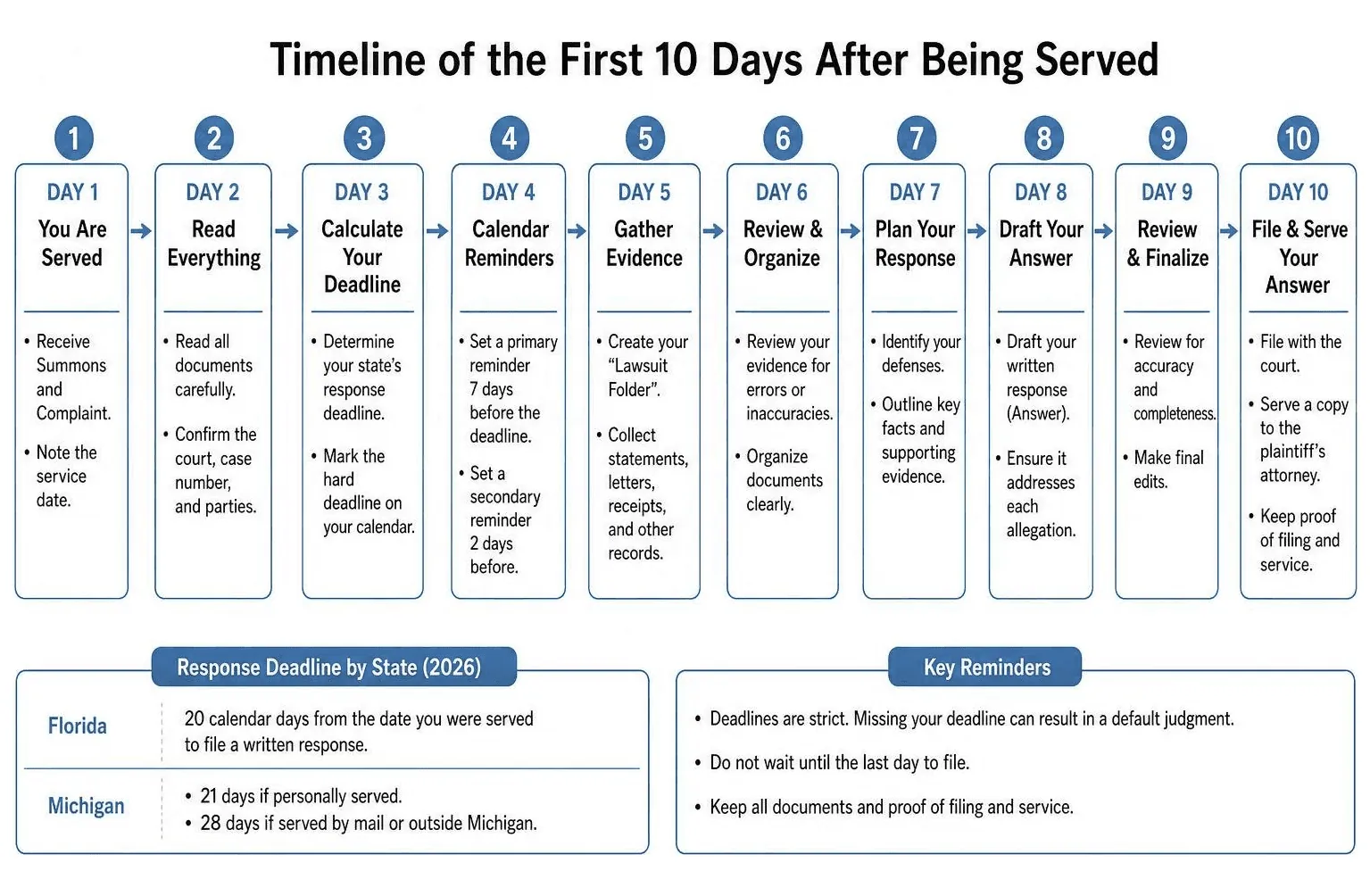
Your response window is the most critical element of your early defense strategy. If you miss this deadline by even a single day, the plaintiff can file for a default judgment, and you lose your chance to fight back.
Because we focus our defense platform on Florida and Michigan, let's look at how the deadlines differ between these two states in 2026:
To keep yourself safe, we always recommend setting up a calendar buffer. Do not wait until the final day to file. Mark the hard deadline on your calendar, and then set a primary reminder 7 days prior and a secondary reminder 2 days prior. For general federal guidelines on managing this stressful period, review What To Do if a Debt Collector Sues You | Consumer Advice .
Before you write a single word of your response, you must gather your evidence. Debt collectors frequently make mistakes—they sue the wrong person, sue for the wrong amount, or sue over debts that are completely past the legal time limit.
Create both a physical and digital "Lawsuit Folder." Inside, compile the following:

Filing a formal "Answer" is the single most important action in learning how to fight a debt collector lawsuit. The Answer is your official written response to the court. By filing it, you prevent an automatic default judgment and force the debt collector to actually step up and prove their claims in court.
Think of the Answer as a shield. It stops the collector's momentum and signals to their legal team that you are not going to be an easy target. For a detailed breakdown of this process, read our step-by-step article on How to Answer a Summons from a Debt Collector.
A standard Complaint is broken down into numbered paragraphs. Your Answer must address every single paragraph individually. For each numbered allegation, you have three options:
If a single paragraph makes multiple claims and even one of them is inaccurate, you should deny the entire paragraph or state that you lack the knowledge to answer. To see what this looks like in practice, review our Sample Answer to Debt Collection Lawsuit.
Once your Answer is drafted, you must complete two critical steps to make it legally active:
At the end of your Answer document, you must include a signed Certificate of Service. This is a short statement certifying to the judge that you sent a copy of the document to the plaintiff's attorney on a specific date. Always keep a stamped, dated copy of your filed Answer for your personal records and regularly check the online court docket to ensure your filing was processed. For Michigan-specific filing rules, consult Going to Court to Defend a Debt Collection Case (opens in a new tab).
An Answer shouldn't just respond to the collector's allegations; it should also include "affirmative defenses." These are legal reasons why, even if the allegations in the Complaint are true, the debt collector should still lose the case.
If you do not list your affirmative defenses in your initial Answer, the court may consider them waived. To understand how to position these defenses strategically, see our Court Debt Defense Strategy.
Most debt lawsuits are not filed by the original creditor (like Chase or Citi). Instead, they are filed by third-party debt buyers (like Midland Funding or Portfolio Recovery Associates) who buy portfolios of old accounts for pennies on the dollar.
Because they are a third party, they must prove they actually own your specific account. This is known as "standing." To establish standing, they must present a complete "chain of title"—a paper trail of bills of sale and assignments showing the debt moving from the original creditor to any intermediary buyers, and finally to the plaintiff suing you.
If there is a single gap in this chain of title, or if they cannot produce the specific annex showing your account number was included in the sale, they have no legal right to sue you. Learn exactly how to demand this documentation in our guide on How to Argue Lack of Evidence in a Lawsuit, and read about common collector pitfalls in Sued by a Debt Collector? (opens in a new tab).
The statute of limitations is a legal clock that limits how long a creditor has to sue you for an unpaid debt. If the clock runs out, the debt becomes "time-barred." While they can still technically ask you to pay, they can no longer legally sue you or threaten a lawsuit.
Because we operate in Florida and Michigan, here are the respective rules for 2026:
The clock typically starts on the date of your last payment or your last account activity. Be incredibly careful: making even a tiny payment on an old debt can restart the statute of limitations clock in many jurisdictions. If you are sued over a debt that is past these time limits, raise the statute of limitations as an affirmative defense to have the case dismissed.
Under the Fair Debt Collection Practices Act (FDCPA), you have the right to demand that a debt collector validate the debt they claim you owe. If you send a written validation request within 30 days of their initial contact, they must cease collection efforts until they provide verification.
In court, this translates to demanding the original contract. Many debt buyers do not have the original signed cardholder agreement or the complete statement history. If they cannot produce these documents during the court's discovery phase, their case falls apart. For more on your federal validation rights, check out the Debt Collection FAQs - FTC Consumer Advice (opens in a new tab).
If a debt collector violates federal or state laws while trying to collect from you, you don't just have a defense—you have an offense. You can file counterclaims or counter-affidavits to turn the tables.
| Legal Tool | What It Is | When to Use It |
|---|---|---|
| Counter-Affidavit | A notarized, sworn statement denying the accuracy of the collector's claims. | Used to combat "account stated" or "open account" lawsuits where the collector relies on a basic summary statement. |
| Counterclaim | A formal lawsuit filed against the plaintiff within the same court case. | Used when the collector has violated the FDCPA, TCPA, or state consumer protection laws. |
For a deep dive into using these active defense measures, read our comprehensive Debt Lawsuit Defense Guide.
In states like Michigan, collectors frequently sue under a legal theory called "account stated." They attach a single, unverified statement to the Complaint and claim that because you didn't object to it in the past, you agree to the amount.
To defeat this, you must file a notarized Counter-Affidavit (sworn denial) alongside your Answer. This legally strips away the presumption of accuracy, forcing them to produce the actual contracts and transaction histories.
If the collector violated the FDCPA—by calling you at unreasonable hours, threatening actions they cannot legally take, or misrepresenting the debt amount—you can file an FDCPA counterclaim. If successful, the collector may have to pay you up to $1,000 in statutory damages, plus your actual damages and attorney fees.
If you are being harassed, do not keep it to yourself. Document everything: log the dates, times, phone numbers, and names of every representative who contacts you. Save every voicemail and letter.
You can report illegal behavior directly to the Federal Trade Commission (FTC) or the Consumer Financial Protection Bureau (CFPB). More importantly, you can use these documented violations as leverage in your lawsuit to force a mutual dismissal of the case.
Filing an Answer does not mean you are forced to go to a full-blown trial. In fact, the vast majority of consumer debt lawsuits are resolved through negotiations. However, filing your Answer is what gives you the leverage to negotiate a favorable deal. When a collector realizes you know how to fight a debt collector lawsuit, they are often highly motivated to settle for a fraction of the balance to avoid the high cost of litigation.
When negotiating with a debt collector's attorney, keep these rules in mind to protect yourself:
Fighting a debt collection lawsuit can feel like climbing a mountain, but you do not have to do it alone. At KillDebt, we have built a DIY legal defense platform powered by ParkerGPT—an AI trained specifically on consumer debt law and real-world strategies developed over 30+ years by defense attorney Brian Parker.
Unlike generic legal tools, our platform analyzes your actual lawsuit documents, uncovers hidden weaknesses in the collector's chain of title, and generates court-ready Answers and affirmative defenses tailored to Florida and Michigan rules.
Best of all, we recently rolled out our brand-new Court Tester tool. Court Tester is an AI courtroom simulation built on your actual case. You simply upload your real court filings, and within minutes, you can practice arguing your motion in front of an AI judge, against AI opposing counsel, with private AI co-counsel whispering winning strategies that only you can see.
Don't let the debt collectors win by default. Take control of your case today by visiting our DIY Legal Defense Platform.
Get started with KillDebt pricing
IMPORTANT LEGAL DISCLAIMER
This educational content is based on general legal principles and my experience in debt collection defense. It is provided for informational purposes only and does not constitute legal advice. Laws vary by state and by local court. For specific legal advice, consult a qualified attorney licensed in your jurisdiction. No attorney-client relationship is created by reading this guide.
Critical Multi-State Variations: FDCPA applies uniformly at the federal level, but state consumer protection laws may provide additional rights and remedies. Statute of limitations periods vary significantly by state and debt type. What constitutes sufficient debt validation varies in practice across jurisdictions. State-specific rules on call frequency, written notice requirements, and permissible collector conduct may differ from federal minimums.

About the author
Brian Parker
I have over 30 years of experience defending consumers against debt collection lawsuits and have seen every tactic, threat, and pressure play that collectors use. Through KillDebt and ParkerGPT, I have systematized the proven defense strategies that actually work - so consumers can respond from a position of knowledge, not fear. My approach focuses on aggressive legal defense based on documented case success rather than false hope that leads to default judgments.